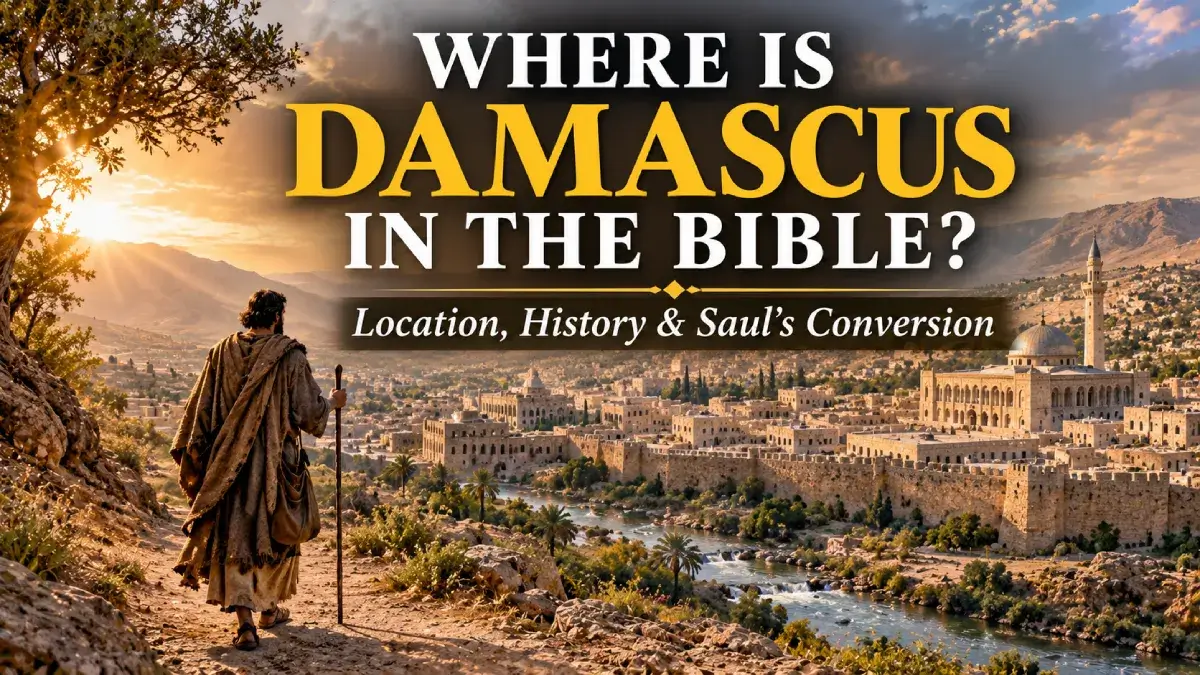
Damascus is located in present-day Syria, near the country’s southwestern region, close to the border with Lebanon. It is northeast of the Sea of Galilee and north of Israel.
In the Bible, Damascus is an ancient Syrian city mentioned as early as Genesis 14:15. It is associated with Abraham’s military pursuit, the kingdom of Aram, conflicts with Israel, prophetic judgments, and the conversion of Saul (later known as Paul) on the road to Damascus.
Damascus is one of the oldest continuously inhabited cities in the world and remains the capital of Syria today.
Damascus is one of the most important ancient cities mentioned in the Bible. It appears in the Old Testament in connection with Abraham, Israel’s kings, prophetic warnings, and conflicts between neighboring nations. In the New Testament, Damascus becomes especially significant because it is the destination where Saul was traveling when Jesus Christ appeared to him, transforming his life and mission.
Damascus was not just an ordinary city in biblical history. Its strategic location, wealth, influence, and connection to major biblical events made it an important place throughout Scripture.
Where Was Damascus Located in Biblical Times?
Damascus was an ancient city in the region of Aram, north of Israel. It was strategically located along important trade routes connecting Mesopotamia, the Mediterranean region, Arabia, and the lands surrounding Israel.
The city was particularly known for its water supply and fertile surroundings. The Barada River provided water to the city and helped create a productive oasis in an otherwise dry region.
In biblical times, Damascus was associated with the Arameans and became the center of the kingdom of Aram-Damascus, which frequently interacted with and fought against Israel
Damascus was important because of its location. It served as a powerful political, military, and commercial center throughout much of biblical history.
Where Is Damascus First Mentioned in the Bible?
Damascus is first associated with the biblical narrative in Genesis 14:15.
“And he divided himself against them, he and his servants, by night, and smote them, and pursued them unto Hobah, which is on the left hand of Damascus.” — Genesis 14:15, KJV
This passage describes Abram (later Abraham) pursuing the kings who had captured Lot and others. Abraham and his men pursued the enemy as far as Hobah, which was north of Damascus.
This reference places Damascus within the geographical setting of the patriarchal narratives and shows that the city or its surrounding region was already recognized in the ancient world.
Damascus is also connected with Abraham’s household in Genesis 15:2, where Abram refers to Eliezer as “Eliezer of Damascus.”
Why Was Damascus Important in the Bible?
Damascus was important for several reasons:
- Political power: It was the capital of the Aramean kingdom.
- Military influence: Damascus frequently fought against Israel and Judah.
- Trade and prosperity: Its location made it an important commercial center.
- Strategic geography: It controlled routes connecting several important regions.
- Prophetic significance: Several prophets pronounced judgments against Damascus.
- New Testament significance: Saul’s encounter with Jesus on the road to Damascus changed the direction of early Christianity.
The city’s history reveals how God’s people interacted with surrounding kingdoms and how biblical events took place within real geographical and political settings.
1. Damascus and Abraham
Damascus is connected with Abraham in the book of Genesis.
In Genesis 14, Abram rescues Lot after Lot is taken captive during a conflict involving several kings. Abram pursues the invading forces and reaches the area near Hobah, north of Damascus.
Genesis 15:2 also mentions Eliezer of Damascus:
“And Abram said, Lord GOD, what wilt thou give me, seeing I go childless, and the steward of my house is this Eliezer of Damascus?” — Genesis 15:2, KJV
This verse is important because it connects Damascus with Abraham’s household during the early patriarchal period.
It reminds us that biblical history is connected with real places, people, and communities that existed long before the nation of Israel became a kingdom.
2. Damascus Was the Capital of Aram
Damascus became the center of the Aramean kingdom, often referred to in Scripture as Aram or Syria.
The kings of Damascus were powerful regional rulers who frequently challenged Israel’s military and political influence.
Throughout the books of Kings and Chronicles, Damascus appears in accounts involving wars, alliances, invasions, and political negotiations.
David Conquers Damascus
During the reign of King David, Israel gained control over Damascus.
The Bible records:
“And David put garrisons in Syria of Damascus: and the Syrians became servants to David, and brought gifts.” — 2 Samuel 8:6, KJV
David’s victory strengthened Israel’s influence in the region. Damascus was strategically important, and control over it helped establish Israel’s military dominance during David’s reign.
However, Damascus eventually regained independence and once again became a powerful kingdom.
3. Damascus and the Enemies of Israel
Damascus frequently appears in the Bible as a rival of Israel.
The kings of Aram fought against Israel during several periods, especially during the divided kingdom.
The conflict was not always continuous. At different times, the kingdoms fought, negotiated, formed alliances, or temporarily cooperated against other threats.
Ben-Hadad and Israel
Several Syrian kings named Ben-Hadad appear in the biblical narrative.
In 1 Kings 15:18–20, King Asa of Judah sought assistance from Ben-Hadad, king of Syria, against Baasha, king of Israel.
This illustrates the complicated political relationships between the kingdoms.
Later, Damascus became involved in conflicts during the reigns of Ahab, Jehoram, Jehu, and other kings of Israel.
These events show that Damascus was a major political and military power—not simply a city mentioned in passing.
4. Naaman the Syrian and Damascus
One of the most memorable stories connected with Damascus is the healing of Naaman, a Syrian military commander.
The story is recorded in 2 Kings 5.
Naaman was a respected commander of the army of the king of Syria, but he suffered from leprosy, a skin disease described in the Bible.
A captive Israelite girl told Naaman’s wife that a prophet in Samaria could heal him.
Naaman traveled to Israel and eventually met the prophet Elisha.
Elisha instructed him:
“Go and wash in Jordan seven times, and thy flesh shall come again to thee, and thou shalt be clean.” — 2 Kings 5:10, KJV
Naaman initially became angry because he expected a more dramatic healing.
He questioned why he should wash in the Jordan when the rivers of Damascus, Abana and Pharpar, seemed better to him.
“Are not Abana and Pharpar, rivers of Damascus, better than all the waters of Israel?” — 2 Kings 5:12, KJV
His servants persuaded him to obey the prophet’s instructions. Naaman went to the Jordan, washed seven times, and was healed.
The story teaches several important lessons:
- God can work beyond the boundaries of Israel.
- Faith sometimes requires humility and obedience.
- Human pride can prevent people from receiving God’s blessing.
- God’s power is not limited by nationality, position, or status.
Naaman was a Syrian commander, yet he experienced God’s mercy through obedience to His word.
5. Damascus in the Prophecies of the Bible
Damascus appears in several prophetic passages where God pronounces judgment against the city.
These prophecies reveal that the nations surrounding Israel were also accountable to God for their actions.
Isaiah’s Prophecy Against Damascus
Isaiah 17 contains a prophecy concerning Damascus.
“The burden of Damascus. Behold, Damascus is taken away from being a city, and it shall be a ruinous heap.” — Isaiah 17:1, KJV
The prophecy speaks of judgment, destruction, and the weakening of Damascus.
The passage also describes the fading glory of the northern kingdom of Israel and connects the fate of Damascus with the broader judgment affecting the region.
Jeremiah’s Prophecy
Jeremiah 49:23–27 also contains a prophecy against Damascus.
The passage describes distress, fear, and judgment coming upon the city.
“Damascus is waxed feeble, and turneth herself to flee, and fear hath seized on her: anguish and sorrows have taken her, as a woman in travail.” — Jeremiah 49:24, KJV
These prophecies remind readers that powerful cities and kingdoms are not beyond God’s authority.
Amos’ Prophecy
The prophet Amos also pronounced judgment against Damascus.
“For three transgressions of Damascus, and for four, I will not turn away the punishment thereof…” — Amos 1:3, KJV
Amos condemned Damascus for cruelty and violence, particularly its treatment of people from Gilead.
The message of Amos emphasizes God’s justice and His concern for the suffering caused by nations and rulers.
6. Saul’s Conversion on the Road to Damascus
One of the most significant events in the New Testament involving Damascus is the conversion of Saul, who later became known as the apostle Paul.
Before his conversion, Saul persecuted Christians. He approved of the persecution of believers and sought authority to arrest followers of Jesus.
Acts 9 describes Saul traveling to Damascus with letters from the high priest authorizing him to arrest Christians and bring them to Jerusalem.
But on the road, something extraordinary happened.
The Bible says:
“And as he journeyed, he came near Damascus: and suddenly there shined round about him a light from heaven.” — Acts 9:3, KJV
Saul fell to the ground and heard the voice of Jesus asking:
“Saul, Saul, why persecutest thou me?” — Acts 9:4, KJV
Saul asked who was speaking, and Jesus revealed Himself.
This encounter changed Saul’s life forever. The man who had persecuted Christians became one of the most influential apostles in the early church.
What Happened to Saul in Damascus?
After the encounter, Saul was blinded.
The men traveling with him led him into Damascus, where he remained without sight for three days.
God then sent a disciple named Ananias to visit Saul.
Ananias initially feared Saul because of his reputation as a persecutor of Christians. However, the Lord told Ananias that Saul was a chosen vessel who would carry His name before Gentiles, kings, and the children of Israel.
Ananias obeyed, visited Saul, laid his hands on him, and Saul regained his sight.
Acts 9:18 says:
“And immediately there fell from his eyes as it had been scales: and he received sight forthwith, and arose, and was baptized.” — Acts 9:18, KJV
Saul’s conversion in Damascus is one of the Bible’s clearest examples of God’s power to transform a person’s life.
7. The Street Called Straight in Damascus
The Bible also gives a specific location within Damascus connected with Saul’s conversion.
Acts 9:11 mentions a street called Straight.
“Arise, and go into the street which is called Straight, and enquire in the house of Judas for one called Saul, of Tarsus…” — Acts 9:11, KJV
This street was where Saul was staying after his encounter with Jesus.
The reference to a street, a house, and a particular person helps make the account historically and geographically grounded. Damascus was not merely a symbolic setting. It was a real city where Saul stayed, recovered his sight, was baptized, and began proclaiming Jesus.
8. Saul Preached Jesus in Damascus
After his conversion, Saul did not remain silent about what he had experienced.
Acts 9:20 says:
“And straightway he preached Christ in the synagogues, that he is the Son of God.”
The people who knew Saul’s former reputation were astonished.
They knew he had come to Damascus to persecute believers, yet now he was proclaiming the very Jesus whose followers he had sought to destroy.
Saul’s transformation demonstrates the power of the gospel to change a person’s heart, beliefs, priorities, and purpose.
Saul Escapes from Damascus
Saul’s preaching eventually led to opposition and a plot against his life.
Acts 9:23–25 describes how his enemies watched the gates of Damascus day and night, hoping to kill him.
The disciples helped Saul escape by lowering him in a basket through an opening in the city wall.
Paul later referred to this experience in 2 Corinthians 11:32–33, explaining that he escaped when he was let down through a window in the wall in a basket.
This episode shows that Damascus was not only the location of Paul’s conversion but also one of the first places where he faced opposition for preaching Christ.
9. What Does Damascus Symbolize in the Bible?
Damascus does not have one single symbolic meaning throughout the Bible. Its significance depends on the passage.
However, several important themes emerge from its biblical history.
A Place of God’s Judgment
The prophetic books show that Damascus, despite its power and wealth, was accountable to God.
Its military strength and political influence could not protect it from divine judgment.
A Place of Transformation
Damascus is closely associated with Saul’s conversion.
The city became the setting where a persecutor of Christians encountered Jesus Christ and was transformed into a preacher of the gospel.
A Reminder That God Works Beyond Israel
The story of Naaman demonstrates that God’s mercy and power were not limited to the Israelites.
A Syrian commander experienced healing through the word of God’s prophet.
A Place Connected With God’s Purpose
Saul’s experience in Damascus shows that God can redirect a person’s life toward a purpose far different from the one they originally intended.
Damascus reminds us that God can intervene in unexpected places and circumstances.
10. Is Damascus Still a City Today?
Yes. Damascus still exists today and is the capital of Syria.
The modern city contains historic neighborhoods, ancient markets, religious landmarks, and archaeological sites connected with its long history.
Damascus is widely recognized as one of the world’s oldest continuously inhabited cities. Its biblical significance, historical importance, and cultural heritage have made it one of the most recognizable cities of the ancient Near East.
The biblical Damascus and the modern Damascus are connected through the same geographic location, although the city has changed significantly over thousands of years.
Bible Verses About Damascus
Here are some important Bible verses mentioning Damascus that are worth reading and studying.
| Bible Reference | Significance |
|---|---|
| Genesis 14:15 | Abram pursued the kings as far as Hobah, near Damascus. |
| Genesis 15:2 | Eliezer is described as being from Damascus. |
| 2 Samuel 8:5–6 | David defeated the Syrians of Damascus. |
| 1 Kings 11:24 | Damascus became associated with Rezon and the kingdom of Aram. |
| 2 Kings 5:12 | Naaman refers to the rivers of Damascus. |
| Isaiah 17:1 | A prophecy of judgment against Damascus. |
| Jeremiah 49:23–27 | A prophecy concerning the judgment of Damascus. |
| Amos 1:3–5 | God pronounces judgment against Damascus for its violence. |
| Acts 9:3–18 | Saul encounters Jesus and is converted near Damascus. |
| Acts 9:11 | Saul is staying in a house on the street called Straight. |
| Acts 9:20 | Saul begins preaching Jesus in the synagogues. |
| Acts 9:23–25 | Saul escapes from Damascus in a basket. |
| 2 Corinthians 11:32–33 | Paul recalls his escape from Damascus. |
| Galatians 1:17 | Paul mentions going to Damascus after his conversion. |
Frequently Asked Questions (FAQs)
Where is Damascus located in the Bible?
Damascus is located in ancient Aram, north of Israel, and is situated in present-day Syria. It is frequently mentioned in the Old Testament as a powerful city and kingdom. In the New Testament, it is the city associated with Saul’s conversion.
Is Damascus in Israel or Syria?
Damascus is in Syria, not Israel. It was an important ancient Syrian city and the capital of the kingdom of Aram. It remains the capital of Syria today.
What happened to Paul in Damascus?
Paul, originally known as Saul, encountered Jesus on his journey to Damascus. He was blinded, taken into the city, and visited by Ananias. After receiving his sight and being baptized, Saul began preaching that Jesus is the Son of God (Acts 9:1–20).
Why is Damascus important in Christianity?
Damascus is important in Christianity because it is connected with the conversion of Saul, who became the apostle Paul. His transformation from a persecutor of Christians into a missionary of Christ is one of the most significant events in the New Testament.
Was Damascus an enemy of Israel?
At various times, Damascus was an enemy of Israel and Judah. The kingdom of Aram fought numerous battles against the Israelites. However, the relationship between these kingdoms varied throughout history, including periods of political alliance and cooperation.
What is the street called Straight in Damascus?
The street called Straight is mentioned in Acts 9:11. Saul stayed in a house on this street after his encounter with Jesus. God sent Ananias to visit him there.
What river was associated with Damascus in the Bible?
The Bible mentions the Abana and Pharpar rivers in 2 Kings 5:12. Naaman referred to these rivers when questioning Elisha’s instruction to wash in the Jordan River for healing.
What does Damascus teach Christians today?
Damascus reminds Christians of God’s sovereignty, judgment, mercy, and transforming power. Saul’s conversion demonstrates that no one is beyond God’s ability to change, while the city’s prophetic history reminds us that earthly power and pride do not exempt anyone from accountability to God.
Final Thoughts: Damascus and Its Biblical Significance
Damascus is one of the most historically significant cities mentioned in the Bible. From the time of Abraham to the kingdom of David, from the conflicts between Israel and Aram to the ministry of the prophet Elisha, Damascus played an important role in biblical history.
But its most memorable New Testament connection is the conversion of Saul.
On the road to Damascus, a man who was determined to persecute Christians encountered the risen Jesus Christ. His life was completely changed, and he became a faithful servant of the gospel.
The story of Damascus reminds us that God can meet people in unexpected places, change their direction, and use their lives for His glory.
The same God who transformed Saul can transform lives today.