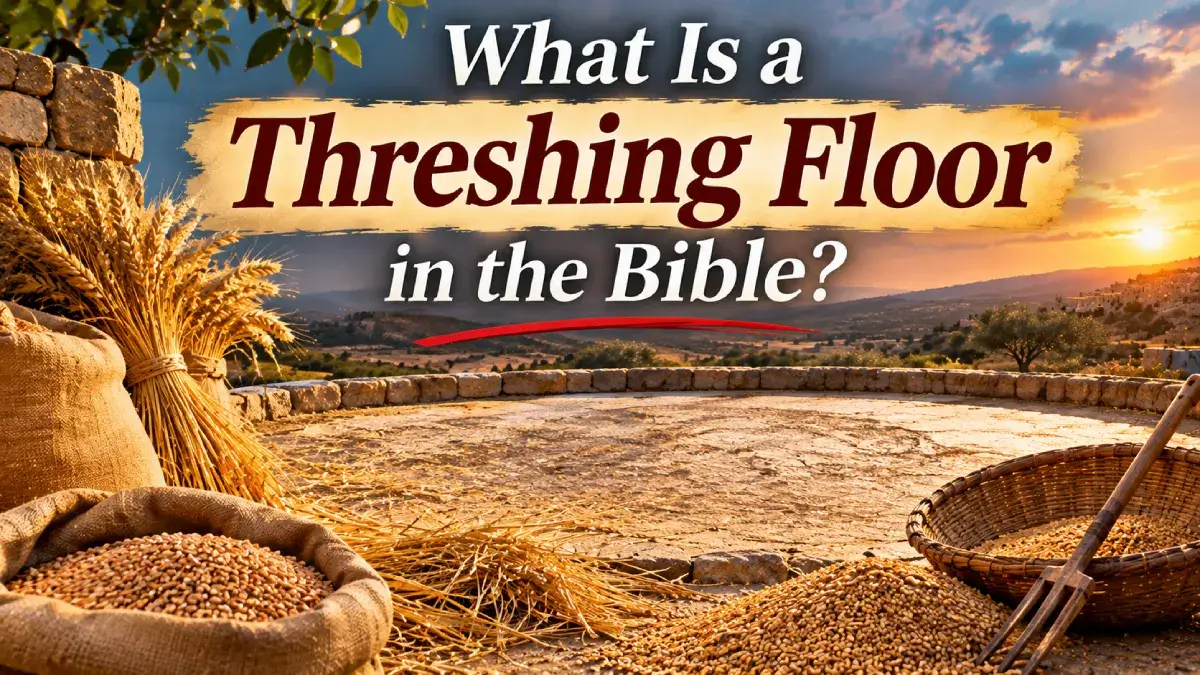
A threshing floor in the Bible was a flat, open area where harvested grain was separated from its stalks and outer husks. Farmers typically spread the grain across the floor and used animals, tools, or human labor to loosen the edible kernels. The mixture was then tossed into the air so that the wind could carry away the lighter chaff while the heavier grain fell back to the ground.
In Scripture, threshing floors are associated with harvest, provision, separation, judgment, worship, and important moments in God’s dealings with His people. Notable biblical events involving threshing floors include Ruth meeting Boaz, David purchasing Araunah’s threshing floor, and Solomon’s temple being built at the site connected with that location.
The Bible mentions threshing floors in several important passages, including the stories of Ruth and Boaz, King David, and Solomon. These places were more than ordinary agricultural spaces. They were locations where grain was separated from its husks, where people worked to prepare food, and where significant moments in biblical history took place.
One of the most familiar references appears in Psalm 1:4, which compares the wicked to chaff that the wind drives away. This picture helps explain why threshing floors became meaningful illustrations of separation, judgment, and the difference between what is valuable and what is worthless.
But what exactly was a threshing floor, and why does it appear so often in Scripture?
Understanding its purpose and biblical significance provides valuable insight into God’s Word and the spiritual lessons connected with harvest, faithfulness, judgment, and redemption.
What Was a Threshing Floor in Biblical Times?
A threshing floor was an outdoor working area used by ancient farmers to process harvested grain. It was usually a flat, firm surface located where the wind could help separate grain from chaff.
After harvesting crops such as wheat and barley, farmers needed to remove the edible kernels from the stalks and surrounding husks. This process was called threshing.
Threshing floors were important because grain was a major part of everyday life. It provided food for families, supported communities, and played a significant role in the agricultural economy of ancient Israel.
1. How Did a Threshing Floor Work?
The process generally involved two main activities: threshing and winnowing.
Threshing: Farmers spread harvested stalks across the floor. They then beat the stalks or used animals to walk over them, loosening the grain from the straw and husks.
Winnowing: After threshing, the mixture was tossed into the air using a fork or shovel. The wind carried away the lighter chaff, while the heavier grain fell back to the floor.
The grain could then be collected, stored, or prepared for grinding into flour.
2. Why Were Threshing Floors Usually Open Spaces?
Wind was essential for winnowing. An elevated or exposed location allowed farmers to take advantage of natural air currents.
The threshing floor also needed a relatively hard, level surface so that the grain could be spread, worked, and gathered efficiently.
These practical details help explain why threshing floors appear in biblical descriptions of hills, open spaces, and elevated locations.
The Spiritual Meaning of a Threshing Floor in the Bible
Although threshing floors served an agricultural purpose, the Bible also uses the imagery of threshing to communicate spiritual truths.
The process of separating grain from chaff provides a picture of distinction between what is valuable and what is worthless.
Here are some important spiritual themes associated with threshing floors.
A. Separation Between Good and Evil
One of the clearest biblical images connected with threshing is the separation of grain from chaff.
Psalm 1:4 (KJV) says:
“The ungodly are not so: but are like the chaff which the wind driveth away.”
This verse contrasts the righteous person, who delights in God’s law, with the ungodly, who are compared to worthless chaff.
Just as farmers separated grain from its outer covering, the imagery illustrates the distinction between a life rooted in God and a life that rejects His ways.
B. God’s Judgment
Threshing imagery also appears in passages describing divine judgment.
Matthew 3:12 (KJV) says:
“Whose fan is in his hand, and he will throughly purge his floor, and gather his wheat into the garner; but he will burn up the chaff with unquenchable fire.”
John the Baptist uses the picture of a farmer separating wheat from chaff to describe the coming judgment associated with the Messiah.
The wheat is gathered, while the chaff is burned. The illustration emphasizes that God knows the difference between genuine faithfulness and what is merely outward.
C. Spiritual Purification
Threshing can also serve as an illustration of spiritual testing and purification.
The agricultural process involves separating the grain from unwanted material. In a similar way, Scripture teaches that God examines the hearts and lives of people.
However, it is important to understand that the Bible does not say every hardship is a literal threshing experience or that every difficulty is punishment. The agricultural image can help explain spiritual truths, but it should be applied carefully.
D. Provision and Abundance
Threshing floors were places where harvested grain was processed and gathered. They therefore naturally connect with food, provision, and the results of agricultural labor.
In the Bible, a successful harvest could represent God’s blessing upon the land and the people.
Deuteronomy 16:13 (KJV) connects the harvest season with Israel’s celebration of the Feast of Tabernacles:
“Thou shalt observe the feast of tabernacles seven days, after that thou hast gathered in thy corn and thy wine.”
The harvest was a reason for thanksgiving and celebration before God.
Important Bible Stories About Threshing Floors
Several significant biblical events take place at or involve threshing floors. These stories reveal their practical importance and their connection with God’s larger purposes.
A. Ruth Meets Boaz at the Threshing Floor
One of the most memorable threshing-floor accounts is found in Ruth 3.
After Ruth and Naomi returned to Bethlehem, Ruth began gathering leftover grain in the fields of Boaz, a relative of Naomi’s deceased husband.
Boaz showed kindness to Ruth and allowed her to glean in his fields.
Later, Naomi instructed Ruth to approach Boaz at the threshing floor after he had finished winnowing barley.
Ruth 3:3 (KJV) says:
“Wash thyself therefore, and anoint thee, and put thy raiment upon thee, and get thee down to the floor: but make not thyself known unto the man, until he shall have done eating and drinking.”
Ruth followed Naomi’s instructions and approached Boaz. When he awoke and discovered her, she asked him to spread his garment over her because he was a near kinsman.
Ruth 3:9 (KJV) says:
“And he said, Who art thou? And she answered, I am Ruth thine handmaid: spread therefore thy skirt over thine handmaid; for thou art a near kinsman.”
Boaz responded honorably and promised to address the matter according to the proper family custom.
This story is important because Boaz eventually married Ruth, and their family became part of the ancestry of King David and, ultimately, Jesus Christ (Ruth 4:13–22; Matthew 1:5–6).
Spiritual lessons from Ruth’s story:
- Ruth demonstrated loyalty and commitment to Naomi.
- Boaz showed kindness, generosity, and integrity.
- Ruth’s request reflected her appeal for the protection of a family redeemer.
- God’s providence worked through ordinary people and circumstances.
The threshing floor became the setting for an important turning point in Ruth’s life.
B. David Buys Araunah’s Threshing Floor
Another major biblical event involving a threshing floor appears in 2 Samuel 24 and 1 Chronicles 21.
After David ordered a census of Israel, the nation experienced a severe plague as part of God’s judgment.
David saw the angel of the LORD near the threshing floor of Araunah the Jebusite (called Ornan in 1 Chronicles).
David asked to purchase the location so that he could build an altar to the LORD.
2 Samuel 24:24 (KJV) says:
“And the king said unto Araunah, Nay; but I will surely buy it of thee at a price: neither will I offer burnt offerings unto the LORD my God of that which doth cost me nothing.”
David purchased the threshing floor and offered sacrifices there. The plague was then stayed.
This passage teaches an important lesson about sincere worship and repentance. David refused to offer something to God that cost him nothing.
Spiritual lessons from David’s threshing floor:
- True worship involves sincerity and sacrifice.
- Leaders must take responsibility for their actions.
- Repentance includes turning back to God.
- God’s mercy is greater than human failure.
The location also became significant in Israel’s history.
C. Solomon’s Temple Was Built at the Site
The threshing floor associated with David’s sacrifice is connected with the location where Solomon later built the temple.
2 Chronicles 3:1 (KJV) says:
“Then Solomon began to build the house of the LORD at Jerusalem in mount Moriah, where the LORD appeared unto David his father, in the place that David had prepared in the threshingfloor of Ornan the Jebusite.”
This is one of the most significant references to a threshing floor in the Bible.
An ordinary agricultural location became associated with David’s repentance, sacrifice, and the construction of the temple.
The connection reminds readers that God can use ordinary places as settings for events of lasting spiritual importance.
Other Important Bible Verses About Threshing Floors
Several additional passages mention threshing floors or use threshing imagery to teach spiritual lessons.
1. 1 Chronicles 21:18
“Then the angel of the LORD commanded Gad to say to David, that David should go up, and set up an altar unto the LORD in the threshingfloor of Ornan the Jebusite.”
This verse records God’s instruction for David to build an altar at Ornan’s threshing floor.
2. Hosea 9:1
“Rejoice not, O Israel, for joy, as other people: for thou hast gone a whoring from thy God, thou hast loved a reward upon every cornfloor.”
Hosea uses agricultural imagery while rebuking Israel for unfaithfulness and idolatry. The verse connects the harvest setting with Israel’s spiritual condition.
3. Joel 2:24
“And the floors shall be full of wheat, and the fats shall overflow with wine and oil.”
This verse appears in a passage describing restoration and blessing. Full threshing floors symbolize agricultural abundance in the context of God’s promised restoration.
4. Micah 4:12–13
These verses use threshing imagery to describe God’s gathering and judgment of nations. Zion is pictured as a threshing instrument that will be used against opposing nations.
The passage demonstrates how familiar agricultural work could become a powerful prophetic image.
5. Matthew 3:12
“Whose fan is in his hand, and he will throughly purge his floor, and gather his wheat into the garner; but he will burn up the chaff with unquenchable fire.”
John the Baptist uses the threshing floor to explain the seriousness of judgment and the separation associated with the coming Messiah.
6. Luke 3:17
Luke records the same teaching about the Messiah separating wheat from chaff.
The passage emphasizes the Messiah’s authority and the consequences of rejecting God’s ways.
What Is the Difference Between Threshing and Winnowing?
Threshing and winnowing are related agricultural activities, but they are not the same.
| Process | Meaning | Purpose |
|---|---|---|
| Threshing | Loosening grain from stalks and husks | Separates the kernels from the harvested plant |
| Winnowing | Tossing the grain mixture into the air | Separates heavier grain from lighter chaff |
Both activities were necessary before grain could be stored and used as food.
This distinction is important when reading biblical passages. Some verses refer to the threshing process, while others describe the wind separating wheat from chaff.
Why Is the Threshing Floor Important in the Bible?
The threshing floor is important because it appears in several major biblical stories and provides an accessible picture of spiritual truths.
Here are five reasons it matters.
1. It reveals everyday life in biblical times.
The threshing floor helps readers understand how ancient communities produced and prepared food.
2. It illustrates separation.
The separation of grain and chaff provides a picture of the distinction between the righteous and the ungodly.
3. It appears in the story of redemption.
Ruth’s encounter with Boaz at the threshing floor contributes to the family line that leads to David and Jesus.
4. It is connected with worship and sacrifice.
David’s purchase of Araunah’s threshing floor became the setting for an altar and an important act of repentance.
5. It connects with the temple in Jerusalem.
According to 2 Chronicles 3:1, Solomon built the temple at the location associated with Ornan’s threshing floor.
Spiritual Lessons Christians Can Learn From the Threshing Floor
The biblical accounts of threshing floors offer several lessons that Christians can reflect upon.
1. God Values What Is Genuine
The separation of wheat from chaff reminds believers that outward appearances are not the same as genuine faith.
God calls His people to live with sincerity, obedience, and faithfulness.
2. God Provides for His People
The threshing floor was a place where harvested grain became usable food. It reminds readers of the importance of God’s provision and the need to give thanks for daily blessings.
3. Faithfulness Matters in Ordinary Situations
Ruth’s story shows how loyalty, humility, and integrity in everyday circumstances can become part of a much larger story.
4. Worship Should Be Sincere
David’s refusal to offer a sacrifice that cost him nothing reminds Christians that worship should involve genuine devotion rather than empty appearances.
5. God Can Bring Restoration
David’s story includes failure, repentance, sacrifice, and mercy. It reminds believers that turning back to God matters, even after serious mistakes.
Frequently Asked Questions About the Threshing Floor in the Bible
What does a threshing floor symbolize in the Bible?
A threshing floor can be associated with harvest, provision, separation, judgment, and worship. Its meaning depends on the passage. The separation of wheat from chaff is especially important in biblical imagery about judgment.
What happened at the threshing floor in Ruth 3?
Ruth approached Boaz at the threshing floor after he had finished winnowing barley. She asked him to act as a near kinsman, and Boaz promised to handle the matter honorably. Their story eventually led to marriage and became part of the ancestry of King David and Jesus Christ.
Why did David buy Araunah’s threshing floor?
David purchased the threshing floor because God instructed him to build an altar there. David offered sacrifices at that location, and the plague affecting Israel was stopped (2 Samuel 24:18–25).
Where was Solomon’s temple built?
According to 2 Chronicles 3:1, Solomon built the temple on Mount Moriah at the location associated with the threshing floor of Ornan the Jebusite.
What is the difference between wheat and chaff in the Bible?
Wheat is the valuable grain that is gathered and kept, while chaff is the light outer material separated and discarded during winnowing. Scripture uses this contrast to illustrate the difference between what is valuable and what is worthless, especially in passages about judgment.
What does threshing mean spiritually?
As a spiritual illustration, threshing can represent separation, testing, or judgment. However, the precise meaning depends on the biblical passage. It should not be assumed that every personal hardship is a form of divine punishment.
Is a threshing floor the same as a winepress?
No. A threshing floor was used to separate grain from stalks and chaff. A winepress was used to extract juice from grapes. Both were important agricultural facilities in biblical times, but they served different purposes.
Final Thoughts
A threshing floor in the Bible was a practical agricultural space where farmers separated valuable grain from unwanted chaff. Yet Scripture uses these locations and the work performed there to communicate deeper lessons about provision, separation, judgment, worship, and redemption.
The stories of Ruth and Boaz, David and Araunah, and Solomon’s temple demonstrate how threshing floors became settings for important moments in biblical history.
Perhaps the most powerful lesson comes from the separation of wheat and chaff. Just as farmers gathered the valuable grain and removed what was useless, Scripture reminds us that God sees beyond outward appearances and calls His people to genuine faithfulness.
When you encounter a threshing floor in the Bible, remember that it is more than an agricultural setting. It can help you understand the daily lives of biblical people and recognize the spiritual truths God communicates through familiar images.