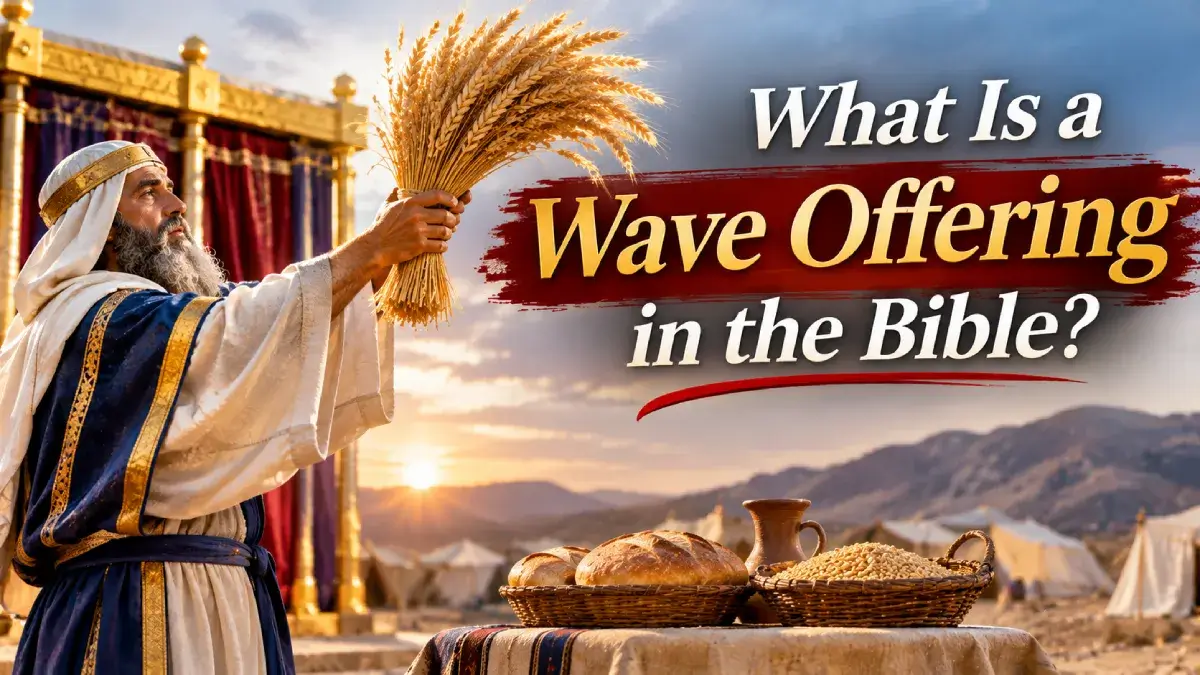
A wave offering in the Bible was an offering ceremonially presented before the LORD by being waved as part of Israel’s worship. The Hebrew term commonly translated as “wave offering” comes from tenufah, which refers to a waving or offering motion.
Wave offerings included portions of sacrifices, firstfruits of the harvest, and items used in the consecration of priests. They were presented to God, and certain portions were assigned to the priests for their service.
The wave offering demonstrated that everything belonged to God and that His people acknowledged Him as the source of their provision and blessings.
The Bible describes several offerings that the Israelites presented to God as part of their worship. Among them was the wave offering, a special act of presenting an offering before the LORD through a ceremonial waving motion.
Wave offerings appear in important passages throughout the Old Testament, particularly in the instructions given to Moses concerning the priests, sacrifices, harvest celebrations, and the dedication of the tabernacle.
One notable example is found in Leviticus 23, where the Israelites were instructed to bring the first sheaf of their harvest to the priest, who would wave it before the LORD. This offering expressed gratitude to God and acknowledged Him as the provider of the harvest.
But what exactly was a wave offering, why was it important, and what spiritual lessons can Christians learn from it today?
Understanding the wave offering helps us appreciate the worship practices of ancient Israel and the biblical themes of gratitude, dedication, holiness, and giving God the first and best.
What Does Wave Offering Mean in the Bible?
The wave offering was a ceremonial act of presenting something before God. It was part of the sacrificial and worship system established for Israel through Moses.
The Hebrew word associated with the wave offering is tenufah (תְּנוּפָה). It is related to the idea of waving or moving something as a ritual presentation.
In the Old Testament, the offering was not simply an ordinary gift. It had a specific place within the worship practices God gave to Israel.
The priest performed the prescribed ceremony, presenting the offering before the LORD. In certain cases, the portion that had been waved became part of the priestly provision.
Why Was It Called a Wave Offering?
It was called a wave offering because the offering was presented through a waving motion before the LORD.
The Bible describes this action in several passages. For example, Leviticus 7:30 says that the worshipper’s hands were to bring the offerings of the LORD made by fire, including the breast, which was to be waved as a wave offering before the LORD.
The precise physical movements are not fully described in every passage, so it is best not to assume that every wave offering followed an identical motion.
The central idea was that the offering was ceremonially presented to God.
What Was the Purpose of a Wave Offering?
Wave offerings served several purposes in the worship and religious life of ancient Israel.
A. To Present an Offering Before God
The primary purpose was to present something to the LORD as part of Israel’s worship.
The Israelites were not simply giving food or possessions to human religious leaders. The offering was first presented to God according to His instructions.
This demonstrated their recognition of God’s authority and ownership.
B. To Express Gratitude for God’s Provision
Some wave offerings were connected with agricultural harvests.
The Israelites depended on God for rain, fertile land, and successful crops. Presenting the first portion of the harvest acknowledged that their provision ultimately came from Him.
Leviticus 23:10 instructs the Israelites to bring a sheaf of the firstfruits of their harvest to the priest.
This act expressed gratitude and dependence on God.
C. To Support the Priests
Certain portions of wave offerings were assigned to the priests.
The priests served in the tabernacle and later in the temple, and they depended on the provisions God established for their support.
Leviticus 7:31–34 explains that the breast of the peace offering was given to Aaron and his sons, while the right thigh was given to the priest who offered the blood and fat of the peace offering.
This arrangement provided for those who carried out the responsibilities of Israel’s worship.
D. To Set Apart People and Things for Sacred Service
Wave offerings also appeared in ceremonies involving the consecration of priests.
In these ceremonies, certain items were presented before the LORD as part of setting Aaron and his sons apart for their priestly responsibilities.
The offering therefore had a connection with holiness, dedication, and service to God.
Important Bible Verses About Wave Offerings
Several passages explain how wave offerings were used in Israel’s worship. Here are some of the most important Scriptures.
1. Leviticus 7:30 — The Wave Offering of the Peace Offering
Leviticus 7:30 (KJV) says:
“His own hands shall bring the offerings of the LORD made by fire, the fat with the breast, it shall he bring, that the breast may be waved for a wave offering before the LORD.”
This verse describes the breast of the peace offering being presented before the LORD.
The passage goes on to explain that the breast was assigned to Aaron and his sons.
It demonstrates that a wave offering could be part of a sacrificial meal and the provision made for the priests.
2. Leviticus 8:27 — The Consecration of Aaron and His Sons
Leviticus 8:27 (KJV) says:
“And he put all upon Aaron’s hands, and upon his sons’ hands, and waved them for a wave offering before the LORD.”
This happened during the consecration of Aaron and his sons as priests.
Moses placed the prescribed offerings in their hands and waved them before the LORD.
The ceremony demonstrated that the priests and their service were dedicated to God.
3. Leviticus 9:21 — The Wave Offering During Priestly Ministry
Leviticus 9:21 (KJV) says:
“And the breasts and the right shoulder Aaron waved for a wave offering before the LORD; as Moses commanded.”
This verse describes Aaron performing the prescribed ceremony during the beginning of his priestly ministry.
It shows that wave offerings were not limited to the consecration ceremony. They also formed part of Israel’s regular sacrificial worship.
4. Leviticus 23:10–11 — The Wave Offering of Firstfruits
Leviticus 23:10–11 (KJV) says:
“When ye be come into the land which I give unto you, and shall reap the harvest thereof, then ye shall bring a sheaf of the firstfruits of your harvest unto the priest:
And he shall wave the sheaf before the LORD, to be accepted for you: on the morrow after the sabbath the priest shall wave it.”
This is one of the clearest examples of a wave offering.
The Israelites were instructed to bring the first sheaf of their harvest to the priest. The priest then waved it before the LORD.
The offering acknowledged God as the source of the harvest and expressed gratitude for His provision.
5. Leviticus 23:17 — The Wave Offering of Two Loaves
Leviticus 23:17 (KJV) says:
“Ye shall bring out of your habitations two wave loaves of two tenth deals: they shall be of fine flour; they shall be baken with leaven; they are the firstfruits unto the LORD.”
This instruction was connected with the Feast of Weeks, also known as Pentecost.
The Israelites were to bring two loaves made from fine flour as a wave offering.
Unlike the unleavened bread associated with Passover, these loaves were specifically instructed to be baked with leaven.
The passage demonstrates that wave offerings could include prepared food as well as portions of animal sacrifices and harvested grain.
6. Numbers 18:11 — A Portion Given to the Priests
Numbers 18:11 (KJV) says:
“And this is thine; the heave offering of their gift, with all the wave offerings of the children of Israel: I have given them unto thee, and to thy sons and to thy daughters with thee, by a statute for ever.”
This verse describes the provisions assigned to Aaron and his household.
The wave offerings were among the sacred portions given to the priestly family.
It reminds readers that God established a way for those who served in the sanctuary to receive support.
What Were the Different Types of Wave Offerings?
The Bible describes wave offerings in several settings. They were not all identical, but they shared the idea of presenting something ceremonially before the LORD.
A. The Wave Offering of the Peace Offering
Leviticus 7:28–34 explains the portions of the peace offering that were presented and assigned to the priests.
The breast was waved before the LORD, and the right thigh was given to the priest who performed the offering.
These instructions formed part of the sacrificial system through which Israel worshipped God.
B. The Wave Offering of Firstfruits
Leviticus 23:9–14 describes the offering of the first sheaf of the harvest.
The Israelites were not to treat the harvest as though it belonged to them independently of God. They were to present the firstfruits to Him.
This offering was connected with the beginning of the harvest and the acknowledgment of God’s provision.
C. The Wave Offering at the Feast of Weeks
Leviticus 23:15–21 gives instructions for the Feast of Weeks.
The Israelites were to count seven complete weeks from the presentation of the firstfruits sheaf. On the fiftieth day, they were to present two loaves as a new grain offering.
The loaves were presented as firstfruits to the LORD.
The Feast of Weeks later became known in the New Testament as Pentecost.
D. The Wave Offering in the Consecration of Priests
Exodus 29:22–28 and Leviticus 8:22–29 describe offerings connected with the consecration of Aaron and his sons.
During the ceremony, Moses placed prescribed portions into their hands and waved them before the LORD.
This was part of their dedication to priestly service.
What Is the Difference Between a Wave Offering and a Heave Offering?
The Bible also mentions a heave offering, and readers sometimes confuse it with a wave offering.
Both were ceremonial offerings presented to God, but the Hebrew terms and descriptions distinguish them.
| Wave Offering | Heave Offering |
|---|---|
| Commonly associated with the Hebrew term tenufah | Commonly associated with the Hebrew term terumah |
| Connected with a waving or presentation motion | Connected with an offering set apart or lifted up |
| Included portions such as the breast of certain peace offerings | Included designated portions of offerings and gifts |
| Often translated “wave offering” | Often translated “heave offering” |
The exact physical movements are not described in detail in every passage. Therefore, it is better to focus on the biblical distinction in terminology and ritual function rather than assume a precise movement in every case.
Both offerings emphasized that the gifts belonged to the LORD and were to be handled according to His instructions.
What Does the Wave Offering Symbolize Spiritually?
The wave offering belonged to the Old Testament worship system. Its meaning should first be understood in its original context.
However, several biblical principles connected with it remain valuable for reflection.
A. Everything Belongs to God
The Israelites presented offerings because they recognized that their possessions, harvests, and resources ultimately came from God.
Psalm 24:1 (KJV) says:
“The earth is the LORD’S, and the fulness thereof; the world, and they that dwell therein.”
The wave offering reminds readers that worship includes acknowledging God’s ownership and authority.
B. Give God the First and Best
The firstfruits offering taught Israel to acknowledge God at the beginning of the harvest.
Rather than waiting until everything had been gathered and stored, the people presented the first portion to Him.
Proverbs 3:9 (KJV) says:
“Honour the LORD with thy substance, and with the firstfruits of all thine increase.”
The principle is that God deserves priority, not merely whatever remains after everything else has been satisfied.
C. Worship Requires Obedience
The wave offering was performed according to God’s instructions.
This teaches an important biblical principle: worship is not simply about performing religious actions. It involves honoring God through obedience.
1 Samuel 15:22 (KJV) says:
“Behold, to obey is better than sacrifice, and to hearken than the fat of rams.”
God desires obedience and a sincere heart rather than outward religious activity without faithfulness.
D. Service to God Should Be Honored
The portions of offerings given to the priests show that God provided for those who served in the sanctuary.
This reflects the importance of supporting ministry and recognizing the responsibilities of those who serve God’s people.
E. Dedication Should Involve Our Whole Lives
The wave offerings connected with priestly consecration remind readers that service to God involves dedication.
Romans 12:1 (KJV) says:
“I beseech you therefore, brethren, by the mercies of God, that ye present your bodies a living sacrifice, holy, acceptable unto God, which is your reasonable service.”
Paul uses sacrificial language to encourage believers to dedicate their lives to God.
This is a New Testament application of the broader biblical theme of offering ourselves in faithful service.
Does the Wave Offering Point to Jesus Christ?
Some Christians see connections between Old Testament offerings and the work of Jesus Christ. These connections should be made carefully, distinguishing direct biblical statements from theological interpretation.
The wave offering of firstfruits in Leviticus 23 is particularly significant when considered alongside Paul’s teaching about Christ’s resurrection.
1 Corinthians 15:20 (KJV) says:
“But now is Christ risen from the dead, and become the firstfruits of them that slept.”
Paul directly describes the risen Christ as the firstfruits of those who have died.
This language connects the resurrection of Jesus with the biblical theme of firstfruits: the first portion anticipates the larger harvest to come.
Some Christians therefore understand the firstfruits offering in Leviticus as a meaningful picture of the resurrection and the future resurrection of believers.
However, Leviticus 23 does not explicitly identify the waved sheaf as Jesus. The connection is best understood through Paul’s New Testament teaching about Christ as the firstfruits.
Jesus’ resurrection assures believers that death does not have the final word and that those who belong to Him will also be raised.
What Can Christians Learn From the Wave Offering Today?
Although Christians are not required to practice the Old Testament sacrificial system, the principles surrounding the wave offering provide valuable lessons.
1. Put God first. The firstfruits offering reminds believers to give God priority in their lives, decisions, time, and resources.
2. Be thankful for provision. The harvest offering teaches gratitude for the blessings God provides.
3. Worship with sincerity. The offerings were presented according to God’s instructions. Genuine worship should come from a heart of faith and obedience.
4. Support those who serve. The priestly portions remind Christians of the importance of caring for those who faithfully serve the church.
5. Dedicate your life to God. The consecration of Aaron and his sons provides a picture of lives set apart for sacred service. Christians can reflect this principle through faithful living and service.
Frequently Asked Questions About Wave Offerings in the Bible
What is the simple meaning of a wave offering?
A wave offering was an offering ceremonially presented before the LORD through a waving motion. It could include portions of sacrifices, harvested grain, or items used in priestly consecration.
What is the Hebrew word for wave offering?
The Hebrew word commonly translated as “wave offering” is tenufah (תְּנוּפָה). It refers to a waving or ceremonial presentation.
Why did the Israelites give wave offerings?
They gave wave offerings as part of the worship system God established. These offerings expressed dedication to God, acknowledged His provision, and provided designated portions for the priests.
What was waved in the Bible?
Different things were presented as wave offerings, including the breast of certain peace offerings, the first sheaf of the harvest, two loaves at the Feast of Weeks, and portions of offerings used in priestly consecration.
What is the difference between a wave offering and a firstfruits offering?
A wave offering describes a ceremonial presentation before the LORD. A firstfruits offering involved presenting the first portion of a harvest to God. In Leviticus 23, the first sheaf was specifically presented as a wave offering.
Is a wave offering the same as a heave offering?
No. They are related but distinct terms in the Old Testament. A wave offering is associated with a waving motion, while a heave offering is associated with a designated offering or presentation. Both were part of Israel’s worship practices.
Is the wave offering still required for Christians?
Christians are not required to perform the Old Testament sacrificial rituals as part of their worship. The New Testament teaches that Jesus Christ offered Himself once for sins (Hebrews 10:10–14). However, Christians can still learn from the principles of gratitude, dedication, generosity, and putting God first.
Does the wave offering represent Jesus?
The Bible does not directly say that every wave offering represents Jesus. However, Paul’s description of Christ as the firstfruits of those who have died (1 Corinthians 15:20) provides a meaningful connection with the Old Testament theme of firstfruits.
Final Thoughts
The wave offering was an important part of worship in ancient Israel. It involved ceremonially presenting portions of sacrifices, harvests, and other prescribed offerings before the LORD.
Through passages such as Leviticus 7, Leviticus 8, and Leviticus 23, we see that wave offerings were connected with thanksgiving, priestly service, dedication, and the acknowledgment that everything ultimately belongs to God.
For Christians today, the wave offering provides an opportunity to reflect on several enduring biblical principles: give God the first and best, remain thankful for His provision, worship with sincerity, and dedicate your life to His service.
The central lesson is simple: God deserves more than what is left over. He deserves the honor, gratitude, and devotion of His people.