Sodomising is a modern English term historically associated with the sexual behavior attributed to the people of Sodom. Today, it generally refers to anal sexual activity, sometimes specifically to anal penetration.
The Bible itself does not use the modern English word sodomising in its original Hebrew or Greek texts. Its historical association comes from the account in Genesis 19, where the men of Sodom attempt to sexually assault Lot’s male visitors.
The Bible also identifies other sins of Sodom, including pride, excessive wealth, neglect of the poor, arrogance, and other wicked behavior (Ezekiel 16:49–50).
Therefore, the biblical discussion of Sodom should be understood through the complete scriptural context rather than reduced to one modern word or definition.
The Bible contains several references to Sodom and Gomorrah, two ancient cities remembered for their wickedness and destruction. These accounts have also influenced the meaning of words used in modern English, including sodomy and sodomising.
But what does sodomising mean in the Bible? Does the Bible use this exact word, and what happened in the biblical city of Sodom?
In modern English, sodomising generally refers to engaging in anal sexual activity. Historically, the related term sodomy became associated with sexual acts believed to resemble the conduct attributed to the people of Sodom. However, the word is not a direct term used in the original Hebrew text of the Bible.
The biblical account most commonly connected with this subject is Genesis 19, where the men of Sodom threaten to sexually assault Lot’s visitors. Other passages, including Ezekiel 16:49–50, Jude 1:7, and 2 Peter 2:6–8, provide additional information about the sins of Sodom and the judgment that followed.
Understanding these passages in context is important because the Bible describes more than one aspect of Sodom’s wickedness.
1. What Is the Meaning of Sodomising?
The word sodomising comes from the historical association between sexual misconduct and the biblical city of Sodom.
In modern English, it generally refers to anal sexual activity. The related noun sodomy has been used historically in religious, legal, and social contexts, although its precise definition has varied across different periods and legal systems.
It is important to distinguish between three things:
- Sodom: An ancient city mentioned in the Bible, associated with wickedness and divine judgment.
- Sodomy: A later English term derived from the name Sodom, historically used for certain sexual acts.
- Sodomising: A modern verb generally referring to engaging in the act described by the term sodomy.
The word itself is not a direct translation of a specific Hebrew word in Genesis 19. Rather, it developed through the historical interpretation of the biblical account.
2. What Happened in Sodom According to the Bible?
The most well-known biblical account involving Sodom is found in Genesis 19.
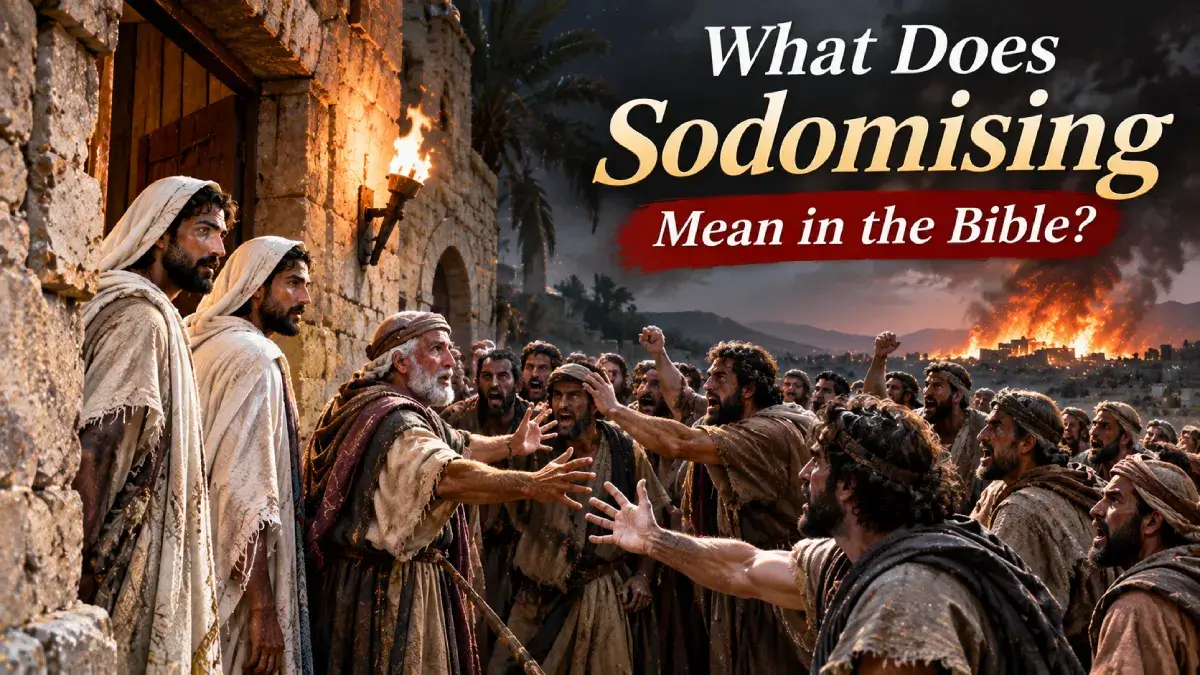
Two angels arrived in Sodom, and Lot welcomed them into his home. However, the men of the city surrounded the house and demanded that Lot bring his visitors outside.
Genesis 19:4–5 (KJV):
But before they lay down, the men of the city, even the men of Sodom, compassed the house round, both old and young, all the people from every quarter:
And they called unto Lot, and said unto him, Where are the men which came in to thee this night? bring them out unto us, that we may know them.
The expression “that we may know them” is understood in this context as a sexual demand.
The men were not asking to meet the visitors socially. They intended to sexually assault them.
Lot refused to surrender his guests and pleaded with the crowd to stop their wicked behavior.
The situation became violent, and the angels intervened by striking the men with blindness.
Genesis 19:11 (KJV):
And they smote the men that were at the door of the house with blindness, both small and great: so that they wearied themselves to find the door.
This passage reveals the seriousness of the crowd’s behavior.
Their actions involved sexual violence, aggression, and a complete disregard for the safety of strangers.
The account is therefore not simply a description of sexual activity. It is a story of attempted gang sexual assault and the extreme wickedness of the city.
3. Why Was Sodom Destroyed?
Genesis 19 describes the destruction of Sodom and Gomorrah after the angels warned Lot to leave.
Genesis 19:24–25 (KJV):
Then the LORD rained upon Sodom and upon Gomorrah brimstone and fire from the LORD out of heaven;
And he overthrew those cities, and all the plain, and all the inhabitants of the cities, and that which grew upon the ground.
The destruction of these cities became one of the Bible’s most significant examples of divine judgment.
However, Genesis 19 is not the only passage that explains the sins of Sodom.
Ezekiel 16:49–50 provides an important additional perspective.
Ezekiel 16:49–50 (KJV):
Behold, this was the iniquity of thy sister Sodom, pride, fulness of bread, and abundance of idleness was in her and in her daughters, neither did she strengthen the hand of the poor and needy.
And they were haughty, and committed abomination before me: therefore I took them away as I saw good.
This passage identifies several sins associated with Sodom:
- Pride and arrogance.
- Excessive prosperity and self-indulgence.
- Idleness and complacency.
- Failure to help the poor and needy.
- Other detestable behavior described as abomination.
This is an important passage because it shows that the Bible’s description of Sodom’s wickedness includes social injustice and arrogance as well as sexual wrongdoing.
Spiritual lesson: God calls people to humility, compassion, righteousness, and concern for those who are vulnerable.
4. What Does Jude 1:7 Say About Sodom?
The New Testament also refers to Sodom and Gomorrah as examples of judgment.
Jude 1:7 (KJV):
Even as Sodom and Gomorrha, and the cities about them in like manner, giving themselves over to fornication, and going after strange flesh, are set forth for an example, suffering the vengeance of eternal fire.
Jude connects the cities with sexual immorality and the pursuit of what the passage describes as “strange flesh.”
The passage is often discussed alongside Genesis 19 because of the men’s attempt to sexually assault Lot’s visitors.
Some interpreters also connect Jude’s wording with the broader biblical tradition about the people of Sodom and their rebellion against God’s order.
The important point is that Jude presents Sodom as a warning about serious sin and divine judgment.
5. What Does 2 Peter 2:6–8 Teach About Sodom?
The apostle Peter also refers to Sodom and Gomorrah.
2 Peter 2:6 (KJV):
And turning the cities of Sodom and Gomorrha into ashes condemned them with an overthrow, making them an ensample unto those that after should live ungodly;
Peter uses the destruction of these cities as an example of God’s judgment against ungodliness.
However, he also highlights the experience of Lot.
2 Peter 2:7–8 (KJV):
And delivered just Lot, vexed with the filthy conversation of the wicked:
(For that righteous man dwelling among them, in seeing and hearing, vexed his righteous soul from day to day with their unlawful deeds;)
Peter describes Lot as distressed by the wicked conduct surrounding him.
This adds another dimension to the story: even when a person lives in a corrupt environment, he or she can remain troubled by wrongdoing and seek to live according to God’s standards.
Spiritual lesson: Do not allow the behavior of the surrounding culture to determine your values. Seek to live faithfully before God.
6. Does the Bible Use the Word Sodomising?
No. The modern English word sodomising is not the original biblical word used in Genesis 19.
The Old Testament was primarily written in Hebrew, while the New Testament was written in Greek. The English term developed much later from the name of the biblical city.
Genesis 19 describes the actions of the men of Sodom without using the modern English word.
The expression “that we may know them” is a context-dependent phrase. In this passage, it carries a sexual meaning because of the surrounding events and Lot’s response.
This distinction matters when studying Scripture.
A modern word may be associated with a biblical event without being a direct translation of the original biblical language.
7. Is the Story of Sodom Only About Homosexuality?
This question requires careful attention to the biblical text.
Genesis 19 describes a crowd of men attempting to sexually assault male visitors. The behavior in the account is violent and coercive. It is not a description of a consensual relationship.
Ezekiel 16:49–50 also identifies pride, excessive prosperity, idleness, and neglect of the poor as sins of Sodom.
Jude 1:7 refers to sexual immorality and the pursuit of “strange flesh,” while 2 Peter 2:6–8 emphasizes the city’s wickedness and Lot’s distress.
Therefore, it would be incomplete to describe the biblical story as being only about one modern category of sexual behavior.
At the same time, the broader biblical teaching about sexual morality must be studied through the relevant passages rather than assuming that every sexual question is answered by Genesis 19 alone.
A careful reading distinguishes sexual violence in the Sodom narrative from consensual relationships and considers the full range of biblical teachings.
8. What Spiritual Lessons Can Christians Learn From Sodom?
The story of Sodom contains several serious warnings and lessons for believers.
1. God Takes Wickedness Seriously
Genesis 19 shows that the wickedness of Sodom had become severe.
The destruction of the city demonstrates that human wrongdoing does not escape God’s attention.
Christians are reminded to take sin seriously and seek God’s forgiveness.
2. Sexual Violence Is Evil
The men of Sodom attempted to force Lot’s visitors into a sexual encounter.
Their actions were violent, threatening, and abusive.
The passage should never be used to minimize sexual assault or blame its victims.
God’s concern for righteousness includes the protection and dignity of people.
3. Pride Can Lead to Destruction
Ezekiel 16:49 identifies pride as one of Sodom’s sins.
Pride causes people to become self-centered and unwilling to recognize their dependence on God.
Believers should cultivate humility rather than arrogance.
4. Care for the Poor and Needy
Ezekiel specifically condemns Sodom’s failure to strengthen the hand of the poor and needy.
This teaches that spiritual life cannot be separated from compassion and practical concern for others.
Christians should care for people who are struggling and use their resources responsibly.
5. Do Not Follow the Wickedness of Society
Second Peter 2:7–8 describes Lot as distressed by the conduct of the people around him.
Believers should not simply accept wrongdoing because it has become common in society.
They are called to remain faithful to God’s Word.
6. God’s Judgment Is a Serious Warning
Jude and Peter both use Sodom as an example of divine judgment.
These passages remind readers that their choices have moral and spiritual consequences.
They also encourage people to turn away from sin and seek God’s mercy.
9. What Is the Difference Between Sodomy and Sexual Assault?
Although the terms are sometimes used together in historical discussions, they do not mean exactly the same thing.
Sodomy is a historical term used for certain sexual acts. Its definition has varied depending on the religious, cultural, and legal context.
Sexual assault refers to sexual contact or behavior imposed on someone without their consent.
Genesis 19 describes an attempted sexual assault because the men of Sodom threaten to take Lot’s visitors by force.
This distinction is important when interpreting the passage.
The biblical account should not be reduced to a discussion of a sexual act while ignoring the violence, coercion, and threat against the visitors.
Frequently Asked Questions About Sodomising in the Bible
What does sodomising mean in the Bible?
Sodomising is a modern English term historically connected with the sexual behavior attributed to the people of Sodom. Today, it generally refers to anal sexual activity. The Bible does not use this modern English word in its original texts.
Where is sodomising mentioned in the Bible?
The modern word is not directly used in the Bible. The passage most commonly associated with the term is Genesis 19:4–11, where the men of Sodom attempt to sexually assault Lot’s visitors.
Why is it called sodomy?
The word sodomy developed from the name of Sodom, the biblical city destroyed in Genesis 19. Over time, the term became associated with certain sexual acts in religious, legal, and cultural usage.
What was the main sin of Sodom?
The Bible identifies several sins associated with Sodom. Ezekiel 16:49–50 specifically mentions pride, excessive prosperity, idleness, and neglect of the poor and needy. Genesis 19 also describes attempted sexual assault and extreme wickedness.
What does Genesis 19 teach about Sodom?
Genesis 19 describes the arrival of two angels in Sodom, Lot’s hospitality toward them, and the crowd’s attempt to sexually assault the visitors. The angels intervened, and the city was later destroyed by divine judgment.
What does Jude 1:7 say about Sodom and Gomorrah?
Jude 1:7 describes Sodom and Gomorrah as examples of sexual immorality and divine judgment. It refers to their pursuit of “strange flesh” and the consequences of their conduct.
Was the incident in Sodom consensual?
No. Genesis 19 describes a crowd threatening to take Lot’s visitors by force. The incident is presented as an attempted sexual assault, not a consensual encounter.
Does the Bible teach that only sexual sin caused Sodom’s destruction?
Ezekiel 16:49–50 identifies pride, excess, idleness, and neglect of the poor and needy among Sodom’s sins. Genesis 19 describes sexual violence and other wicked behavior. The biblical picture includes multiple forms of wrongdoing.
Final Thoughts
The question “What does sodomising mean in the Bible?” is best understood by examining the biblical city of Sodom and the events recorded in Genesis 19.
The modern word sodomising developed from the name Sodom and is generally used today to describe anal sexual activity. However, the Bible does not use that modern English term in its original languages.
Genesis 19 describes the attempted sexual assault of Lot’s visitors, while Ezekiel 16:49–50 identifies pride, excessive prosperity, idleness, and neglect of the poor among the sins of Sodom. Jude 1:7 and 2 Peter 2:6–8 provide further New Testament references to the city’s wickedness and judgment.
Together, these passages remind us that God calls His people to holiness, humility, compassion, and righteousness. The story of Sodom is a warning against violence, arrogance, injustice, and rebellion against God.
Rather than focusing on a single modern label, readers should study the complete biblical account and understand the lessons Scripture teaches about sin, judgment, and the importance of living according to God’s Word.