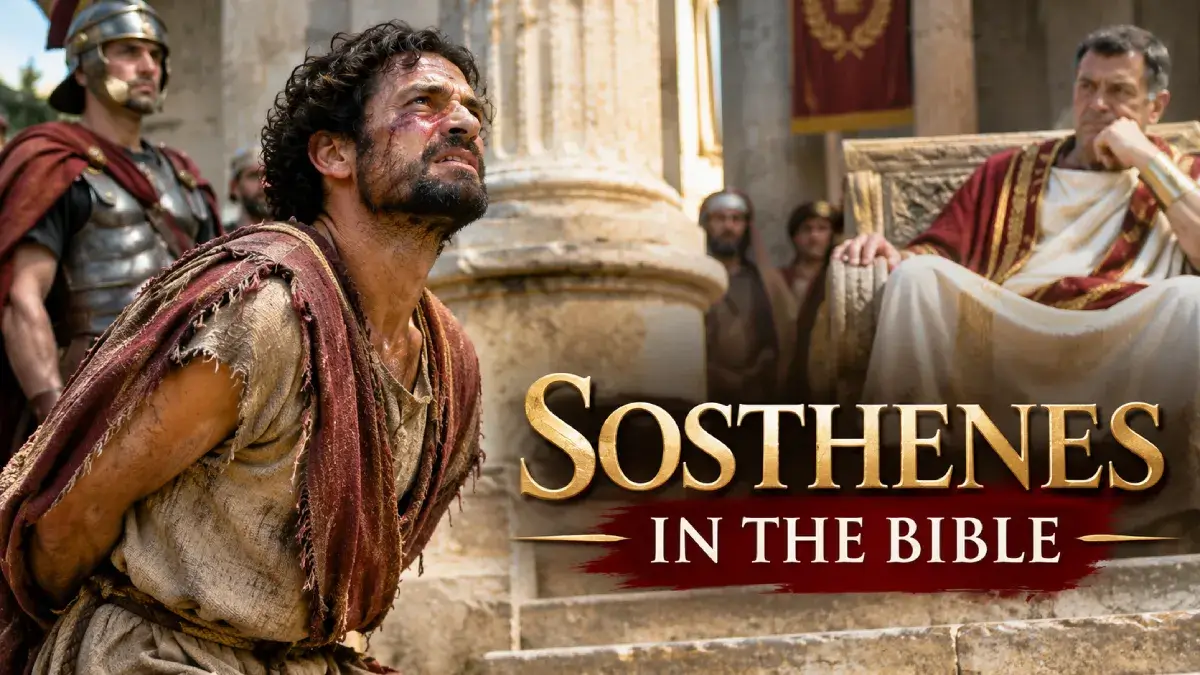
Sosthenes was a man mentioned in two New Testament passages. In Acts 18:17, he is identified as the ruler of a synagogue in Corinth who was seized and beaten in front of the judgment seat. In 1 Corinthians 1:1, Paul mentions a Sosthenes as a Christian brother who joins him in greeting the church at Corinth.
Some Bible scholars and readers believe these references describe the same man, suggesting that the synagogue ruler may later have become a follower of Jesus. However, the Bible does not explicitly confirm that they were the same person.
The Bible mentions several well-known apostles, prophets, and leaders, but it also introduces individuals whose stories appear in only a few verses. One such person is Sosthenes. Although his name appears only briefly in the New Testament, the passages connected with him provide an interesting glimpse into the challenges faced by early Christians.
Sosthenes is mentioned in Acts 18:17, where he is identified as the ruler of a synagogue in Corinth and becomes the victim of a public beating. His name appears again in 1 Corinthians 1:1, where Paul refers to a man named Sosthenes as a brother in Christ and includes him in the greeting of his letter.
Are these references describing the same person? What happened to Sosthenes in Corinth? Was he a Jewish synagogue leader who later became a Christian?
In this article, we will examine what the Bible actually says about Sosthenes, explore the possible connection between the two New Testament references, and consider the spiritual lessons his brief story offers.
1. Where Is Sosthenes Mentioned in the Bible?
The name Sosthenes appears in two important New Testament passages.
Sosthenes in Acts 18:17
The first reference appears in the book of Acts, during Paul’s ministry in Corinth.
Acts 18:17 (KJV):
Then all the Greeks took Sosthenes, the chief ruler of the synagogue, and beat him before the judgment seat. And Gallio cared for none of those things.
This passage identifies Sosthenes as the chief ruler of the synagogue. It also describes an incident in which he was seized and beaten before the Roman proconsul Gallio.
The event occurred during a period of opposition to Paul’s preaching in Corinth. Jewish opponents brought Paul before Gallio, accusing him of persuading people to worship God contrary to the law.
Gallio refused to treat the matter as a criminal offense and dismissed the case. Following his decision, Sosthenes was beaten.
Sosthenes in 1 Corinthians 1:1
The second reference appears in Paul’s first letter to the Corinthians.
1 Corinthians 1:1 (KJV):
Paul, called to be an apostle of Jesus Christ through the will of God, and Sosthenes our brother,
Here, Paul mentions Sosthenes as “our brother.” The expression indicates a fellow believer or Christian brother.
This greeting is especially interesting because Acts 18:17 previously introduced a man named Sosthenes as a synagogue ruler in Corinth.
The two references have led many readers to consider whether the synagogue ruler later became a Christian and worked alongside Paul. That is a possible interpretation, but Scripture does not directly establish the connection.
2. What Happened to Sosthenes in Acts 18?
To understand Sosthenes’ story, it is important to examine the events surrounding his appearance in Acts 18.
Paul Preaches in Corinth
Acts 18 describes Paul’s ministry in Corinth, where he preached the message of Jesus Christ to both Jews and Gentiles.
Paul initially reasoned in the synagogue every Sabbath, attempting to persuade his listeners.
Acts 18:4 (KJV):
And he reasoned in the synagogue every sabbath, and persuaded the Jews and the Greeks.
However, not everyone accepted his message. Some opposed him and spoke against his teaching.
Paul eventually declared that he would turn his attention toward the Gentiles.
The Jews Bring Paul Before Gallio
The opposition to Paul continued, and some Jewish leaders brought him before Gallio, the Roman proconsul of Achaia.
Acts 18:12 (KJV):
And when Gallio was the deputy of Achaia, the Jews made insurrection with one accord against Paul, and brought him to the judgment seat,
They accused Paul of persuading people to worship God in a way they considered contrary to the law.
Before Paul could fully respond, Gallio dismissed the accusation.
Gallio Refuses to Intervene
Gallio concluded that the matter concerned questions of Jewish law and terminology rather than a serious criminal offense under Roman law.
Acts 18:15 (KJV):
But if it be a question of words and names, and of your law, look ye to it; for I will be no judge of such matters.
He then drove the accusers away from the judgment seat.
Sosthenes Is Beaten
After Gallio dismissed the case, the crowd seized Sosthenes and beat him in front of the judgment seat.
The passage does not clearly explain why Sosthenes was targeted. It is possible that the crowd blamed him for the unsuccessful accusation against Paul, but Acts does not state the precise motive.
The account ends by saying that Gallio did not concern himself with what happened.
This incident reveals the tension and hostility surrounding Paul’s ministry in Corinth. It also gives us one of the few glimpses of Sosthenes in the biblical record.
3. Was Sosthenes the Synagogue Ruler in Acts 18 the Same Person in 1 Corinthians 1:1?
This is one of the most interesting questions about Sosthenes in the Bible.
Acts 18:17 identifies Sosthenes as a synagogue ruler, while 1 Corinthians 1:1 mentions a Sosthenes as Paul’s Christian brother.
Could they be the same person?
There are reasons why some readers consider this possibility.
Reason 1: Both References Are Connected to Corinth
Acts 18 describes Sosthenes in Corinth, and Paul’s first letter to the Corinthians is addressed to the church in that same city.
The shared geographical connection makes the identification plausible.
Reason 2: The Name Is Unusual in These Accounts
Both passages use the same name, Sosthenes. This has encouraged readers to consider whether Paul was referring to the same individual who appeared in Acts.
However, sharing a name does not prove that two references describe the same person.
Reason 3: The Later Reference Calls Him a Brother
In 1 Corinthians 1:1, Paul describes Sosthenes as “our brother.”
If this is the same man from Acts 18, it would suggest a remarkable change: a synagogue ruler who was involved in the events surrounding Paul’s opposition later became a follower of Christ.
That would be an encouraging example of spiritual transformation.
What Does the Bible Actually Confirm?
The Bible does not explicitly say that the two men were the same person. It does not provide a detailed account of the synagogue ruler’s conversion, nor does it explain how the Sosthenes mentioned in 1 Corinthians came to work alongside Paul.
Therefore, it is best to describe the identification as a possibility rather than an established biblical fact.
4. What Was the Role of Sosthenes in 1 Corinthians?
In 1 Corinthians 1:1, Sosthenes appears alongside Paul in the opening greeting of the letter.
Paul writes:
Paul, called to be an apostle of Jesus Christ through the will of God, and Sosthenes our brother,
This brief introduction tells us that Sosthenes was recognized as a Christian brother and was associated with Paul when the letter was written.
He Was a Fellow Believer
Paul’s description of Sosthenes as “our brother” identifies him with the Christian community.
The term expresses spiritual fellowship among believers.
He Was Associated With Paul’s Letter
Sosthenes is included in the greeting, but the passage does not tell us exactly what role he played in writing or delivering the letter.
It is reasonable to recognize his association with Paul, but we should not claim that he was the secretary, principal author, or messenger without further evidence.
He Was Connected to the Corinthian Church
Since 1 Corinthians is addressed to the church at Corinth, Sosthenes’ appearance in the greeting is significant.
The passage shows that Paul was not acting in isolation. Other believers were associated with his ministry and message.
5. What Does the Name Sosthenes Mean?
The name Sosthenes is generally understood to have Greek origins.
It is commonly explained as meaning “of safe strength,” “strong in strength,” or “strength in safety.” It is formed from Greek elements associated with safety or preservation and strength.
Although the meaning of a biblical name can add interesting background, the Bible does not give a specific spiritual interpretation of Sosthenes’ name.
It is therefore important not to build theological conclusions solely on the proposed meaning of his name.
6. What Can We Learn From Sosthenes in the Bible?
Although the Bible provides limited information about Sosthenes, the passages mentioning him offer several lessons worth considering.
1. A Person’s Story Can Be More Than One Moment
Acts 18 introduces Sosthenes during a difficult public incident. In 1 Corinthians, a man with the same name is identified as a Christian brother.
If both references describe the same individual, his story may illustrate a remarkable change in direction.
We should not define a person’s entire life by one difficult moment or one chapter of their history.
God can work in people’s lives in ways that are not always immediately visible.
2. Faithfulness Can Bring Opposition
The events in Acts 18 show that Paul’s ministry faced resistance and public hostility.
Sosthenes was also caught up in the conflict and suffered a beating.
The account reminds us that the early Christian movement developed in a challenging environment. Following Christ and proclaiming the gospel did not always bring acceptance or approval.
2 Timothy 3:12 (KJV):
Yea, and all that will live godly in Christ Jesus shall suffer persecution.
This verse reminds Christians that faithfulness to God may involve opposition.
3. God Can Work Through Unexpected People
If the Sosthenes of Acts 18 and 1 Corinthians 1:1 were the same person, his possible transformation would be a powerful example of how God can work through unexpected individuals.
The Bible contains many accounts of people whose lives changed dramatically after encountering God’s grace.
Paul himself is a prominent example. He once persecuted Christians but later became a devoted apostle of Jesus Christ (Acts 9:1–22).
Sosthenes’ possible story encourages us not to assume that anyone is beyond the reach of God’s grace.
4. Christian Ministry Involves Fellowship
In 1 Corinthians 1:1, Sosthenes is mentioned alongside Paul.
This small detail reminds us that Christian ministry involves fellowship, cooperation, and shared commitment to the gospel.
Believers are called to encourage and support one another rather than work only for personal recognition.
Ecclesiastes 4:9 (KJV):
Two are better than one; because they have a good reward for their labour.
5. God Knows the Details of Every Life
The Bible does not tell us everything about Sosthenes. We do not know his complete background, personal struggles, or what happened to him after the reference in 1 Corinthians.
Yet the brief account is preserved in Scripture.
This reminds us that a person’s importance is not measured by how many times their name appears in the Bible or how much public attention they receive.
Faithfulness and service matter, even when they are not widely recognized.
7. Other Important People in Acts 18
Sosthenes appears in a chapter that introduces several important figures connected with Paul’s ministry in Corinth.
Understanding these individuals helps place his story in its historical setting.
Paul
Paul was the apostle who preached the gospel in Corinth. He reasoned in the synagogue and later continued his ministry among the Gentiles.
Gallio
Gallio was the Roman proconsul of Achaia. He dismissed the accusation brought against Paul, considering it a dispute about Jewish law rather than a matter requiring Roman judgment.
Crispus
Crispus was the ruler of the synagogue before the events involving Sosthenes.
Acts 18:8 (KJV):
And Crispus, the chief ruler of the synagogue, believed on the Lord with all his house; and many of the Corinthians hearing believed, and were baptized.
Crispus believed in the Lord, and his household also became believers.
Aquila and Priscilla
Aquila and Priscilla were Jewish believers whom Paul met in Corinth. They worked with Paul and supported his ministry.
Their presence in Acts 18 highlights the importance of Christian fellowship and cooperation during the early spread of the gospel.
Frequently Asked Questions About Sosthenes in the Bible
Who was Sosthenes in the Bible?
Sosthenes was a man mentioned in Acts 18:17 as the chief ruler of a synagogue in Corinth. He was beaten in front of the judgment seat after Gallio dismissed the accusation against Paul. A man named Sosthenes is also mentioned in 1 Corinthians 1:1 as Paul’s Christian brother.
How many times is Sosthenes mentioned in the Bible?
The name Sosthenes appears in two New Testament passages: Acts 18:17 and 1 Corinthians 1:1.
Was Sosthenes a Christian?
The Sosthenes mentioned in 1 Corinthians 1:1 is identified as “our brother,” indicating that he was a Christian believer. Whether he was the same Sosthenes who served as a synagogue ruler in Acts 18:17 is not explicitly confirmed.
Why was Sosthenes beaten in Acts 18?
Acts 18:17 says that Sosthenes was seized and beaten before the judgment seat after Gallio dismissed the case against Paul. However, the passage does not clearly explain why the crowd targeted him.
Was Sosthenes converted by Paul?
The Bible does not provide a direct account of Sosthenes’ conversion. If the synagogue ruler in Acts 18 was the same man mentioned in 1 Corinthians 1:1, he may have later become a Christian. However, Scripture does not confirm this identification or explain how he came to faith.
Who was the ruler of the synagogue before Sosthenes?
Acts 18:8 identifies Crispus as the chief ruler of the synagogue who believed in the Lord. Sosthenes is later identified as a synagogue ruler in Acts 18:17. The passage does not explain all the details of the leadership transition.
What does the name Sosthenes mean?
Sosthenes is a Greek name commonly understood to carry the idea of strength and safety or preservation. The Bible does not provide a specific spiritual meaning for the name.
What is the main lesson from Sosthenes’ story?
One important lesson is that God can work through unexpected people. If the two New Testament references describe the same man, his story may illustrate a significant change from synagogue leadership during Paul’s opposition to Christian fellowship with Paul.
Final Thoughts
Sosthenes is one of the lesser-known individuals in the New Testament, but his brief appearances offer an interesting glimpse into the early Christian church.
In Acts 18:17, he is introduced as the chief ruler of a synagogue in Corinth who was beaten before the judgment seat. In 1 Corinthians 1:1, a man named Sosthenes appears as Paul’s Christian brother.
Although many readers believe these references may describe the same person, the Bible does not explicitly confirm it. We should therefore distinguish what Scripture clearly states from what remains a possible interpretation.
His story reminds us that God can work through unexpected people, that Christian ministry involves fellowship, and that even individuals mentioned briefly in Scripture have a place in the larger story of the early church.
The story of Sosthenes encourages us to remain open to God’s work in people’s lives and to remember that no person’s story should be judged by only one moment.