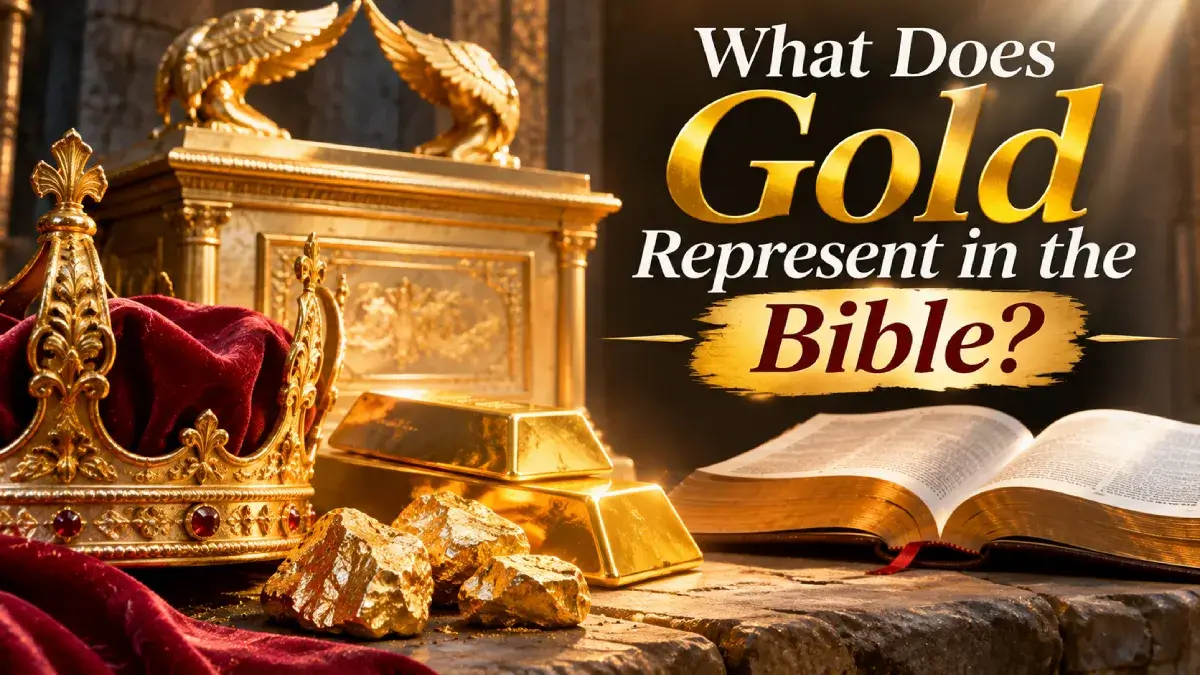
In the Bible, gold commonly represents wealth, glory, holiness, kingship, purity, wisdom, and tested faith. Its meaning depends on the passage and its context.
Gold was used in the tabernacle and temple to distinguish sacred objects and spaces. It was also associated with royal honor, as seen in the gifts presented to Jesus by the wise men. In 1 Peter 1:7, gold becomes an illustration of faith tested through trials.
However, the Bible also warns against loving wealth, worshiping idols, or trusting in material possessions. Gold is valuable, but it must never take the place of God.
Gold is one of the most frequently mentioned precious metals in the Bible. From the gold given to the tabernacle and temple to the gifts presented to Jesus by the wise men, this valuable metal appears in many important biblical events.
But what does gold represent in the Bible? Is it simply a symbol of wealth, or does it carry a deeper spiritual meaning?
Throughout Scripture, gold is associated with several important themes, including God’s glory, holiness, kingship, purity, wisdom, and tested faith. It was used in sacred places and objects, appeared in descriptions of heavenly realities, and served as an illustration of the value of genuine faith.
Understanding what gold symbolizes in the Bible helps us recognize the spiritual lessons behind these passages. It also reminds us that although earthly gold is valuable, our relationship with God and the faith He develops within us are worth far more.
Let’s explore the biblical meaning of gold, important Scriptures about gold, and the spiritual lessons Christians can learn from it.
10 Important Meanings of Gold in the Bible
Gold does not have only one symbolic meaning in Scripture. Its significance changes according to how it is used.
Here are ten important biblical themes associated with gold.
1. Gold Represents God’s Glory and Majesty
Gold is often associated with the glory, majesty, and splendor of God.
One example is found in the description of the heavenly city in Revelation.
Revelation 21:18 (KJV):
And the building of the wall of it was of jasper: and the city was pure gold, like unto clear glass.
The New Jerusalem is described with imagery of extraordinary beauty and precious materials. Its gold-like appearance communicates the magnificence of the city God has prepared.
Gold is also used in the descriptions of sacred objects connected with worship. Its beauty and value helped distinguish these objects from ordinary household items.
The biblical use of gold in these settings points readers toward the greatness and holiness of God.
Spiritual lesson: Earthly beauty and riches cannot compare with the glory of God and the eternal hope He promises.
2. Gold Represents Holiness and Sacredness
Gold was used extensively in the construction of the tabernacle, the place where God instructed Israel to worship Him.
Exodus 25:10–11 (KJV):
And they shall make an ark of shittim wood: two cubits and a half shall be the length thereof, and a cubit and a half the breadth thereof, and a cubit and a half the height thereof.
And thou shalt overlay it with pure gold, within and without shalt thou overlay it, and shalt make upon it a crown of gold round about.
God instructed Moses to have the Ark of the Covenant covered with pure gold.
Other sacred objects, including the lampstand and various utensils, were also made of gold or covered with it.
This use of gold helped distinguish the tabernacle’s sacred furnishings and reflected the honor and reverence associated with worshiping God.
Gold itself was not divine or magical. Its use was part of God’s specific instructions for the tabernacle.
Spiritual lesson: Worship should be approached with reverence, recognizing the holiness and greatness of God.
3. Gold Represents Purity and Refinement
Gold is a precious metal that can be refined through intense heat. The process removes impurities and produces a purer substance.
The Bible uses this process as an illustration of faith being tested.
1 Peter 1:7 (KJV):
That the trial of your faith, being much more precious than of gold that perisheth, though it be tried with fire, might be found unto praise and honour and glory at the appearing of Jesus Christ:
Peter compares tested faith with gold refined by fire.
Although gold is valuable, it is temporary and can perish. Genuine faith is even more precious because it has eternal significance.
Trials can reveal the strength and sincerity of a believer’s faith. They can also produce perseverance and a deeper dependence on God.
Spiritual lesson: Difficult seasons can test and strengthen your faith. Keep trusting God even when life becomes challenging.
4. Gold Represents Kingship and Royal Honor
Throughout biblical history, gold was associated with kings, rulers, and royal possessions.
Kings often possessed gold as a sign of wealth, influence, and authority.
One well-known example is King Solomon.
1 Kings 10:14 (KJV):
Now the weight of gold that came to Solomon in one year was six hundred threescore and six talents of gold;
This verse describes the extraordinary amount of gold Solomon received during his reign.
His wealth reflected the prosperity and international recognition of his kingdom.
Gold also appears in the story of the wise men who visited Jesus after His birth.
Matthew 2:11 (KJV):
And when they were come into the house, they saw the young child with Mary his mother, and fell down, and worshipped him: and when they had opened their treasures, they presented unto him gifts; gold, and frankincense, and myrrh.
The wise men brought gold as one of their gifts to Jesus.
Gold was a valuable gift fit for someone worthy of honor. Many Christians understand it as symbolically reflecting Jesus’ kingship, although Matthew does not explicitly explain the individual meanings of the three gifts.
Spiritual lesson: Jesus is worthy of honor and worship. His kingdom is greater than every earthly kingdom.
5. Gold Represents Wisdom and Spiritual Value
The Bible frequently compares wisdom with precious materials, including gold.
Proverbs 16:16 (KJV):
How much better is it to get wisdom than gold! and to get understanding rather to be chosen than silver!
This verse makes an important distinction between material wealth and spiritual value.
Gold may provide comfort and financial security, but wisdom helps a person make decisions that honor God.
A person can possess great wealth and still lack understanding, humility, and godly character.
The book of Job also makes a similar comparison.
Job 28:17 (KJV):
The gold and the crystal cannot equal it: and the exchange of it shall not be for jewels of fine gold.
The surrounding passage describes the extraordinary value of wisdom and understanding. It teaches that spiritual wisdom cannot be purchased with earthly riches.
Spiritual lesson: Pursue godly wisdom more than material possessions. Understanding God’s ways is more valuable than accumulating wealth.
6. Gold Represents Wealth and Earthly Prosperity
One of the most straightforward meanings of gold in the Bible is material wealth.
In ancient times, gold was a highly valuable possession. Kings, merchants, and wealthy individuals used it to demonstrate their prosperity.
Genesis 13:2 (KJV):
And Abram was very rich in cattle, in silver, and in gold.
This verse describes Abraham’s considerable wealth.
Gold was also part of the treasures collected by kings and nations. It could be used for trade, gifts, royal possessions, and the construction of important buildings.
However, Scripture does not teach that possessing gold automatically makes someone righteous or spiritually blessed.
The Bible acknowledges material wealth while warning people not to make it their source of security.
Spiritual lesson: Material possessions can be useful, but they should never become more important than your relationship with God.
7. Gold Represents the Danger of Idolatry
Although gold was used in sacred objects, the Bible also records how people misused it to create idols.
One of the clearest examples is the golden calf.
Exodus 32:4 (KJV):
And he received them at their hand, and fashioned it with a graving tool, after he had made it a molten calf: and they said, These be thy gods, O Israel, which brought thee up out of the land of Egypt.
While Moses was on Mount Sinai, the Israelites became impatient and asked Aaron to make a god for them.
Aaron collected their gold and formed a golden calf. The people then worshiped the image.
The problem was not the gold itself. The problem was that the people used it to create an idol and turned their worship away from the living God.
This event became a serious example of disobedience and idolatry.
Spiritual lesson: Never allow money, possessions, success, or anything else to take the place of God in your heart.
8. Gold Represents the Value of Genuine Faith
The New Testament teaches that faith is more precious than gold.
1 Peter 1:7 (KJV):
That the trial of your faith, being much more precious than of gold that perisheth, though it be tried with fire, might be found unto praise and honour and glory at the appearing of Jesus Christ:
Peter’s comparison reveals that faith has a value that earthly wealth cannot match.
Gold can be lost, stolen, damaged, or spent. It is also temporary.
But faith in Jesus Christ has eternal significance.
This passage does not suggest that every hardship automatically makes someone spiritually stronger. Rather, it encourages believers to remain faithful through trials, trusting that their faith is precious to God.
Spiritual lesson: Do not measure your spiritual life by what you own. A genuine faith in Christ is worth more than earthly riches.
9. Gold Represents God’s Judgment and the Testing of His People
Gold refined through fire is also used in Scripture to illustrate God’s examination and purification.
Malachi 3:3 (KJV):
And he shall sit as a refiner and purifier of silver: and he shall purify the sons of Levi, and purge them as gold and silver, that they may offer unto the LORD an offering in righteousness.
Malachi describes the Lord as a refiner who purifies His people.
The immediate context concerns the coming messenger and the Lord’s work of purification and judgment, particularly among the sons of Levi.
The image of refining communicates the removal of impurity so that what remains is acceptable.
Other passages, such as Proverbs 17:3, use the refining of silver and gold to illustrate how the Lord tests hearts.
Spiritual lesson: God cares about the condition of our hearts, not merely our outward appearance. Allow His Word to correct and shape your life.
10. Gold Represents Eternal Beauty in the New Jerusalem
Gold also appears in the Bible’s description of the future city of God.
Revelation 21:21 (KJV):
And the twelve gates were twelve pearls; every several gate was of one pearl: and the street of the city was pure gold, as it were transparent glass.
The description of the New Jerusalem is filled with precious stones, gold, and extraordinary beauty.
The imagery communicates the glory and perfection of God’s eternal dwelling place.
The city is not presented as an ordinary earthly settlement. It represents the fulfillment of God’s promise to dwell with His people.
Gold in this passage contributes to the picture of a place beyond ordinary human beauty and value.
Spiritual lesson: Set your hope on the eternal promises of God rather than becoming consumed by temporary earthly treasures.
Important Bible Verses About Gold and Their Meanings
Here are additional Scriptures that help explain what gold represents in the Bible.
| Bible verse | Main lesson |
|---|---|
| Genesis 2:11–12 | Gold is described as a valuable resource in the land of Havilah. |
| Genesis 13:2 | Abraham possessed great material wealth, including gold. |
| Exodus 25:11 | Gold was used in the construction of the Ark of the Covenant. |
| Exodus 32:4 | Gold was misused to create an idol. |
| 1 Kings 10:14 | Solomon received enormous quantities of gold. |
| Job 23:10 | Job compares his testing with gold that comes through fire. |
| Job 28:17 | Wisdom is more valuable than precious gold. |
| Psalm 19:10 | God’s judgments are more desirable than much fine gold. |
| Proverbs 16:16 | Wisdom and understanding are better than gold and silver. |
| Proverbs 25:12 | Wise correction is compared with an ornament of gold. |
| Isaiah 13:12 | A person is described as more precious than fine gold. |
| Malachi 3:3 | God is pictured as refining and purifying His people. |
| Matthew 2:11 | The wise men presented gold to Jesus. |
| 1 Peter 1:7 | Tested faith is more precious than gold. |
| Revelation 21:18 | The New Jerusalem is described as pure gold. |
What Does Pure Gold Symbolize in the Bible?
Pure gold is often associated with value, beauty, and the absence of impurities.
In the Old Testament, God specifically instructed the Israelites to use pure gold for certain tabernacle furnishings.
For example, Exodus 25:31 describes the lampstand as being made of pure gold.
The use of pure gold distinguished these objects and reflected the care and reverence required in constructing the tabernacle.
The refining imagery also appears in passages about spiritual testing. In 1 Peter 1:7, faith is compared to gold that is tried by fire.
However, it is important to understand that the Bible does not assign one universal symbolic meaning to every reference to pure gold. Its meaning depends on the surrounding passage.
In sacred settings, it can communicate honor and beauty. In refining imagery, it illustrates testing and purification.
What Does Gold and Silver Represent in the Bible?
Gold and silver frequently appear together in Scripture because both were valuable metals in the ancient world.
They were used in trade, royal treasures, gifts, and sacred objects.
However, the Bible sometimes uses them to make comparisons about spiritual priorities.
Psalm 19:10 (KJV):
More to be desired are they than gold, yea, than much fine gold: sweeter also than honey and the honeycomb.
In this verse, David describes the words and judgments of the Lord as more desirable than gold.
Similarly, Proverbs 16:16 teaches that wisdom is better than gold and understanding is better than silver.
These passages remind us that God’s Word and spiritual wisdom have greater value than material possessions.
Gold and silver can provide earthly benefits, but they cannot replace God’s truth, salvation, or eternal life.
What Does Gold Represent in the Tabernacle and Temple?
Gold played an important role in the construction of both the tabernacle and Solomon’s temple.
God instructed Moses to use gold in several sacred objects and furnishings.
Some examples include:
- The Ark of the Covenant: Exodus 25:10–11 describes the ark as being overlaid with pure gold.
- The Mercy Seat: Exodus 25:17–18 describes a mercy seat of pure gold with two cherubim.
- The Golden Lampstand: Exodus 25:31 describes a lampstand made of pure gold.
- The Altar of Incense: Exodus 30:1–3 describes an altar overlaid with pure gold.
- The Temple Interior: 1 Kings 6:20–22 describes Solomon’s use of gold in the temple’s inner sanctuary and altar.
Gold helped make these objects beautiful and distinguished them as furnishings dedicated to the worship of God.
The temple’s use of gold also reflected the extraordinary resources and craftsmanship involved in its construction.
These details remind us that worship was important to Israel and that the tabernacle and temple were set apart for sacred purposes.
What Does Gold Mean in a Dream According to the Bible?
People sometimes ask whether dreaming about gold has a specific biblical meaning.
The Bible records dreams involving precious metals and valuable objects. For example, Daniel interpreted King Nebuchadnezzar’s dream of a great image with a head of gold in Daniel 2:32–38. Daniel explained that the golden head represented Nebuchadnezzar’s kingdom.
However, this does not establish a universal rule that dreaming about gold always means wealth, blessing, promotion, or spiritual favor.
Biblical dreams must be understood within their specific contexts. Scripture does not provide a fixed dream dictionary in which every object has one guaranteed meaning.
If you dream about gold, avoid making major decisions based only on that dream. Instead, examine your thoughts and actions in light of God’s Word.
The Bible consistently teaches that wisdom, faithfulness, and obedience to God are more important than material wealth.
What Spiritual Lessons Can Christians Learn From Gold in the Bible?
The biblical references to gold provide several important lessons for Christian living.
1. Value God Above Material Possessions
Gold is valuable, but it cannot provide salvation or eternal life.
Jesus warned against storing up earthly treasures while neglecting heavenly priorities.
Matthew 6:19–20 (KJV):
Lay not up for yourselves treasures upon earth, where moth and rust doth corrupt, and where thieves break through and steal:
But lay up for yourselves treasures in heaven, where neither moth nor rust doth corrupt, and where thieves do not break through nor steal:
Christians should use material resources responsibly without allowing them to control their hearts.
2. Allow Trials to Strengthen Your Faith
First Peter 1:7 compares tested faith with gold refined by fire.
Difficult experiences can expose weaknesses and teach believers to depend more deeply on God.
Rather than abandoning faith during hardship, Christians can seek God’s wisdom and remain faithful through difficult seasons.
3. Pursue Wisdom More Than Wealth
Proverbs 16:16 makes it clear that wisdom is better than gold.
Money can purchase many things, but it cannot guarantee good judgment, a peaceful heart, or a life that honors God.
Ask God for wisdom and make His Word the foundation of your decisions.
4. Avoid Idolatry
The golden calf in Exodus 32 reminds us that even valuable things can become dangerous when they receive the worship that belongs to God.
Modern idols may not look like golden statues. Money, career success, possessions, status, and personal ambitions can also become controlling influences.
Keep God first in your life.
5. Remember That Eternal Things Matter Most
Revelation 21 describes the New Jerusalem with imagery of gold and precious stones.
The passage directs our attention toward God’s eternal promises.
Earthly wealth is temporary, but the hope believers have in Christ is eternal.
Frequently Asked Questions About Gold in the Bible
What does gold represent in the Bible?
Gold represents different things depending on the passage. It can be associated with wealth, glory, holiness, kingship, purity, wisdom, and tested faith. The surrounding biblical context determines its particular significance.
What does gold symbolize spiritually?
Gold can illustrate spiritual value, purity, honor, and refinement. For example, 1 Peter 1:7 compares faith tested through trials with gold refined by fire. The verse emphasizes that genuine faith is more precious than temporary material wealth.
What does pure gold represent in the Bible?
Pure gold is used in sacred furnishings and descriptions of great beauty. It can also serve as an illustration of refinement. However, its exact meaning depends on the passage in which it appears.
Why was gold used in the tabernacle?
God instructed Moses to use gold in several tabernacle furnishings, including the Ark of the Covenant and the lampstand. Gold distinguished these sacred objects and contributed to the beauty and honor of the place of worship.
What does gold represent in Revelation?
Gold appears in Revelation’s descriptions of the heavenly city, especially Revelation 21:18 and 21:21. It contributes to the imagery of extraordinary beauty, glory, and the eternal dwelling place of God with His people.
What does gold and silver mean in the Bible?
Gold and silver commonly represent valuable earthly possessions. However, Scripture teaches that wisdom, God’s Word, and genuine faith are more valuable than precious metals (Psalm 19:10; Proverbs 16:16; 1 Peter 1:7).
Is gold a symbol of Jesus in the Bible?
The Bible does not explicitly establish gold as a universal symbol of Jesus. In Matthew 2:11, the wise men presented gold to Jesus, and many Christians understand this gift as fitting for a king. This is a traditional symbolic interpretation rather than an explanation directly stated by Matthew.
Does gold always represent something good in the Bible?
No. Gold can be associated with wealth and sacred objects, but it also appears in the story of the golden calf in Exodus 32. The Bible warns against idolatry and trusting in riches. Gold itself is not good or evil; what matters is how people use it and what place it holds in their hearts.
Final Thoughts
So, what does gold represent in the Bible? Scripture uses gold in several ways, including as a symbol of wealth, glory, sacred honor, kingship, and refinement. It appears in the tabernacle and temple, in the gifts presented to Jesus, and in the description of the New Jerusalem.
But one of the most important lessons is that faith and wisdom are more valuable than earthly gold.
First Peter 1:7 reminds us that genuine faith is more precious than gold, even gold refined by fire. Proverbs 16:16 teaches that wisdom is better than gold and understanding is better than silver.
Gold may be beautiful and valuable, but it cannot replace God. Let these Scriptures encourage you to seek His wisdom, remain faithful through trials, and treasure the eternal riches found in Jesus Christ.