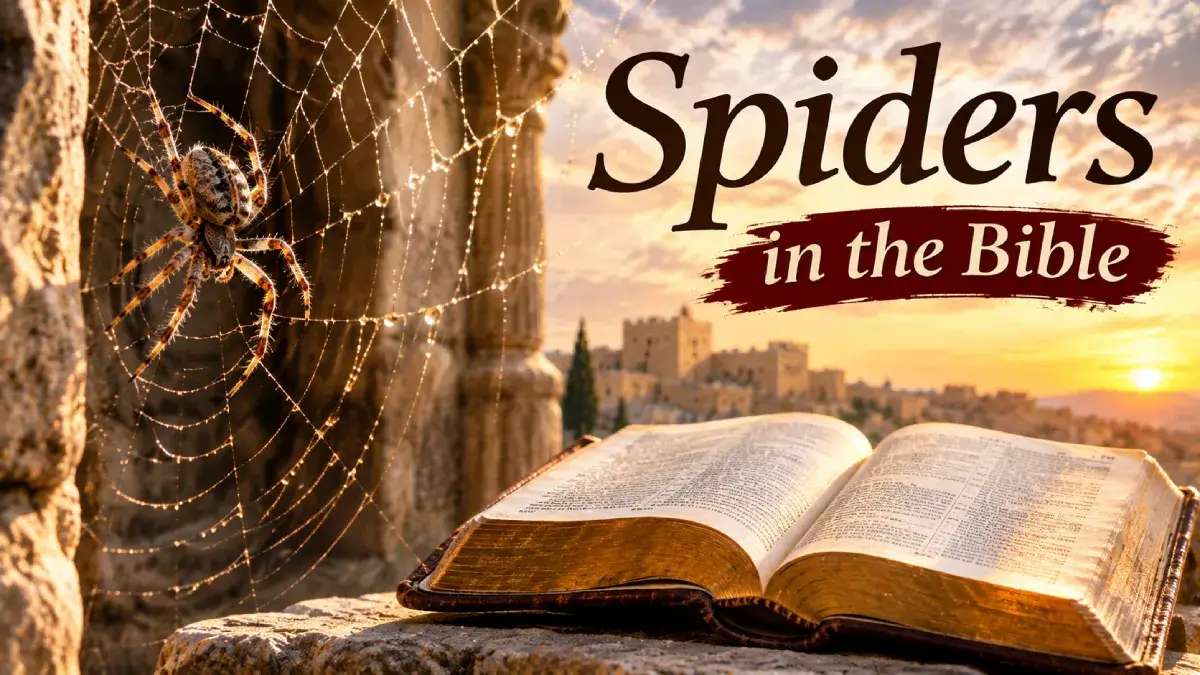
Spiders and spider webs are used in the Bible primarily as illustrations of fragile security, unreliable trust, and the futility of sinful actions.
In Job 8:14, Bildad compares the confidence of the wicked to a spider’s web, which cannot provide lasting security. In Isaiah 59:5–6, spider webs illustrate the useless results of wicked plans and actions.
Proverbs 30:28 also mentions a small creature translated as a spider in the King James Version, highlighting how something small can demonstrate remarkable ability and find its way into a king’s palace.
The Bible does not assign one universal spiritual meaning to spiders. Their significance depends on the passage in which they appear.
Spiders are small creatures, but the Bible uses their webs to communicate some powerful spiritual lessons. Although Scripture does not discuss spiders extensively, a few passages mention them or refer to their webs as illustrations of human life, false security, and the consequences of wickedness.
In the book of Job, a spider’s web is used to describe the fragile trust of someone who depends on something unreliable. In Isaiah, spider webs illustrate the uselessness of sinful actions and evil schemes. Proverbs also contains an interesting reference to a small creature that appears in some Bible translations as a spider.
So, what do spiders symbolize in the Bible? Are spider webs connected with weakness, deception, or something else? And what can Christians learn from these passages?
Let’s explore the biblical references to spiders, examine their context, and discover the spiritual lessons behind these fascinating Scriptures.
How Many Times Are Spiders Mentioned in the Bible?
The number of references depends on the Bible translation being used.
In the King James Version (KJV), spiders or spider webs appear in three important passages:
- Job 8:14 – The confidence of the wicked is compared to a spider’s web.
- Proverbs 30:28 – A small creature is described as holding on with its hands and entering kings’ palaces.
- Isaiah 59:5–6 – Wicked people are compared to those who weave spider webs.
These passages use spider imagery in different ways. Job emphasizes unreliable confidence, Isaiah describes the uselessness of wicked works, and Proverbs draws attention to the remarkable ability of a small creature.
It is important to remember that translations sometimes use different words for the creature mentioned in Proverbs 30:28. Therefore, the exact number of references to spiders can vary depending on the translation.
Important Bible Verses About Spiders
Let’s examine the main Scriptures that mention spiders or their webs and understand what each passage teaches.
1. Job 8:14 – Trusting in a Spider’s Web
Job 8:14 (KJV):
Whose hope shall be cut off, and whose trust shall be a spider’s web.
This is one of the clearest references to a spider in the Bible.
In this passage, Bildad the Shuhite is speaking to Job. He describes the hope of a godless person as something fragile and unreliable, comparing that person’s trust to a spider’s web.
A spider’s web may look intricate and impressive, but it cannot provide the kind of protection or security that a person needs. It is easily damaged and cannot bear much weight.
Bildad uses this image to explain that confidence built on wickedness cannot last.
Spiritual lesson: We should not place our ultimate trust in things that cannot provide lasting security. Human achievements, possessions, and personal strength are temporary. Our deepest confidence should be in God.
However, we should also recognize the context: Bildad was one of Job’s friends, and his speeches do not always accurately explain Job’s suffering. The comparison in Job 8:14 is part of Bildad’s argument, not a complete explanation of everything that happens to faithful people.
2. Proverbs 30:28 – A Small Creature in the King’s Palace
Proverbs 30:28 (KJV):
The spider taketh hold with her hands, and is in kings’ palaces.
This verse appears in a collection of observations about small creatures that demonstrate remarkable wisdom or ability.
The spider is presented as a creature that can hold on with its hands and make its way into places associated with kings.
The lesson is not primarily about weakness or deception. Instead, the verse draws attention to the surprising ability of a small creature.
Something may appear insignificant, yet it can demonstrate remarkable capability.
Spiritual lesson: Do not underestimate what is small or seemingly insignificant. God can use humble beginnings, small opportunities, and ordinary abilities to accomplish meaningful things.
A translation note: The Hebrew word used here is semamit. While the KJV translates it as “spider,” several modern translations identify the creature as a lizard or gecko. The precise identification is debated. The broader observation about a small creature’s ability to enter a king’s palace remains central to the verse.
3. Isaiah 59:5 – Weaving Spider’s Webs
Isaiah 59:5 (KJV):
They hatch cockatrice’ eggs, and weave the spider’s web: he that eateth of their eggs dieth, and that which is crushed breaketh out into a viper.
This verse uses strong imagery to describe the wickedness of the people addressed by Isaiah.
The prophet describes people whose actions produce harm rather than goodness. Their plans are compared to dangerous eggs and spider webs.
The spider’s web is an image of something carefully constructed but incapable of providing genuine protection or producing anything good.
The surrounding verses explain the moral condition being addressed: violence, dishonesty, injustice, and sinful behavior.
Spiritual lesson: Not everything people carefully build is good or beneficial. A person can spend time developing plans and strategies that ultimately produce harm. God calls His people to pursue righteousness rather than construct lives around sin.
4. Isaiah 59:6 – Spider Webs Cannot Become Clothing
Isaiah 59:6 (KJV):
Their webs shall not become garments, neither shall they cover themselves with their works: their works are works of iniquity, and the act of violence is in their hands.
This verse continues the spider-web illustration from Isaiah 59:5.
A spider’s web cannot be used as a proper garment. It cannot provide the covering or protection that clothing offers.
Isaiah uses this picture to explain that the works of wicked people cannot cover their sin or make their actions acceptable.
They may create plans and carry out impressive-looking activities, but those works cannot turn evil into righteousness.
Spiritual lesson: Human efforts cannot hide wrongdoing from God. We cannot make ourselves righteous simply by covering sinful actions with outward appearances. God desires genuine repentance and righteousness.
What Does a Spider’s Web Symbolize in the Bible?
The spider’s web is the most important image associated with spiders in Scripture.
Although the Bible does not provide a detailed symbolic dictionary for spider webs, the passages in Job and Isaiah offer several insights.
1. Fragile Security
Job 8:14 compares the trust of the wicked to a spider’s web.
A web is delicate and easily destroyed. It cannot provide lasting security.
This image reminds us that placing our confidence in unreliable things can leave us vulnerable.
Psalm 20:7 (KJV):
Some trust in chariots, and some in horses: but we will remember the name of the LORD our God.
The verse encourages us to place our ultimate confidence in God rather than in human power or resources.
2. The Futility of Wicked Works
Isaiah 59:5–6 uses spider webs to describe the works of people who practice evil.
Their efforts may appear carefully constructed, but they cannot produce righteousness or provide a covering for sin.
The passage teaches that the quality of our actions matters more than how impressive our plans may appear.
3. False Appearances
A spider web can look delicate and beautifully arranged, but its appearance does not make it suitable for every purpose.
In Isaiah’s illustration, the web cannot function as a garment.
This offers a useful reminder that outward appearances do not necessarily reflect inward righteousness.
God looks beyond appearances and knows the true condition of the heart.
1 Samuel 16:7 (KJV):
But the LORD said unto Samuel, Look not on his countenance, or on the height of his stature; because I have refused him: for the LORD seeth not as man seeth; for man looketh on the outward appearance, but the LORD looketh on the heart.
What Can We Learn From Spiders in the Bible?
The biblical references to spiders offer several practical lessons for our spiritual lives.
1. Put Your Trust in God, Not Fragile Things
Job 8:14 reminds us that unreliable confidence cannot provide lasting security.
People often place their trust in money, success, relationships, possessions, or personal abilities. While these things may have value, none can replace God.
Circumstances can change, possessions can disappear, and human strength can fail.
Proverbs 3:5 (KJV):
Trust in the LORD with all thine heart; and lean not unto thine own understanding.
The verse encourages us to depend on God’s wisdom rather than relying entirely on our own understanding.
2. Do Not Build Your Life on Sinful Actions
Isaiah 59:5–6 teaches that wicked works cannot provide a meaningful covering for wrongdoing.
A person may try to hide dishonesty, injustice, or harmful behavior behind outward success. But such actions cannot make the heart righteous.
Instead, we should pursue honesty, compassion, justice, and obedience to God’s Word.
3. Never Underestimate Small Things
Proverbs 30:28 presents a small creature demonstrating an unusual ability.
This observation reminds us that size and outward appearance do not always determine importance.
A small act of kindness, a simple prayer, or a seemingly insignificant decision to obey God can have a meaningful impact.
Zechariah 4:10 (KJV):
For who hath despised the day of small things?
This verse encourages us not to despise small beginnings.
4. Look Beyond Outward Appearances
Isaiah’s spider-web illustration reminds us that something can look carefully constructed without being useful or righteous.
In our own lives, we should not focus only on appearing religious or successful.
God desires genuine faith, sincere repentance, and a life that reflects His character.
5. Seek Lasting Security in God’s Word
The image of a fragile spider’s web provides a contrast with the stability of God’s promises.
Psalm 18:2 (KJV):
The LORD is my rock, and my fortress, and my deliverer; my God, my strength, in whom I will trust.
God is described as a rock and fortress because He is a dependable source of protection and strength.
Our lives should be built on His truth rather than on temporary foundations.
Are Spiders a Symbol of Evil in the Bible?
Some people associate spiders with darkness, fear, danger, or evil. However, the Bible does not teach that spiders themselves are evil or demonic creatures.
The main references to spiders and their webs are illustrations used to communicate spiritual truths.
- Job 8:14: The spider’s web represents fragile and unreliable trust.
- Proverbs 30:28: A small creature demonstrates surprising ability.
- Isaiah 59:5–6: Spider webs illustrate the uselessness of wicked works.
None of these passages commands believers to fear spiders or treats them as supernatural symbols of evil.
It is important to distinguish biblical teaching from personal symbolism, folklore, and cultural beliefs.
If someone sees a spider and associates it with a particular spiritual meaning, that personal association should not automatically be treated as a message from God.
Christians should build their understanding of spiritual matters on Scripture rather than superstition.
Does Seeing a Spider Have a Biblical Spiritual Meaning?
The Bible does not say that seeing a spider in your house, bedroom, or elsewhere is a sign of a specific spiritual event.
There is no biblical teaching that a spider appearing in a particular location means that someone is experiencing a spiritual attack, that evil is nearby, or that God is sending a particular warning.
Although the Bible uses spiders and their webs as illustrations, these passages do not establish rules for interpreting everyday spider sightings.
Instead of becoming fearful or relying on superstitious interpretations, believers can reflect on the actual lessons found in Scripture:
- Trust God rather than unreliable things.
- Avoid sinful actions and dishonest behavior.
- Appreciate the value of small things.
- Seek genuine righteousness rather than outward appearances.
The most important question is not what a spider’s appearance supposedly predicts, but what God’s Word teaches us about how to live.
Spider vs. Spider Web: Understanding Their Biblical Significance
The Bible’s references are particularly interesting because most of the spiritual imagery concerns the spider’s web rather than the spider itself.
| Biblical reference | Main image | Lesson |
|---|---|---|
| Job 8:14 | Spider’s web | Unreliable trust cannot provide lasting security |
| Proverbs 30:28 | Small creature in a palace | Do not underestimate small things |
| Isaiah 59:5–6 | Webs that cannot become garments | Wicked works cannot produce righteousness or cover sin |
This distinction helps prevent readers from assigning the same symbolic meaning to every spider-related passage.
Job and Isaiah use the web to communicate different aspects of spiritual truth, while Proverbs focuses on the ability of a small creature.
Frequently Asked Questions About Spiders in the Bible
What do spiders symbolize in the Bible?
Spiders and their webs are used as illustrations of fragile trust, unreliable security, and the futility of wicked works. Proverbs 30:28 also presents a small creature as an example of surprising ability.
Where are spiders mentioned in the Bible?
In the King James Version, spiders or spider webs appear in Job 8:14, Proverbs 30:28, and Isaiah 59:5–6.
What does a spider web mean in Job 8:14?
Job 8:14 compares the confidence of the wicked to a spider’s web. The image communicates fragile and unreliable trust that cannot provide lasting security.
What does Isaiah 59:6 mean?
Isaiah 59:6 explains that spider webs cannot become garments or provide a proper covering. The illustration shows that the sinful works of the people cannot make their actions righteous or cover their wrongdoing.
Does Proverbs 30:28 really mention a spider?
The King James Version translates the creature in Proverbs 30:28 as a spider. However, the Hebrew word semamit is understood by several modern translations as a lizard or gecko. The exact identification is debated.
Are spiders considered evil in the Bible?
No. The Bible does not describe spiders themselves as evil or demonic. They are used as illustrations in passages that teach lessons about trust, wickedness, and the abilities of small creatures.
Does seeing a spider mean something spiritually?
The Bible does not assign a specific spiritual meaning to seeing a spider in everyday life. Believers should avoid superstition and focus on the lessons Scripture actually teaches.
What is the main spiritual lesson from spiders in the Bible?
One important lesson is that we should not place our trust in fragile or unreliable things. Job 8:14 encourages readers to recognize the weakness of false security, while other passages remind us to pursue righteousness and appreciate the value of small things.
Final Thoughts
Spiders are mentioned only briefly in the Bible, but the images associated with them communicate meaningful spiritual lessons.
In Job 8:14, a spider’s web illustrates the fragile confidence of someone who depends on unreliable things. In Isaiah 59:5–6, the web represents the uselessness of wicked actions that cannot provide a covering for sin. Proverbs 30:28 offers a different perspective, drawing attention to the surprising ability of a small creature.
These passages remind us that appearances can be misleading, sinful actions cannot produce righteousness, and our ultimate security should be found in God.
The next time you read about a spider or its web in Scripture, remember the central lesson: Do not build your confidence on fragile foundations. Put your trust in God, pursue righteousness, and never underestimate the value of small things.