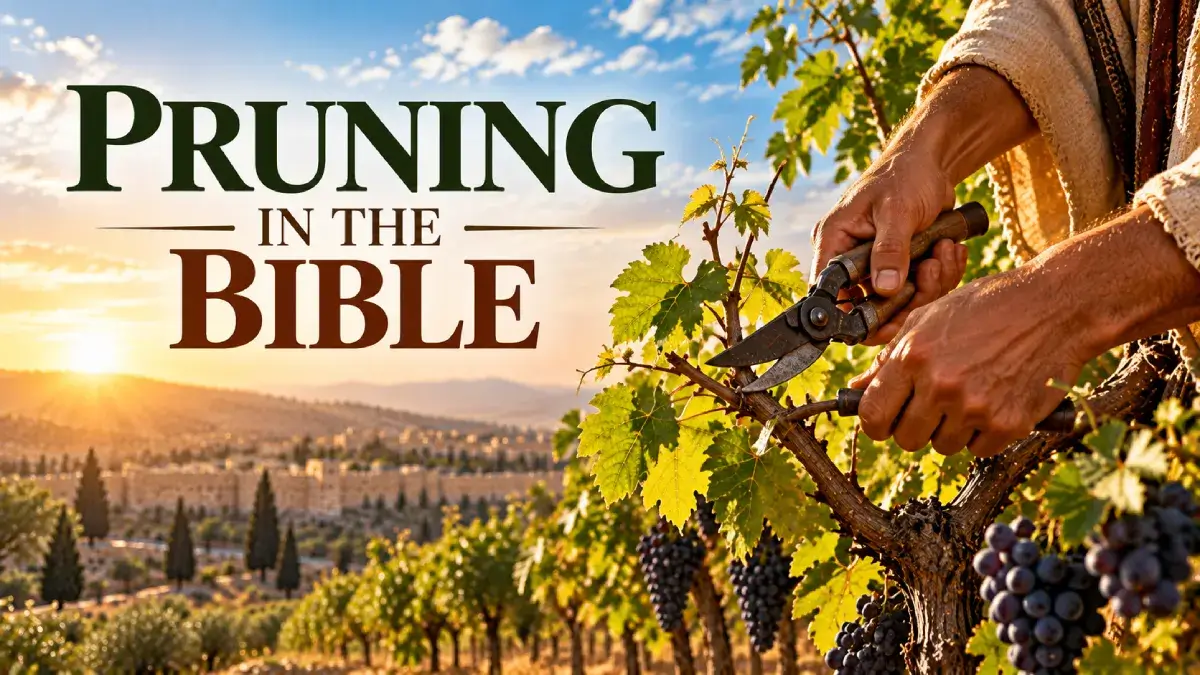
Pruning in the Bible represents God’s work of cultivating spiritual fruitfulness in the lives of His people. The central passage is John 15:1–8, where Jesus teaches that His Father prunes fruitful branches so that they may bear more fruit.
The biblical image of pruning is associated with:
- Spiritual growth and maturity.
- Becoming more fruitful in Christian living.
- Correction and discipline.
- Remaining connected to Jesus.
- Removing habits and attitudes that hinder spiritual growth.
- Living in obedience to God’s Word.
The central lesson is that lasting spiritual fruitfulness comes from abiding in Christ rather than depending entirely on human strength.
Key Bible verse: John 15:2 (KJV)
“Every branch that beareth fruit, he purgeth it, that it may bring forth more fruit.”
In this verse, the word purgeth is rendered as prunes in many modern Bible translations.
Have you ever wondered why a gardener cuts away healthy-looking branches from a plant? Although pruning may seem like a destructive process, it can help a plant grow stronger, produce more fruit, and remain healthy. In a similar way, the Bible uses the imagery of pruning to teach important lessons about spiritual growth, discipline, and fruitfulness.
One of the clearest examples appears in John 15, where Jesus describes Himself as the true vine and His followers as branches. He explains that the Father removes unfruitful branches and prunes fruitful ones so that they may bear more fruit.
This picture offers a powerful reminder that spiritual growth sometimes involves correction, change, and letting go of things that prevent us from living faithfully. However, pruning should not be understood as proof that God has abandoned someone or that every painful experience is a direct act of divine correction.
In this article, we will explore pruning in the Bible, its spiritual meaning, key Bible verses, examples of pruning imagery, and practical lessons Christians can apply to their daily lives.
What Is Pruning in the Bible?
Pruning is an agricultural practice in which a gardener cuts away selected parts of a plant to encourage healthy growth, manage its shape, or improve fruit production.
In biblical times, vines were familiar parts of agricultural life. Jesus used this everyday image to communicate a spiritual truth His disciples could understand.
In John 15:1, Jesus declares:
“I am the true vine, and my Father is the husbandman.” — John 15:1 (KJV)
Jesus then identifies His followers as branches that depend on the vine for life and fruitfulness.
The picture has three main elements:
- The vine: Jesus Christ, the source of spiritual life.
- The husbandman or gardener: God the Father, who tends the vine.
- The branches: Jesus’ followers, who are called to remain in Him and bear fruit.
The illustration emphasizes that Christian fruitfulness does not come from independence from Christ. Instead, believers grow by remaining connected to Him, receiving His teaching, and living in obedience to His commands.
Pruning is therefore not merely about removing something undesirable. In John 15:2, the fruitful branch is pruned precisely so that it can bear more fruit.
7 Powerful Bible Verses About Pruning
Several passages use the imagery of vines, branches, cultivation, and spiritual fruitfulness. The following verses help explain the biblical meaning of pruning.
1. John 15:1 — Jesus Is the True Vine
“I am the true vine, and my Father is the husbandman.” — John 15:1 (KJV)
Jesus introduces the vine illustration by identifying Himself as the true vine and the Father as the gardener.
A branch cannot produce lasting fruit independently of the vine. In the same way, Jesus teaches that His followers depend on Him for spiritual life.
Spiritual lesson: Begin with your relationship with Christ. Spiritual growth is not simply a matter of trying harder; it involves trusting Him, receiving His Word, and following His teaching.
2. John 15:2 — God Prunes Fruitful Branches
“Every branch that beareth fruit, he purgeth it, that it may bring forth more fruit.” — John 15:2 (KJV)
This is the central verse about pruning in the Bible.
Jesus explains that the Father prunes branches that already bear fruit so that they can become more fruitful. The image suggests cultivation and development rather than abandonment.
In a Christian’s life, growth may involve learning patience, developing humility, correcting harmful habits, or becoming more consistent in love and obedience.
Spiritual lesson: Do not assume that the need for growth means you have failed. Even fruitful branches are subject to further cultivation.
3. John 15:3 — Cleansed Through the Word
“Now ye are clean through the word which I have spoken unto you.” — John 15:3 (KJV)
Jesus tells His disciples that they are clean through the word He has spoken to them.
This verse connects the vine illustration with the cleansing and shaping influence of Jesus’ teaching. God’s Word reveals truth, challenges false beliefs, and guides believers toward faithful living.
Spiritual lesson: Regularly read and apply Scripture. Allow God’s Word to examine your attitudes, guide your decisions, and shape your character.
4. John 15:4 — Abide in Christ
“Abide in me, and I in you. As the branch cannot bear fruit of itself, except it abide in the vine; no more can ye, except ye abide in me.” — John 15:4 (KJV)
Jesus emphasizes the necessity of remaining in Him.
A branch cannot produce grapes simply by attempting to work harder. It needs to remain connected to the vine. Likewise, spiritual fruitfulness depends on an ongoing relationship with Christ.
Spiritual lesson: Make prayer, Scripture, obedience, and fellowship with other believers part of your daily life. Do not reduce spiritual growth to outward activity alone.
5. John 15:5 — Apart From Christ, We Can Do Nothing
“I am the vine, ye are the branches: He that abideth in me, and I in him, the same bringeth forth much fruit: for without me ye can do nothing.” — John 15:5 (KJV)
Jesus makes the source of spiritual fruitfulness unmistakable.
Christian service, character development, and obedience are not meant to be sustained by self-reliance alone. Believers need the life and guidance that come from Christ.
Spiritual lesson: Ask God to help you depend on Christ rather than relying entirely on your own abilities, achievements, or willpower.
6. Hebrews 12:10–11 — Discipline Produces Righteousness
Hebrews 12:10–11 explains that God’s discipline is intended for the good of His people and can produce the peaceful fruit of righteousness in those trained by it.
The passage uses the language of discipline rather than vine pruning. Nevertheless, it offers a related biblical principle: correction can contribute to spiritual maturity.
Discipline may be painful at the time, but it can train believers to live more faithfully.
Spiritual lesson: When Scripture corrects your behavior, receive its instruction with humility. Remember that growth often requires learning, repentance, and change.
7. Galatians 5:22–23 — The Fruit God Desires
Galatians 5:22–23 lists the fruit of the Spirit, including love, joy, peace, longsuffering, gentleness, goodness, faith, meekness, and temperance.
Although this passage does not specifically mention pruning, it identifies qualities that characterize a life shaped by the Holy Spirit.
Spiritual lesson: Measure spiritual growth not only by achievements or activity but also by the development of Christlike character.
The Spiritual Meaning of Pruning in the Bible
Pruning carries several important lessons when John 15 is read in its context.
1. Pruning Can Represent Spiritual Growth
The gardener prunes a fruitful branch so that it can produce more fruit. The process therefore points toward continued development.
A Christian may already demonstrate faith, kindness, and obedience while still having areas that need growth. Becoming more patient, learning to forgive, and developing greater humility are examples of continued spiritual maturity.
God’s work in a believer’s life is not limited to the beginning of faith. Spiritual growth continues over time.
2. Pruning Emphasizes Fruitfulness, Not Mere Activity
In John 15, Jesus repeatedly speaks about bearing fruit. His concern is not simply that branches look impressive but that they produce fruit.
Similarly, Christian life is not measured only by how busy a person is in church, how many responsibilities they carry, or how publicly they serve.
The fruit of a faithful life includes love, obedience, generosity, patience, and other qualities that reflect Christ.
Pruning reminds believers to consider whether their habits and priorities are helping them live faithfully.
3. Pruning Highlights the Importance of Remaining in Christ
John 15:4–5 repeatedly emphasizes abiding in Jesus.
This is central to the passage. Pruning is not a technique for becoming spiritually successful through personal effort alone. The branches depend on the vine.
Prayer, meditation on Scripture, obedience, and dependence on Christ help believers remain grounded in their relationship with Him.
4. Pruning Can Illustrate Correction
The Bible teaches that God’s Word corrects and trains His people. Second Timothy 3:16 describes Scripture as profitable for doctrine, reproof, correction, and instruction in righteousness.
When Scripture exposes pride, dishonesty, resentment, or selfishness, believers have an opportunity to repent and change.
This correction should be received with humility rather than resentment.
However, it is important not to label every disappointment, illness, loss, or painful circumstance as God’s punishment. The Bible does not teach that every hardship has the same cause.
5. Pruning Reminds Us That Growth Takes Time
A gardener does not expect a vine to produce a full harvest immediately after planting it. Cultivation takes patience and ongoing care.
Spiritual maturity also develops over time. Believers may need to revisit lessons, overcome recurring weaknesses, and continue practicing obedience.
Progress may be gradual, but faithful growth remains meaningful.
What Does It Mean When God Prunes You?
Christians often use the expression “God is pruning me” to describe a season of spiritual growth, correction, or change.
This can be a helpful way to reflect on personal development, provided it is used carefully.
God may be teaching you to let go of harmful habits
A person may recognize that anger, dishonesty, envy, excessive pride, or destructive behavior is interfering with faithful living.
Scripture calls believers to put away sinful practices and develop Christlike character. Ephesians 4:22–24 describes putting off the old self and putting on the new self.
In this sense, pruning can serve as a picture of leaving behind patterns that do not reflect Christ.
God may be teaching you to reorder your priorities
Sometimes a person becomes so occupied with responsibilities, ambitions, or distractions that prayer, relationships, and spiritual growth receive little attention.
Pruning can be a useful metaphor for examining these priorities and making room for what matters most.
This does not mean every responsibility must be abandoned. Rather, believers can ask whether their time and energy are being directed wisely.
God may be developing patience and humility
Difficult relationships and unexpected changes can reveal weaknesses that were previously easy to overlook.
A believer may discover a need for greater patience, a willingness to apologize, or the ability to listen before responding.
These experiences can become opportunities for growth, although not every painful circumstance should automatically be interpreted as a specific act of divine pruning.
God may be teaching you dependence on Christ
John 15:5 reminds believers that lasting fruitfulness depends on Jesus.
When self-reliance proves insufficient, Christians may be encouraged to seek God more sincerely, pray more honestly, and trust Christ rather than placing all their confidence in personal strength.
The central question is not simply, “What is God taking away?” It is also, “How can I remain in Christ and grow in the fruit He desires?”
What Does God Prune From Our Lives?
The Bible does not provide a single list of things God removes from every believer. However, Scripture clearly calls Christians to turn away from sinful attitudes and cultivate godly character.
The following are practical areas believers can examine in the light of God’s Word.
1. Pride
Proverbs 16:18 warns about the danger of pride.
Pride can make it difficult to receive correction, admit mistakes, or recognize the needs of others. Humility helps believers acknowledge their dependence on God and treat people with respect.
2. Anger and Resentment
Ephesians 4:31–32 instructs believers to put away bitterness, wrath, anger, and malice while practicing kindness and forgiveness.
Unresolved resentment can damage relationships and hinder spiritual maturity. Scripture encourages believers to address conflict honestly and pursue forgiveness.
Forgiveness does not mean denying wrongdoing or remaining in an unsafe situation. Healthy boundaries and accountability may still be necessary.
3. Fear and Anxiety That Control Decisions
The Bible repeatedly encourages believers to trust God in times of fear and uncertainty.
This does not mean that experiencing anxiety is itself a moral failure. Rather, believers can learn to bring their concerns to God, seek wise counsel, and take responsible action instead of allowing fear to govern every decision.
4. Envy and Jealousy
Galatians 5:19–21 identifies envy among the works of the flesh.
Comparing ourselves constantly with others can create dissatisfaction and resentment. Gratitude and love help redirect attention toward God’s gifts and the good of others.
5. Selfishness
Philippians 2:3–4 encourages believers to act with humility and consider the interests of others.
Pruning can be a helpful metaphor for allowing God to challenge selfish priorities and develop a more generous, service-oriented character.
6. Habits That Distract From Faithfulness
Some habits may not be sinful in themselves but can become unhealthy when they dominate a person’s attention or interfere with responsibilities.
Believers can examine how they use their time, whether they are neglecting important relationships, and whether their daily choices support their spiritual commitments.
The aim is not to feel guilty about every pleasure or activity. It is to pursue a balanced life shaped by love, wisdom, and obedience.
Biblical Examples of Pruning and Spiritual Growth
John 15 provides the clearest biblical teaching about vine pruning. Other passages offer related illustrations of growth, correction, and transformation.
1. Peter: From Overconfidence to Greater Maturity
Peter confidently declared his loyalty to Jesus, but later denied knowing Him during Jesus’ trial (Luke 22:54–62).
After the resurrection, Jesus restored Peter and commissioned him to care for His followers (John 21:15–19).
Peter’s story illustrates how failure can be followed by repentance, restoration, and renewed service. The Bible does not explicitly describe this event as pruning, but it demonstrates the possibility of spiritual growth after painful correction.
Lesson: Failure does not have to be the end of your spiritual journey. Respond with repentance, receive Christ’s grace, and learn to follow Him more faithfully.
2. David: Correction and Repentance
In 2 Samuel 12, the prophet Nathan confronted David over his sin involving Bathsheba and Uriah.
David acknowledged his wrongdoing, and Psalm 51 expresses a heartfelt plea for mercy and inner renewal.
David’s experience shows that spiritual growth requires honesty about sin and a willingness to turn back to God.
Lesson: Do not ignore correction. Confession and repentance are important parts of a faithful relationship with God.
3. The Early Church: Growth Through Challenges
The book of Acts records how the early church faced persecution, disagreements, and practical challenges while continuing its mission.
These experiences required prayer, wisdom, courage, and cooperation among believers.
Although Acts does not label every challenge as pruning, the church’s story illustrates how faithfulness can continue amid difficulties.
Lesson: Challenges can become opportunities to practice perseverance, seek wisdom, and serve others faithfully.
How to Apply the Lesson of Pruning to Your Life
The biblical message of pruning is most useful when it leads to practical reflection and faithful action.
1. Examine your heart honestly
Psalm 139:23–24 records a prayer asking God to search the heart and reveal any harmful way.
You can pray similarly, asking God to show you attitudes, habits, or decisions that need attention. Be willing to listen to Scripture and receive wise feedback from trusted people.
2. Remain connected to Christ
Make space for prayer, Bible reading, worship, and Christian fellowship.
These practices are not a way to earn God’s love. They help you nurture your relationship with Christ and remain attentive to His teaching.
3. Respond to correction with humility
When you recognize a mistake, acknowledge it instead of immediately becoming defensive.
Ask what needs to change, make amends where appropriate, and develop a practical plan to act differently in the future.
4. Focus on the fruit of the Spirit
Read Galatians 5:22–23 and choose one quality to cultivate intentionally.
For example, you might practice patience in difficult conversations, kindness toward someone who frustrates you, or self-control when you feel tempted to react impulsively.
5. Be patient with your progress
Lasting change often requires consistent effort and support.
Do not measure your spiritual life only by how quickly a weakness disappears. Celebrate meaningful progress while remaining willing to learn and grow.
6. Ask for help when necessary
Godly growth can include receiving counsel from pastors, mature believers, trusted friends, or qualified professionals.
Seeking support is not a sign that your faith is weak. It can be a wise step toward healing, accountability, and maturity.
A Prayer for Spiritual Growth and Pruning
Heavenly Father, thank You for being patient and faithful as I grow in my relationship with You. Help me remain in Jesus, the true vine, and teach me to depend on Him each day.
Search my heart and reveal the attitudes and habits that keep me from reflecting Christ’s character. Give me humility to receive correction, courage to make necessary changes, and patience as I learn to live more faithfully.
Help me grow in love, joy, peace, patience, kindness, goodness, faithfulness, gentleness, and self-control. When I face difficulties, give me wisdom to respond with faith rather than fear. Keep me from assuming that every hardship is punishment, and help me trust Your Word as I seek to follow You.
May my life bear fruit that honors You and blesses others. In Jesus’ name, Amen.
Frequently Asked Questions About Pruning in the Bible
What is the main Bible verse about pruning?
John 15:2 is the main verse about pruning. Jesus says that the Father prunes every fruitful branch so that it may bear more fruit.
The verse emphasizes continued growth and fruitfulness in the life of someone who belongs to Christ.
What does pruning symbolize spiritually?
Pruning commonly symbolizes spiritual cultivation, correction, maturity, and increased fruitfulness. In John 15, it is specifically connected to the Father’s work in the lives of branches that bear fruit.
The central emphasis is on becoming more fruitful through continued dependence on Jesus.
Why does God prune fruitful branches?
According to John 15:2, the Father prunes fruitful branches so that they can produce more fruit.
The illustration teaches that spiritual growth does not stop once a person begins to demonstrate faithfulness. Believers continue to grow in obedience, love, and Christlike character.
Does pruning mean God is punishing me?
Not necessarily. John 15:2 describes the pruning of a fruitful branch as preparation for greater fruitfulness, not simply as punishment.
The Bible does teach that God disciplines His people, as Hebrews 12 explains, but it does not support the conclusion that every hardship is a punishment from God. It is important to consider circumstances carefully rather than assume a single explanation for every difficulty.
What does it mean to be pruned by God?
Christians often use this expression to describe learning from Scripture, receiving correction, changing harmful habits, and growing in Christlike character.
John 15 places special emphasis on remaining in Jesus and bearing fruit. The image invites believers to examine their lives and pursue greater faithfulness.
What is the difference between pruning and discipline in the Bible?
Pruning is an agricultural image Jesus uses in John 15 to explain how fruitful branches are cultivated for greater fruitfulness. Discipline is discussed directly in passages such as Hebrews 12:5–11, where correction and training are connected to righteousness.
The two ideas can be related in Christian reflection, but they are not identical images in Scripture.
How can I know if God is pruning me?
Rather than trying to interpret every event as a hidden message, begin by examining your life in the light of Scripture.
Ask whether there are attitudes to correct, habits to change, relationships to repair, or qualities of Christlike character to develop. Seek prayerful wisdom and trusted counsel as you respond.
Does pruning always involve suffering?
The Bible does not say that every season of spiritual growth must involve suffering. Growth can come through learning, encouragement, correction, service, prayer, and ordinary daily obedience.
Some lessons are difficult, but hardship should not automatically be interpreted as evidence that God is pruning or punishing someone.
What is the fruit mentioned in John 15?
John 15 speaks of bearing fruit as the result of abiding in Jesus. In the wider New Testament, spiritual fruit includes godly character and faithful living, as described in Galatians 5:22–23.
John 15 also connects fruitfulness with obedience to Jesus’ commands and love for one another.
How can I remain in Christ and bear more fruit?
Jesus teaches that His followers must abide in Him (John 15:4–5). Believers can put this teaching into practice through prayer, Scripture, obedience, love, fellowship, and dependence on Christ.
The goal is not simply to become more active but to live in a way that reflects Jesus’ character and teaching.
Final Thoughts
Pruning in the Bible is a powerful illustration of spiritual growth and fruitfulness. In John 15:1–8, Jesus teaches that He is the true vine, His followers are the branches, and the Father is the gardener who prunes fruitful branches so that they may bear more fruit.
This passage reminds us that spiritual maturity involves continued growth, correction, dependence on Christ, and a life that reflects His character.
When you recognize an attitude that needs to change, receive Scripture’s correction with humility. When you experience difficulty, seek wisdom rather than assuming that every hardship is punishment. Above all, remember Jesus’ central instruction: abide in Him.
The goal of pruning is not simply to remove something from your life. It is to cultivate a life that bears more fruit for God’s glory.