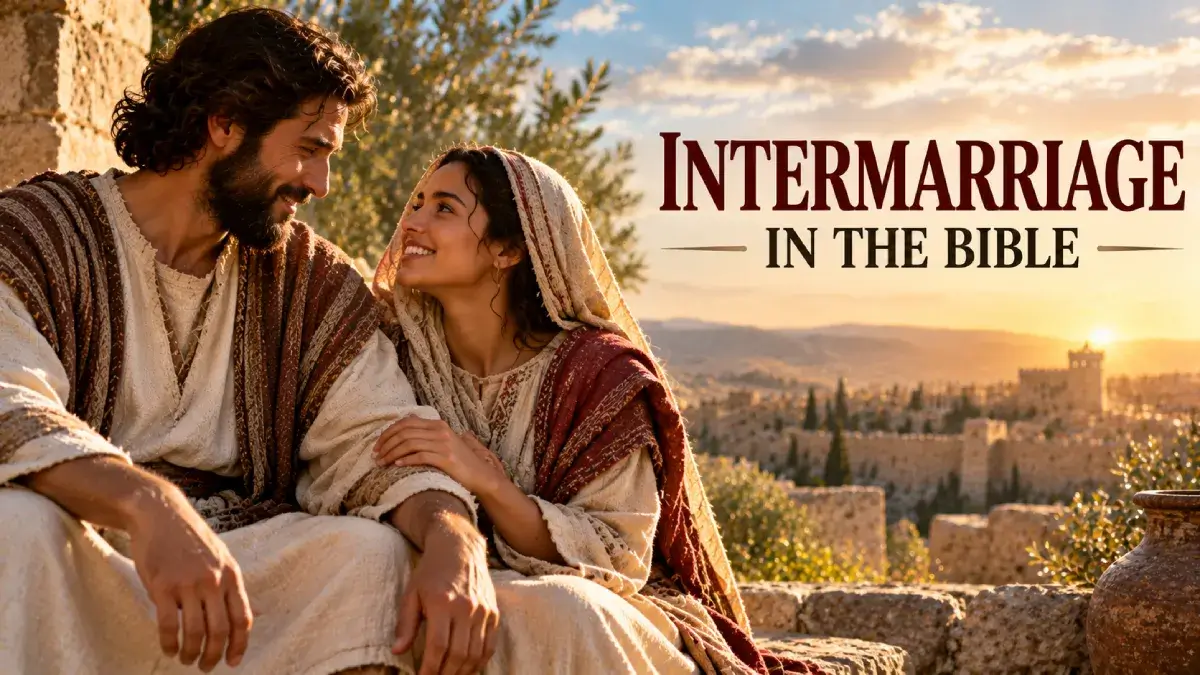
Intermarriage in the Bible generally refers to marriage between people from different national, ethnic, cultural, or religious backgrounds. In many Old Testament passages, the main concern was not simply a difference in nationality but the danger that marriage with people who worshiped other gods would lead Israel away from the Lord.
Deuteronomy 7:3–4 warns the Israelites against intermarrying with certain surrounding nations because their spouses could turn their hearts toward other gods. However, the Bible also records marriages involving foreigners who embraced faith in the God of Israel, such as Ruth and Boaz.
In the New Testament, 2 Corinthians 6:14 warns believers against being unequally yoked with unbelievers, while 1 Corinthians 7:12–16 addresses believers who are already married to unbelieving spouses.
The central biblical principle is that marriage should not draw a person away from God. These passages must be understood in their historical and spiritual context rather than treated as a blanket prohibition against every marriage across ethnic or national boundaries.
Intermarriage in the Bible is a topic that raises important questions about marriage, faith, culture, and obedience to God. Throughout Scripture, we find accounts of people marrying spouses from different nations and backgrounds. Some marriages became examples of faith and God’s grace, while others contributed to spiritual compromise and disobedience.
In the Old Testament, God gave Israel specific instructions concerning marriage with surrounding nations, particularly those whose religious practices could lead His people into idolatry. In the New Testament, the emphasis includes the spiritual relationship between believers and unbelievers, the importance of faithfulness to Christ, and the purpose of marriage.
But what exactly does intermarriage mean in the Bible? Does Scripture forbid marrying someone from another nation or culture? And how should Christians understand these passages today?
To answer these questions, we need to examine the biblical context, the people involved, and the principles Scripture teaches about faith and marriage.
1. What Is Intermarriage in the Bible?
Intermarriage commonly means marriage between people from different backgrounds. Depending on the context, it can refer to differences in nationality, ethnicity, culture, religion, or community.
In the Bible, the meaning depends on the passage being discussed.
In the Old Testament, intermarriage frequently refers to Israelites marrying people from surrounding nations. These marriages sometimes raised concerns because the surrounding peoples worshiped other gods and practiced religious customs that Israel was commanded not to follow.
For example, Deuteronomy 7:3–4 warns Israel against certain marriages because of their spiritual consequences:
“Neither shalt thou make marriages with them; thy daughter thou shalt not give unto his son, nor his daughter shalt thou take unto thy son.” — Deuteronomy 7:3, KJV
The following verse explains the reason: the foreign spouse could turn the Israelite away from following the Lord.
This context is important. The passage connects the marriage restriction with loyalty to God and the danger of idolatry.
Today, Christians may use the term intermarriage to describe marriage across different religions, ethnicities, cultures, or nationalities. These situations are not all identical, so the relevant biblical principles must be applied carefully.
2. Why Did God Forbid Certain Intermarriages in the Old Testament?
God gave Israel specific instructions about marriage with certain surrounding peoples. These instructions were connected to Israel’s covenant relationship with Him and His command that His people reject idolatry.
Deuteronomy 7:3–4 — The danger of turning away from God
Deuteronomy 7 explains that Israel was not to form these marriage relationships with the nations identified in the passage because of the spiritual danger involved.
Deuteronomy 7:4 says:
“For they will turn away thy son from following me, that they may serve other gods.” — Deuteronomy 7:4, KJV
The concern was that marriage could influence the Israelites to abandon their worship of the Lord and begin serving other gods.
This warning was particularly important because Israel was called to live as God’s covenant people. Their worship, laws, and communal life were intended to reflect their relationship with Him.
Exodus 34:12–16 — The danger of idolatry
Exodus 34 also warns Israel against making certain covenants with the inhabitants of the land. The passage connects these relationships with the danger of participating in idolatrous worship.
Exodus 34:16 explains that the people could lead Israel’s children into unfaithfulness.
These instructions show that God was concerned about the spiritual direction of His people. Marriage was not treated as an isolated personal decision; it could influence a family’s worship and the faith of future generations.
Was the prohibition about ethnicity alone?
The passages should not be reduced to a simple rule that every foreigner was unacceptable as a spouse.
The Bible includes positive accounts of foreigners who turned to the God of Israel. Ruth, a Moabite woman, is a prominent example. Her story demonstrates that nationality alone does not explain every biblical teaching about marriage.
The specific Old Testament prohibitions were given to Israel in a particular covenant and historical setting. Their application today requires attention to the New Testament’s teachings and the broader biblical emphasis on faithfulness to God.
3. Examples of Intermarriage in the Bible
The Bible records several marriages involving people from different nations or backgrounds. These examples reveal that the circumstances and spiritual commitments involved matter when interpreting the accounts.
1. Ruth and Boaz — A Positive Example
Bible references: Ruth 1–4; Matthew 1:5
Ruth was a Moabite woman who married an Israelite man named Boaz. Her story is one of the Bible’s best-known accounts of a foreign woman becoming part of the community of God’s people.
After the deaths of her husband and father-in-law, Ruth chose to remain with her mother-in-law, Naomi, rather than return to her former life in Moab.
Ruth 1:16 records her famous commitment:
“Thy people shall be my people, and thy God my God.” — Ruth 1:16, KJV
Ruth’s words express loyalty to Naomi and a commitment to the God of Israel.
Later, Boaz married Ruth, and their family became part of the ancestry of King David. Matthew 1:5 also names Ruth in the genealogy of Jesus Christ.
What can we learn?
Ruth’s story shows that a person’s foreign background does not prevent them from becoming part of God’s people. Her faithfulness, loyalty, and commitment to the Lord are central to the narrative.
The account should not be treated as a direct command about every modern interfaith marriage, but it does demonstrate that Scripture’s treatment of foreigners is more nuanced than a blanket rejection based on nationality.
2. Moses and Zipporah — A Marriage to a Midianite Woman
Bible references: Exodus 2:15–22; Exodus 4:24–26; Numbers 12:1
Moses married Zipporah, the daughter of Reuel, a priest of Midian.
Exodus 2:21 says:
“And Moses was content to dwell with the man: and he gave Moses Zipporah his daughter.” — Exodus 2:21, KJV
Zipporah was from Midian, a people distinct from Israel. The Bible does not present their marriage as a straightforward example of the specific prohibition in Deuteronomy 7 against marrying the nations listed there.
Later, Numbers 12:1 records criticism of Moses concerning a Cushite woman he had married. Interpreters differ on how this woman relates to Zipporah and on the details of the passage.
What can we learn?
Moses’ marriage reminds us that biblical accounts involving people from different nations must be examined in their own contexts. We should not assume that every mention of a foreign spouse represents the same situation or carries the same judgment.
3. Joseph and Asenath — An Egyptian Wife
Bible reference: Genesis 41:45, 50–52
Joseph married Asenath, the daughter of Potiphera, priest of On in Egypt. Pharaoh gave her to Joseph during the period when Joseph served as a ruler in Egypt.
Genesis 41:45 identifies Asenath as Joseph’s wife, and Genesis 41:50–52 records the birth of their sons, Manasseh and Ephraim.
Joseph’s story takes place before Israel received the law given through Moses at Sinai. The text does not explicitly condemn his marriage to Asenath.
What can we learn?
Joseph’s marriage is an example of a union across national and cultural boundaries. However, Scripture provides limited information about Asenath’s personal faith, so we should avoid claiming more about her spiritual life than the text tells us.
4. Samson and the Philistine Woman — A Warning About Disobedience
Bible references: Judges 14:1–4; Judges 16:4–21
Samson, one of Israel’s judges, sought a Philistine woman as his wife despite the concerns of his parents.
Judges 14:3 records his insistence that they get her for him. Judges 14:4 explains that the Lord was working through the circumstances to bring about an opportunity against the Philistines.
Later, Samson became involved with Delilah, whose actions contributed to his downfall.
The Samson narrative is complex. It includes God’s purposes in Israel’s conflict with the Philistines, Samson’s personal weaknesses, and his repeated failures to exercise wise judgment.
What can we learn?
Samson’s story warns readers about impulsive decisions and the consequences of allowing personal desires to override wisdom. It should not be simplified into a claim that every marriage across national boundaries leads to spiritual failure.
5. Solomon and His Foreign Wives — A Clear Warning
Bible references: 1 Kings 11:1–10; Nehemiah 13:26
Solomon had many foreign wives, including women from nations concerning which God had warned Israel.
First Kings 11:2 explains the warning:
“Ye shall not go in to them, neither shall they come in unto you: for surely they will turn away your heart after their gods.” — 1 Kings 11:2, KJV
The passage then describes the spiritual consequences. Solomon’s wives turned his heart toward other gods, and he did not remain fully devoted to the Lord.
Nehemiah 13:26 later refers to Solomon as an example of how foreign wives led even a king who was loved by God into sin.
What can we learn?
Solomon’s story directly illustrates the danger emphasized in Deuteronomy 7: allowing a marriage relationship to draw a person away from worshiping God.
The central issue in the narrative is spiritual unfaithfulness and idolatry, not merely cultural difference.
6. Ahab and Jezebel — Marriage and Idolatry
Bible references: 1 Kings 16:29–33; 1 Kings 21
Ahab, king of Israel, married Jezebel, daughter of the king of the Sidonians. The biblical account connects their relationship with the promotion of Baal worship in Israel.
First Kings 16:31–33 describes Ahab’s actions, including serving Baal and building an altar for him.
Jezebel later played a prominent role in the persecution of the Lord’s prophets and the promotion of idolatry.
What can we learn?
The account demonstrates the destructive effects of leadership that promotes false worship. It also shows how marriage and political alliances can influence religious life and public conduct.
The text emphasizes Ahab’s own wrongdoing as well as Jezebel’s influence; it does not remove Ahab’s responsibility for his choices.
7. Ezra’s Response to Intermarriage — Ezra 9–10
Bible references: Ezra 9:1–15; Ezra 10:1–17
After the Israelites returned from exile, Ezra learned that some people, including leaders, had married women from surrounding peoples.
Ezra was deeply distressed and prayed, confessing the community’s unfaithfulness to God. The account connects the problem with the religious practices of the surrounding nations and Israel’s history of disobedience.
Ezra 9:2 describes the concern that the holy seed had become mixed with the peoples of the lands.
Ezra 10 then records the community’s response, including the difficult decision to separate from the foreign wives and the children involved.
This passage is one of the most challenging biblical accounts about intermarriage. It should be read in its historical context, including Israel’s covenant identity, its return from exile, and the specific spiritual concerns described in Ezra.
What can we learn?
Ezra’s response shows how seriously the returning community viewed its covenant responsibilities. At the same time, this passage should not be used casually to justify hostility toward people of other ethnicities or to ignore the Bible’s wider teachings about justice, compassion, and faith.
8. Nehemiah Condemns Intermarriage That Led to Unfaithfulness
Bible reference: Nehemiah 13:23–27
Nehemiah found that some Jewish men had married women from Ashdod, Ammon, and Moab. He was particularly concerned that their children were growing up without fully learning the language of Judah.
Nehemiah connected the situation with Israel’s spiritual vulnerability and referred to Solomon’s failure as a warning.
The passage reflects the challenges of rebuilding a distinct covenant community after exile. Its concerns include religious identity, language, and the risk of returning to the idolatry that had contributed to Israel’s earlier troubles.
What can we learn?
Nehemiah’s account reinforces the biblical concern that marriage can affect a community’s faith and the spiritual formation of its children. The underlying principle is the importance of remaining faithful to God.
4. What Does the New Testament Say About Intermarriage?
The New Testament does not repeat every Old Testament marriage law in the same form. Instead, it provides teachings about faith, marriage, unity in Christ, and the relationship between believers and unbelievers.
Three passages are especially important.
1. Second Corinthians 6:14 — Do Not Be Unequally Yoked
Paul writes:
“Be ye not unequally yoked together with unbelievers.” — 2 Corinthians 6:14, KJV
This verse is often discussed when Christians consider marrying someone who does not share their faith.
The immediate context of 2 Corinthians 6 contrasts righteousness with lawlessness and the temple of God with idols. Christians commonly apply the principle to close partnerships, including marriage, because marriage deeply influences a person’s values, priorities, and spiritual life.
However, the verse does not explicitly use the word marriage. Therefore, it is best to explain that applying it to marriage is a common Christian interpretation of its broader principle rather than claiming that the verse itself is a detailed marriage law.
The underlying question is whether a close relationship will help a believer remain faithful to Christ or continually pull them in a different spiritual direction.
2. First Corinthians 7:12–16 — When a Believer Is Already Married to an Unbeliever
Paul addresses a different situation in 1 Corinthians 7. He discusses believers who are already married to spouses who do not believe.
First Corinthians 7:12–13 teaches that if an unbelieving spouse is willing to remain in the marriage, the believing spouse should not divorce them merely because of the difference in faith.
Verse 16 asks:
“For what knowest thou, O wife, whether thou shalt save thy husband? or how knowest thou, O man, whether thou shalt save thy wife?” — 1 Corinthians 7:16, KJV
This passage is important because it distinguishes between choosing a marriage and responding faithfully within an existing marriage.
Paul does not tell a Christian to abandon a willing spouse simply because that spouse is an unbeliever. Instead, he encourages the believer to maintain the marriage, provided the spouse is willing to remain.
The passage also does not require someone to remain in an abusive or dangerous situation. Questions of safety and abuse require appropriate support and careful pastoral, legal, or professional guidance.
3. First Corinthians 7:39 — Marriage in the Lord
Paul writes about a widow who is free to marry:
“She is at liberty to be married to whom she will; only in the Lord.” — 1 Corinthians 7:39, KJV
In context, Paul is discussing a widow’s freedom to remarry. The phrase “only in the Lord” is commonly understood by many Christians as supporting marriage within the Christian faith.
The verse is therefore relevant to Christian discussions about choosing a spouse. It encourages believers to consider not only attraction or compatibility but also their shared commitment to Christ.
5. Does the Bible Forbid Marriage Between Different Races or Ethnicities?
The Bible does not teach that every marriage between people of different races or ethnicities is sinful.
Many of the Old Testament warnings about intermarriage concern specific nations and the danger of idolatry. Deuteronomy 7:3–4 explicitly connects the restriction with the possibility of turning Israel away from God to serve other gods.
The Bible also contains examples of foreigners who became part of God’s people. Ruth, a Moabite, expressed her commitment to the God of Israel and became an ancestor of King David and, according to Matthew 1, Jesus Christ.
These examples caution against treating ethnicity and spiritual commitment as interchangeable concepts.
Christians may differ in how they apply particular passages to contemporary relationships, but the biblical text should not be used to claim that racial difference alone makes a marriage sinful.
A more careful approach asks whether the relationship is consistent with biblical teachings about faithfulness to God, love, respect, commitment, and mutual responsibility.
6. What Can Christians Learn From Biblical Intermarriage?
The Bible’s accounts of intermarriage offer several important lessons for modern readers.
1. Spiritual faithfulness matters
Solomon’s story makes clear that a relationship can become spiritually destructive when it leads someone away from God.
Christians should consider whether a potential marriage will support their faith, encourage wise decisions, and help them live according to biblical convictions.
2. Nationality alone does not tell the whole story
Ruth’s story demonstrates that a foreign background does not prevent someone from embracing the God of Israel.
When studying biblical marriage accounts, it is important to examine the people’s faith, conduct, and circumstances rather than assuming that every foreign spouse had the same beliefs.
3. Marriage decisions have lasting consequences
Marriage influences a person’s home life, priorities, relationships, and often the religious upbringing of children.
This is one reason Scripture places such importance on wisdom and shared spiritual direction.
4. Existing marriages deserve care and faithfulness
First Corinthians 7:12–16 reminds believers who are already married to unbelievers not to treat the difference in faith as an automatic reason for divorce.
The passage encourages faithfulness when the spouse is willing to remain in the marriage.
5. Love, respect, and commitment are essential
The Bible’s teaching about marriage is not limited to warnings. Scripture also emphasizes love, faithfulness, mutual care, and honoring one’s spouse.
Ephesians 5:25 instructs husbands to love their wives as Christ loved the church. First Corinthians 13:4–7 describes love as patient, kind, and enduring.
These principles should shape the way Christians approach marriage, including relationships across different cultures and backgrounds.
7. Bible Verses About Intermarriage and Marriage
Here are several passages worth studying when exploring what the Bible says about intermarriage.
| Bible verse | Main teaching |
|---|---|
| Deuteronomy 7:3–4 | Warns Israel against marriages that could lead to idolatry. |
| Exodus 34:12–16 | Warns against relationships that could draw Israel into false worship. |
| Ruth 1:16 | Records Ruth’s commitment to Naomi and the God of Israel. |
| Ruth 4:13–17 | Describes Ruth and Boaz’s family and their place in David’s ancestry. |
| 1 Kings 11:1–10 | Shows Solomon turning away from the Lord under the influence of his wives. |
| Ezra 9:1–15 | Records Ezra’s prayer concerning intermarriage and Israel’s covenant unfaithfulness. |
| Nehemiah 13:23–27 | Connects intermarriage with concerns about Israel’s religious identity. |
| 2 Corinthians 6:14 | Warns believers against being unequally yoked with unbelievers. |
| 1 Corinthians 7:12–16 | Addresses existing marriages between believers and unbelievers. |
| 1 Corinthians 7:39 | Says a widow is free to remarry, “only in the Lord.” |
| Ephesians 5:25 | Calls husbands to love their wives sacrificially. |
| Galatians 3:28 | Emphasizes the unity of believers in Christ. |
Galatians 3:28 is particularly relevant when considering how the Christian faith views human worth and unity:
“There is neither Jew nor Greek, there is neither bond nor free, there is neither male nor female: for ye are all one in Christ Jesus.” — Galatians 3:28, KJV
This verse concerns the unity of believers in Christ, not a direct rule about whom Christians should marry. Nevertheless, it reminds readers that distinctions of ethnicity and social status do not determine a person’s worth before God.
8. How Should a Christian Think About Marrying Someone From a Different Faith?
For Christians considering marriage, the biblical passages above invite careful reflection rather than a decision based only on emotion or external background.
Here are some questions worth considering:
- Does this relationship support my faith? Think honestly about whether the relationship encourages you to follow Christ or creates ongoing pressure to abandon your convictions.
- Can we respect each other’s beliefs? Respect is important, but it is also necessary to discuss how religious differences will affect everyday life.
- How will we approach major decisions? Consider worship, church involvement, family traditions, finances, and the religious upbringing of children.
- Are we aligned on commitment and responsibility? Biblical marriage calls for faithfulness, love, honesty, and mutual care.
- Have we sought wise counsel? A trusted pastor, mature Christian mentor, or qualified marriage counselor may help you examine the practical and spiritual implications of the relationship.
These questions are not a substitute for studying Scripture. They are practical ways to consider how biblical principles apply to a real relationship.
If you are already married to someone of a different faith, 1 Corinthians 7:12–16 is especially relevant. It encourages believers to remain faithful within the marriage when their spouse is willing to continue the relationship.
Frequently Asked Questions About Intermarriage in the Bible
What does intermarriage mean in the Bible?
Intermarriage generally refers to marriage between people from different national, ethnic, cultural, or religious backgrounds. In many Old Testament passages, it refers to Israelites marrying people from surrounding nations, with particular concern about idolatry and spiritual unfaithfulness.
Why did God forbid intermarriage in the Old Testament?
Deuteronomy 7:3–4 explains that certain marriages could lead the Israelites away from worshiping the Lord and toward other gods. The restriction was connected to Israel’s covenant relationship with God and the danger of idolatry.
Was Ruth’s marriage to Boaz an example of intermarriage?
Yes. Ruth was a Moabite woman, and Boaz was an Israelite. Their marriage is recorded in Ruth 4. Ruth’s commitment to the God of Israel is an important part of her story, and she is named in the genealogy of Jesus in Matthew 1:5.
4. Does the Bible forbid interracial marriage?
The Bible does not teach that every marriage between people of different races is sinful. The main concern in many Old Testament intermarriage passages is spiritual unfaithfulness and idolatry, not simply racial difference.
Can a Christian marry a non-Christian?
Second Corinthians 6:14 is commonly applied to marriage and encourages believers not to be unequally yoked with unbelievers. First Corinthians 7:39 also says that a widow is free to remarry “only in the Lord.” Christians should consider these passages carefully and seek wise counsel when making marriage decisions.
What should a Christian do if already married to an unbeliever?
First Corinthians 7:12–16 teaches that a believer should not divorce an unbelieving spouse who is willing to remain in the marriage merely because of the difference in faith. This passage concerns existing marriages and should be distinguished from choosing a spouse before marriage.
Does Galatians 3:28 mean Christians can marry anyone?
Galatians 3:28 teaches that believers are one in Christ despite distinctions such as Jewish or Greek identity and social status. It does not directly address marriage choices. Christians should consider it alongside the Bible’s specific teachings about faith, marriage, love, and commitment.
Is intermarriage always sinful according to the Bible?
The Bible does not present every marriage across national or cultural boundaries as sinful. Its accounts differ, and many Old Testament warnings concern relationships that could lead God’s people into idolatry. The relevant passages must be read in context.
Final Thoughts: Understanding Intermarriage in the Bible
Intermarriage in the Bible is a complex subject that requires more than a simple yes-or-no answer.
The Old Testament warns Israel against particular marriage relationships that could lead to idolatry and covenant unfaithfulness. Solomon’s story illustrates the danger of turning away from God, while Ruth’s story shows that a foreign woman who committed herself to the God of Israel could become part of the lineage of David and Jesus.
The New Testament emphasizes spiritual faithfulness, the importance of being equally committed to Christ, and the responsibility to care for an existing marriage even when spouses differ in faith.
For Christians today, the key is to study each passage in context and consider how its principles relate to faith, marriage, love, and lifelong commitment. Ethnicity alone should not be confused with spiritual allegiance, and difficult passages should not be used to justify racial hostility.
Ultimately, the biblical question is not simply where a spouse comes from, but how the marriage relates to faithfulness to God and the responsibilities of loving, honoring, and caring for one another.