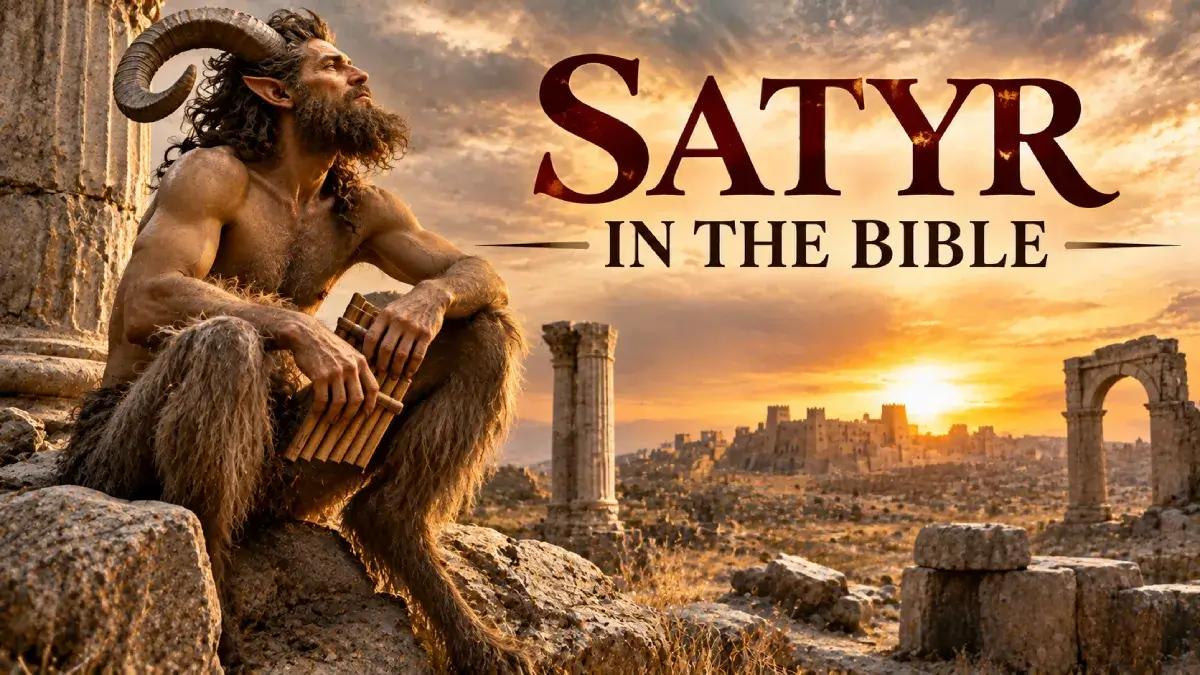
A satyr in the Bible is a goat-like or hairy creature mentioned in the King James Version of Isaiah 13:21 and Isaiah 34:14. The word translates the Hebrew term se’irim, which has associations with hairy, goat-like beings.
In both passages, satyrs are mentioned in descriptions of desolate places following God’s judgment.
The biblical references are:
- Isaiah 13:21: Satyrs are mentioned among the creatures inhabiting the ruins of Babylon.
- Isaiah 34:14: A satyr is mentioned in a description of the desolation of Edom.
The biblical use of the word should not automatically be equated with the familiar half-human, half-goat creatures of Greek mythology. The precise nature of the creatures described in these passages is debated, and translations differ.
The central lesson: These passages use striking imagery to describe the complete desolation of places facing God’s judgment.
The Bible contains many unusual words and descriptions that can make readers curious about their meaning. One such word is satyr. Although it is not commonly discussed in everyday Bible studies, it appears in the King James Version (KJV) in passages describing the destruction and desolation of ancient cities.
What exactly is a satyr in the Bible? Is it the same creature found in Greek mythology, or does the biblical word have a different meaning?
The word appears in two passages in the KJV: Isaiah 13:21 and Isaiah 34:14. Both passages describe places that would become desolate and inhabited by wild creatures. The original Hebrew word is se’irim, which is associated with hairy or goat-like beings. Different Bible translations render this word in different ways, including wild goats and goat-like creatures.
Understanding this word requires looking at its biblical context, original Hebrew background, and the difference between biblical descriptions and ancient pagan mythology.
In this article, we will explore the meaning of satyr in the Bible, examine the two main Scriptures where it appears, understand its historical background, and discover the spiritual lessons these passages teach.
What Does Satyr Mean in the Bible?
The word satyr is used in the King James Version to translate a Hebrew expression associated with hairy or goat-like creatures.
In ancient Greek and Roman mythology, satyrs were imagined as creatures with human and goat-like features. They were commonly associated with wild nature, music, revelry, and sensuality.
However, the biblical use of the word comes from a Hebrew term rather than directly describing the Greek mythological creature.
The Hebrew word is se’irim (שְׂעִירִים), the plural form of sa’ir, which can mean hairy or he-goat.
In the Old Testament, the term appears in different contexts. Some passages associate it with goat-like beings connected with improper worship, while Isaiah uses it in descriptions of desolate places.
The KJV translators used the English word satyr to communicate the unusual creature imagery in Isaiah.
Other translations use different expressions, such as:
- Wild goats
- Goat-like creatures
- Demons or goat-demons
- Hairy creatures
These differences show why it is important to compare Bible translations and consider the original language.
Where Is Satyr Mentioned in the Bible?
In the King James Version, the word satyr appears in two passages: Isaiah 13:21 and Isaiah 34:14.
Both passages belong to prophetic descriptions of judgment against nations that would experience destruction.
1. Isaiah 13:21 — Satyrs in the Ruins of Babylon
“But wild beasts of the desert shall lie there; and their houses shall be full of doleful creatures; and owls shall dwell there, and satyrs shall dance there.” — Isaiah 13:21 (KJV)
This verse appears in Isaiah’s prophecy concerning Babylon.
Babylon was a powerful ancient city associated with wealth, military strength, political influence, and pride. Isaiah 13 describes God’s judgment against Babylon and predicts that the once-great city would become desolate.
The surrounding verses mention wild animals, creatures of the wilderness, and unusual inhabitants of abandoned places.
The reference to satyrs contributes to this picture of complete destruction. The city that once represented human power and greatness would no longer function as a thriving center of civilization.
What does this verse teach?
- Human power and greatness are temporary.
- Pride and rebellion against God have consequences.
- God’s judgment is not limited by the strength of earthly kingdoms.
- Places that appear powerful today can become ruins tomorrow.
The reference to satyrs is part of the prophetic imagery used to communicate Babylon’s future desolation.
2. Isaiah 34:14 — Satyrs in the Desolation of Edom
“The wild beasts of the desert shall also meet with the wild beasts of the island, and the satyr shall cry to his fellow; the screech owl also shall rest there, and find for herself a place of rest.” — Isaiah 34:14 (KJV)
This passage appears in Isaiah 34, which describes God’s judgment against the nations, with particular attention to Edom.
Edom was an ancient nation descended from Esau, the brother of Jacob. Throughout the Old Testament, Edom appears in several conflicts involving Israel.
Isaiah 34 describes the land becoming desolate. Wild creatures and unusual beings are pictured as inhabiting the abandoned territory.
The satyr is described as crying to its fellow, adding to the atmosphere of wilderness and desolation.
What does this verse teach?
- No nation is beyond God’s judgment.
- Earthly power cannot guarantee lasting security.
- God’s prophetic warnings should be taken seriously.
- Human pride cannot overcome God’s authority.
The passage uses vivid descriptions to communicate the seriousness and completeness of the judgment being announced.
What Is the Hebrew Meaning of Satyr?
To understand the word more accurately, it helps to examine the Hebrew term behind the English translation.
The word translated as satyr in Isaiah is se’irim.
It comes from the Hebrew word sa’ir, which is associated with something hairy or a male goat.
Depending on the context, the word can refer to goat-like creatures or beings associated with improper religious practices.
This explains why different English translations use different expressions.
| Bible reference | KJV wording | General meaning |
|---|---|---|
| Isaiah 13:21 | Satyrs | Goat-like or hairy creatures |
| Isaiah 34:14 | Satyr | A goat-like creature in a desolation scene |
| Leviticus 17:7 | Devils | Beings associated with forbidden worship |
| 2 Chronicles 11:15 | Devils | Objects or beings connected with improper worship |
The passages in Leviticus and 2 Chronicles use the same Hebrew word family, although the KJV translates it differently.
This is important because the meaning of a Hebrew word should be understood through its context rather than assuming it always refers to exactly the same thing.
Is a Biblical Satyr the Same as a Greek Mythological Satyr?
Not necessarily. Although the English word is the same, the biblical and mythological contexts are different.
Satyrs in Greek and Roman Mythology
In Greek mythology, satyrs were commonly portrayed as male nature spirits with human and goat-like features.
They were often associated with:
- Wilderness and forests.
- Music and dancing.
- Wine and celebrations.
- Sensuality and revelry.
- The mythological god Dionysus.
They were frequently represented with goat-like legs, horns, tails, and human upper bodies.
These descriptions belong to the traditions of Greek and Roman mythology.
Satyrs in the Bible
The Bible uses the Hebrew term se’irim in several Old Testament passages.
In Isaiah 13:21 and 34:14, the KJV uses the word satyr to describe creatures associated with desolate places.
The Bible does not provide a detailed physical description of these creatures or identify them explicitly as the mythological followers of Dionysus.
The similarities in goat-like imagery do not prove that the biblical references describe exactly the same beings found in Greek mythology.
The important distinction: The English translation uses the familiar word satyr, but the original Hebrew term and its biblical context must guide our understanding.
Other Bible Verses Related to Satyrs and Goat-Like Beings
Although the English word satyr appears twice in the KJV, the Hebrew word se’irim also appears in other passages.
These references help us understand the broader biblical background.
1. Leviticus 17:7 — Israel Must Not Sacrifice to Devils
“And they shall no more offer their sacrifices unto devils, after whom they have gone a whoring. This shall be a statute for ever unto them throughout their generations.” — Leviticus 17:7 (KJV)
God gave this command to Israel concerning the proper way to offer sacrifices.
The verse warns the Israelites against offering sacrifices to se’irim, translated as “devils” in the KJV.
The passage makes clear that Israel was not to participate in forbidden forms of worship.
It emphasizes that worship and sacrifice belonged to the Lord rather than to other spiritual beings or objects of devotion.
Spiritual lesson: God’s people are called to worship Him alone and reject practices that draw them into idolatry.
2. 2 Chronicles 11:15 — Jeroboam’s Unauthorized Worship
“And he ordained him priests for the high places, and for the devils, and for the calves which he had made.” — 2 Chronicles 11:15 (KJV)
This verse describes religious practices established during the reign of Jeroboam.
Jeroboam appointed priests for high places and for worship involving calves and se’irim, translated as “devils” in the KJV.
The verse is part of the biblical account of Israel’s departure from proper worship.
Spiritual lesson: Religious practices that contradict God’s instructions can lead people away from faithful worship.
These passages show that the Hebrew word has a broader background than the two Isaiah references alone.
Why Are Satyrs Mentioned in Isaiah’s Prophecies?
Why would Isaiah mention satyrs when describing the destruction of Babylon and Edom?
The answer is connected with the prophetic imagery of wilderness and desolation.
1. To Describe Complete Destruction
Isaiah 13 and 34 describe cities and territories that would experience judgment.
The mention of wild creatures and unusual inhabitants communicates that these places would no longer function as thriving human settlements.
The imagery is powerful because it contrasts former human activity with abandoned wilderness.
2. To Show the Temporary Nature of Human Power
Babylon was one of the most powerful empires of the ancient world.
Yet Isaiah’s prophecy describes its downfall.
The mention of creatures inhabiting its ruins reminds readers that even great human achievements cannot guarantee lasting security.
3. To Emphasize God’s Authority Over Nations
The prophecies demonstrate that God is sovereign over nations and their future.
Political strength, wealth, military power, and influence cannot place a kingdom beyond His authority.
4. To Create a Picture of Desolation
The descriptions of wild animals, birds, and satyrs contribute to the atmosphere of an abandoned land.
The point is not to provide a scientific description of unusual creatures. It is to communicate the seriousness of the judgment being announced.
What Spiritual Lessons Can We Learn From the Satyr in the Bible?
Although the word appears only twice in the KJV, the passages provide several important lessons.
1. Human Pride Can Lead to Destruction
Babylon’s judgment reminds us that human greatness and pride are temporary.
Proverbs 16:18 says:
“Pride goeth before destruction, and an haughty spirit before a fall.” — Proverbs 16:18 (KJV)
People and nations should not assume that power or success makes them independent of God.
2. God’s Word Should Be Taken Seriously
Isaiah’s prophecies remind readers that God’s warnings are meaningful.
The Bible repeatedly calls people to turn away from wrongdoing and live according to His truth.
Ignoring God’s instructions can have serious consequences.
3. Worship Belongs to God Alone
Leviticus 17:7 and 2 Chronicles 11:15 warn against worship involving se’irim and other unauthorized practices.
These passages remind believers to remain faithful to God rather than adopting practices that contradict His Word.
4. Earthly Glory Does Not Last Forever
Babylon’s former greatness did not protect it from destruction.
The same principle applies to wealth, fame, political influence, and human achievements.
First John 2:17 reminds believers that the world and its desires are passing away, but the person who does God’s will abides forever.
5. Biblical Context Matters
The word satyr can create confusion because it is also familiar from Greek mythology.
Studying the Hebrew word, comparing translations, and reading the surrounding passage help prevent misunderstandings.
A single English word should never be used to build an entire doctrine without considering its original context.
How to Study Unusual Words in the Bible
The word satyr is an excellent example of why careful Bible study matters.
When you encounter an unfamiliar biblical term, consider these steps.
1. Read the entire passage.
Do not study a word in isolation. Read the surrounding verses to understand the subject and message.
2. Compare Bible translations.
The KJV uses satyr, while other translations may use terms such as wild goat or goat-like creature.
Comparing translations can reveal differences in how the original language is understood.
3. Examine the original Hebrew or Greek.
A Bible dictionary or concordance can help identify the original word and its range of meanings.
4. Consider the historical context.
Understand the nation, culture, and circumstances being discussed.
For example, Isaiah 13 concerns Babylon, while Isaiah 34 focuses on God’s judgment against the nations and Edom.
5. Avoid unsupported assumptions.
Do not automatically equate a biblical creature with a figure from mythology, folklore, or modern popular culture.
Let the biblical context guide your conclusions.
Frequently Asked Questions About Satyr in the Bible
How many times does the word satyr appear in the Bible?
The English word satyr appears twice in the King James Version: Isaiah 13:21 and Isaiah 34:14.
Other Bible translations may use different words for the same Hebrew term.
What does satyr mean in the Bible?
In the biblical context, satyr translates the Hebrew word se’irim, which is associated with hairy or goat-like beings.
In Isaiah, these creatures appear in descriptions of desolate places.
Is a satyr a demon in the Bible?
The answer depends on the passage and translation.
In Leviticus 17:7 and 2 Chronicles 11:15, the related Hebrew word se’irim is translated as “devils” in the KJV. In Isaiah 13:21 and 34:14, it is translated as “satyr.”
Scholars and Bible translations differ in how they understand the precise nature of these beings. It is best not to assume that every occurrence has exactly the same meaning.
Is a satyr the same as a Greek mythological creature?
Not necessarily.
Greek mythology describes satyrs as creatures with human and goat-like features. The Bible uses a Hebrew term associated with hairy or goat-like beings.
The English translation uses the word satyr, but Scripture does not explicitly identify the Isaiah creatures as the mythological followers of Dionysus.
What does Isaiah 13:21 mean?
Isaiah 13:21 is part of a prophecy describing Babylon’s destruction.
It pictures the once-great city becoming desolate and inhabited by wild creatures, including satyrs in the KJV.
The imagery emphasizes the completeness of Babylon’s downfall.
What does Isaiah 34:14 mean?
Isaiah 34:14 describes the desolation of the land associated with God’s judgment against Edom and the nations.
The reference to the satyr crying to its fellow contributes to the picture of a wilderness inhabited by unusual creatures.
What is the Hebrew word for satyr?
The Hebrew word is se’irim, the plural form of sa’ir, which is associated with hairiness or a male goat.
It is translated differently depending on the biblical context.
Are satyrs real according to the Bible?
The Bible mentions satyrs in the KJV, but it does not provide enough information to establish that they are the same creatures described in Greek mythology.
The passages use them within prophetic descriptions of desolate places. Their exact nature is a matter of interpretation.
Why does the KJV use the word satyr?
The KJV translators used the English word satyr to translate the Hebrew term in Isaiah 13:21 and Isaiah 34:14.
The word communicated the idea of unusual goat-like beings associated with deserted places.
Other translations choose different English expressions to convey the Hebrew wording.
What is the spiritual lesson of the satyr in the Bible?
The references to satyrs contribute to prophetic descriptions of judgment and desolation.
They remind readers that human pride, idolatry, and rebellion have consequences, and that earthly power cannot overcome God’s authority.
Final Thoughts
The satyr in the Bible is an unusual subject, but studying it helps us understand the importance of biblical language and context.
The word appears twice in the King James Version, in Isaiah 13:21 and Isaiah 34:14. Both passages describe places facing judgment and becoming desolate. The original Hebrew term, se’irim, is associated with hairy or goat-like beings and is translated in different ways across Bible versions.
Although the English word is also familiar from Greek mythology, we should not automatically assume that the biblical references describe exactly the same mythological creatures.
The broader message of these passages concerns God’s authority, the consequences of rebellion, and the temporary nature of human power.
When studying unusual words in Scripture, always examine the original language, compare translations, and read the surrounding verses.
The goal of Bible study is not simply to understand unusual words, but to understand the truth God communicates through His Word.