The exact English word faith appears 247 times in the King James Version (KJV), according to one word-count method, in 231 verses. Of those occurrences, 2 are in the Old Testament and 245 are in the New Testament. The number differs in other translations because translators sometimes use different English words to communicate the original Hebrew and Greek meaning.
Faith is especially prominent in Romans, Hebrews, and Galatians. Some of the best-known passages about faith include Hebrews 11:1, Ephesians 2:8–9, Romans 10:17, and 2 Corinthians 5:7.
It is important to remember that counting the word faith does not capture every biblical teaching about trusting God. Scripture also describes faith through words such as believe, trust, and faithfulness.
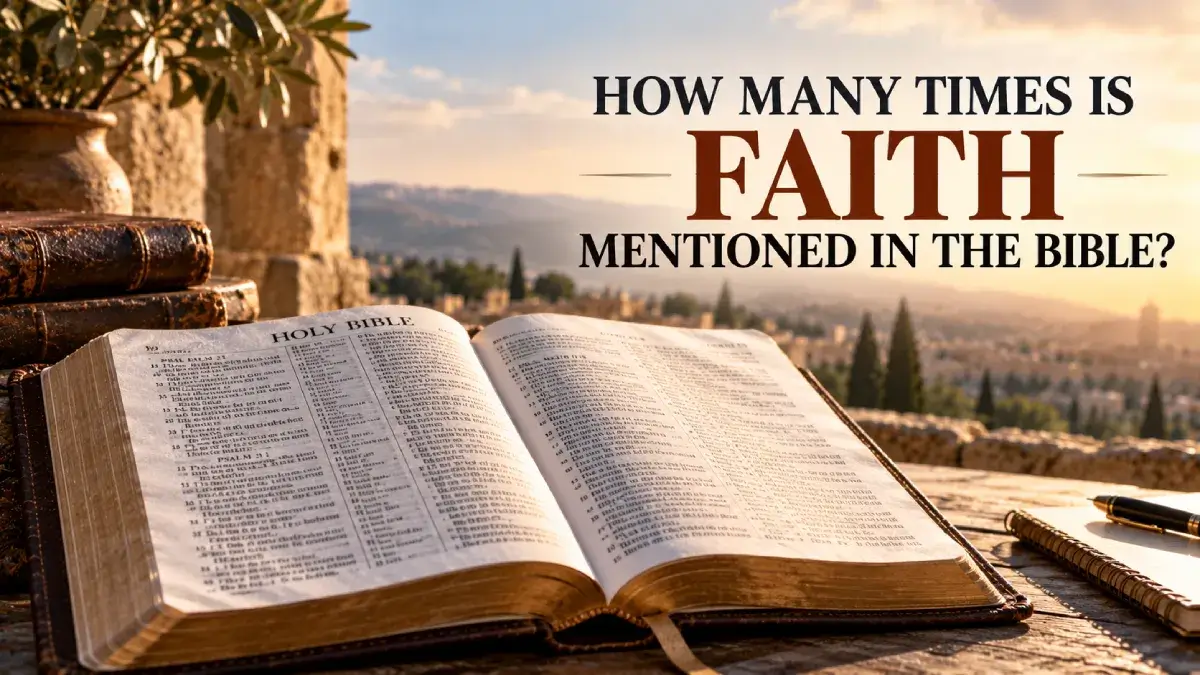
How Many Times Is Faith Mentioned in the Bible?
Faith is one of the most important themes in the Bible. From trusting God’s promises to believing in Jesus Christ, Scripture repeatedly teaches that faith is essential to a relationship with God. But have you ever wondered how many times the word faith actually appears in the Bible?
The answer depends on which Bible translation you read and how the word is counted. Some translations use the word faith more often than others, while related words such as believe, faithful, and faithfulness express closely connected ideas.
Understanding the number is interesting, but discovering what the Bible teaches about faith is even more valuable.
Why Does the Number of Times Faith Appears Differ?
You may find different answers when searching for how many times faith is mentioned in the Bible. This does not necessarily mean that one source is wrong. Different counting methods can produce different totals.
1. Bible translations use different words
The Bible was originally written primarily in Hebrew and Aramaic in the Old Testament and Greek in the New Testament. Translators must choose English words that communicate the meaning of the original text.
As a result, the same underlying idea may be translated differently in different English Bibles.
For example, word-count references report the following totals for the word faith in selected translations:
| Bible translation | Old Testament | New Testament | Total |
|---|---|---|---|
| King James Version (KJV) | 2 | 245 | 247 |
| New American Standard Bible (1995) | 4 | 246 | 250 |
| New International Version (NIV) | 16 | 254 | 270 |
| New Revised Standard Version (NRSV) | 18 | 246 | 264 |
These figures come from a published comparison of Bible word counts. They are approximate and reflect the particular editions and counting method used.
The main lesson is that there is no single English word count that applies to every Bible translation.
2. Counting “faith” is different from counting “believe”
Faith and belief are closely related, but they are not the same English word.
For example, the KJV says in John 3:16 that whoever “believeth in him” should not perish but have everlasting life. The verse communicates trust in Christ, but it does not use the exact word faith.
If someone searches only for the word faith, verses that use believe or believeth will not be included in the total.
3. Related words can change the total
Words such as faithful and faithfulness are related to faith, but they have distinct meanings and may be counted separately.
Faith often describes trust or belief, while faithfulness commonly describes reliability, loyalty, or steadfastness.
Therefore, an accurate word count should explain whether it includes only the exact word faith or also includes related forms.
How Many Times Is Faith Mentioned in the Old Testament?
In the King James Version, the exact word faith appears twice in the Old Testament under the counting method described above.
One of those references is Deuteronomy 32:20, where Moses speaks of a disobedient generation:
“Children in whom is no faith.” — Deuteronomy 32:20, KJV
This passage appears in Moses’ song, which describes Israel’s unfaithfulness toward God. The verse uses the absence of faith to describe a people who have turned away from the Lord.
Although the English word faith appears relatively rarely in the KJV Old Testament, the concept of trusting God is present throughout its pages.
Abraham believed God’s promise
One of the clearest Old Testament examples of faith is Abraham.
Genesis 15:6 says:
“And he believed in the LORD; and he counted it to him for righteousness.” — Genesis 15:6, KJV
God had promised Abraham that he would have descendants despite circumstances that made the promise seem impossible. Abraham believed God’s word.
This verse is foundational to the Bible’s teaching about faith. Although the KJV uses the word believed rather than faith in this passage, it describes the kind of trust that later biblical writers discuss explicitly.
Paul refers to Abraham’s example in Romans 4 when explaining the relationship between faith and righteousness.
Faith in God’s promises
The Old Testament contains many other examples of people trusting God.
- Noah obeyed God’s instructions to build an ark (Genesis 6–7).
- Moses trusted God while leading Israel out of Egypt (Exodus 14).
- Joshua and Caleb believed that God could give Israel the promised land (Numbers 14:6–9).
- David trusted the Lord when facing Goliath (1 Samuel 17:45–47).
These stories show that faith is not merely a word to count. It is a theme expressed through trust, obedience, courage, and dependence on God.
How Many Times Is Faith Mentioned in the New Testament?
In the King James Version, the word faith appears 245 times in the New Testament according to the same counting method.
Faith is especially prominent in the New Testament because its writers explain the significance of Jesus Christ, salvation, discipleship, prayer, and the Christian life.
Faith in the teachings of Jesus
Jesus frequently spoke about faith and its importance.
In Matthew 17:20, Jesus teaches His disciples about faith in God:
“If ye have faith as a grain of mustard seed…” — Matthew 17:20, KJV
Jesus uses the image of a mustard seed to illustrate that even a small amount of genuine faith can be significant when directed toward God. The passage emphasizes God’s power rather than treating faith as a magical force that allows people to control every outcome.
Jesus also commended individuals who demonstrated trust in Him. In Matthew 8:10, He marvels at the faith of a centurion who believes Jesus can heal his servant without needing to enter the man’s home.
These passages reveal that faith involves confidence in Jesus and His authority.
Faith in the writings of Paul
The apostle Paul explains faith extensively in his letters. His teachings address salvation, justification, grace, spiritual growth, and the believer’s relationship with Christ.
Romans 1:17 declares:
“The just shall live by faith.” — Romans 1:17, KJV
Paul uses this statement to explain the righteousness of God revealed in the gospel. Faith is central to how people receive and live in response to God’s saving work.
Another important passage is Ephesians 2:8–9:
“For by grace are ye saved through faith; and that not of yourselves: it is the gift of God.” — Ephesians 2:8, KJV
These verses teach that salvation is by God’s grace through faith, not something people can earn through their own works.
Faith does not mean that good works are unimportant. In Ephesians 2:10, Paul immediately explains that believers are created in Christ Jesus for good works. Good works are the result of God’s transforming work, not a way to earn salvation.
Which Books of the Bible Mention Faith Most Often?
Faith appears in many books of the Bible, but some New Testament books discuss it particularly often.
According to a KJV word-count reference, Romans contains the most occurrences of the word faith, followed by Hebrews and Galatians.
| Book of the Bible | Reported occurrences of “faith” (KJV) |
|---|---|
| Romans | 39 |
| Hebrews | 32 |
| Galatians | 22 |
| 1 Timothy | 19 |
| James | 16 |
| Acts | 15 |
| Matthew | 12 |
| Luke | 12 |
These figures are based on one exact-word counting method and should be understood as translation-specific statistics.
1. Romans: Faith and righteousness
Romans explores the relationship between faith, sin, grace, and righteousness. Paul explains that people are justified through faith rather than by relying on their own ability to fulfill the law perfectly.
Romans 5:1 states:
“Therefore being justified by faith, we have peace with God through our Lord Jesus Christ.” — Romans 5:1, KJV
Faith is central to Paul’s explanation of how believers receive peace with God through Jesus Christ.
2. Hebrews: Faith and perseverance
Hebrews 11 is often called the Bible’s “faith chapter” because it describes numerous people who trusted God.
Hebrews 11:1 gives a well-known description of faith:
“Now faith is the substance of things hoped for, the evidence of things not seen.” — Hebrews 11:1, KJV
The chapter then describes Abel, Enoch, Noah, Abraham, Sarah, Moses, and others who acted in response to God’s promises.
Their experiences were not all easy or immediately successful. Some saw God’s promises fulfilled during their lifetimes, while others endured suffering and died still looking forward to what God had promised.
Hebrews 11 teaches that faith involves trusting God’s character and promises, even when the outcome is not yet visible.
3. Galatians: Faith and freedom in Christ
Galatians emphasizes that people are not justified by observing the works of the law but through faith in Jesus Christ.
Galatians 2:20 expresses Paul’s personal commitment to Christ:
“The life which I now live in the flesh I live by the faith of the Son of God, who loved me, and gave himself for me.” — Galatians 2:20, KJV
Paul describes a life shaped by Christ’s love and the believer’s dependence on Him.
Galatians also connects faith with love. Galatians 5:6 speaks of “faith which worketh by love,” showing that faith should influence how Christians live and treat others.
What Does the Bible Teach About Faith?
The number of times a word appears can be interesting, but its meaning is more important. Several central biblical teachings help explain why faith is such a significant theme.
1. Faith means trusting God
Biblical faith is more than agreeing that God exists. It involves trusting Him and responding to His word.
Proverbs 3:5 teaches:
“Trust in the LORD with all thine heart; and lean not unto thine own understanding.” — Proverbs 3:5, KJV
This verse encourages believers to depend on God rather than treating their own understanding as the final authority in every situation.
Trust does not require pretending that difficulties do not exist. It means bringing those difficulties to God while seeking His wisdom and guidance.
2. Faith comes through hearing God’s Word
Romans 10:17 says:
“So then faith cometh by hearing, and hearing by the word of God.” — Romans 10:17, KJV
In its context, Paul is explaining the importance of hearing and responding to the message about Christ.
Reading Scripture, listening to biblical teaching, and reflecting on God’s promises can help believers understand what they are trusting and why.
Faith grows as people learn more about God’s character and the gospel.
3. Faith should influence our actions
James emphasizes that genuine faith is not merely an empty profession.
James 2:17 says:
“Even so faith, if it hath not works, is dead, being alone.” — James 2:17, KJV
James is not teaching that people can purchase salvation through good deeds. He is explaining that a claim to faith should be reflected in a person’s actions.
For example, a believer who trusts God’s command to love others should seek to show compassion, generosity, and practical care.
Faith is not just something Christians say they have. It should shape how they live.
4. Faith helps believers face uncertainty
Second Corinthians 5:7 teaches:
“For we walk by faith, not by sight.” — 2 Corinthians 5:7, KJV
Paul writes about confidence in God’s promises while believers live in the present world, awaiting what is still to come.
Walking by faith does not mean ignoring evidence, refusing wise advice, or acting recklessly. It means living with trust in God even when the future is not fully known.
5. Faith should be accompanied by love
First Corinthians 13:2 explains that even extraordinary faith, without love, amounts to nothing.
This reminds Christians that faith is not intended to produce pride or harshness. Trusting God should be accompanied by love, humility, patience, and concern for others.
Faith and love belong together in the Christian life.
What Is the Difference Between Faith and Faithfulness?
Because these words are related, readers sometimes confuse their meanings.
Faith commonly refers to trust, belief, or confidence in God. Faithfulness refers to being dependable, loyal, or steadfast.
For example, Hebrews 11:6 teaches that it is impossible to please God without faith. The emphasis is on coming to God with belief in His existence and His goodness toward those who seek Him.
By contrast, Lamentations 3:22–23 celebrates God’s steadfast mercies and faithfulness. The emphasis is on God’s reliability and continuing love.
The two ideas are closely connected: believers trust God because He is faithful, and their trust should help them become more faithful in their own lives.
However, when answering a question about the number of times faith is mentioned, these related words should not automatically be included in the count.
Does the Bible Say Faith Is More Important Than Works?
The Bible teaches that salvation is by God’s grace through faith, while also teaching that genuine faith produces good works.
Ephesians 2:8–9 emphasizes salvation by grace through faith, not by works. The next verse, Ephesians 2:10, explains that believers are created in Christ Jesus for good works.
James 2:17 emphasizes that faith without works is dead.
These passages address complementary aspects of Christian teaching. Good works do not earn God’s grace, but a living faith should produce a changed life.
The Bible’s teaching is not that people must choose between faith and obedience. Rather, faith is a response to God that should shape a believer’s actions.
How Can You Grow in Faith According to the Bible?
If studying the word faith has encouraged you to strengthen your relationship with God, consider these practical steps.
- Read Scripture regularly. Spend time in the Gospels, Romans, and Hebrews to understand God’s promises and the life of Jesus.
- Pray honestly. Bring your fears, doubts, needs, and questions to God rather than hiding them.
- Remember God’s faithfulness. Reflect on biblical examples of God’s care and the ways He has helped you through difficult seasons.
- Put biblical teaching into practice. Let your trust in God influence your decisions, relationships, and treatment of others.
- Seek fellowship with other believers. Christian community can provide encouragement, wisdom, prayer, and accountability.
- Persevere through difficulties. Faith does not guarantee an easy life. Hebrews 12:1–2 encourages believers to run with patience while looking to Jesus.
Growing in faith is not about measuring your spiritual worth by how confident you feel every day. It is about continuing to turn toward God and learning to trust Him through changing circumstances.
Frequently Asked Questions
1. How many times is faith mentioned in the Bible?
In the King James Version, the exact word faith appears 247 times in 231 verses according to one published word-count method. Other translations produce different totals because they use different English wording.
2. How many times is faith mentioned in the Old Testament?
The exact word faith appears twice in the King James Version Old Testament under this counting method. However, the Old Testament frequently describes the concept of faith through words such as believe and trust, and through stories of people relying on God’s promises.
3. How many times is faith mentioned in the New Testament?
In the King James Version, the word faith appears 245 times in the New Testament according to the same counting method. Romans, Hebrews, and Galatians are among the books where it appears most frequently.
4. What is the first mention of faith in the Bible?
The first occurrence of the exact English word faith in the King James Version is Deuteronomy 32:20. However, the concept of faith appears earlier. Genesis 15:6 says that Abraham believed the Lord, and God counted it to him for righteousness.
5. What is the most important Bible verse about faith?
There is no single verse that every Christian must identify as the most important. Hebrews 11:1 describes faith, Romans 10:17 explains its relationship to hearing God’s Word, Ephesians 2:8–9 teaches salvation by grace through faith, and Romans 5:1 connects faith with peace with God through Jesus Christ.
6. Does the Bible say faith can move mountains?
Matthew 17:20 uses the image of faith as small as a mustard seed and the moving of mountains to illustrate the significance of faith in God. The passage emphasizes God’s power, not a guarantee that every personal wish will happen exactly as requested.
7. Is faith mentioned more often in the New Testament than in the Old Testament?
Yes, in the King James Version the exact word faith appears much more frequently in the New Testament: 245 occurrences compared with 2 in the Old Testament under the counting method used here. This comparison concerns the English word, not every expression of faith throughout Scripture.
Final Thoughts: Faith Is More Than a Number
So, how many times is faith mentioned in the Bible? The King James Version contains 247 occurrences of the exact word faith according to one published counting method. The total varies across translations, so it is important to identify which Bible version is being counted.
Yet the deeper message of Scripture is more important than the number itself. From Abraham trusting God’s promise to the New Testament teaching about faith in Jesus Christ, the Bible repeatedly calls people to trust God and respond to Him with obedience and love.
Hebrews 11:6 reminds us that faith is essential to pleasing God. Romans 10:17 points us toward His Word, and James 2:17 reminds us that genuine faith should influence our actions.
Rather than focusing only on how often the word appears, take time to study the passages, understand their context, and consider how their message can shape your daily life.
Faith is not merely a word to count. It is a trust in God that can shape the way we live.