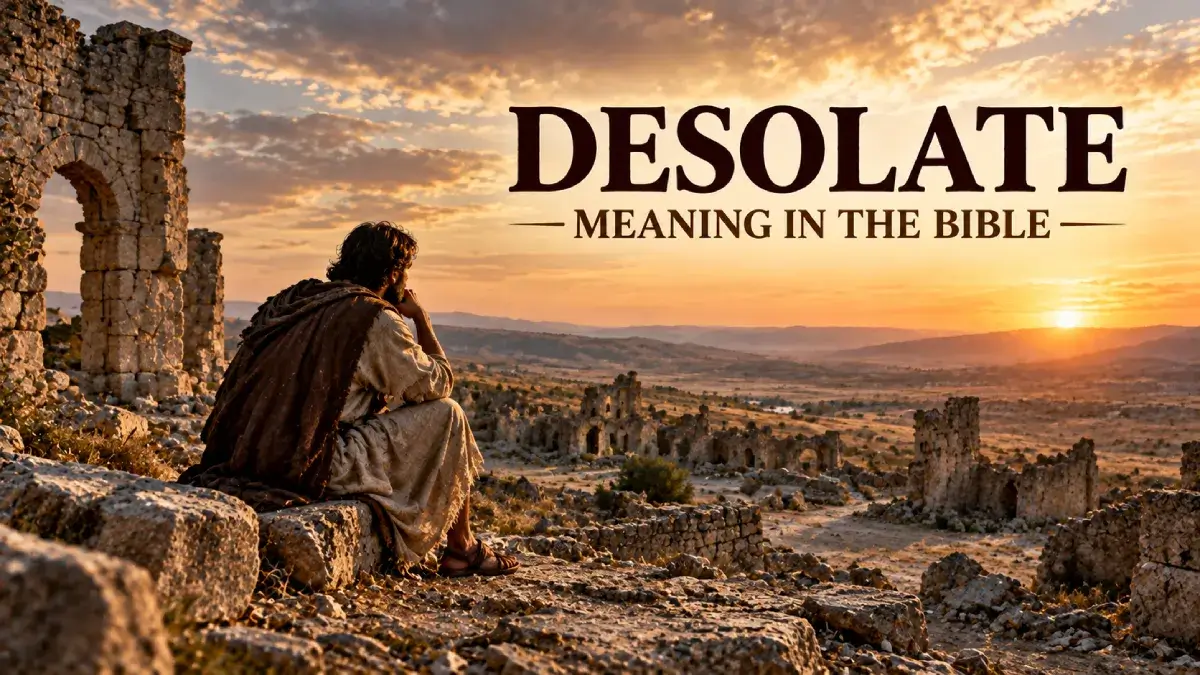
What does desolate mean in the Bible? The word describes a condition of emptiness, abandonment, loneliness, devastation, or ruin. Depending on the passage, it may refer to a deserted place, a city destroyed by judgment, a person experiencing deep sorrow, or a situation in which people feel abandoned and without hope.
Throughout Scripture, the word desolate appears in different settings. The Old Testament uses it to describe devastated cities, deserted lands, and the consequences of disobedience. In other passages, desolation expresses grief, isolation, or the absence of comfort. Yet the Bible also reveals that desolation does not have to be the end of the story. God promises restoration, comfort, and renewed hope to His people.
Understanding the biblical meaning of desolate helps us recognize the seriousness of God’s judgment, the reality of human suffering, and the hope of His restoring power.
In this article, we will explore the definition of desolate in the Bible, examine important Bible verses about desolation, consider its spiritual meaning, and discover how these Scriptures can encourage us during difficult seasons.
What Does Desolate Mean in the Bible?
The word desolate generally means deserted, abandoned, empty, devastated, or left in a state of ruin. In the Bible, its precise meaning depends on the context in which it appears.
For example, a desolate city may be one whose inhabitants have been removed or whose buildings have been destroyed. A desolate land may be barren or uninhabited. A person who feels desolate may be experiencing loneliness, grief, or deep distress.
In biblical passages, desolation can carry several related meanings:
- Abandonment: A place or person left without companionship or support.
- Destruction: A city, land, or community devastated by war or judgment.
- Emptiness: A place deprived of life, activity, or inhabitants.
- Loneliness: A condition of isolation, sorrow, or feeling forsaken.
- Spiritual consequences: The ruin that can follow persistent disobedience and rejection of God’s instructions.
- Restoration after devastation: The reversal of a condition in which a place or people have been left ruined.
These meanings overlap, but they are not interchangeable in every passage.
For example, when Scripture describes Jerusalem as desolate, the focus may be on destruction and the loss of its inhabitants. When a biblical figure experiences distress or loneliness, the idea may be more personal.
The central idea is that something once occupied, flourishing, supported, or alive has become empty, deserted, or devastated.
What Is the Hebrew Meaning of Desolate?
In the Old Testament, English words such as desolate, desolation, deserted, and laid waste translate several Hebrew words. These words do not all have precisely the same meaning.
One Hebrew root associated with desolation is shamem, which can convey ideas such as being desolated, devastated, appalled, or left waste. Its meaning depends on the form of the word and the context.
Other Hebrew terms can describe wilderness, barrenness, solitude, or ruined places. Consequently, it is not accurate to assume that every occurrence of the English word desolate translates the same Hebrew word.
The broader biblical picture includes cities made desolate through judgment, lands left uninhabited, and places that later experience restoration.
For example, Ezekiel 36:34 speaks of land that had been desolate being cultivated again.
The verse presents desolation as a condition that can be reversed through God’s restorative work.
What Is the Greek Meaning of Desolate in the New Testament?
The New Testament also uses several Greek expressions that English translations may render as desolate, deserted, forsaken, or lonely.
One important Greek word is erēmos, which can refer to a wilderness, deserted place, or uninhabited area. Depending on context, related forms can communicate the idea of being deserted or left desolate.
In Matthew 23:38, Jesus says:
“Behold, your house is left unto you desolate.” — Matthew 23:38, KJV
Here, desolate communicates abandonment and impending judgment in the context of Jesus’ words about Jerusalem.
By contrast, when the Gospels describe Jesus going to a deserted place to pray, the emphasis is on being away from crowds and seeking solitude rather than on destruction or divine punishment.
This distinction is important: a deserted place is not necessarily a cursed place, and a person experiencing loneliness is not necessarily experiencing God’s judgment.
The context determines the meaning.
10 Powerful Bible Verses About Desolation and Their Meanings
The following passages show how Scripture uses the idea of desolation in different situations.
1. Matthew 23:38 — “Your House Is Left Unto You Desolate”
“Behold, your house is left unto you desolate.” — Matthew 23:38, KJV
This is one of the clearest New Testament verses containing the word desolate.
Jesus speaks these words during His rebuke of the religious leaders in Matthew 23. He laments Jerusalem’s history of rejecting God’s messengers and warns of the consequences of that rejection.
The word house is understood in this context in relation to Jerusalem and its religious and national life. The surrounding passage points toward judgment and the coming devastation associated with the city’s rejection of God’s purposes.
Spiritual lesson: Persistent rejection of truth has serious consequences. This passage calls readers to examine their response to God rather than treating His warnings lightly.
It is important to read Jesus’ words in their historical and literary context rather than use them to justify hostility toward Jewish people. The passage is a warning within Jesus’ own Jewish setting about rejection, judgment, and accountability.
2. Isaiah 62:4 — God Promises That Desolation Will Not Be the Final Word
Isaiah 62:4 declares that God’s people will no longer be described as forsaken and that their land will no longer be called desolate.
The passage uses the language of restored relationships and renewed joy. Instead of abandonment, it pictures God’s people being welcomed and valued.
The surrounding chapter celebrates God’s purposes for Jerusalem and the restoration of His people.
Spiritual lesson: Desolation is not always the end of the story. Scripture repeatedly portrays God as the One who can bring restoration after a season of loss.
This verse is especially encouraging to readers who feel forgotten or who are waiting for God to bring renewal to a difficult situation.
3. Ezekiel 36:34 — Desolate Land Made Productive Again
“And the desolate land shall be tilled, whereas it lay desolate in the sight of all that passed by.” — Ezekiel 36:34, KJV
In Ezekiel 36, God speaks about the restoration of Israel’s land after a period of devastation.
The land that had become desolate would once again be cultivated. Places that had been ruined would become productive, and the surrounding nations would see the change.
The passage emphasizes God’s power to restore what had been devastated.
Spiritual lesson: God can bring renewal after loss. The imagery of cultivated land reminds us that restoration can involve rebuilding, renewed purpose, and the return of fruitful activity.
The original promise concerns Israel’s restoration. Its broader spiritual theme can encourage believers, but it should not be treated as a guarantee that every personal hardship will end in the same way or on the same timetable.
4. Psalm 25:16 — A Prayer From a Lonely Heart
“Turn thee unto me, and have mercy upon me; for I am desolate and afflicted.” — Psalm 25:16, KJV
In this verse, David asks God to turn toward him with mercy because he is desolate and afflicted.
Here, the emphasis is personal rather than geographical. David is expressing distress and a sense of being alone in a difficult situation.
The psalm as a whole is a prayer for guidance, forgiveness, and deliverance from enemies and troubles.
Spiritual lesson: We can honestly bring our loneliness and distress before God. Faith does not require us to pretend that everything is well.
David’s prayer reminds us that Scripture makes room for honest expressions of pain while continuing to seek God’s mercy.
5. Lamentations 1:1 — Jerusalem Sitting Desolate
“How doth the city sit solitary, that was full of people!” — Lamentations 1:1, KJV
Lamentations begins with a sorrowful description of Jerusalem after its devastation.
The city that had once been full of people is portrayed as solitary. Its loss is described through the imagery of a grieving woman, emphasizing the depth of the city’s suffering.
The book reflects on the destruction of Jerusalem and the consequences of the people’s rebellion, while also expressing profound grief over the suffering that followed.
Spiritual lesson: Sin and injustice can have devastating consequences, and Scripture does not minimize the pain those consequences bring.
This passage also teaches us how to lament. Biblical faith allows space to mourn losses, acknowledge suffering, and speak honestly about tragedy.
6. Isaiah 54:1 — Hope for the Barren and Desolate
“Sing, O barren, thou that didst not bear; break forth into singing, and cry aloud, thou that didst not travail with child.” — Isaiah 54:1, KJV
Isaiah 54 uses the imagery of a barren woman to describe a surprising future of growth and restoration for God’s people.
The surrounding verses speak of expansion, renewed security, and the reversal of shame.
Although the verse does not use the English word desolate in the KJV, the wider passage includes the imagery of one who had been forsaken and grieved, now receiving renewed hope.
Spiritual lesson: God can bring hope where the future appears empty. What looks unproductive or hopeless today does not necessarily define what lies ahead.
The passage originally speaks to God’s people and their restoration. Its imagery can encourage personal reflection, but it should not be used to promise that every person will receive a particular outcome in family life or other circumstances.
7. Jeremiah 4:27 — Judgment and Devastation
“For thus hath the LORD said, The whole land shall be desolate; yet will I not make a full end.” — Jeremiah 4:27, KJV
Jeremiah warns of severe judgment coming upon the land because of the people’s persistent rebellion.
Yet the verse includes an important qualification: God says that He will not make a full end.
The passage therefore holds two truths together. The coming devastation is serious, but judgment is not described as total annihilation.
Spiritual lesson: God’s warnings should be taken seriously, but the Bible also presents hope beyond judgment.
This verse helps readers understand that the biblical concept of desolation is not always the final chapter. Even in passages of severe warning, Scripture may point toward God’s continuing purposes.
8. Psalm 68:6 — God Places the Solitary in Families
“God setteth the solitary in families: he bringeth out those which are bound with chains: but the rebellious dwell in a dry land.” — Psalm 68:6, KJV
This verse presents God as One who cares for the isolated and brings freedom to those in bondage.
The word solitary is particularly relevant to the theme of desolation because it describes people who are alone or without the support of a community.
The psalm celebrates God’s power, protection, and care for the vulnerable.
Spiritual lesson: God values people who are isolated and vulnerable. His concern for the lonely should shape the way His people treat others.
This verse encourages churches and communities to welcome those who feel forgotten and to provide practical care for people who lack support.
9. Isaiah 61:4 — Rebuilding Ancient Ruins
“And they shall build the old wastes, they shall raise up the former desolations, and they shall repair the waste cities, the desolations of many generations.” — Isaiah 61:4, KJV
Isaiah 61 describes a future in which ruined places are rebuilt and long-standing devastation is repaired.
The language pictures the restoration of communities that had experienced loss across generations.
The chapter opens with a proclamation of good news, healing, liberty, and comfort, linking restoration with God’s gracious purposes.
Spiritual lesson: Restoration can involve rebuilding what has been damaged over time. The biblical picture includes renewed communities, restored dignity, and the repair of what was broken.
For Christians, the passage can inspire acts of service, community renewal, and compassionate care. Its original context should remain central when applying its themes today.
10. Matthew 14:13 — Jesus Withdraws to a Desolate Place
“When Jesus heard of it, he departed thence by ship into a desert place apart.” — Matthew 14:13, KJV
After hearing of John the Baptist’s death, Jesus withdraws by boat to a deserted place. Yet crowds follow Him, and He responds to them with compassion.
This passage uses the idea of a deserted place differently from passages about ruined cities or divine judgment.
The location is isolated, but it is not presented as a place cursed or abandoned by God.
Spiritual lesson: Solitude and desolation are not always the same thing. A quiet or deserted place can provide space for reflection, while a person’s emotional experience of abandonment is a different matter.
The passage also shows Jesus’ compassion toward the crowds who came to Him.
What Is the Spiritual Meaning of Desolation?
The spiritual meaning of desolation depends on the passage, but several themes appear repeatedly throughout Scripture.
1. Desolation Can Represent the Consequences of Sin
In many Old Testament passages, desolation is associated with judgment following persistent disobedience.
Cities and lands become devastated, and people experience the consequences of abandoning God’s instructions.
Jeremiah 4:27 is one example. The devastation described there is part of a warning about the consequences of rebellion.
These passages remind readers that actions have consequences and that Scripture treats justice, faithfulness, and obedience seriously.
However, it would be incorrect to conclude that every person experiencing suffering or loneliness is being punished for personal sin. The Bible does not support such a blanket assumption.
2. Desolation Can Describe Loneliness and Grief
Psalm 25:16 uses desolation to describe a person’s distress.
Lamentations also gives voice to grief after the destruction of Jerusalem. These passages show that the Bible acknowledges profound emotional pain.
People can experience loneliness even when surrounded by others. They may grieve a loss, struggle with isolation, or feel overwhelmed by circumstances.
The biblical response is not to dismiss those feelings. Instead, Scripture gives us prayers, laments, and expressions of hope that help us bring our suffering before God.
3. Desolation Can Describe a Place Left in Ruins
A devastated city or abandoned land is one of the most common biblical uses of desolation.
Prophets frequently describe places that have been emptied or destroyed because of war, judgment, or national catastrophe.
In such passages, desolation is not merely a feeling. It describes a visible condition in which places that once supported human life have been left ruined.
This meaning helps readers understand many of the prophetic books and their historical settings.
4. Desolation Can Be Reversed Through Restoration
Isaiah 62:4, Ezekiel 36:34, and Isaiah 61:4 all provide examples of restoration imagery.
These passages describe a reversal of conditions associated with abandonment, devastation, or ruin.
The restoration may involve land becoming productive, communities being rebuilt, or God’s people experiencing renewed hope.
The biblical message is not that every loss will be reversed immediately. Rather, the Scriptures consistently present God as capable of bringing restoration and working toward His purposes beyond seasons of devastation.
Does Desolate Mean Abandoned by God?
Not necessarily.
Although some biblical passages connect desolation with judgment, others describe deserted places, personal loneliness, or the restoration of ruined land.
A desolate place is not automatically evidence that God has abandoned someone.
Psalm 25:16, for example, records David describing himself as desolate and afflicted while praying directly to God for mercy. His experience of distress does not mean he has stopped seeking God.
Likewise, Matthew 14:13 describes Jesus going to a deserted place. The location is isolated, but the passage does not portray Him as abandoned by God.
These examples remind us to distinguish between feeling forsaken, living in a difficult situation, and the theological claim that God has abandoned a person.
The Bible frequently encourages people in distress to seek God, trust His character, and remain faithful even when circumstances are painful.
What Is the Difference Between Desolate, Deserted, and Forsaken?
These words are closely related, but their meanings differ slightly.
| Word | General meaning | Example of biblical usage |
|---|---|---|
| Desolate | Devastated, empty, abandoned, or ruined | Matthew 23:38 |
| Deserted | Left without inhabitants or visitors | Matthew 14:13 describes a deserted place |
| Forsaken | Abandoned or left without support | Isaiah 62:4 contrasts being forsaken with restoration |
| Barren | Unable to produce growth or fruit; sometimes used figuratively | Isaiah 54:1 |
| Waste | Ruined, unproductive, or devastated | Isaiah 61:4 |
These words may overlap in English translations, and the original Hebrew or Greek terms can carry different shades of meaning.
When studying a particular verse, it is best to examine the surrounding passage rather than rely on a dictionary definition alone.
What Does It Mean to Feel Spiritually Desolate?
People sometimes use the expression spiritually desolate to describe a season in which they feel distant from God, struggle to pray, or find it difficult to experience spiritual encouragement.
Although this phrase is often used in Christian conversation, it is important to distinguish it from the specific uses of desolate in Scripture.
Feeling spiritually empty does not necessarily mean that God has rejected someone. It may occur during grief, exhaustion, uncertainty, depression, or a period of spiritual struggle.
The Bible contains many prayers in which faithful people express confusion, sorrow, or a sense of distance from God.
For example, Psalm 42 repeatedly describes a soul that is downcast while continuing to hope in God.
If you feel spiritually desolate, consider these practical steps:
- Pray honestly. Tell God what you are experiencing instead of pretending to feel something you do not.
- Read Scripture gradually. Begin with a short psalm or a Gospel passage rather than placing unrealistic demands on yourself.
- Seek supportive relationships. Talk with a trusted Christian friend, pastor, or mature believer.
- Care for your physical and emotional well-being. Rest, connection, and professional support can be important when distress becomes overwhelming.
- Give yourself time. Spiritual growth does not always feel dramatic, and a difficult season does not define your entire relationship with God.
The Psalms remind us that honest lament and trust can exist together. We can experience sorrow while continuing to seek God.
How Does God Restore What Is Desolate?
The Bible presents restoration in several forms. Sometimes it involves a physical place being rebuilt. At other times, it involves renewed community, comfort, freedom, or hope.
Through His Promises
Isaiah 62:4 describes God’s people no longer being called forsaken or their land being called desolate.
The passage uses the language of restored relationship and renewed joy to express God’s purpose for His people.
Through Renewal and Rebuilding
Ezekiel 36:34 describes land that had been desolate becoming cultivated again.
The image of productive land illustrates the reversal of devastation and the renewal of life.
Through Comfort for Those Who Mourn
Isaiah 61:1–3 speaks of good news, healing, liberty, comfort, and beauty in place of ashes.
These images communicate God’s concern for people experiencing grief and loss.
Through the Hope Found in Christ
The New Testament presents Jesus as the source of hope, reconciliation, and new life.
Christians believe that His death and resurrection provide the foundation for hope even when earthly circumstances remain difficult.
Restoration may not always happen in the way we expect. Some losses remain painful, and some situations require long periods of healing. Biblical hope does not require us to deny those realities.
Instead, it encourages us to trust God’s character and continue seeking His guidance amid uncertainty.
Bible Verses to Read When You Feel Desolate
If you are experiencing loneliness, grief, or spiritual discouragement, the following Scriptures may offer encouragement.
Psalm 34:18
“The LORD is nigh unto them that are of a broken heart; and saveth such as be of a contrite spirit.” — Psalm 34:18, KJV
This verse reminds readers that God is near to those experiencing deep sorrow.
Isaiah 41:10
“Fear thou not; for I am with thee: be not dismayed; for I am thy God.” — Isaiah 41:10, KJV
God’s words to His people offer reassurance in the face of fear and uncertainty.
Psalm 46:1
“God is our refuge and strength, a very present help in trouble.” — Psalm 46:1, KJV
This psalm presents God as a source of refuge when circumstances feel unstable.
Matthew 11:28
“Come unto me, all ye that labour and are heavy laden, and I will give you rest.” — Matthew 11:28, KJV
Jesus invites those who are weary and burdened to come to Him for rest.
Romans 8:38–39
Paul expresses his conviction that nothing in creation can separate believers from the love of God in Christ Jesus.
This passage offers a strong foundation for Christian hope when life feels uncertain.
These verses do not promise that every difficulty will disappear immediately. They encourage believers to seek God, receive support, and hold on to the hope expressed throughout Scripture.
A Prayer for Those Who Feel Desolate
Heavenly Father,
Thank You for being a God who sees us in our sorrow and understands our struggles. When I feel lonely, empty, or overwhelmed by the difficulties of life, help me remember that I can bring my pain honestly before You.
Give me strength when I feel weak, comfort when I grieve, and wisdom when I do not know what to do. Help me to recognize Your truth in Scripture and to receive support from people who care for me.
Where there has been loss, guide me through the process of healing. Where there has been brokenness, show me the next step toward restoration. When I cannot see what lies ahead, help me trust Your goodness without pretending that my struggles are easy.
Teach me to show compassion to others who feel forgotten or abandoned. May my words and actions reflect Your love and offer encouragement to those who are suffering.
Thank You for the hope we have through Jesus Christ.
In Jesus’ name, Amen.
Frequently Asked Questions About the Meaning of Desolate in the Bible
What does desolate mean in the Bible?
Desolate generally means deserted, abandoned, empty, devastated, or left in ruins. Its exact meaning depends on the passage. It may describe a ruined city, a deserted land, a person’s distress, or a condition that God promises to restore.
What is the spiritual meaning of desolate?
Spiritually, desolation can describe the consequences of judgment, a sense of loneliness or grief, or a condition of emptiness. In restoration passages, it can also provide a contrast with the renewal God promises to His people.
What does Matthew 23:38 mean when Jesus says the house is left desolate?
In Matthew 23, Jesus warns Jerusalem about the consequences of rejecting God’s messengers and His purposes. The word describes abandonment and impending devastation in the context of His judgment. It should be read within the historical and literary setting of the chapter.
Does desolate mean God has abandoned you?
No, not necessarily. Scripture uses the word in different contexts. A person may feel lonely or distressed without that experience proving that God has abandoned them. Psalm 25:16, for example, describes David as desolate and afflicted while he seeks God’s mercy.
What does a desolate place mean in the Bible?
A desolate place may be a deserted, uninhabited, barren, or ruined location. The meaning depends on the context. In Matthew 14:13, Jesus goes to a deserted place, whereas other passages use desolation to describe destruction or judgment.
What Hebrew word means desolate?
Several Hebrew words are translated with terms such as desolate, devastated, deserted, or laid waste. One Hebrew root associated with desolation is shamem. The precise meaning depends on the word’s form and its context in the passage.
What does desolate mean in Isaiah 62:4?
Isaiah 62:4 describes a reversal of abandonment. God’s people and their land will no longer be characterized as forsaken and desolate. The verse uses the language of restoration and renewed relationship.
What does desolate mean in Lamentations 1:1?
Lamentations 1:1 portrays Jerusalem as solitary after its destruction. The verse emphasizes the contrast between the city that was once full of people and its devastated condition afterward.
What is the opposite of desolate in the Bible?
Depending on the context, opposites may include restored, inhabited, fruitful, comforted, or flourishing. Isaiah 62:4 and Ezekiel 36:34 provide examples of biblical passages that contrast desolation with restoration.
What should I read when I feel spiritually desolate?
Psalm 34, Psalm 42, Isaiah 41:10, Matthew 11:28, and Romans 8:38–39 are helpful passages for reflection. They offer language for sorrow, encouragement in difficulty, and hope in God’s care.
Final Thoughts: Desolation Is Not Always the End of the Story
The meaning of desolate in the Bible extends beyond simple emptiness. Depending on the passage, it can describe abandoned cities, devastated land, the consequences of judgment, or the sorrow of someone who feels alone.
Yet Scripture also contains powerful pictures of restoration. Isaiah speaks of places once considered desolate being renewed. Ezekiel describes ruined land becoming productive again. The Psalms give voice to people who experience distress while continuing to seek God.
These passages help us understand that desolation is a serious condition, but it is not always the final word in the biblical story.
If you are studying the Bible, pay attention to the context of each verse. Ask whether the passage is describing judgment, physical destruction, personal sorrow, solitude, or promised restoration. Doing so will help you understand the message more accurately.
And if you are personally experiencing a season of loneliness or discouragement, remember that feeling desolate does not automatically mean God has abandoned you. You can bring your struggles to Him honestly, seek support from others, and continue to hold on to the hope found in His Word.
The Bible invites us to take suffering seriously while also remembering God’s capacity to comfort, renew, and restore.