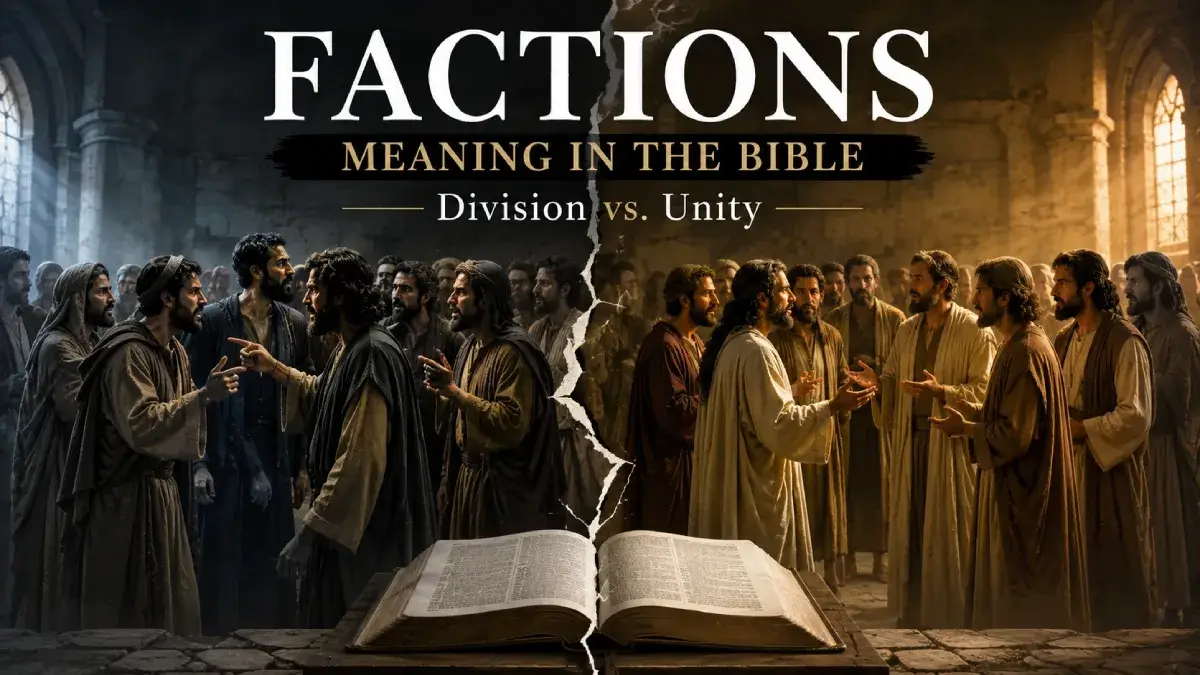
The word factions may sound like a political or organizational term today, but the Bible uses it to describe something much deeper: division among people, especially when disagreements, rivalries, or competing groups disrupt unity.
In the New Testament, factions are repeatedly presented as a serious spiritual problem. The apostle Paul warns believers about divisions, quarrels, jealousy, selfish ambition, and groups forming against one another.
So, what does factions mean in the Bible?
In simple terms, a faction is a group formed around disagreement, rivalry, or personal interests that creates division within a larger community. In a Christian context, factions can damage fellowship because people begin identifying more strongly with their group, leader, opinion, or preference than with Christ.
One of the clearest passages is Galatians 5:19–21, where Paul lists “factions” among the works of the flesh.
Understanding this word can help us recognize why Scripture takes unity so seriously.
What Does Factions Mean in the Bible?
A faction is a division or party that develops within a larger group.
Biblically, factions are associated with:
- Division
- Rivalry
- Disagreement
- Selfish ambition
- Jealousy
- Quarreling
- Party spirit
- Competition between groups
The problem is not simply that people disagree.
Christians can have legitimate differences of opinion while still loving one another and remaining united in Christ.
A faction develops when disagreement becomes division and rivalry—when people begin taking sides, attacking others, or placing their own group interests above the unity of God’s people.
What Is the Biblical Meaning of Factions?
The biblical concept of factions is closely connected with the idea of choosing sides and creating divisions within a community.
Paul includes factions in a list of behaviors that reflect the “works of the flesh” in Galatians 5:19–21. The surrounding words include hostility, strife, jealousy, anger, selfish ambition, dissensions, and envy.
This context is important.
Factions do not usually appear suddenly. They can grow out of:
- Jealousy
- Pride
- Anger
- Selfish ambition
- Unresolved disagreements
- Competition
- Desire for control
- Loyalty to personalities rather than Christ
A disagreement can therefore become dangerous when it stops being about truth or wisdom and becomes about winning, controlling, or defeating another person.
Factions in Galatians 5:20
One of the most important Bible verses about factions is Galatians 5:20.
Paul lists factions among the works of the flesh, alongside things such as hatred, discord, jealousy, fits of rage, selfish ambition, dissensions, and envy.
The exact wording varies among Bible translations. Some translations use terms such as factions, selfish ambition, dissensions, or party spirit.
The larger point remains the same: behavior that deliberately creates division and rivalry is inconsistent with life directed by the Holy Spirit.
Paul then contrasts these works of the flesh with the fruit of the Spirit in Galatians 5:22–23.
That contrast is significant.
The flesh produces division.
The Spirit produces love, joy, peace, patience, kindness, goodness, faithfulness, gentleness, and self-control.
What Is the Difference Between Factions and Dissensions?
Factions and dissensions are closely related, but they emphasize slightly different aspects of division.
Dissension refers to serious disagreement or conflict between people.
Faction emphasizes the formation of a group or party within a larger community.
For example, imagine a church where members disagree about an issue.
A disagreement by itself does not necessarily create a faction.
But if people begin forming opposing groups, refusing to associate with one another, attacking the other side, and identifying themselves by their competing camps, the disagreement has developed into something much more serious.
The Bible consistently calls believers toward reconciliation rather than destructive division.
What Does the Bible Say About Divisions?
The New Testament contains numerous warnings about division among Christians.
Paul strongly confronted divisions in the church at Corinth.
1 Corinthians 1:10
Paul urges believers to agree with one another and avoid divisions, encouraging them to be united in mind and conviction.
The Corinthian church had developed competing loyalties around different Christian leaders.
Some were saying they followed Paul.
Others identified with Apollos.
Others with Cephas.
Paul’s response makes the central issue clear:
Christ cannot be divided.
The problem was not that Paul, Apollos, or Cephas were necessarily teaching identical personalities or styles. The problem was that believers were turning Christian leadership into competing camps.
Factions in the Corinthian Church
The church in Corinth provides one of the clearest biblical examples of factionalism.
In 1 Corinthians 3:3–4, Paul points to jealousy and quarreling among the believers.
Some were saying:
“I follow Paul.”
Others:
“I follow Apollos.”
Paul challenges them because their allegiance to particular leaders was producing division.
This is an important lesson for Christians today.
It is possible to admire a pastor, teacher, denomination, ministry, or theological tradition without turning that preference into an identity that divides believers from one another.
Our ultimate allegiance belongs to Jesus Christ.
Are Factions a Sin According to the Bible?
The Bible treats destructive factions as sinful behavior.
Galatians 5:19–21 places factions among the works of the flesh. Paul warns that those who persist in such behaviors are not walking according to the Spirit.
However, this does not mean that every disagreement between Christians is automatically sinful.
The Bible itself contains examples of serious disagreements.
The issue is how believers respond to disagreement.
There is a difference between:
- Seeking truth and creating division
- Discussing doctrine and attacking people
- Having convictions and becoming prideful
- Correcting error and becoming hostile
- Disagreeing respectfully and forming rival camps
Biblical unity does not require pretending that every Christian believes exactly the same thing.
It requires believers to pursue truth with love, humility, and loyalty to Christ.
What Causes Factions in the Church?
Factions can develop for many reasons.
1. Pride
Pride can make people believe their opinions are superior to everyone else’s.
Once pride takes control, listening becomes difficult.
2. Selfish Ambition
Paul connects selfish ambition with other works of the flesh in Galatians 5.
A person may want influence, recognition, authority, or control.
When personal ambition becomes more important than serving others, division can follow.
3. Jealousy
Jealousy can create competition between people who should be working together.
Instead of celebrating another person’s success, someone may begin seeing that person as a rival.
4. Personal Loyalty
The Corinthian believers became divided around Christian leaders.
Personal loyalty becomes unhealthy when a person’s reputation or influence becomes more important than faithfulness to Christ.
5. Unresolved Conflict
Small disagreements can become major divisions when people refuse to address them with honesty, forgiveness, and humility.
6. Doctrinal Disputes
Some doctrinal disagreements are genuinely important.
Christians should care about biblical truth.
But even legitimate theological concerns can become destructive when believers treat everyone who disagrees with them as an enemy.
Factions vs. Healthy Christian Disagreement
This distinction is essential.
The Bible does not command Christians to avoid every disagreement.
Paul himself corrected false teaching, confronted serious sin, and defended the truth of the gospel.
The problem is not truth versus unity.
Biblical Christianity calls believers to pursue truth and unity together.
Healthy disagreement can involve:
- Listening carefully
- Studying Scripture
- Asking questions
- Speaking truthfully
- Showing humility
- Remaining loving
- Avoiding personal attacks
Factions involve:
- Taking sides
- Attacking opponents
- Spreading hostility
- Protecting personal interests
- Creating rival groups
- Refusing reconciliation
A Christian can strongly disagree with someone while still treating that person as a brother or sister in Christ.
What Does Jesus Teach About Unity?
Jesus prayed for the unity of His followers in John 17:20–23.
He prayed that His followers would be one.
This prayer shows that Christian unity is not a minor issue.
Unity serves a purpose: it points people toward the reality of God’s work through Christ.
Christian unity does not mean that every believer has the same personality, background, denomination, or opinion on every secondary issue.
It means that believers share a deeper identity in Christ.
Bible Verses About Factions and Division
Here are some important passages to study when exploring the biblical meaning of factions.
Galatians 5:19–23
Paul contrasts the works of the flesh—including factions, dissensions, and selfish ambition—with the fruit of the Spirit.
1 Corinthians 1:10
Paul appeals to believers to avoid divisions and to be united in mind and thought.
1 Corinthians 3:3–4
Paul identifies jealousy and quarrelling as evidence of spiritual immaturity within the Corinthian church.
Romans 16:17
Paul warns believers to watch out for those who cause divisions and create obstacles contrary to Christian teaching.
Titus 3:10–11
Paul instructs Titus to warn a divisive person and, after repeated warnings, have nothing more to do with that person.
Philippians 2:1–4
Paul encourages believers to practice humility, look to the interests of others, and avoid selfish ambition.
Ephesians 4:1–3
Believers are encouraged to live with humility, gentleness, patience, and love while making every effort to maintain the unity of the Spirit.
John 17:21
Jesus prays that His followers would be one.
These passages show that the biblical response to destructive division is not simply to ignore it. Christians are called to pursue truth, humility, reconciliation, and spiritual unity.
What Is the Difference Between Factions and Unity?
Factions divide people according to competing loyalties.
Christian unity brings people together around Christ.
| Factions | Biblical Unity |
|---|---|
| Selfish ambition | Humility |
| Rivalry | Cooperation |
| Jealousy | Love |
| Taking sides | Reconciliation |
| Personal glory | God’s glory |
| Attacking others | Speaking truth in love |
| “My group” | “We belong to Christ” |
| Division | Peace |
This does not mean biblical unity requires ignoring sin or false teaching.
Instead, it means that even when correction is necessary, Christians should pursue it with the character of Christ.
How Should Christians Respond to Factions?
If division begins developing within a church, family, ministry, or Christian community, Scripture provides principles for responding wisely.
1. Examine Your Own Heart
Before confronting someone else, ask:
Am I contributing to this division?
Look honestly at your own motives.
Are you angry?
Jealous?
Trying to win?
Protecting your reputation?
Seeking control?
Humility begins with self-examination.
2. Put Christ Above Personalities
The Corinthian church provides a powerful warning against excessive loyalty to individual leaders.
Pastors and teachers can be valuable gifts to the church, but they are not substitutes for Christ.
Our identity should not depend on belonging to a particular personality or group.
3. Speak Truth With Love
Ephesians 4:15 calls believers to speak the truth in love.
Truth without love can become harsh.
Love without truth can become compromise.
Christians are called to pursue both.
4. Forgive Where Possible
Unresolved offenses can become seeds of division.
Forgiveness does not mean pretending that wrongdoing never happened. But where repentance and reconciliation are possible, Christians should pursue peace.
5. Avoid Gossip
Gossip can turn private disagreements into community-wide conflicts.
Instead of spreading stories about someone, address concerns appropriately and directly.
6. Pray for Unity
Jesus Himself prayed for the unity of His followers.
If unity mattered to Jesus, it should matter to His people.
Can Christians Disagree Without Creating Factions?
Yes.
Christian maturity does not mean agreeing with everyone about everything.
Romans 14 demonstrates that believers may have differences over certain matters while still being called to love and respect one another.
The important question is:
Can we disagree without despising one another?
A mature Christian can say:
“I believe this is what Scripture teaches, and I want to follow it faithfully.”
without saying:
“Anyone who disagrees with me is my enemy.”
There is room for conviction without hostility.
What Does “Faction” Mean in Galatians 5:20?
In Galatians 5:20, the word translated “factions” appears within Paul’s list of the works of the flesh.
The surrounding terms help explain the meaning.
Paul mentions hostility, discord, jealousy, fits of rage, selfish ambition, dissensions, factions, and envy.
Together, these words describe a pattern of behavior driven by the flesh rather than the Spirit.
A faction is therefore more than simply having an opinion.
It involves division, rivalry, and competing parties.
The solution is not merely organizational restructuring.
Paul’s answer is spiritual:
Walk by the Spirit.
What Is the Opposite of Factions in the Bible?
The opposite of destructive factionalism is not simply organizational agreement.
Biblically, the opposite includes:
- Love
- Peace
- Humility
- Patience
- Forgiveness
- Unity
- Service
- Gentleness
- Self-control
These qualities are especially visible in the fruit of the Spirit in Galatians 5:22–23.
Instead of asking, “How can I get my side to win?” a Spirit-led believer asks:
“How can I honor Christ and love others in this situation?”
That change in motivation can transform the way Christians handle disagreement.
A Practical Lesson About Factions
Factions often begin with something that seems small.
A disagreement.
A preference.
A personality conflict.
A theological difference.
A leadership decision.
A misunderstanding.
But if pride, jealousy, anger, and selfish ambition are allowed to grow, the disagreement can become division.
That is why Scripture addresses the heart behind factionalism rather than merely the visible conflict.
The goal is not simply to stop people from arguing.
The goal is to become people who are increasingly shaped by the Holy Spirit.
How to Avoid Factions in Your Church or Community
You can help protect Christian unity by practicing a few simple principles:
- Keep Christ at the center.
Remember that Jesus is the foundation of the church. - Assume the best when possible.
Not every disagreement is an attack. - Listen before responding.
Understanding someone is different from agreeing with them. - Refuse to fuel gossip.
Do not make someone else’s conflict your conversation topic. - Practice humility.
You may be wrong, or you may only understand part of the situation. - Address problems directly and lovingly.
Private conversations can prevent unnecessary public conflict. - Pray for those you disagree with.
Prayer changes the posture of the heart. - Value people more than winning arguments.
Being right is not an excuse for being unloving. - Stand firmly for biblical truth.
Unity should never require abandoning the truth of Scripture. - Pursue peace whenever possible.
Romans 12:18 encourages believers to live at peace with others as far as it depends on them.
FAQ: Factions Meaning in the Bible
What does factions mean in the Bible?
Factions refers to divisions or rival groups that form within a larger community, often because of selfish ambition, jealousy, disagreement, or competing loyalties. Galatians 5:20 lists factions among the works of the flesh.
Is creating factions a sin?
Destructive factionalism is treated as sinful in Scripture. Galatians 5:19–21 places factions among the works of the flesh, while other passages warn against people who deliberately cause division.
What is an example of factions in the Bible?
The Corinthian church provides a clear example. Some believers identified themselves with Paul while others identified with Apollos or Cephas. Paul challenged this division in 1 Corinthians 1 and 3.
What is the difference between factions and disagreement?
Disagreement does not automatically create a faction. Christians can disagree while remaining loving and united. A faction develops when disagreement becomes rivalry, division, party spirit, or competing groups.
What does Galatians 5:20 say about factions?
Galatians 5:20 includes factions in Paul’s list of the works of the flesh. The surrounding context also mentions hostility, jealousy, anger, selfish ambition, dissensions, and envy.
What is the opposite of factions in the Bible?
The biblical opposite of destructive factionalism includes unity, love, peace, humility, patience, forgiveness, and service. These qualities are consistent with the fruit of the Spirit described in Galatians 5:22–23.
How should Christians deal with division in the church?
Christians should respond with prayer, humility, truth, love, appropriate correction, forgiveness, and a commitment to unity. At the same time, biblical unity does not mean ignoring serious sin or abandoning essential truth.
Does Christian unity mean everyone must agree?
No. Scripture allows for differences of opinion on certain matters. Christian unity means remaining committed to Christ and treating fellow believers with love and respect even when disagreements exist.
What does the Bible say about people who cause division?
Romans 16:17 warns believers to watch out for people who cause divisions contrary to biblical teaching. Titus 3:10–11 also gives instructions concerning a persistently divisive person.
Final Reflection
The meaning of factions in the Bible is ultimately about more than people disagreeing.
Factions develop when disagreement becomes division, rivalry, selfish ambition, and competing loyalties.
The church in Corinth shows how quickly believers can become divided around personalities. Galatians 5 reminds us that factionalism belongs among the works of the flesh. And Jesus’ prayer in John 17 reminds us that unity among His followers matters deeply to God.
Christian unity does not require pretending that differences do not exist.
It means choosing Christ over rivalry, humility over pride, love over hostility, and reconciliation over division.
When disagreements arise, the question should not simply be, “Which side am I on?”
A better question is:
“Am I responding in a way that reflects Jesus Christ?”
“Make every effort to keep the unity of the Spirit through the bond of peace.” — Ephesians 4:3
May our conversations, churches, families, and Christian communities be marked not by factions and rivalry, but by the love, humility, truth, and peace that come from walking with Christ.