If you are reading the King James Version (KJV), you may come across the word variance and wonder what it means in a biblical context.
Today, “variance” can simply mean a difference or disagreement. But in the Bible, particularly in the KJV, the word is used in passages describing division, conflict, quarrels, or separation between people.
The word appears twice in the KJV: Matthew 10:35 and Galatians 5:20. Interestingly, the English word “variance” represents two different Greek words in these passages, so the precise meaning depends on the context.
In simple terms:
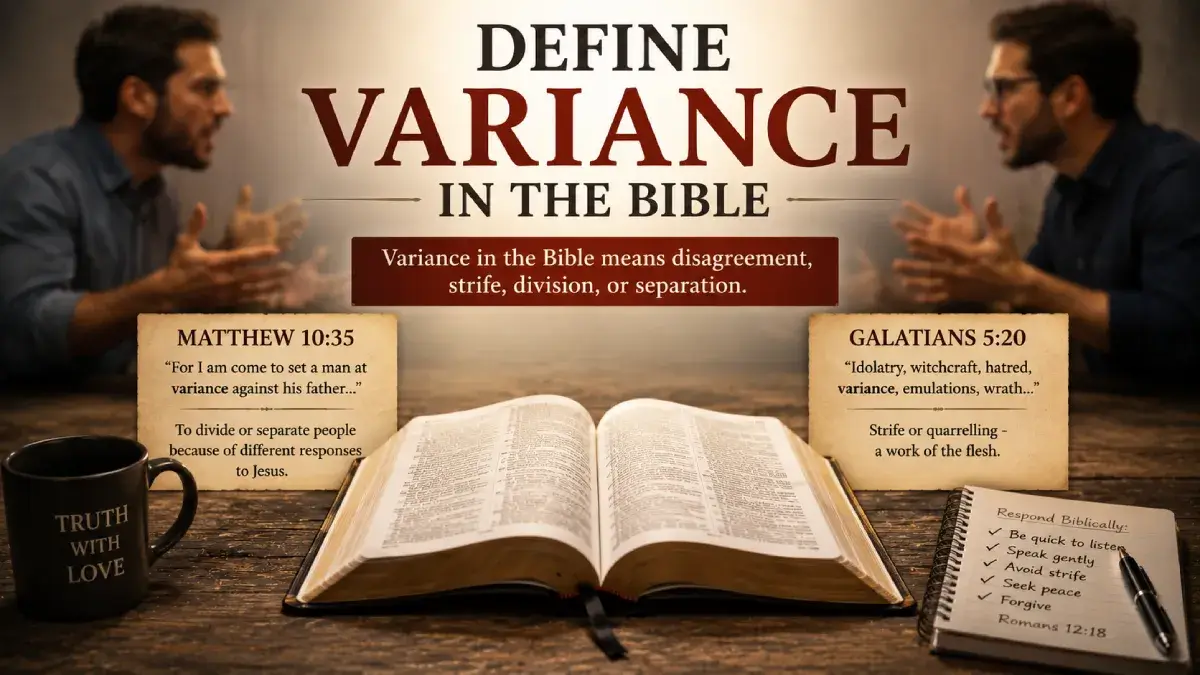
Variance in the Bible refers to a state of disagreement, strife, division, or separation between people.
However, Matthew 10:35 and Galatians 5:20 use the concept in different ways. Understanding those differences helps us interpret the verses correctly.
What Does Variance Mean in the Bible?
The traditional meaning of variance is disagreement, dissension, discord, or contention. A King James dictionary defines it as contention or strife.
The word can describe a situation where people are no longer in agreement or harmony.
For example, people may be:
- At odds with one another
- Quarreling
- Divided
- In conflict
- Opposed to each other
- Experiencing serious disagreement
The biblical idea goes beyond having different opinions. It can involve relational conflict or division.
But there is an important distinction between the two places where the KJV uses “variance.”
Where Is Variance Mentioned in the Bible?
The KJV uses the word variance twice:
- Matthew 10:35
- Galatians 5:20
Let’s examine both passages.
1. Variance in Matthew 10:35
Jesus says:
“For I am come to set a man at variance against his father, and the daughter against her mother, and the daughter in law against her mother in law.” – Matthew 10:35, KJV
At first, this verse may seem surprising.
Jesus is known as the Prince of Peace, so why would He say that He came to set people “at variance”?
The answer becomes clearer when we consider the surrounding verses.
Jesus was explaining that following Him could result in division within families.
Matthew 10:34 says:
“Think not that I am come to send peace on earth: I came not to send peace, but a sword.”
Jesus was not commanding His followers to create fights or hatred.
Instead, He was warning that loyalty to Him can create division when people respond differently to His message. Some family members may believe in Christ while others reject Him.
The result can be conflict even among people who previously lived peacefully together. A commentary on Matthew 10:35 describes the contrast as division rather than Jesus promoting physical warfare.
What does “at variance” mean here?
In Matthew 10:35, the underlying Greek verb is dichazō, which carries the idea of cutting apart, dividing, or separating.
Therefore, “set at variance” means something like:
to divide or place people in opposition to one another.
The lesson
Jesus was warning His disciples to understand the cost of following Him.
Faith in Christ can sometimes create difficult relationships because people don’t always agree about Him.
2. Variance in Galatians 5:20
The second occurrence appears in Paul’s list of the works of the flesh:
“Idolatry, witchcraft, hatred, variance, emulations, wrath, strife, seditions, heresies.” – Galatians 5:20, KJV
Here, the meaning is different from Matthew 10:35.
Paul isn’t describing division that happens because someone chooses to follow Christ.
He is describing sinful behavior produced by the flesh.
The Greek word translated “variance” in Galatians 5:20 is eris, which refers to strife, quarrelling, contention, or wrangling.
This is why many modern translations use words such as:
- Strife
- Discord
- Quarreling
- Rivalries
- Disputes
What does variance mean in Galatians 5:20?
Here, variance means contentious conflict or quarrelsome behavior.
It describes the kind of hostility that damages relationships and produces division.
The Difference Between Variance in Matthew 10:35 and Galatians 5:20
This distinction is important.
| Passage | Greek word | Meaning |
|---|---|---|
| Matthew 10:35 | dichazō | To divide, separate, or set people against one another |
| Galatians 5:20 | eris | Strife, quarrelling, contention, or dispute |
So while both passages use the English word variance, they aren’t identical in the original language.
Matthew 10:35
The division results from people’s differing responses to Jesus.
Galatians 5:20
The contention is identified as a work of the flesh.
This is one reason it is important to read biblical words in their context rather than assuming one English word always has exactly one meaning.
Is Variance a Sin According to the Bible?
The answer depends on which passage you’re considering.
In Galatians 5:20, variance is included among the works of the flesh. Paul places it alongside hatred, wrath, strife, seditions, and other sinful behaviors.
Therefore, the contentious and quarrelsome behavior described there is sinful.
But Matthew 10:35 is different.
Jesus isn’t telling His disciples to deliberately cause family arguments. He is warning them that allegiance to Him may result in division because people will respond differently to the gospel.
That distinction is essential.
What Causes Variance According to the Bible?
Scripture identifies several attitudes that can produce conflict.
Pride
Proverbs 13:10 says:
“Only by pride cometh contention.”
Pride can make people unwilling to admit they are wrong or listen to another perspective.
Anger
Proverbs 29:22 says:
“An angry man stirreth up strife.”
Uncontrolled anger can quickly turn disagreement into conflict.
Selfish Ambition
James 3:16 warns that where envy and selfish ambition exist, there can be disorder and harmful practices.
Harsh Words
Proverbs 15:1 gives the opposite approach:
“A soft answer turneth away wrath.”
The way we respond to disagreement can either calm or intensify it.
Gossip
Proverbs 26:20 says:
“Where no wood is, there the fire goeth out.”
The principle is simple: conflict needs fuel to continue.
What Does the Bible Say About Avoiding Variance?
The Bible consistently encourages believers to pursue peace.
Romans 12:18 says:
“If it be possible, as much as lieth in you, live peaceably with all men.”
This is a practical principle.
You cannot control how another person behaves, but you can control your own response.
When disagreements arise, Christians should seek:
- Wisdom
- Patience
- Humility
- Gentleness
- Forgiveness
- Reconciliation
- Peace
That doesn’t mean ignoring truth or allowing harmful behavior.
It means refusing to turn every disagreement into a battle.
Variance vs. Healthy Disagreement
It is important not to confuse disagreement with contention.
Two people can disagree without being enemies.
Healthy disagreement:
“I understand your position, but I interpret this passage differently.”
Contentious variance:
“You’re wrong, and I’m going to attack you until you agree with me.”
The problem isn’t simply that two people see things differently.
The problem is the spirit and behavior surrounding the disagreement.
Christians can discuss difficult questions while still showing love and respect.
What Can Christians Learn From the Bible’s Teaching on Variance?
1. Not Every Conflict Can Be Avoided
Matthew 10:35 reminds us that following Jesus can sometimes create relational division.
Faithfulness to Christ may occasionally cost us relationships or approval.
2. Don’t Create Conflict Needlessly
Galatians 5:20 warns against quarrelsome behavior that comes from the flesh.
Christians should not enjoy arguing simply for the sake of arguing.
3. Examine Your Motives
Ask yourself:
Am I defending truth, or am I defending my pride?
That question can expose the difference between conviction and contentiousness.
4. Choose Gentle Words
Proverbs 15:1 reminds us that our words can either calm anger or make it worse.
5. Pursue Peace When Possible
Romans 12:18 gives believers a clear responsibility to pursue peaceful relationships whenever possible.
Is “Variance” the Same as “Division” in the Bible?
Not always.
The words overlap in some contexts, but biblical vocabulary needs to be considered passage by passage.
In Matthew 10:35, the Greek word behind “variance” has the sense of dividing or separating.
In Galatians 5:20, eris is more directly associated with strife or quarrelling.
There is also another Greek word, dichostasia, which is translated as “seditions” in Galatians 5:20 and is associated with dissension or division.
This demonstrates why studying biblical words in context is so valuable.
What Is the Opposite of Variance?
If variance involves strife, quarrelling, or division, Scripture points believers toward qualities such as:
Peace
“Blessed are the peacemakers.” – Matthew 5:9
Gentleness
Believers are instructed to be gentle rather than quarrelsome.
Patience
Patience gives us space to listen and respond wisely.
Humility
Humility makes it easier to admit mistakes and consider another person’s perspective.
Love
Christian love seeks the good of others rather than simply trying to win arguments.
A Simple Prayer for Peace in Relationships
Heavenly Father,
Give me wisdom when disagreements arise. Help me recognize pride, anger, and selfishness in my own heart. Teach me to listen carefully and speak with gentleness.
Help me stand firmly for truth without becoming quarrelsome. Give me humility when I am wrong and grace when others hurt me. Help me pursue peace wherever possible.
When following You creates difficult relationships, give me courage to remain faithful while continuing to show love.
In Jesus’ name, Amen.
Final Thoughts on the Meaning of Variance in the Bible
So, how do you define variance in the Bible?
In general, variance means disagreement, strife, contention, division, or separation. But the exact meaning depends on the biblical passage.
In Matthew 10:35, “to set at variance” describes division or separation that can occur when people respond differently to Jesus. The underlying Greek word carries the idea of dividing or separating.
In Galatians 5:20, “variance” refers to strife, quarrelling, or contentious behavior and is listed among the works of the flesh.
The distinction gives us an important biblical lesson:
Not every division is created by sinful behavior, but believers should never deliberately cultivate sinful contention.
When disagreement comes, seek truth with humility, speak with grace, and pursue peace whenever possible.
And when your faith in Christ creates opposition, remember that Jesus Himself warned His followers that allegiance to Him could sometimes bring division – even within families.
Frequently Asked Questions
What does variance mean in the Bible?
Variance generally means disagreement, strife, contention, division, or separation. Its precise meaning depends on the passage. In Matthew 10:35 it refers to division, while in Galatians 5:20 it refers to quarrelling or strife.
Where does the Bible mention variance?
The King James Version uses the word variance in Matthew 10:35 and Galatians 5:20.
Is variance a sin?
In Galatians 5:20, variance refers to contentious strife and is included among the works of the flesh. Matthew 10:35 is different: Jesus warns that following Him can result in division between people.
What is the difference between variance and contention?
They can overlap in meaning. In Galatians 5:20, variance is associated with strife and quarrelling, while the broader idea of contention refers to ongoing conflict or disagreement.
What does “set at variance” mean in Matthew 10:35?
It means to divide or separate people from one another. Jesus was warning that people’s different responses to Him could result in conflict, including within families.
How should Christians respond to variance?
Christians should seek truth without unnecessary quarrelling, examine their motives, listen carefully, speak gently, forgive, and pursue peace whenever possible.