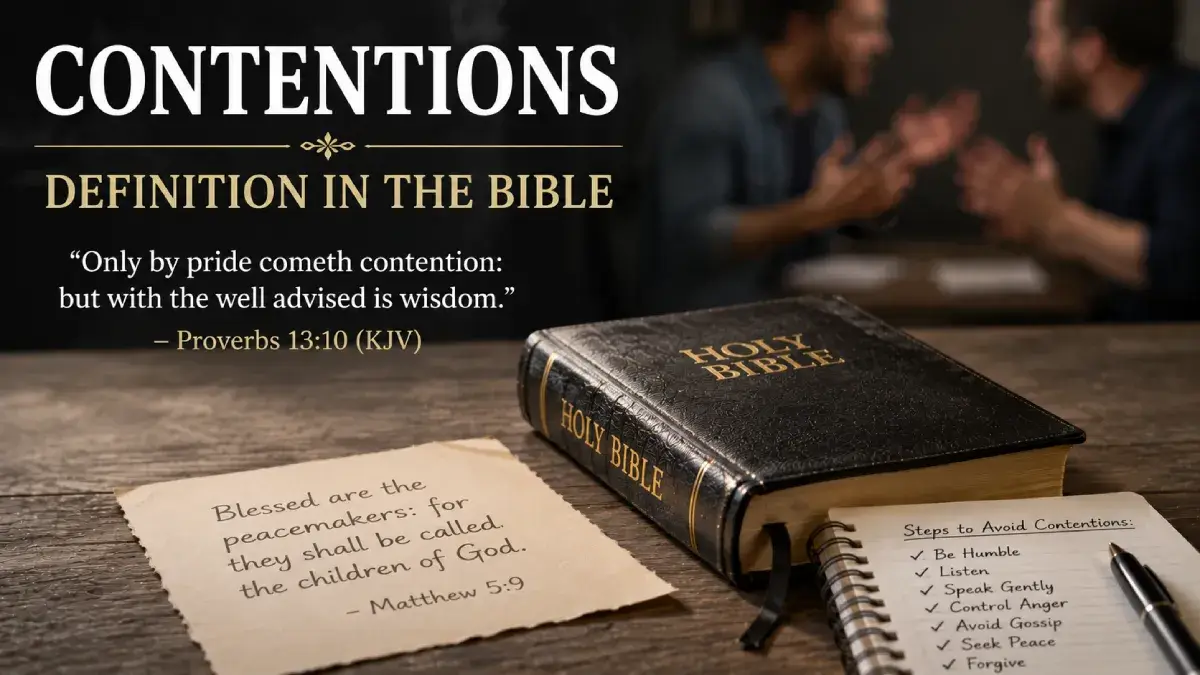
The word contentions appears in several Bible passages, particularly in the King James Version (KJV). If you have come across verses that warn against “contentions,” you may wonder what the word means and why Scripture takes the subject so seriously.
In the Bible, contentions generally refer to quarrels, disputes, strife, arguments, or ongoing conflict between people. Biblical contentions can begin with anger, pride, jealousy, selfish ambition, careless words, or disagreements that are allowed to grow.
Scripture doesn’t teach that Christians should avoid every disagreement. Sometimes truth requires correction, discernment, or even a difficult conversation. But the Bible repeatedly warns against the kind of argumentative spirit that creates division and destroys relationships.
One of the clearest examples is Proverbs 17:14:
“The beginning of strife is as when one letteth out water: therefore leave off contention, before it be meddled with.” – Proverbs 17:14, KJV
The picture is powerful. Once water breaks through a barrier, it can become difficult to control. In the same way, a small disagreement can become a major conflict when people continue feeding it.
Let’s examine what contentions means in the Bible, the verses that address it, and how Christians can respond when conflict arises.
What Does “Contentions” Mean in the Bible?
The biblical word contentions refers to quarreling, strife, disputes, arguments, or hostile disagreement.
Depending on the context and Bible translation, the same underlying idea may appear as:
- Strife
- Quarreling
- Disputes
- Arguments
- Fighting
- Conflict
- Contention
- Dissension
The important idea is not simply that two people disagree.
Contention describes conflict that has developed into strife or quarrelsome behavior.
For example, two Christians might have different opinions about a secondary issue without being contentious. But if that disagreement turns into insults, anger, hostility, division, or a constant desire to prove the other person wrong, it has moved toward biblical contention.
What Is the Simple Biblical Definition of Contention?
A simple definition is:
Contention in the Bible is persistent quarrel, strife, or hostile disagreement that produces conflict and division.
It can happen between:
- Husbands and wives
- Family members
- Friends
- Neighbors
- Church members
- Leaders and followers
- Nations
- Individuals with different opinions
The Bible consistently encourages God’s people to pursue peace rather than deliberately creating or continuing unnecessary conflict.
10 Bible Verses About Contentions
1. Proverbs 13:10 – Pride Produces Contention
“Only by pride cometh contention: but with the well advised is wisdom.” – Proverbs 13:10, KJV
This verse identifies pride as a major source of contention.
Why does pride create arguments?
Because pride makes us want to:
- Always be right
- Have the final word
- Defend ourselves
- Win arguments
- Refuse correction
- Look superior to others
Humility changes the way we handle disagreement.
Biblical lesson
When conflict begins, ask:
“Am I trying to resolve this, or am I simply trying to win?”
2. Proverbs 15:1 – A Gentle Answer Can Stop Conflict
“A soft answer turneth away wrath: but grievous words stir up anger.” – Proverbs 15:1, KJV
Words have enormous power.
A harsh response can escalate an argument. A calm response can interrupt the cycle.
This doesn’t mean avoiding truth or pretending that problems don’t exist.
It means choosing to communicate truth without deliberately provoking anger.
Biblical lesson
How you say something can affect whether a disagreement becomes a contention.
3. Proverbs 17:14 – Stop Contention Early
“The beginning of strife is as when one letteth out water: therefore leave off contention, before it be meddled with.”
The longer an argument continues, the harder it may become to stop.
A disagreement that could have been resolved quickly can turn into resentment, bitterness, and broken relationships.
Biblical lesson
Deal with unnecessary conflict early rather than allowing it to grow.
4. Proverbs 22:10 – Remove the Scorner
“Cast out the scorner, and contention shall go out; yea, strife and reproach shall cease.”
This verse shows how certain attitudes can fuel conflict.
A person who continually mocks, insults, or provokes others can create an environment of strife.
Biblical lesson
Sometimes peace requires establishing boundaries around destructive behavior.
5. Proverbs 26:21 – Contentious People Keep Arguments Burning
“As coals are to burning coals, and wood to fire; so is a contentious man to kindle strife.”
This is one of the clearest descriptions of the destructive nature of contention.
Wood keeps a fire burning.
Likewise, a contentious person can keep an argument alive by continually adding fuel.
That fuel might be:
- More accusations
- Angry words
- Gossip
- Sarcasm
- Insults
- Old grievances
- Suspicion
Biblical lesson
If you keep adding fuel to a conflict, don’t be surprised when the conflict continues burning.
6. Proverbs 29:22 – Anger Produces More Conflict
“An angry man stirreth up strife, and a furious man aboundeth in transgression.”
Anger can become a catalyst for contention.
Uncontrolled anger can cause us to say things we later regret and make decisions based on emotion rather than wisdom.
Biblical lesson
Learning self-control is an important part of learning how to handle conflict biblically.
7. Proverbs 26:20 – Don’t Feed the Fire
“Where no wood is, there the fire goeth out: so where there is no talebearer, the strife ceaseth.”
This verse connects contention with gossip.
Just as a fire eventually goes out when there is no fuel, conflict can lose momentum when people stop spreading it.
Biblical lesson
Don’t keep a conflict alive by repeating it to everyone else.
8. 2 Timothy 2:23 – Avoid Foolish Arguments
“But foolish and unlearned questions avoid, knowing that they do gender strifes.”
Paul warned Timothy about arguments that don’t produce spiritual benefit.
Not every debate deserves your participation.
Some arguments simply create more arguments.
Biblical lesson
Wisdom includes knowing which arguments to avoid.
9. Titus 3:9 – Avoid Foolish Disputes
“But avoid foolish questions, and genealogies, and contentions, and strivings about the law; for they are unprofitable and vain.”
Paul again warns believers about disputes that are spiritually unproductive.
This doesn’t mean Christians should never discuss difficult theological subjects.
Rather, it warns against becoming consumed by arguments that produce no useful spiritual result.
Biblical lesson
Before entering an argument, ask whether it is profitable.
10. Philippians 2:3 – Choose Humility
“Let nothing be done through strife or vainglory; but in lowliness of mind let each esteem other better than themselves.”
Paul gives believers an alternative to contention:
humility.
Instead of trying to elevate ourselves, we’re instructed to consider others with humility.
Biblical lesson
Humility is one of the strongest defenses against unnecessary conflict.
What Causes Contentions According to the Bible?
The Bible identifies several attitudes and behaviors that can lead to contention.
1. Pride
Proverbs 13:10 directly connects pride with contention.
Pride makes disagreement personal.
2. Anger
Proverbs 29:22 shows how uncontrolled anger stirs up strife.
3. Harsh Words
Proverbs 15:1 teaches that grievous words can stir anger.
4. Gossip
Proverbs 26:20 connects the removal of the talebearer with the end of strife.
5. Selfish Ambition
James 3:16 warns that where envy and selfish ambition exist, disorder and every evil practice can follow.
6. Refusing to Listen
A person who has already decided that only their perspective matters can turn nearly every conversation into an argument.
7. Foolish Arguments
2 Timothy 2:23 and Titus 3:9 warn against disputes that are unproductive.
What Is the Difference Between Contention and Healthy Disagreement?
This is an important distinction.
Not every disagreement is sinful.
Christians can disagree about decisions, interpretations, preferences, or practical matters.
The problem is when disagreement becomes characterized by hostility, pride, anger, insults, division, or an unwillingness to pursue peace.
For example:
Healthy disagreement:
“I understand your perspective, but I see this passage differently. Let’s study it together.”
Contentious disagreement:
“You’re completely wrong, and I’m going to make sure everyone knows it.”
The issue isn’t simply having different opinions.
The issue is how we respond to disagreement.
Does the Bible Say Christians Should Avoid All Arguments?
No.
Christians are called to stand for truth.
Jesus confronted hypocrisy. Paul corrected false teaching. The apostles defended the gospel.
However, Scripture also teaches believers to avoid quarrelsome behavior.
Paul wrote:
“And the servant of the Lord must not strive; but be gentle unto all men, apt to teach, patient.” – 2 Timothy 2:24, KJV
The biblical pattern is therefore not:
“Never disagree.”
It is:
“Don’t become quarrelsome.”
Truth and gentleness should work together.
How Should Christians Handle Contentions?
1. Examine Your Own Heart
Before confronting someone, ask whether pride, anger, jealousy, or resentment is influencing you.
2. Listen Before Responding
James 1:19 gives practical wisdom:
“Let every man be swift to hear, slow to speak, slow to wrath.”
Listening can prevent misunderstandings from becoming conflicts.
3. Speak Gently
Proverbs 15:1 reminds us that a gentle answer can turn away wrath.
4. Don’t Gossip About the Conflict
Taking your disagreement to everyone except the person involved usually makes matters worse.
5. Know When to Walk Away
Not every argument needs another response.
Sometimes wisdom means ending the conversation.
6. Seek Reconciliation
Romans 12:18 says:
“If it be possible, as much as lieth in you, live peaceably with all men.”
You cannot control another person’s response, but you can control your own pursuit of peace.
Bible Verses About Avoiding Strife
Several passages give practical guidance for avoiding unnecessary conflict.
Proverbs 15:18
“A wrathful man stirreth up strife: but he that is slow to anger appeaseth strife.”
Proverbs 20:3
“It is an honour for a man to cease from strife.”
Romans 12:18
“If it be possible, as much as lieth in you, live peaceably with all men.”
Ephesians 4:31–32
Believers are instructed to put away bitterness, wrath, anger, and evil speaking while embracing kindness, tenderheartedness, and forgiveness.
Colossians 3:13
Christians are called to forgive one another as the Lord has forgiven them.
These verses show that biblical Christianity isn’t merely concerned with avoiding arguments. It calls believers toward peace, forgiveness, patience, kindness, and reconciliation.
What Does “Contentious” Mean in the Bible?
The related word contentious describes someone who is inclined toward argument, quarrel, or strife.
A contentious person doesn’t simply happen to disagree occasionally.
Contention can become a characteristic pattern.
A contentious attitude may look like:
- Always needing the last word
- Constantly criticizing others
- Turning small issues into major disputes
- Refusing to admit mistakes
- Enjoying arguments
- Repeating old offenses
- Provoking people
- Spreading conflict through gossip
The Bible encourages believers to develop the opposite qualities:
gentleness, patience, humility, wisdom, forgiveness, and peace.
What Does the Bible Say About a Contentious Person?
Scripture repeatedly warns that a contentious person can damage relationships and communities.
Proverbs 26:21 compares such a person to fuel added to a fire.
The warning is especially relevant in families, marriages, friendships, workplaces, and churches.
One person’s constant argumentative behavior can create an atmosphere where everyone becomes defensive.
The biblical response is not necessarily to retaliate.
Instead, believers are called to pursue wisdom, establish appropriate boundaries when necessary, speak truthfully, and refuse to participate in unnecessary strife.
5 Practical Questions to Ask Before an Argument
When you feel a disagreement becoming heated, stop and ask:
1. Is this actually important?
Some disagreements have eternal significance. Others are simply matters of preference.
2. Am I motivated by truth or pride?
Proverbs 13:10 warns about pride producing contention.
3. Will my words help?
Proverbs 15:1 reminds us of the power of our response.
4. Am I listening?
James 1:19 calls us to be quick to hear and slow to speak.
5. Can I pursue peace?
Romans 12:18 calls believers to live peaceably whenever possible.
These questions can turn a potential argument into an opportunity for wisdom.
A Short Prayer for Peace in Conflict
Heavenly Father,
Give me wisdom when I disagree with others. Help me recognize pride, anger, and selfishness in my own heart. Make me quick to listen, slow to speak, and slow to become angry.
Help me speak truth with gentleness and refuse to fuel unnecessary conflict. Give me the humility to apologize when I am wrong and the grace to forgive others when I have been hurt.
Help me pursue peace without compromising truth. Let my words bring wisdom, healing, and reconciliation rather than division.
In Jesus’ name, Amen.
Final Thoughts on the Biblical Meaning of Contentions
The biblical definition of contentions is closely connected with quarrels, strife, disputes, and conflict.
Scripture repeatedly warns us about the damage contention can cause.
Proverbs teaches that pride, anger, harsh words, and gossip can fuel strife. The New Testament warns Christians against becoming consumed by foolish disputes and calls them instead to gentleness, patience, humility, forgiveness, and peace.
The goal isn’t to avoid every disagreement.
The goal is to learn how to disagree without becoming contentious.
When conflict comes, remember:
Listen before speaking.
Check your heart.
Speak gently.
Don’t feed gossip.
Know when to walk away.
Pursue reconciliation when possible.
And most importantly, remember the wisdom of Proverbs 15:1:
“A soft answer turneth away wrath.”
Sometimes the most powerful response to contention isn’t another argument.
It’s wisdom, humility, and peace.
Frequently Asked Questions
What does contentions mean in the Bible?
Contentions means quarrels, disputes, strife, or hostile disagreement. The Bible generally uses the concept negatively when it describes unnecessary conflict that produces division and strife.
What is the biblical meaning of contention?
Biblical contention refers to conflict or quarrelsome behavior between people. Scripture particularly warns against contention driven by pride, anger, selfishness, gossip, and foolish disputes.
What Bible verse talks about contention?
Proverbs 13:10 says, “Only by pride cometh contention.” Proverbs 17:14, Proverbs 26:21, Titus 3:9, and other passages also address contention and strife.
What causes contention according to the Bible?
The Bible connects contention with attitudes and behaviors such as pride, anger, harsh words, gossip, envy, selfish ambition, and foolish disputes.
Does contention always mean disagreement?
No. People can disagree without being contentious. Biblical contention involves quarrelsome or hostile conflict rather than simply having different opinions.
How can I avoid being contentious?
Practice humility, listen carefully, control anger, speak gently, avoid gossip, don’t participate in pointless arguments, and pursue peace whenever possible.