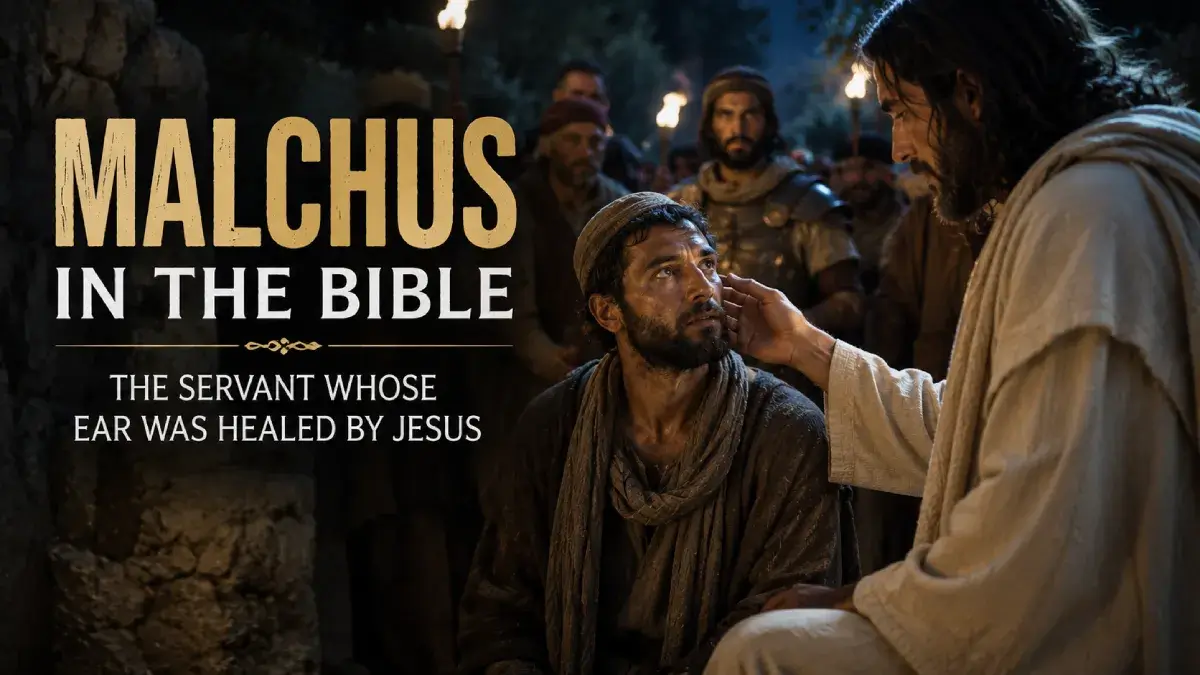
The name Malchus appears only briefly in the Bible, but the event involving him is one of the most memorable moments surrounding Jesus’ arrest.
Malchus was a servant of the high priest who was present when Jesus was arrested in the Garden of Gethsemane. During the confrontation, one of Jesus’ disciples drew a sword and struck Malchus, cutting off his right ear.
The Gospel of John identifies the disciple as Peter and gives the injured man’s name as Malchus.
What makes the story especially remarkable is what happened next.
Jesus healed the injured man’s ear.
This small detail reveals something profound about Jesus’ character. Even as He was being arrested and led toward the cross, Jesus showed compassion toward a person who had come with those who were arresting Him.
So, who was Malchus in the Bible? Why is his name mentioned? Who cut off his ear? And what can Christians learn from Jesus’ response?
Let’s explore the story.
Who Was Malchus in the Bible?
Malchus was a servant of the high priest who was present when Jesus was arrested.
His name is specifically mentioned in John 18:10.
John records that Peter drew a sword and struck the high priest’s servant, cutting off his right ear. John identifies the servant as:
Malchus.
The other Gospel accounts describe the same incident, although they do not all provide his name.
Malchus therefore appears in the biblical narrative at a critical moment: the arrest of Jesus in Gethsemane.
His appearance is brief, but his encounter with Jesus provides an extraordinary picture of Christ’s mercy.
Where Is Malchus Mentioned in the Bible?
Malchus is mentioned by name in John 18:10.
The incident is also recorded in the other Gospels:
- Matthew 26:51 — someone with Jesus cuts off the ear of the high priest’s servant.
- Mark 14:47 — a sword is used against the high priest’s servant.
- Luke 22:50–51 — the servant’s ear is cut off, and Jesus heals him.
- John 18:10 — John identifies the disciple as Peter and the servant as Malchus.
This makes the story particularly interesting.
John gives us the man’s name.
Luke records Jesus healing him.
When these accounts are read together, we get a fuller picture of what happened.
What Happened to Malchus?
Malchus was part of the group that came to arrest Jesus.
Jesus had gone to the Garden of Gethsemane after the Last Supper.
Judas Iscariot arrived with a group of people sent by the religious authorities. They came with weapons and lanterns to find Jesus.
When the group identified Jesus, one of His disciples reacted violently.
John 18:10 tells us that Simon Peter had a sword.
Peter struck the high priest’s servant and cut off his right ear.
That servant was Malchus.
But Jesus did not respond by encouraging His disciples to fight.
Instead, He intervened.
Who Cut Off Malchus’s Ear?
Peter cut off Malchus’s ear.
John 18:10 is the Gospel that explicitly identifies Peter as the disciple who used the sword.
Peter drew the sword and struck the high priest’s servant.
John identifies the servant as Malchus.
The event is also recorded in Matthew, Mark, and Luke, but those accounts do not name Peter in the immediate description of the sword attack.
John provides the specific identification.
Why Did Peter Cut Off Malchus’s Ear?
Peter appears to have been attempting to defend Jesus from those who had come to arrest Him.
The disciples understood that Jesus was in danger, and Peter responded with a weapon.
His action reflects the natural human impulse to fight when someone we love is threatened.
But Jesus immediately rejected that approach.
In John 18:11, Jesus tells Peter to put the sword away.
Matthew’s account records Jesus saying:
“Put your sword back in its place.”
Jesus then explains that those who take up the sword will face its consequences.
The message is clear:
Jesus was not going to accomplish His mission through violent resistance.
Why Did Jesus Heal Malchus?
Luke 22:51 contains one of the most remarkable details in the entire story.
After Malchus’s ear was cut off, Jesus touched the man’s ear and healed him.
Think about the setting.
Jesus was being arrested.
His enemies had come to take Him away.
One of His followers had just injured one of the men involved in the arrest.
Yet Jesus responded by healing the wounded man.
This demonstrates the extraordinary compassion of Christ.
Jesus did not allow the hostility surrounding Him to determine His response.
The Significance of Jesus Healing Malchus
Jesus healing Malchus carries several important lessons.
Jesus Showed Mercy to an Enemy
Malchus was associated with the group that came to arrest Jesus.
Yet Jesus showed compassion toward him.
Jesus Rejected Unnecessary Violence
Peter believed that the situation required a sword.
Jesus demonstrated a different way.
Jesus Controlled the Situation
Jesus was not helplessly caught in events beyond His control.
He willingly submitted to arrest.
Jesus Loved Even in His Final Hours
Jesus’ compassion did not disappear when He was under pressure.
Jesus Practiced What He Taught
Jesus had taught His followers to love their enemies.
Here, His actions demonstrated that teaching.
Was Malchus a Roman Soldier?
No. The Bible identifies Malchus as a servant of the high priest.
John 18:10 specifically calls him the high priest’s servant.
The arrest party included various people, but Scripture does not identify Malchus as a Roman soldier.
This distinction is important because Malchus is sometimes portrayed simply as a soldier or guard in popular retellings.
The biblical text gives us a more specific description:
He was the servant of the high priest.
Was Malchus a Slave?
The word translated “servant” can have a broader range of meaning depending on the translation and context.
Some Bible translations use “servant,” while the underlying terminology can refer to someone serving another person.
The Bible does not give us enough information to reconstruct Malchus’s complete social status or personal history.
Therefore, it is best to stay with what Scripture explicitly tells us:
Malchus was a servant of the high priest.
Who Was Malchus’s Master?
Malchus served the high priest.
John 18:10 describes him as the high priest’s servant.
The Gospel account does not spend much time explaining Malchus personally. His significance in the story comes primarily from his encounter with Jesus.
Malchus was apparently close enough to the high priest’s household or representatives to be present during Jesus’ arrest.
Which High Priest Did Malchus Serve?
The events surrounding Jesus’ arrest involve Annas and Caiaphas, who appear in the trial narratives.
John 18:13 says Jesus was first taken to Annas, who was the father-in-law of Caiaphas, the high priest that year.
John later describes Caiaphas as the high priest.
Because Malchus is called the servant of the high priest, the Gospel account connects him with the high-priestly circle involved in Jesus’ arrest.
However, Scripture does not provide a detailed biography of Malchus or explain his exact duties.
Did Malchus Know Jesus?
The Bible does not tell us what Malchus personally knew about Jesus before the arrest.
He was present with the group that came to arrest Jesus, but Scripture does not describe Malchus’s personal thoughts, beliefs, or attitude toward Jesus.
We should therefore avoid claiming that Malchus was a believer, an unbeliever, or a particular kind of opponent.
What we do know is that he encountered Jesus directly—and experienced His healing.
Did Malchus Become a Follower of Jesus?
The Bible does not say.
This is one of the most common questions about Malchus.
Because Jesus healed him, it can be tempting to assume that Malchus later became a Christian.
But Scripture does not tell us what happened to him afterward.
There are traditions and imaginative interpretations about Malchus, but these should not be confused with biblical information.
The safest answer is:
We do not know what happened to Malchus after Jesus healed him.
Did Malchus Have His Ear Completely Cut Off?
The Gospels describe the ear as being cut off.
John specifically says it was Malchus’s right ear.
The biblical text does not provide a detailed medical description of the injury.
Luke, however, records that Jesus healed the injured ear.
The emphasis of the narrative is therefore not on the medical details but on Jesus’ miraculous compassion in the middle of His arrest.
What Happened to Malchus After Jesus Healed Him?
The Bible does not provide a later biography of Malchus.
After Jesus healed his ear, the Gospel narrative continues with Jesus’ arrest and subsequent trials.
Malchus disappears from the biblical account.
We are not told:
- Whether he later believed in Jesus
- Whether he became a disciple
- Whether he told others about the miracle
- What happened to him after the resurrection
- How his life changed after encountering Jesus
Those questions are interesting, but Scripture does not answer them.
Why Does John Mention Malchus by Name?
One interesting feature of the story is that John names Malchus, while the other Gospel accounts simply refer to the high priest’s servant.
John also names Peter as the disciple who used the sword.
This gives the account a level of specificity.
John 18:10 essentially identifies both individuals involved in the confrontation:
Peter — the disciple with the sword.
Malchus — the high priest’s servant who was injured.
This makes the event particularly vivid.
Why Does Luke Emphasize the Healing?
Luke’s account contains the detail that Jesus healed the wounded ear.
That detail is important because it reveals Jesus’ response to violence.
Peter acts with a sword.
Jesus responds with healing.
The contrast is powerful.
One response produces injury.
The other produces restoration.
This is consistent with Jesus’ broader ministry, which repeatedly involved healing, mercy, restoration, and compassion.
Matthew 26 and the Sword
Matthew’s account adds Jesus’ warning about the sword.
Jesus tells Peter to put his sword away.
He then explains that those who take up the sword will perish by the sword.
Jesus also emphasizes that He could call upon the Father for heavenly assistance if He wanted to avoid what was happening.
This shows that Jesus’ arrest was not simply a situation where He lacked the power to resist.
He chose to submit.
He understood that the events were part of His mission.
Mark 14 and the High Priest’s Servant
Mark records the same basic event.
One of the people with Jesus draws a sword and strikes the high priest’s servant.
Mark does not give the servant’s name in this passage.
However, when Mark is read alongside John, we know that the servant was Malchus.
The four Gospel accounts sometimes provide different details about the same event, and those details can complement one another.
Luke 22:50–51 and the Miracle
Luke’s account is especially important because it records the healing.
After the servant’s ear was cut off, Jesus responded:
“No more of this!”
Then He touched the man’s ear and healed him.
This brief statement is powerful.
Jesus effectively stopped the cycle of violence.
Peter injured.
Jesus healed.
The contrast could hardly be clearer.
John 18:10–11 and Jesus’ Command
John gives us the most specific identification of the people involved.
Peter has a sword.
Malchus is the servant of the high priest.
Peter cuts off Malchus’s right ear.
Jesus tells Peter to put the sword away.
John’s account also connects Jesus’ response to His willingness to drink the cup given to Him by the Father.
Jesus understood that His arrest and crucifixion were part of His mission.
Malchus and the Arrest of Jesus
Malchus’s story cannot be separated from the larger story of Jesus’ arrest.
Jesus had spent His final hours teaching His disciples.
He prayed in Gethsemane.
Judas arrived with those who had come to arrest Him.
Jesus was identified.
Peter reacted with violence.
Malchus was wounded.
Jesus healed him.
Then Jesus surrendered Himself.
This sequence provides a remarkable picture of Jesus’ character under extreme pressure.
What Can We Learn From Malchus in the Bible?
Although Malchus appears only briefly, his story provides several meaningful lessons.
1. Jesus Shows Mercy Even Under Pressure
Jesus was facing arrest, humiliation, and crucifixion.
Yet He still stopped to heal someone who had been injured during the confrontation.
Our circumstances do not have to determine whether we show compassion.
2. Jesus Does Not Need Violence to Accomplish God’s Will
Peter wanted to fight.
Jesus told him to put away his sword.
Christ’s kingdom would not be established through Peter’s violence.
3. Jesus Can Interrupt the Cycle of Violence
Peter injured Malchus.
Jesus healed Malchus.
The story gives us a picture of how Christ responds to violence: with restoration rather than retaliation.
4. Loving Your Enemies Is More Than a Teaching
Jesus had taught His followers to love their enemies.
When confronted with an enemy, He demonstrated that principle.
5. Jesus’ Mission Was Voluntary
Jesus was not simply overpowered.
He willingly submitted to the events leading toward the cross.
6. A Brief Encounter With Jesus Can Be Significant
Malchus appears only briefly in Scripture.
Yet his encounter with Jesus involved a remarkable miracle.
Even people who appear only briefly in the biblical narrative can teach profound lessons.
Malchus and the Christian Call to Love Enemies
The story of Malchus connects strongly with Jesus’ teaching in Matthew 5:44:
“Love your enemies and pray for those who persecute you.”
Malchus was part of the group involved in Jesus’ arrest.
Peter responded by striking him.
Jesus responded by healing him.
This is an extraordinary example of the difference between retaliation and love.
Jesus did not approve of the injustice surrounding His arrest.
But He did not allow injustice to turn Him into someone who responded with hatred.
Malchus and Forgiveness
The Bible does not explicitly say that Jesus forgave Malchus.
In fact, Malchus is not described as personally committing an offense against Jesus.
However, Jesus’ healing of him demonstrates mercy toward someone on the opposing side of the confrontation.
The broader context of Jesus’ teaching on forgiveness makes this especially meaningful.
Jesus consistently taught His followers to forgive and love others.
His treatment of Malchus provides a practical example of that character.
Did Jesus Heal Malchus’s Ear Before or After the Arrest?
The healing occurred during the confrontation surrounding Jesus’ arrest.
Luke 22:50–51 places the healing immediately after the servant’s ear was cut off.
The group had come to arrest Jesus, and the conflict occurred before Jesus was taken away.
The miracle therefore happened during the arrest scene.
Did Peter Regret Cutting Off Malchus’s Ear?
The Bible does not explicitly record Peter expressing regret about the incident at that moment.
We should therefore be cautious about claiming what Peter personally felt.
However, Jesus’ command to put away the sword clearly showed Peter that violence was not the way Jesus intended His followers to respond.
Peter would later experience his own painful failure when he denied knowing Jesus.
His story as a whole became one of repentance, restoration, and transformation.
Was Malchus at Jesus’ Trial?
The Bible does not specifically state that Malchus was present at every stage of Jesus’ trial.
He appears in the arrest account.
We should not assume that he personally participated in the later proceedings unless Scripture tells us so.
The biblical narrative gives us very little information about his life beyond this encounter.
Malchus in the Bible: A Picture of Grace
Perhaps the most beautiful aspect of Malchus’s story is that the last thing Scripture tells us about him in connection with Jesus is not that Jesus condemned him, but that Jesus healed him.
The circumstances were hostile.
Jesus was being arrested.
Peter reacted violently.
Malchus was injured.
Yet Jesus brought healing into the middle of the chaos.
This reflects a repeated pattern in Jesus’ ministry.
Where people were broken, He brought restoration.
Where people were suffering, He showed compassion.
Where there was fear, He brought peace.
And in the final hours before the cross, that character remained unchanged.
What Does Malchus Mean in the Bible?
The name Malchus is generally connected with a Semitic root associated with king or royalty.
However, the Bible does not provide a symbolic interpretation of his name.
It is therefore better not to build a major theological meaning around the name itself.
The important biblical information is about the person and his encounter with Jesus.
Is Malchus Mentioned in the Old Testament?
No.
The Malchus connected with Jesus’ arrest is a New Testament figure.
His story appears in the Gospel accounts of Jesus’ arrest.
Is Malchus Mentioned in Acts?
No.
The Bible does not provide a later account of Malchus in Acts.
This is another reason why we should be cautious about claims concerning what happened to him after Jesus’ resurrection.
Is Malchus Mentioned by Name in All Four Gospels?
No.
John is the Gospel that names him as Malchus.
Matthew, Mark, and Luke describe the injured servant but do not give his name in the relevant passages.
Luke provides the unique detail that Jesus healed the ear.
John provides the names of both the disciple and the servant.
Reading all four accounts together gives the fullest picture.
A Simple Timeline of Malchus’s Story
Here is the sequence of events:
1. Jesus goes to Gethsemane.
Jesus enters the garden and prepares for the events ahead.
2. Judas arrives with an arresting group.
They come with weapons and authority to take Jesus.
3. Malchus is present.
He is identified as the high priest’s servant.
4. Peter draws a sword.
Peter reacts to the threat against Jesus.
5. Peter cuts off Malchus’s right ear.
The confrontation becomes violent.
6. Jesus stops the violence.
Jesus tells Peter to put away the sword.
7. Jesus heals Malchus.
Luke records that Jesus restores the injured ear.
8. Jesus allows Himself to be arrested.
He continues toward the cross.
This short sequence reveals an enormous amount about Jesus’ character.
Lessons From Jesus’ Response to Malchus
The story challenges us to consider how we respond when we are under pressure.
When Others Attack, Do We Retaliate?
Peter’s instinct was to fight.
Jesus’ response was radically different.
When We Have Been Wronged, Can We Still Show Compassion?
Jesus demonstrated compassion in an extremely hostile situation.
Do We Trust God Enough to Refuse Revenge?
Jesus did not need Peter’s sword to protect His mission.
Can We Bring Healing Instead of More Harm?
The contrast between Peter and Jesus is striking.
Peter caused injury.
Jesus brought healing.
That is a powerful picture for Christian living.
What Malchus Teaches Us About Jesus
The story of Malchus ultimately tells us more about Jesus than it tells us about Malchus.
Malchus is a minor figure.
Jesus is the central figure.
Through this brief encounter, we see Jesus as:
- Compassionate
- Merciful
- Peaceful
- Self-controlled
- Courageous
- Willing to suffer
- Committed to His mission
- Concerned about the wounded
- Opposed to unnecessary violence
Even when surrounded by people who had come to arrest Him, Jesus continued to act with mercy.
Frequently Asked Questions About Malchus in the Bible
Who was Malchus in the Bible?
Malchus was a servant of the high priest who was present when Jesus was arrested in Gethsemane. Peter cut off his right ear, and Jesus healed him.
Where is Malchus mentioned in the Bible?
Malchus is specifically named in John 18:10. The incident involving the high priest’s servant is also recorded in Matthew 26:51, Mark 14:47, and Luke 22:50–51.
Who cut off Malchus’s ear?
Peter cut off Malchus’s right ear with a sword. John 18:10 specifically identifies Peter as the disciple who struck him.
Which ear did Peter cut off?
Peter cut off Malchus’s right ear, according to John 18:10.
Did Jesus heal Malchus?
Yes. Luke 22:51 records that Jesus touched the injured man’s ear and healed him.
Was Malchus a Roman soldier?
No. Scripture identifies Malchus as a servant of the high priest.
Was Malchus a disciple of Jesus?
The Bible does not say that Malchus was a disciple of Jesus.
Did Malchus become a Christian?
The Bible does not tell us what happened to Malchus after Jesus healed him. There is no biblical statement that he became a Christian.
Was Malchus a slave?
The Bible calls him the high priest’s servant. Scripture does not provide enough information to give a more detailed account of his social status.
Why did Peter cut off Malchus’s ear?
Peter appears to have been trying to defend Jesus when the group came to arrest Him. Jesus, however, commanded Peter to put away his sword.
Why did Jesus heal Malchus?
The Gospel of Luke records that Jesus healed him but does not provide a separate explanation for why He performed the healing. The act demonstrates Jesus’ compassion and His rejection of the violence occurring around His arrest.
What does Malchus teach us about Jesus?
Malchus’s story shows Jesus responding to violence with mercy and healing. It also demonstrates that Jesus remained compassionate even during His arrest.
Is Malchus mentioned in all four Gospels?
The event is recorded in all four Gospels, but Malchus is named specifically in John. Luke uniquely records Jesus healing the injured ear.
What does the name Malchus mean?
Malchus is generally associated with a Semitic root connected with kingship or royalty. The Bible does not give a theological interpretation of his name.
Did Jesus know Malchus personally?
The Bible does not tell us whether Jesus knew Malchus personally before the arrest.
Was Malchus present when Jesus was crucified?
The Bible does not say whether Malchus was present at Jesus’ crucifixion.
What happened to Malchus after Jesus healed him?
Scripture does not tell us. His story disappears from the biblical narrative after the arrest scene.
Final Thoughts on Malchus in the Bible
The story of Malchus in the Bible is short, but its message is powerful.
Malchus was simply a servant of the high priest who arrived with the group sent to arrest Jesus.
Peter drew his sword.
Malchus was wounded.
And Jesus stepped in.
Instead of allowing the violence to continue, Jesus brought healing.
Instead of encouraging His followers to fight, He told Peter to put away the sword.
Instead of escaping His mission, Jesus willingly surrendered Himself and continued toward the cross.
The story gives us a remarkable picture of Christ’s character.
Peter brought injury. Jesus brought healing.
Peter reached for a sword. Jesus reached toward the wounded.
Peter responded to the threat with force. Jesus responded with mercy.
And perhaps that is one of the most important lessons from Malchus.
When we are surrounded by conflict, fear, or hostility, we can easily respond in the same spirit.
But Jesus shows us another way.
Choose mercy over revenge.
Choose healing over harm.
Choose peace over unnecessary violence.
And remember that even in the darkest moments before the cross, Jesus remained full of compassion.