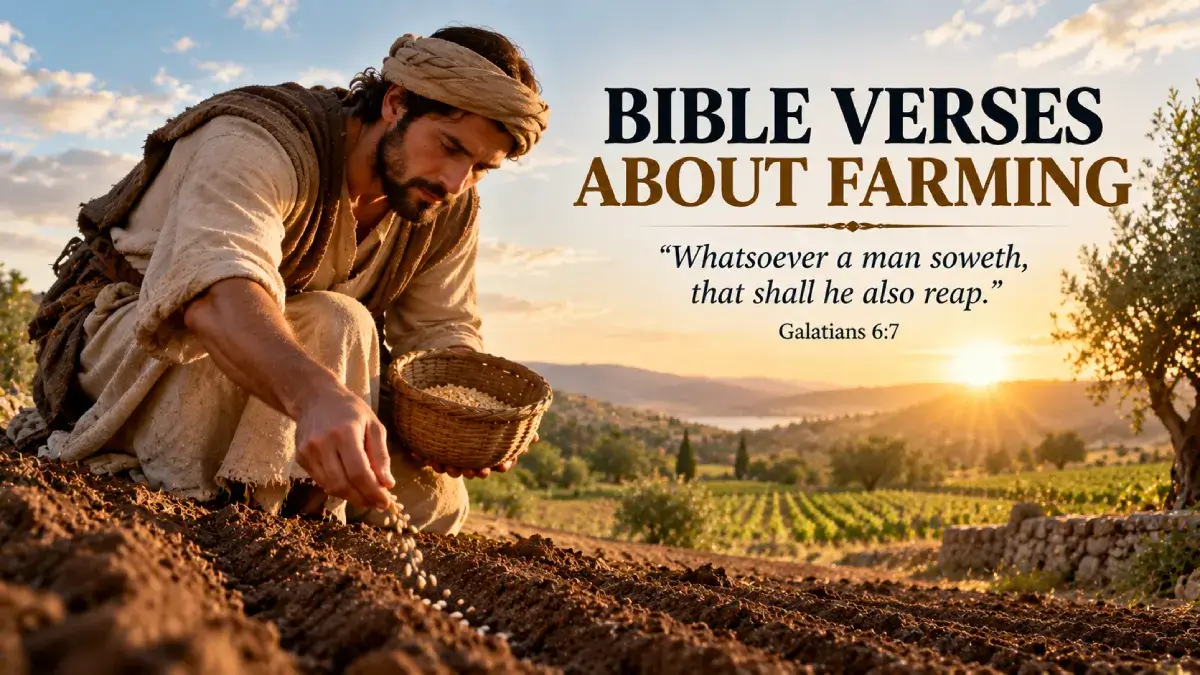
Bible Verses About Farming: Quick Answer
Farming is mentioned throughout the Bible because agriculture was central to everyday life in biblical times. Scripture frequently speaks about planting, sowing, harvesting, vineyards, fields, crops, farmers, rain, and the land.
One of the most well-known passages is:
“Whatsoever a man soweth, that shall he also reap.”
— Galatians 6:7, KJV
Jesus also used farming and agriculture to teach spiritual truths. In the Parable of the Sower, He compared God’s Word to seed falling on different types of soil.
Other important Bible verses about farming include:
- Genesis 8:22 — Seedtime and harvest will continue.
- Proverbs 20:4 — The lazy person refuses to plow in season.
- Proverbs 10:4 — Diligent work produces results.
- Ecclesiastes 11:6 — Sow your seed in the morning and continue working.
- Matthew 13:3–8 — Jesus’ Parable of the Sower.
- Matthew 13:24–30 — The Parable of the Wheat and Tares.
- John 12:24 — A grain of wheat illustrates death and fruitfulness.
- 1 Corinthians 3:6–9 — One plants, another waters, but God gives the increase.
- James 5:7 — The farmer patiently waits for the precious fruit of the earth.
- Psalm 126:5–6 — Those who sow in tears will reap with joy.
The Bible uses farming both as a literal occupation and as a powerful picture of faith, patience, obedience, work, growth, and spiritual fruitfulness.
What Does the Bible Say About Farming?
Farming was an essential part of life in the biblical world.
People planted crops, tended vineyards, raised animals, harvested grain, gathered fruit, and depended heavily on seasonal weather.
Because agriculture was so familiar to biblical audiences, God frequently used farming illustrations to communicate spiritual truths.
The Bible uses:
- Seeds to represent God’s Word and spiritual beginnings.
- Soil to represent people’s hearts.
- Planting to represent work and action.
- Watering to represent ongoing care.
- Harvest to represent results.
- Fruit to represent the outcome of a person’s life.
- Fields to represent opportunities and people.
- Farmers to illustrate patience and faithful labor.
These agricultural images make some of Scripture’s deepest spiritual lessons easier to understand.
1. Genesis 8:22 — Seedtime and Harvest
After the flood, God made a promise concerning the ongoing rhythms of creation:
“While the earth remaineth, seedtime and harvest, and cold and heat, and summer and winter, and day and night shall not cease.”
This is one of the foundational Bible verses about farming.
The verse recognizes the recurring agricultural cycle:
Seedtime → growth → harvest
Farmers depend upon these rhythms.
The passage also reminds us that God remains faithful in sustaining the created order.
Farming lesson
Farming requires patience because planting and harvesting happen in different seasons.
Spiritual lesson
Some things God is doing in our lives also require patience. We may plant today without seeing the harvest immediately.
2. Genesis 2:15 — Working the Garden
Before sin entered the world, God placed Adam in the Garden of Eden:
“To dress it and to keep it.”
This is significant because work itself was not introduced as a punishment for sin.
Human beings were given responsibility to cultivate and care for God’s creation.
Farming lesson
Cultivation requires responsibility and care.
Spiritual lesson
Work can be a meaningful part of God’s design rather than something inherently negative.
3. Genesis 4:2 — Cain Was a Tiller of the Ground
Genesis records:
“Abel was a keeper of sheep, but Cain was a tiller of the ground.”
Cain worked the soil.
This demonstrates how agriculture was already part of human life very early in biblical history.
The Bible frequently presents different forms of work—including farming and animal husbandry—as ordinary human occupations.
4. Genesis 26:12 — Isaac Sows and Reaps
“Then Isaac sowed in that land, and received in the same year an hundredfold: and the LORD blessed him.”
Isaac planted crops and experienced an abundant harvest.
The verse connects his prosperity with God’s blessing.
However, this should not be turned into a promise that every farmer will receive an extraordinary harvest simply because they work hard.
The passage describes Isaac’s particular circumstances.
Farming lesson
A farmer can work diligently, but ultimately remains dependent on God for the conditions that make growth possible.
5. Proverbs 20:4 — Plowing at the Right Time
“The sluggard will not plow by reason of the cold; therefore shall he beg in harvest, and have nothing.”
This is one of the clearest biblical lessons about farming and diligence.
Agriculture has seasons.
If a farmer refuses to do necessary work when the appropriate time arrives, there may be consequences later.
The proverb uses farming to teach against laziness and procrastination.
Spiritual lesson
There are opportunities that require action at the right time.
Constantly postponing necessary work can eventually produce regret.
6. Proverbs 10:4 — Diligent Hands
“He becometh poor that dealeth with a slack hand: but the hand of the diligent maketh rich.”
Agriculture provides an obvious illustration of this principle.
A field does not normally produce a harvest without preparation, planting, cultivation, and eventual harvesting.
Diligence matters.
The verse expresses a general wisdom principle rather than guaranteeing that every diligent person will become wealthy.
7. Proverbs 12:11 — Working the Land
“He that tilleth his land shall be satisfied with bread: but he that followeth vain persons is void of understanding.”
This verse directly connects working the land with providing food.
The contrast is between productive work and pursuing empty things.
Farming lesson
There is dignity in productive labor.
Spiritual lesson
God’s wisdom encourages people to invest their time in meaningful responsibilities rather than wasting it on empty pursuits.
8. Proverbs 24:27 — Prepare Your Work
“Prepare thy work without, and make it fit for thyself in the field; and afterwards build thine house.”
This verse emphasizes preparation and priorities.
A farmer must think about the field before enjoying the benefits of the harvest.
Lesson
Good results often require preparation before visible progress appears.
9. Ecclesiastes 3:1–2 — A Time to Plant
Ecclesiastes says:
“To every thing there is a season, and a time to every purpose under the heaven.”
Then:
“A time to plant, and a time to pluck up that which is planted.”
Farming operates according to seasons.
There is a time to plant.
There is a time to harvest.
Trying to harvest before planting makes no sense.
Spiritual lesson
Not every season of life looks the same.
Sometimes we are planting.
Sometimes we are waiting.
Sometimes we are harvesting.
Wisdom recognizes the season we are in.
10. Ecclesiastes 11:6 — Sow Your Seed
“In the morning sow thy seed, and in the evening withhold not thine hand.”
This passage encourages consistent effort.
A farmer does not necessarily know which seed will ultimately flourish.
Therefore, the instruction is to continue sowing.
Spiritual lesson
We may not know exactly which efforts will produce results, but we can remain faithful in doing what is good.
11. Psalm 126:5 — Those Who Sow in Tears
“They that sow in tears shall reap in joy.”
This is one of the most beautiful farming metaphors in Scripture.
Sowing can represent difficult work performed during painful circumstances.
The farmer plants despite not yet seeing the harvest.
The psalm uses this image to communicate hope.
Lesson
A difficult season does not necessarily mean your labor is meaningless.
Faithful work can precede joyful results.
12. Psalm 126:6 — Sowing and Reaping With Joy
The next verse says:
“He that goeth forth and weepeth, bearing precious seed, shall doubtless come again with rejoicing.”
The picture is of someone carrying seed while experiencing sorrow.
Yet the journey ends in rejoicing.
The passage reminds believers that God can bring joy out of seasons that currently involve pain.
13. Matthew 13:3–8 — The Parable of the Sower
Jesus frequently taught using agricultural imagery.
In the Parable of the Sower, a farmer scatters seed.
Some falls:
- by the wayside,
- on rocky ground,
- among thorns,
- and on good ground.
The seed produces different results depending on where it falls.
Jesus later explains that the seed represents the word of the kingdom.
Spiritual lesson
The same message can produce different responses in different hearts.
The condition of the soil matters.
14. Matthew 13:8 — The Good Soil Produces Fruit
Jesus says:
“But other fell into good ground, and brought forth fruit, some an hundredfold, some sixtyfold, some thirtyfold.”
The image of good soil producing a harvest illustrates spiritual fruitfulness.
The goal is not merely to receive God’s Word intellectually.
It should produce fruit.
Farming lesson
Healthy soil produces a crop.
Spiritual lesson
A receptive heart responds to God’s Word with fruitful living.
15. Matthew 13:24–30 — The Wheat and the Tares
Jesus also told the Parable of the Wheat and the Tares.
A man planted good seed in his field.
An enemy later sowed tares among the wheat.
The servants wanted to remove the tares immediately.
But the master instructed them to allow both to grow until the harvest.
Jesus later explained the parable.
Spiritual lesson
The parable teaches about God’s kingdom, the presence of evil, and the final separation at the harvest.
It also reminds us that God’s final judgment occurs according to His wisdom and timing.
16. Mark 4:26–29 — The Seed Grows
Jesus gives another agricultural illustration:
“So is the kingdom of God, as if a man should cast seed into the ground.”
The farmer plants the seed.
Then:
“The earth bringeth forth fruit of herself.”
The farmer does not fully understand how the growth happens.
Eventually comes the harvest.
Spiritual lesson
Some growth happens gradually and mysteriously.
We may participate faithfully without controlling every aspect of the process.
17. John 12:24 — A Grain of Wheat
Jesus says:
“Except a corn of wheat fall into the ground and die, it abideth alone: but if it die, it bringeth forth much fruit.”
This is one of the Bible’s most profound agricultural illustrations.
Jesus uses a seed to explain His coming death and its fruitfulness.
A seed is buried in the ground, yet from that apparent loss comes new life and fruit.
Spiritual lesson
God can bring extraordinary fruitfulness through sacrifice.
18. 1 Corinthians 3:6 — Planting and Watering
Paul writes:
“I have planted, Apollos watered; but God gave the increase.”
This verse provides an important perspective on spiritual work.
Paul planted.
Apollos watered.
But God gave the increase.
The agricultural image helps explain Christian ministry.
Different people may have different roles.
One person may introduce someone to the gospel.
Another may teach them.
Another may encourage them.
But spiritual growth ultimately depends on God.
19. 1 Corinthians 3:9 — God’s Field
Paul continues:
“For we are labourers together with God: ye are God’s husbandry, ye are God’s building.”
The word “husbandry” here refers to cultivation or a cultivated field.
Paul describes God’s people as God’s cultivated field.
This gives farming a powerful spiritual dimension.
Lesson
Christian ministry involves cultivation.
People need:
- teaching,
- encouragement,
- patience,
- correction,
- prayer,
- and care.
20. Galatians 6:7 — You Reap What You Sow
“Whatsoever a man soweth, that shall he also reap.”
This is probably the most widely recognized spiritual farming metaphor in the Bible.
Paul uses the agricultural principle of sowing and harvesting to explain moral consequences.
The following verse says:
“For he that soweth to his flesh shall of the flesh reap corruption; but he that soweth to the Spirit shall of the Spirit reap life everlasting.”
Spiritual lesson
Our choices matter.
What we repeatedly invest in can shape the direction and consequences of our lives.
21. Galatians 6:9 — Don’t Become Weary
Paul continues the farming imagery:
“And let us not be weary in well doing: for in due season we shall reap, if we faint not.”
This verse is especially meaningful for anyone who feels that their work is producing no visible results.
Farmers understand waiting.
A seed does not become a mature crop overnight.
Likewise, some good work requires time before its results become visible.
Lesson
Stay faithful even when the harvest has not appeared yet.
22. James 5:7 — The Farmer Waits for the Harvest
James writes:
“Behold, the husbandman waiteth for the precious fruit of the earth, and hath long patience for it.”
This is a direct reference to the patience required of farmers.
The farmer cannot force the crop to mature instantly.
He waits.
James uses this image to encourage believers to be patient.
Farming lesson
Growth takes time.
Spiritual lesson
Faith often requires patient endurance.
23. James 5:8 — Be Patient
James continues:
“Be ye also patient; stablish your hearts: for the coming of the Lord draweth nigh.”
The farming metaphor points toward patient Christian living.
The farmer works while waiting.
Likewise, Christians are called to remain faithful while waiting for God’s purposes to be fulfilled.
24. Matthew 9:37–38 — The Harvest Is Plenteous
Jesus told His disciples:
“The harvest truly is plenteous, but the labourers are few.”
Here, Jesus uses harvest language to describe people who are ready to hear the message of God’s kingdom.
He then tells His disciples:
“Pray ye therefore the Lord of the harvest, that he will send forth labourers into his harvest.”
Spiritual lesson
The harvest metaphor becomes a picture of mission and evangelism.
Christians are called not only to pray but also to participate as faithful workers.
25. John 4:35 — The Fields Are Ready
Jesus tells His disciples:
“Lift up your eyes, and look on the fields; for they are white already to harvest.”
The agricultural picture becomes an illustration of spiritual opportunity.
The disciples were being taught to recognize that people were ready to hear the message.
Lesson
Sometimes opportunities are already present, but we fail to recognize them because we are not looking.
What Does Farming Symbolize in the Bible?
Farming has several important symbolic meanings in Scripture.
1. Work
Farming requires consistent effort.
Scripture uses agricultural labor to teach diligence.
2. Patience
Farmers must wait between planting and harvest.
This makes farming a natural illustration of patience.
3. Spiritual Growth
Seeds growing into plants illustrate gradual spiritual development.
4. God’s Provision
Farmers work the soil, but ultimately depend upon God for rain, seasons, and growth.
5. Consequences
The principle of sowing and reaping illustrates how choices produce results.
6. Evangelism
Jesus uses harvest imagery to describe people who need to hear the gospel.
7. Judgment
Several biblical passages use harvest imagery to describe God’s final judgment.
Bible Verses About Planting and Harvesting
If you are specifically searching for Scriptures about planting and harvesting, these are especially useful:
Genesis 8:22
“Seedtime and harvest… shall not cease.”
Ecclesiastes 3:2
“A time to plant, and a time to pluck up that which is planted.”
Ecclesiastes 11:6
“In the morning sow thy seed.”
Psalm 126:5
“They that sow in tears shall reap in joy.”
Galatians 6:7
“Whatsoever a man soweth, that shall he also reap.”
Galatians 6:9
“In due season we shall reap, if we faint not.”
James 5:7
“The husbandman waiteth for the precious fruit of the earth.”
Bible Verses About Farmers
Several passages directly mention farmers or agricultural workers.
James 5:7
“The husbandman waiteth for the precious fruit of the earth.”
2 Timothy 2:6
“The husbandman that laboureth must be first partaker of the fruits.”
Paul uses the farmer as an example of someone who works and then shares in the results of that labor.
Proverbs 27:18
“Whoso keepeth the fig tree shall eat the fruit thereof.”
This illustrates the connection between faithful care and eventual fruit.
Bible Verses About Farming and Hard Work
Farming demonstrates that meaningful results usually require work.
Consider these passages:
Proverbs 12:11
“He that tilleth his land shall be satisfied with bread.”
Proverbs 20:4
“The sluggard will not plow by reason of the cold.”
Proverbs 10:4
“The hand of the diligent maketh rich.”
Ecclesiastes 11:6
“In the morning sow thy seed.”
2 Timothy 2:6
“The husbandman that laboureth must be first partaker of the fruits.”
The overall message is that diligence matters.
Bible Verses About Farming and Patience
Farming is also an excellent illustration of patience.
A farmer cannot plant a seed today and demand a harvest tomorrow.
James 5:7 says:
“The husbandman waiteth for the precious fruit of the earth, and hath long patience for it.”
This is an important reminder for anyone waiting for the results of faithful work.
Some things take time.
Bible Verses About Seeds
Seeds appear throughout Scripture as powerful illustrations.
Matthew 13:8
“Other fell into good ground, and brought forth fruit.”
Mark 4:26
“So is the kingdom of God, as if a man should cast seed into the ground.”
John 12:24
“Except a corn of wheat fall into the ground and die, it abideth alone.”
1 Corinthians 15:36
Paul uses the planting of a seed to explain resurrection:
“That which thou sowest is not quickened, except it die.”
The seed becomes an especially powerful biblical picture of death, transformation, and new life.
What Can Christians Learn From Farmers?
Farming offers several practical lessons for Christian life.
1. Plant Faithfully
Don’t wait to see the harvest before you begin doing what is right.
2. Be Patient
Growth often takes time.
3. Work Diligently
A farmer cannot simply wish for a harvest.
4. Trust God
Farmers can cultivate and plant, but they cannot control everything.
5. Understand Seasons
Not every season produces the same results.
6. Don’t Give Up Too Quickly
Galatians 6:9 reminds us that the harvest comes “in due season.”
7. Expect Fruit
Healthy planting should eventually produce results.
Does the Bible Say Farming Is a Blessing?
The Bible presents agriculture as an important part of God’s provision and human responsibility.
God’s blessings are sometimes described in agricultural terms, including:
- fruitful land,
- abundant crops,
- rain,
- grain,
- wine,
- oil,
- livestock,
- and harvest.
For example, Deuteronomy contains many descriptions of the agricultural abundance associated with God’s blessing of Israel.
At the same time, Scripture also records droughts, famines, crop failures, and agricultural hardship.
Therefore, the Bible does not teach that every farmer will always experience abundant crops.
Rather, agricultural imagery is frequently used to demonstrate God’s provision, human responsibility, dependence, and covenant blessings.
A Prayer for Farmers and Agricultural Workers
Heavenly Father,
Thank You for the land, the rain, the seasons, and the food that sustains us.
Bless those who work the soil and care for crops and animals.
Give farmers wisdom as they make decisions about planting, cultivation, and harvest.
Protect their fields from destructive weather, disease, pests, and other dangers.
Give them strength when the work is difficult and patience when results are slow.
Help us remember that although people plant and cultivate, You ultimately sustain creation and give growth.
Teach us to apply the lessons of farming to our own lives—to work faithfully, wait patiently, and trust You with the harvest.
In Jesus’ name, Amen.
15 Short Bible Verses About Farming
Here are some of the best Scriptures to remember:
- Genesis 8:22 — “Seedtime and harvest… shall not cease.”
- Genesis 2:15 — Adam was placed in the garden to work and keep it.
- Genesis 26:12 — Isaac sowed and received a harvest.
- Proverbs 10:4 — “The hand of the diligent maketh rich.”
- Proverbs 12:11 — “He that tilleth his land shall be satisfied with bread.”
- Proverbs 20:4 — The sluggard refuses to plow in season.
- Ecclesiastes 3:2 — “A time to plant.”
- Ecclesiastes 11:6 — “In the morning sow thy seed.”
- Psalm 126:5 — “They that sow in tears shall reap in joy.”
- Matthew 13:8 — The seed in good ground produces fruit.
- John 12:24 — The grain of wheat illustrates fruitfulness.
- 1 Corinthians 3:6 — “I have planted, Apollos watered; but God gave the increase.”
- Galatians 6:7 — “Whatsoever a man soweth, that shall he also reap.”
- Galatians 6:9 — “In due season we shall reap.”
- James 5:7 — The farmer waits patiently for the harvest.
Frequently Asked Questions
What is a good Bible verse about farming?
Genesis 8:22 is one of the foundational verses: “While the earth remaineth, seedtime and harvest… shall not cease.”
James 5:7 is another excellent passage because it directly describes the farmer waiting patiently for the harvest.
What does the Bible say about farmers?
The Bible presents farming as an important occupation and frequently uses farmers, seeds, fields, planting, and harvests to illustrate spiritual truths about work, patience, growth, faith, and God’s provision.
What Bible verse says you reap what you sow?
Galatians 6:7 says: “Whatsoever a man soweth, that shall he also reap.”
Paul uses this agricultural principle to teach about moral and spiritual consequences.
What does farming symbolize in the Bible?
Farming can symbolize work, patience, spiritual growth, consequences, God’s provision, evangelism, and final judgment, depending on the biblical context.
What does Jesus say about farming?
Jesus frequently used farming illustrations. He taught the Parable of the Sower, the Wheat and the Tares, and the Growing Seed. He also compared His coming death to a grain of wheat and described people who needed the gospel as a harvest.
What does the Bible say about planting seeds?
Scripture uses planting seeds both literally and spiritually. Ecclesiastes 11:6 encourages sowing faithfully, while Jesus uses seeds to represent God’s Word and the kingdom of God.
What does the Bible say about harvest?
Harvest is associated with both literal crops and spiritual realities. Galatians 6:9 speaks about reaping after faithful work, while Matthew 9:37 uses harvest as an image for people ready to hear the message of God’s kingdom.
Does the Bible say farmers should be patient?
Yes. James 5:7 specifically says: “The husbandman waiteth for the precious fruit of the earth, and hath long patience for it.”
The farmer’s patience is used as an example for believers.
What is the spiritual meaning of sowing and reaping?
Sowing and reaping can illustrate the consequences of our choices and actions. Galatians 6:7–9 uses the agricultural principle to encourage believers to sow toward what is good and not become weary in doing it.
Final Thoughts
The Bible contains hundreds of agricultural references because farming was deeply connected to everyday life in the biblical world.
But Scripture does more than describe farming.
It uses farming to teach us about life with God.
A seed reminds us that small beginnings can eventually produce great fruit.
A field reminds us that growth requires cultivation.
A farmer reminds us that meaningful work requires diligence.
A harvest reminds us that actions eventually produce results.
And the waiting season reminds us that God’s timing is not always immediate.
Perhaps one of the most encouraging farming passages is Galatians 6:9:
“And let us not be weary in well doing: for in due season we shall reap, if we faint not.”
The farmer teaches us to plant faithfully, work diligently, wait patiently, and trust God with the harvest.
Whatever season you are experiencing today, remember that not every seed produces an immediate visible result. Some of the most important work happens beneath the surface before the first signs of growth appear.
Keep sowing what is good. Keep working faithfully. Keep trusting God. And when the right season comes, the harvest will reveal what was planted.