Quick Answer
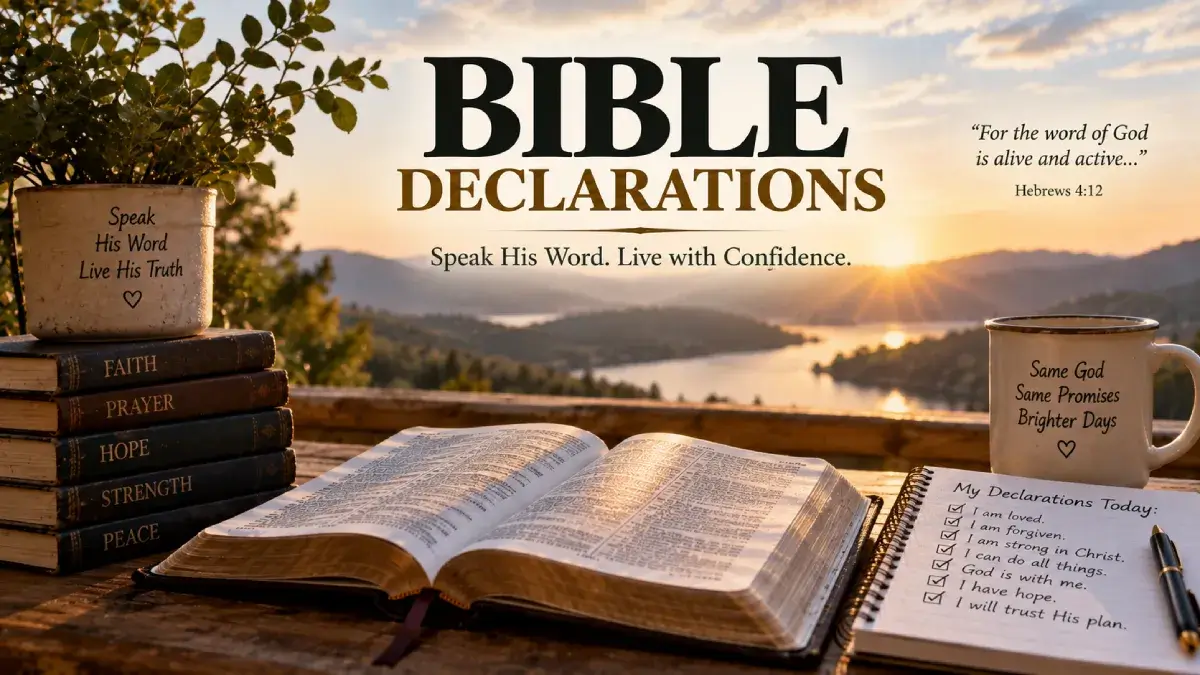
Bible declarations are faith-filled statements based on the truths and promises found in Scripture. They can help Christians remind themselves of what the Bible says about God, their identity, faith, hope, peace, strength, and future.
A biblical declaration is not a way of commanding God to do something. Instead, it is a way of agreeing with, remembering, and proclaiming biblical truth.
For example:
“I can do all things through Christ which strengtheneth me.” — Philippians 4:13 (KJV)
A Christian might turn this verse into the declaration:
“Through Christ, I have strength to face what God has placed before me.”
The purpose is not to use words as a magical formula, but to fill the mind and heart with God’s truth.
What Are Bible Declarations?
Bible declarations are statements based on Scripture that a person intentionally speaks, prays, or meditates upon.
They may focus on subjects such as:
- faith
- courage
- peace
- God’s presence
- identity in Christ
- forgiveness
- wisdom
- protection
- strength
- provision
- hope
- perseverance
- God’s faithfulness
The Bible repeatedly encourages believers to remember and speak God’s truth.
Psalm 119:105 says:
“Thy word is a lamp unto my feet, and a light unto my path.”
Biblical declarations therefore begin with God’s Word, not merely with positive thinking.
Are Bible Declarations Biblical?
The exact phrase “Bible declarations” is not a specific biblical doctrine or formula.
However, the practice of speaking, remembering, confessing, meditating on, and proclaiming God’s truth has biblical foundations.
For example, Psalm 1:2 describes the person who delights in God’s law and meditates on it continually.
Romans 10:9 also connects faith and confession:
“That if thou shalt confess with thy mouth the Lord Jesus…”
The important distinction is this:
Biblical declarations repeat or affirm biblical truth; they do not give human beings authority over God.
A declaration should therefore remain consistent with what Scripture actually teaches.
Bible Declarations vs. Positive Affirmations
Bible declarations and positive affirmations can sound similar, but they do not necessarily have the same foundation.
A generic affirmation might say:
“I am capable of achieving anything I want.”
A biblical declaration might say:
“I can do all things through Christ which strengtheneth me.” — Philippians 4:13
The second statement derives its confidence from Christ, not simply from the individual’s abilities.
Another example:
Positive affirmation: “I will never experience difficulty.”
Biblical declaration: “God is with me even when I walk through difficult circumstances.”
Psalm 23:4 provides the biblical foundation for the second idea.
The Bible does not promise that believers will never experience hardship. Instead, Scripture repeatedly teaches God’s presence and faithfulness in the midst of hardship.
30 Powerful Bible Declarations
Here are 30 declarations based on biblical passages. These are phrased as personal statements while keeping the underlying ideas connected to Scripture.
1. I Am God’s Child
Declaration: I am a child of God through faith in Christ.
Bible reference: John 1:12
The Christian’s identity begins with relationship with God rather than worldly status.
2. God Is With Me
Declaration: God is with me, and I do not have to face life alone.
Bible reference: Joshua 1:9; Matthew 28:20
God repeatedly assures His people of His presence.
Joshua 1:9 says:
“The LORD thy God is with thee whithersoever thou goest.”
3. I Can Have Courage
Declaration: I can be strong and courageous because God is with me.
Bible reference: Joshua 1:9
Biblical courage does not mean that a person never feels afraid. It means trusting God in the presence of fear.
4. God Gives Me Strength
Declaration: God is my strength when I am weak.
Bible reference: Isaiah 40:31; Psalm 28:7
Isaiah 40:31 teaches that those who wait upon the Lord will renew their strength.
5. Christ Gives Me Strength
Declaration: Through Christ, I can endure what He calls me to face.
Bible reference: Philippians 4:13
This verse is sometimes used as a promise of unlimited achievement. Its immediate context, however, concerns Paul’s ability to remain content through changing circumstances.
6. I Can Trust God
Declaration: I choose to trust the Lord rather than depend entirely on my own understanding.
Bible reference: Proverbs 3:5–6
“Trust in the LORD with all thine heart; and lean not unto thine own understanding.”
This is one of the clearest biblical foundations for a declaration of trust.
7. God Gives Me Peace
Declaration: I can bring my anxieties to God and trust Him with them.
Bible reference: Philippians 4:6–7
Paul instructs believers to bring their requests to God through prayer and thanksgiving.
The result described in the passage is God’s peace guarding the heart and mind.
8. I Do Not Have to Be Afraid
Declaration: I will not allow fear to have the final word because God is with me.
Bible reference: Isaiah 41:10
God says:
“Fear thou not; for I am with thee.”
This is a declaration of confidence in God’s presence rather than a claim that difficult circumstances will never occur.
9. God Is My Refuge
Declaration: When I am troubled, I can run to God as my refuge and strength.
Bible reference: Psalm 46:1
“God is our refuge and strength, a very present help in trouble.”
This declaration is especially meaningful during difficult seasons.
10. God Gives Wisdom
Declaration: I can ask God for wisdom when I do not know what to do.
Bible reference: James 1:5
James teaches that anyone who lacks wisdom should ask God.
This is a powerful reminder that believers do not have to pretend they have every answer.
11. I Am Forgiven
Declaration: When I confess my sins, I can trust God to forgive and cleanse me.
Bible reference: 1 John 1:9
The verse says:
“He is faithful and just to forgive us our sins, and to cleanse us from all unrighteousness.”
Biblical confidence in forgiveness rests on God’s faithfulness.
12. I Am a New Creation
Declaration: In Christ, I am a new creation.
Bible reference: 2 Corinthians 5:17
Paul describes those who are in Christ as a “new creature” in the KJV.
This declaration emphasizes transformation rather than being permanently defined by one’s past.
13. God Will Guide Me
Declaration: I can ask God to direct my path and trust Him for guidance.
Bible reference: Proverbs 3:5–6; Psalm 32:8
The Bible repeatedly encourages believers to seek God’s wisdom and direction.
14. God’s Grace Is Sufficient
Declaration: God’s grace is sufficient for me in my weakness.
Bible reference: 2 Corinthians 12:9
God tells Paul:
“My grace is sufficient for thee: for my strength is made perfect in weakness.”
This declaration is especially powerful when circumstances cannot immediately be changed.
15. I Can Persevere
Declaration: I can keep going faithfully because God gives me strength to persevere.
Bible reference: Galatians 6:9; Hebrews 12:1
Galatians 6:9 encourages believers not to become weary in doing good.
Biblical perseverance is not pretending everything is easy. It means remaining faithful despite difficulty.
16. God Hears My Prayer
Declaration: I can bring my concerns to God because He hears me.
Bible reference: 1 John 5:14–15; Psalm 34:17
Prayer is presented throughout Scripture as an important part of the believer’s relationship with God.
17. I Have Hope
Declaration: My hope is ultimately in God and His promises.
Bible reference: Romans 15:13; Psalm 42:11
Biblical hope is more than optimism.
It is confidence rooted in God.
18. God’s Mercies Are New
Declaration: I can begin today remembering that God’s mercies are new every morning.
Bible reference: Lamentations 3:22–23
The passage reminds God’s people of His continuing faithfulness.
This is especially meaningful after failure, disappointment, or a difficult season.
19. I Am Not Abandoned
Declaration: God will not abandon His people. I can trust His presence.
Bible reference: Hebrews 13:5; Deuteronomy 31:8
Hebrews 13:5 contains the promise:
“I will never leave thee, nor forsake thee.”
20. I Can Cast My Burdens on God
Declaration: I can give my burdens to God and trust Him to sustain me.
Bible reference: Psalm 55:22
“Cast thy burden upon the LORD, and he shall sustain thee.”
This does not mean believers never experience stress. It means they do not have to carry their burdens without turning to God.
21. I Am Loved by God
Declaration: God’s love is demonstrated through Christ, and I can rest in that love.
Bible reference: Romans 5:8; John 3:16
Romans 5:8 points to God’s love being demonstrated through Christ’s death for sinners.
22. I Can Forgive Others
Declaration: Because I have received God’s forgiveness, I am called to forgive others.
Bible reference: Ephesians 4:32; Colossians 3:13
Biblical declarations should not only focus on what God gives us. They should also remind us how God calls us to live.
23. I Can Choose Peace
Declaration: I can pursue peace and respond to others with grace.
Bible reference: Romans 12:18; Colossians 4:6
The Bible repeatedly calls believers toward peaceful and gracious relationships.
24. God Is Faithful
Declaration: God is faithful, and I can rely on His character.
Bible reference: 1 Corinthians 1:9; Deuteronomy 7:9
God’s faithfulness is one of the Bible’s recurring themes.
25. I Can Seek God’s Kingdom First
Declaration: I want to seek God’s kingdom and His righteousness first.
Bible reference: Matthew 6:33
Jesus teaches His followers to prioritize God’s kingdom rather than being consumed by anxiety about material needs.
26. I Am Called to Love Others
Declaration: I am called to love God and love others.
Bible reference: Matthew 22:37–39
Jesus identifies love for God and love for one’s neighbor as central commandments.
27. I Can Stand Firm in Faith
Declaration: I will stand firm in faith and remain faithful to God.
Bible reference: 1 Corinthians 16:13; Ephesians 6:13
Paul repeatedly encourages Christians to stand firm.
This declaration emphasizes perseverance and spiritual faithfulness.
28. I Have God’s Word to Guide Me
Declaration: God’s Word gives me guidance for my path.
Bible reference: Psalm 119:105
“Thy word is a lamp unto my feet, and a light unto my path.”
Scripture provides a foundation for Christian decision-making and spiritual growth.
29. I Can Give Thanks
Declaration: I can give thanks to God even when circumstances are difficult.
Bible reference: 1 Thessalonians 5:18; Psalm 107:1
Thanksgiving in Scripture is rooted in God’s character rather than requiring perfect circumstances.
30. My Future Is in God’s Hands
Declaration: I can entrust my future to God and remain faithful today.
Bible reference: Proverbs 16:9; Psalm 37:5
Proverbs 16:9 reminds us:
“A man’s heart deviseth his way: but the LORD directeth his steps.”
This encourages trust without pretending that we know exactly what the future holds.
Bible Declarations for the Morning
Starting the day with Scripture can help direct your attention toward God.
Here are several short morning declarations:
- God is with me today. — Joshua 1:9
- This is the day the Lord has made. — Psalm 118:24
- God will give me wisdom for today’s decisions. — James 1:5
- I can trust God with my future. — Proverbs 3:5–6
- God’s mercies are new every morning. — Lamentations 3:22–23
- I will seek God’s kingdom first. — Matthew 6:33
- I will walk in love. — Ephesians 5:2
- I will be strong in the Lord. — Ephesians 6:10
These declarations can become part of a morning prayer or Bible-reading routine.
Bible Declarations for Anxiety and Fear
When anxiety or fear becomes overwhelming, Scripture can redirect attention toward God.
Consider these declarations:
“God is my refuge and strength.”
Psalm 46:1
“I will not fear, because God is with me.”
Isaiah 41:10
“I can bring my requests to God.”
Philippians 4:6–7
“God’s peace can guard my heart and mind.”
Philippians 4:7
“I can cast my cares upon Him.”
1 Peter 5:7
These verses do not promise that anxiety will disappear instantly. They encourage believers to bring their concerns to God.
Bible Declarations for Strength
When you feel exhausted or discouraged, these passages can become declarations of faith.
Isaiah 40:31 God gives renewed strength to those who wait upon Him.
Psalm 28:7 The Lord is described as strength and shield.
2 Corinthians 12:9 God’s grace is sufficient in weakness.
Philippians 4:13 Christ gives strength to endure circumstances.
Ephesians 6:10 Believers are called to be strong in the Lord and in His power.
A biblical declaration of strength is therefore not:
“Nothing difficult will happen to me.”
It is closer to:
“God will strengthen me to remain faithful through difficulty.”
Bible Declarations for Protection
Scripture contains many passages about God’s protection.
Psalm 91
Psalm 91 is one of the Bible’s best-known passages concerning God’s protection.
Psalm 121:7
“The LORD shall preserve thee from all evil.”
Psalm 23:4
Even in the valley of the shadow of death, the psalmist says:
“Thou art with me.”
2 Thessalonians 3:3
Paul writes:
“The Lord is faithful, who shall stablish you, and keep you from evil.”
These verses encourage trust in God without turning Scripture into a guarantee that believers will never experience danger or suffering.
Bible Declarations for Healing
The Bible contains many passages about God’s compassion, healing, and care.
Some commonly studied passages include:
- Psalm 103:2–3
- Isaiah 53:4–5
- Jeremiah 17:14
- James 5:14–16
- Psalm 147:3
A careful biblical approach is important here.
Christians can confidently pray for healing while recognizing that Scripture does not teach that every person will necessarily receive physical healing immediately whenever a particular verse is spoken.
A healthy declaration might be:
“God is my healer and sustainer, and I will trust Him with my body and circumstances.”
Bible Declarations for Provision
The Bible encourages believers to trust God for their needs.
Matthew 6:31–33 teaches Jesus’ followers not to be consumed by anxiety about food, clothing, and other necessities.
Philippians 4:19 says:
“But my God shall supply all your need according to his riches in glory by Christ Jesus.”
A biblical declaration can therefore be:
“I will trust God with my needs and seek His kingdom first.”
This should not be turned into a promise that Christians will always receive every material desire.
Bible Declarations for Family
You can also use Scripture to pray for your family.
Consider:
- Joshua 24:15
- Proverbs 22:6
- Psalm 127:3–5
- Ephesians 4:32
- Colossians 3:12–14
Possible declarations include:
“My family and I will seek to serve the Lord.”
“I will treat my family with kindness, patience, and forgiveness.”
“I will seek to build my home on biblical wisdom.”
These declarations turn attention toward biblical responsibilities rather than simply asking God to make family life trouble-free.
Bible Declarations for Your Identity
Many people use Bible declarations to remind themselves who they are in Christ.
Consider these passages:
I am God’s child.
John 1:12
I am a new creation.
2 Corinthians 5:17
I am God’s workmanship.
Ephesians 2:10
I am chosen and called to live for God.
1 Peter 2:9
I am loved by God.
Romans 5:8
These declarations can be particularly helpful when a person’s identity has become tied to past mistakes, failures, social status, or other people’s opinions.
How to Use Bible Declarations
Bible declarations are most helpful when they are connected to reading and understanding Scripture.
Here is a simple five-step approach.
1. Choose a Scripture
Start with an actual Bible passage.
For example:
Philippians 4:13
2. Understand the Context
Read the verses around the passage.
This helps prevent taking a verse out of context.
For example, Philippians 4:13 is about Paul’s ability to remain faithful and content through different circumstances.
3. Turn the Truth Into a Personal Statement
You might say:
“Because Christ strengthens me, I can remain faithful through difficult circumstances.”
This keeps the declaration connected to the meaning of the passage.
4. Pray the Truth
Instead of simply repeating words mechanically, turn the Scripture into prayer.
For example:
“Lord, help me trust You when circumstances are difficult. Give me the strength to remain faithful.”
5. Live According to the Scripture
The goal of biblical declarations is not simply to speak words.
The truth of Scripture should shape:
- thoughts,
- choices,
- attitudes,
- relationships,
- and actions.
James 1:22 reminds believers to be doers of the word, not hearers only.
What Bible Declarations Are Not
Understanding what declarations are not can prevent confusion.
They Are Not Magic Words
The Bible does not teach that repeating a particular phrase automatically makes something happen.
They Are Not a Way to Control God
God is not obligated to fulfill every statement a person speaks.
They Are Not a Replacement for Prayer
Declarations can accompany prayer, but they should not replace a genuine relationship with God.
They Are Not a Replacement for Scripture Study
A short declaration can summarize a biblical truth, but reading the passage in context remains important.
They Are Not a Guarantee of a Trouble-Free Life
Jesus Himself warned His followers that they would experience trouble in the world (John 16:33).
Biblical faith does not mean pretending hardship does not exist.
How to Make Your Own Bible Declarations
You don’t need hundreds of statements.
You can create personal declarations directly from Scripture.
Step 1: Identify Your Need
Ask:
- Am I afraid?
- Am I discouraged?
- Do I need wisdom?
- Am I struggling with forgiveness?
- Am I worried about the future?
- Do I need encouragement?
Step 2: Find Relevant Scriptures
Use a Bible concordance or topical Bible to find passages related to the issue.
Step 3: Read the Context
Don’t use a verse simply because it contains words that sound encouraging.
Read the surrounding passage.
Step 4: Write the Biblical Truth
Turn the truth into a short first-person statement.
Step 5: Pray and Practice It
Use the declaration as a reminder during prayer, meditation on Scripture, and daily life.
10 Short Bible Declarations to Remember
If you want a simple list to save or share, here are ten:
- God is with me. — Joshua 1:9
- I can trust the Lord. — Proverbs 3:5–6
- God is my refuge and strength. — Psalm 46:1
- Christ gives me strength. — Philippians 4:13
- God gives me wisdom when I ask. — James 1:5
- God’s grace is sufficient for me. — 2 Corinthians 12:9
- I am a new creation in Christ. — 2 Corinthians 5:17
- God hears my prayers. — 1 John 5:14
- I can cast my cares upon God. — 1 Peter 5:7
- My hope is in the Lord. — Romans 15:13
Frequently Asked Questions About Bible Declarations
What is a biblical declaration?
A biblical declaration is a personal statement based on a truth found in Scripture. It can be spoken, prayed, memorized, or meditated upon as a way of remembering God’s Word.
Are declarations in the Bible?
The exact modern practice called “Bible declarations” is not presented as a formal biblical practice. However, Scripture contains many examples of believers declaring God’s character, promises, faithfulness, and truth.
What is a powerful Bible declaration?
One powerful declaration is based on Philippians 4:13: “Through Christ, I have strength to face what God has called me to face.”
The verse’s context concerns Paul’s contentment and endurance in different circumstances.
Can I declare Bible verses over my life?
Yes. Christians can read, memorize, pray, and personally affirm biblical truths. The important thing is to understand the passage correctly and avoid treating the words as a magical formula.
What is a good Bible declaration for the morning?
A simple morning declaration is: “This is the day which the LORD hath made; we will rejoice and be glad in it.” — Psalm 118:24
You can use the verse as a reminder to begin the day with gratitude and trust in God.
What is a Bible declaration for anxiety?
A useful declaration based on Philippians 4:6–7 is: “I can bring my worries to God in prayer and trust Him with what I cannot control.”
What is a Bible declaration for strength?
A declaration based on Isaiah 40:31 is: “As I wait on the Lord, I can trust Him to renew my strength.”
Are Bible declarations the same as affirmations?
Not necessarily. Both can involve positive statements, but biblical declarations are specifically grounded in Scripture. Their authority comes from God’s Word rather than from positive thinking alone.
Final Thoughts on Bible Declarations
Bible declarations are most powerful when they point us back to God’s Word rather than to ourselves.
Scripture gives believers truths to remember when they are:
- afraid,
- discouraged,
- confused,
- tempted,
- weary,
- hopeful,
- grateful,
- or uncertain about the future.
A declaration such as “God is with me” is meaningful because it is rooted in Scripture. A declaration such as “I will never have problems” has no equivalent biblical promise.
The purpose of biblical declarations is therefore not to create our own reality through words. It is to remember God’s truth, strengthen our faith, shape our thinking, and encourage faithful living.
As Psalm 119:105 reminds us:
“Thy word is a lamp unto my feet, and a light unto my path.”
When Bible declarations are rooted in Scripture, understood in context, and accompanied by prayer and obedience, they can become a simple daily practice for keeping God’s Word at the center of our thoughts and lives.