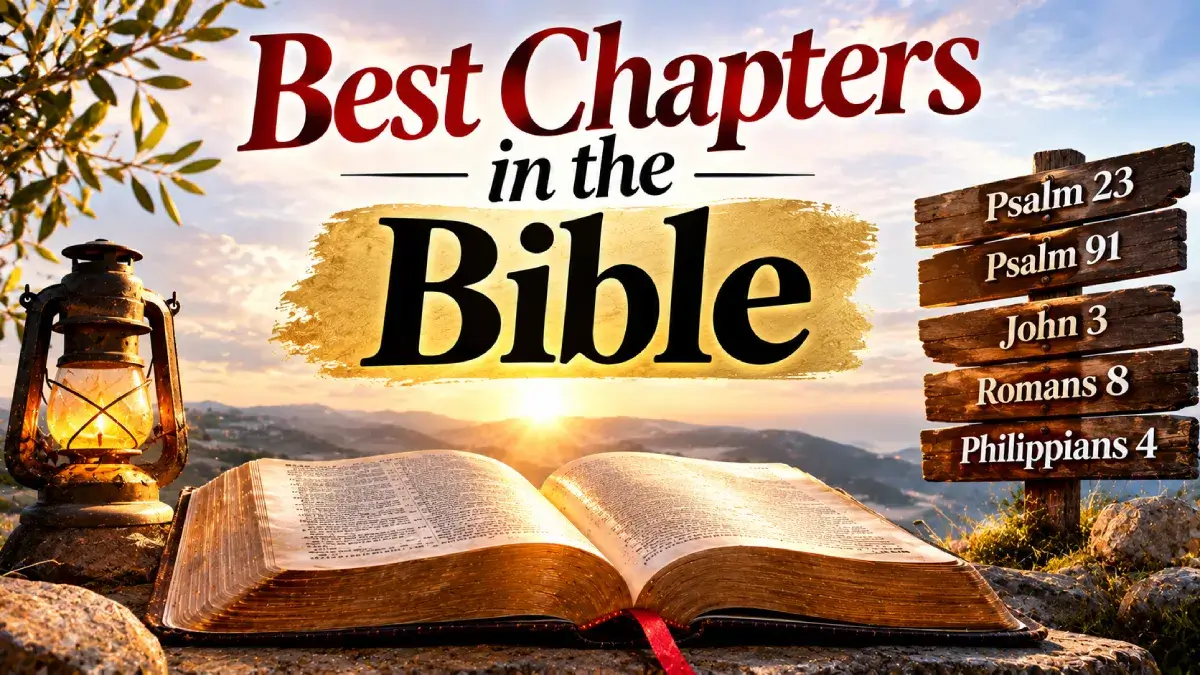
If you are looking for the most powerful and meaningful chapters in the Bible, start with these:
| Bible Chapter | Main Message |
|---|---|
| Psalm 23 | God is our Shepherd and provider |
| Psalm 91 | God’s protection and refuge |
| Psalm 1 | The blessing of walking in God’s way |
| Proverbs 3 | Wisdom, trust, and guidance |
| Isaiah 40 | God’s strength and comfort |
| Matthew 5 | Jesus’ teachings about kingdom living |
| Matthew 6 | Prayer, priorities, and trusting God |
| John 3 | Salvation and God’s love |
| John 15 | Abiding in Christ |
| Romans 8 | Life in Christ and God’s unfailing love |
| 1 Corinthians 13 | The true nature of love |
| Philippians 4 | Peace, contentment, and strength |
| Hebrews 11 | Examples of faith |
| Psalm 139 | God’s knowledge and presence |
| Joshua 1 | Courage and obedience |
These chapters are excellent places to begin if you want to understand the Bible’s central themes and find spiritual encouragement.
The Bible contains 1,189 chapters filled with wisdom, encouragement, promises, history, prophecy, faith, and guidance for everyday life. But if you are wondering where to begin, certain chapters stand out because of their powerful messages, memorable verses, and timeless truths about God.
Whether you are a new believer, looking for encouragement during a difficult season, strengthening your faith, or simply wanting to grow in your knowledge of Scripture, some chapters of the Bible are especially meaningful to read and study.
The best chapters in the Bible include Psalm 23, Psalm 91, Psalm 1, Proverbs 3, Isaiah 40, Matthew 5, John 3, Romans 8, 1 Corinthians 13, and Philippians 4. These chapters teach us about God’s love, faithfulness, salvation, wisdom, peace, hope, and the Christian life.
In this guide, we will explore 25 of the best chapters in the Bible, explain why each one is worth reading, and share what you can learn from them.
1. Psalm 23 – The Lord Is My Shepherd
Psalm 23 is one of the most beloved chapters in the Bible. Written by David, it describes the Lord as a shepherd who guides, provides, protects, and cares for His people.
The chapter reminds us that God is present in both peaceful seasons and difficult valleys.
Key verse:
“The LORD is my shepherd; I shall not want.” — Psalm 23:1 (KJV)
Psalm 23 teaches us that we are not alone. God provides spiritual nourishment, guides our steps, restores our souls, and remains with us when life becomes difficult.
Why read Psalm 23?
- When you feel anxious or overwhelmed.
- When you need reassurance of God’s presence.
- When you are walking through a difficult season.
- When you need comfort and peace.
2. Psalm 91 – The Chapter of God’s Protection
Psalm 91 is a powerful chapter about dwelling in God’s presence and trusting Him as our refuge. It describes the Lord as a shelter, fortress, deliverer, and protector.
Key verse:
“He that dwelleth in the secret place of the most High shall abide under the shadow of the Almighty.” — Psalm 91:1 (KJV)
This chapter encourages believers to place their confidence in God rather than fear. It speaks about God’s care in danger, trouble, uncertainty, and adversity.
Psalm 91 does not mean that believers will never experience suffering. Rather, it calls us to trust God in every circumstance and recognize Him as our ultimate refuge.
Why read Psalm 91?
- When you are afraid.
- When you feel vulnerable or uncertain.
- When you need to strengthen your trust in God.
- When you want to meditate on God’s faithfulness.
3. Psalm 1 – The Blessing of Walking With God
Psalm 1 introduces the book of Psalms by contrasting the life of the righteous with the life of the wicked.
It teaches that the person who delights in God’s Word and meditates on it continually is like a tree planted beside rivers of water.
Key verse:
“And he shall be like a tree planted by the rivers of water, that bringeth forth his fruit in his season.” — Psalm 1:3 (KJV)
The chapter reminds us that our spiritual lives are shaped by what we listen to, what we believe, what we value, and the direction in which we walk.
Lessons from Psalm 1:
- Be careful about the influences you allow into your life.
- Delight in God’s Word.
- Develop a consistent relationship with Scripture.
- Spiritual growth takes time and nourishment.
4. Proverbs 3 – Trust in the Lord With All Your Heart
Proverbs 3 is one of the best Bible chapters for guidance, wisdom, and decision-making. It teaches us to trust God rather than depend entirely on our own understanding.
Key verse:
“Trust in the LORD with all thine heart; and lean not unto thine own understanding.” — Proverbs 3:5 (KJV)
The following verse tells us to acknowledge God in all our ways and trust Him to direct our paths.
This chapter also teaches about wisdom, humility, discipline, generosity, and the importance of living in a way that honors God.
Why read Proverbs 3?
- When you need direction.
- When making important decisions.
- When you are uncertain about your future.
- When you want to develop godly wisdom.
5. Isaiah 40 – Strength for the Weary
Isaiah 40 is a chapter of comfort, hope, and encouragement. It reminds God’s people of His greatness, power, and everlasting nature.
When human strength fails, God’s strength remains.
Key verse:
“But they that wait upon the LORD shall renew their strength; they shall mount up with wings as eagles.” — Isaiah 40:31 (KJV)
This chapter reminds us that God does not become tired or weary. He gives strength to the weak and helps those who trust in Him.
It is particularly meaningful for people experiencing exhaustion, discouragement, disappointment, or uncertainty.
Why read Isaiah 40?
- When you feel spiritually exhausted.
- When you are losing hope.
- When you need encouragement to keep going.
- When you need a reminder of God’s power.
6. Matthew 5 – The Beatitudes and Kingdom Living
Matthew 5 begins the Sermon on the Mount, one of the most important teachings of Jesus.
It opens with the Beatitudes, describing the blessings of the poor in spirit, those who mourn, the meek, those who hunger and thirst for righteousness, the merciful, the pure in heart, and the peacemakers.
Key verse:
“Blessed are the pure in heart: for they shall see God.” — Matthew 5:8 (KJV)
Jesus also teaches about being salt and light, loving enemies, forgiveness, righteousness, and living with a heart that honors God.
Matthew 5 shows that following Christ is not merely about outward behavior. It involves the transformation of the heart.
Why read Matthew 5?
- To understand the teachings of Jesus.
- To learn how Christians should live.
- To develop humility, mercy, and righteousness.
- To understand what it means to be salt and light.
7. Matthew 6 – Prayer, Priorities, and Trusting God
Matthew 6 continues the Sermon on the Mount and teaches about prayer, giving, fasting, money, worry, and the importance of seeking God’s kingdom first.
One of its most important passages is the Lord’s Prayer.
Key verse:
“But seek ye first the kingdom of God, and his righteousness; and all these things shall be added unto you.” — Matthew 6:33 (KJV)
Jesus warns against living for earthly treasures and encourages believers to trust their heavenly Father.
The chapter also contains a powerful teaching about worry, reminding us that our heavenly Father knows what we need.
Why read Matthew 6?
- When you are worrying about tomorrow.
- When money or possessions are becoming your priority.
- When you want to improve your prayer life.
- When you need to refocus on God’s kingdom.
8. John 3 – God’s Love and the Gift of Salvation
John 3 is one of the most important chapters in the Bible because it explains the need for spiritual rebirth and God’s love for the world.
Jesus speaks with Nicodemus about being born again and explains that salvation is not simply a matter of religious knowledge or outward behavior.
Key verse:
“For God so loved the world, that he gave his only begotten Son, that whosoever believeth in him should not perish, but have everlasting life.” — John 3:16 (KJV)
John 3 points us to Jesus Christ as the source of eternal life and reveals God’s love through the gift of His Son.
Why read John 3?
- To understand the gospel.
- To learn what it means to be born again.
- To understand God’s love.
- To study the message of salvation through Jesus Christ.
9. John 15 – Abiding in Christ
John 15 contains Jesus’ teaching about the vine and the branches. He describes Himself as the true vine and His followers as branches that must remain connected to Him.
Key verse:
“I am the vine, ye are the branches: He that abideth in me, and I in him, the same bringeth forth much fruit.” — John 15:5 (KJV)
Jesus teaches that spiritual fruitfulness comes from abiding in Him. Apart from Christ, we cannot accomplish the spiritual work God desires in our lives.
This chapter also emphasizes love, obedience, friendship with Christ, and the opposition His followers may experience from the world.
Why read John 15?
- When your spiritual life feels dry.
- When you want to grow closer to Jesus.
- When you desire to produce spiritual fruit.
- When you need to understand Christian love and obedience.
10. Romans 8 – No Condemnation and No Separation From God’s Love
Romans 8 is widely regarded as one of the most powerful chapters in the New Testament. It speaks about life in the Spirit, freedom from condemnation, the hope of future glory, and the security of God’s love.
Key verse:
“There is therefore now no condemnation to them which are in Christ Jesus.” — Romans 8:1 (KJV)
The chapter explains that those who belong to Christ are not defined by condemnation. It also describes the Spirit’s help, God’s purpose, the hope of redemption, and His unfailing love.
Near the end, Paul declares that neither death nor life, nor any other created thing, can separate believers from the love of God in Christ Jesus.
Why read Romans 8?
- When you feel guilty or condemned.
- When you are struggling spiritually.
- When suffering makes you question your faith.
- When you need reassurance of God’s love.
11. 1 Corinthians 13 – The Chapter of Love
1 Corinthians 13 is one of the most famous chapters in the Bible. It explains that spiritual gifts, knowledge, sacrifice, and impressive achievements are meaningless without love.
Key verse:
“Charity suffereth long, and is kind; charity envieth not; charity vaunteth not itself, is not puffed up.” — 1 Corinthians 13:4 (KJV)
The chapter describes love as patient, kind, humble, enduring, and truthful.
It reminds us that Christian maturity is not measured only by knowledge, abilities, or outward accomplishments. Love must be at the center of our relationships and actions.
Why read 1 Corinthians 13?
- To understand biblical love.
- To strengthen relationships.
- To reflect on how you treat others.
- To learn the difference between genuine love and selfishness.
12. Philippians 4 – Peace, Contentment, and Strength
Philippians 4 is an excellent chapter for anyone dealing with anxiety, financial concerns, difficult circumstances, or emotional struggles.
Paul writes about rejoicing, prayer, peace, contentment, and the strength that comes through Christ.
Key verse:
“I can do all things through Christ which strengtheneth me.” — Philippians 4:13 (KJV)
This verse is often quoted as a promise of success in everything we attempt. However, its context is about Paul’s ability to remain content in both abundance and hardship through Christ’s strength.
Why read Philippians 4?
- When you feel anxious.
- When you need peace of mind.
- When you are facing financial or personal challenges.
- When you want to learn contentment.
13. Hebrews 11 – The Hall of Faith
Hebrews 11 is one of the best chapters in the Bible for understanding what faith looks like in action.
It highlights the lives of people who trusted God, including Abel, Enoch, Noah, Abraham, Sarah, Moses, and others.
Key verse:
“Now faith is the substance of things hoped for, the evidence of things not seen.” — Hebrews 11:1 (KJV)
These examples show that faith is not merely believing something intellectually. Biblical faith involves trusting God, obeying His Word, and continuing to follow Him even when the outcome is not visible.
Some people in this chapter experienced deliverance, while others endured suffering. Both groups are commended for their faith.
Why read Hebrews 11?
- When your faith is being tested.
- When you are waiting for God’s promises.
- When you need examples of faithful living.
- When you want to understand what faith means biblically.
14. Psalm 139 – God Knows You Completely
Psalm 139 is a deeply personal chapter about God’s knowledge, presence, and care.
David describes how God knows his thoughts, words, actions, and ways. He also recognizes that there is nowhere he can go beyond God’s presence.
Key verse:
“O LORD, thou hast searched me, and known me.” — Psalm 139:1 (KJV)
The chapter reminds us that God knows us completely. We cannot hide from His presence, and we are not forgotten by Him.
It also contains a beautiful reflection on God’s involvement in our creation and a prayer asking Him to search the heart and lead us in His way.
Why read Psalm 139?
- When you feel unseen or misunderstood.
- When you struggle with your identity.
- When you need reassurance that God is near.
- When you want to examine your heart before God.
15. Joshua 1 – Be Strong and Courageous
Joshua 1 records God’s words of encouragement to Joshua as he prepares to lead Israel after Moses’ death.
Joshua faces a significant responsibility, but God repeatedly tells him to be strong and courageous.
Key verse:
“Be strong and of a good courage; be not afraid, neither be thou dismayed: for the LORD thy God is with thee whithersoever thou goest.” — Joshua 1:9 (KJV)
God’s encouragement is connected to His presence and to Joshua’s responsibility to obey and meditate on God’s Word.
This chapter is especially meaningful when facing a new beginning, a difficult responsibility, or an uncertain future.
Why read Joshua 1?
- When you are entering a new season.
- When you feel afraid of the future.
- When you are taking on leadership responsibilities.
- When you need courage to obey God.
16. Psalm 27 – The Lord Is My Light and Salvation
Psalm 27 is a chapter about courage, confidence, and seeking God’s presence during adversity.
David expresses confidence in the Lord even when surrounded by enemies and danger.
Key verse:
“The LORD is my light and my salvation; whom shall I fear?” — Psalm 27:1 (KJV)
This chapter teaches us that fear does not have to control our lives when we trust in God. David’s confidence is not based on the absence of trouble but on the presence of the Lord.
He also expresses a desire to dwell in God’s presence and wait patiently for Him.
Why read Psalm 27?
- When you are afraid.
- When you feel surrounded by problems.
- When you need courage and confidence.
- When you are waiting for God to answer.
17. Psalm 46 – God Is Our Refuge and Strength
Psalm 46 is a powerful chapter about God’s presence in the middle of chaos.
It describes circumstances in which the earth moves, mountains fall, and waters roar. Yet the people of God are encouraged to trust Him.
Key verse:
“God is our refuge and strength, a very present help in trouble.” — Psalm 46:1 (KJV)
The chapter reminds us that God’s presence is not limited to peaceful circumstances. He remains our refuge even when life feels unstable.
Why read Psalm 46?
- When life feels chaotic.
- When you are facing uncertainty.
- When you need reassurance of God’s presence.
- When you want to quiet your heart before the Lord.
18. Ecclesiastes 3 – A Time for Everything
Ecclesiastes 3 is one of the most thoughtful chapters in the Bible about the seasons and rhythms of life.
It explains that there is a time for different experiences: birth and death, planting and harvesting, mourning and dancing, silence and speaking, and many other realities.
Key verse:
“To every thing there is a season, and a time to every purpose under the heaven.” — Ecclesiastes 3:1 (KJV)
This chapter reminds us that life includes seasons we cannot control. We may not understand every circumstance, but God remains sovereign over time and purpose.
Why read Ecclesiastes 3?
- When you are experiencing change.
- When you are grieving or waiting.
- When you are struggling to understand life’s seasons.
- When you need perspective on time and purpose.
19. Luke 15 – The Lost Sheep, Lost Coin, and Lost Son
Luke 15 contains three parables told by Jesus: the lost sheep, the lost coin, and the prodigal son.
Each story reveals God’s concern for the lost and His joy when sinners repent.
The parable of the prodigal son is especially powerful because it portrays a son who leaves home, wastes his inheritance, and eventually returns in repentance. His father welcomes him with compassion.
Key verse:
“For this my son was dead, and is alive again; he was lost, and is found.” — Luke 15:24 (KJV)
This chapter teaches us about repentance, grace, forgiveness, restoration, and the joy of returning to God.
Why read Luke 15?
- When you feel distant from God.
- When you need to understand repentance.
- When you are struggling to forgive someone.
- When you want to learn about God’s mercy.
20. Ephesians 6 – The Armor of God
Ephesians 6 teaches believers about spiritual warfare and the importance of standing firm in faith.
Paul describes the armor of God, including the belt of truth, breastplate of righteousness, shoes of the gospel of peace, shield of faith, helmet of salvation, and sword of the Spirit.
Key verse:
“Put on the whole armour of God, that ye may be able to stand against the wiles of the devil.” — Ephesians 6:11 (KJV)
The chapter also emphasizes prayer, perseverance, and standing firm against spiritual opposition.
Why read Ephesians 6?
- When you feel spiritually discouraged.
- When you are facing temptation.
- When you need to understand spiritual warfare.
- When you want to strengthen your prayer life.
21. 2 Timothy 3 – The Importance of Scripture
2 Timothy 3 describes difficult times, warns about ungodly behavior, and reminds Timothy to remain faithful to the Scriptures.
It teaches that God’s Word is essential for spiritual growth, correction, instruction, and preparation for faithful living.
Key verse:
“All scripture is given by inspiration of God, and is profitable for doctrine, for reproof, for correction, for instruction in righteousness.” — 2 Timothy 3:16 (KJV)
This chapter encourages believers to remain rooted in God’s Word rather than being influenced by false teaching or ungodly behavior.
Why read 2 Timothy 3?
- When you want to understand the purpose of Scripture.
- When you are studying biblical truth.
- When you need discernment.
- When you want to remain faithful in difficult times.
22. Psalm 121 – The Lord Is Your Keeper
Psalm 121 is a short but deeply encouraging chapter about God’s constant care.
It begins by looking toward the hills and asking where help comes from. The answer is clear: help comes from the Lord, the Maker of heaven and earth.
Key verse:
“The LORD shall preserve thee from all evil: he shall preserve thy soul.” — Psalm 121:7 (KJV)
The chapter describes God as the One who watches over His people, never sleeps, and remains attentive to their lives.
Why read Psalm 121?
- When you are traveling.
- When you feel alone.
- When you need reassurance of God’s care.
- When you are uncertain about your safety or future.
23. 1 Peter 5 – Humility, Casting Your Care on God, and Watchfulness
1 Peter 5 offers practical guidance for believers, especially during suffering and spiritual challenges.
It teaches humility, faithful leadership, submission to God, watchfulness, and resistance against the devil.
Key verse:
“Casting all your care upon him; for he careth for you.” — 1 Peter 5:7 (KJV)
This verse reminds us that God cares about our burdens. We are invited to bring our worries to Him rather than carrying them alone.
The chapter also encourages believers to remain humble and steadfast in faith.
Why read 1 Peter 5?
- When you are carrying heavy burdens.
- When you are experiencing stress.
- When you need to grow in humility.
- When you are facing spiritual opposition.
24. Galatians 5 – Freedom in Christ and the Fruit of the Spirit
Galatians 5 explains the freedom believers have in Christ and contrasts the works of the flesh with the fruit of the Spirit.
Key verse:
“But the fruit of the Spirit is love, joy, peace, longsuffering, gentleness, goodness, faith.” — Galatians 5:22 (KJV)
The chapter teaches that Christian freedom is not an opportunity to live selfishly. Instead, believers are called to serve one another in love and walk according to the Spirit.
Why read Galatians 5?
- When you want to grow spiritually.
- When you are struggling with sinful habits.
- When you want to understand the fruit of the Spirit.
- When you need to understand Christian freedom.
25. Revelation 21 – The Promise of a New Heaven and New Earth
Revelation 21 is one of the most hopeful chapters in the Bible. It describes the new heaven and new earth and the holy city, New Jerusalem, coming down from God.
The chapter presents the future hope of God’s dwelling with His people, where sorrow, death, crying, and pain will no longer exist.
Key verse:
“And God shall wipe away all tears from their eyes; and there shall be no more death, neither sorrow, nor crying, neither shall there be any more pain.” — Revelation 21:4 (KJV)
This chapter reminds believers that the story of Scripture ends not with despair but with God’s victory, restoration, and eternal presence.
Why read Revelation 21?
- When you are grieving.
- When you are discouraged by suffering.
- When you need hope for eternity.
- When you want to understand God’s ultimate plan of restoration.
Best Bible Chapters for Different Situations
Sometimes the best chapter to read depends on what you are experiencing right now.
| If You Are… | Read This Chapter |
|---|---|
| Anxious | Philippians 4 |
| Afraid | Psalm 91 |
| Feeling lost | Psalm 23 |
| Needing direction | Proverbs 3 |
| Spiritually exhausted | Isaiah 40 |
| Facing a new beginning | Joshua 1 |
| Feeling rejected or alone | Psalm 139 |
| Struggling with faith | Hebrews 11 |
| Needing to understand salvation | John 3 |
| Trying to grow closer to Jesus | John 15 |
| Seeking peace | Psalm 46 |
| Grieving | Revelation 21 |
| Struggling with temptation | Ephesians 6 |
| Wanting to understand love | 1 Corinthians 13 |
| Needing forgiveness and restoration | Luke 15 |
| Wanting spiritual growth | Galatians 5 |
| Needing courage | Psalm 27 |
| Going through a difficult season | Ecclesiastes 3 |
| Carrying heavy burdens | 1 Peter 5 |
| Wanting to understand God’s Word | 2 Timothy 3 |
What Is the Best Chapter in the Bible to Read Every Day?
If you want one chapter to read every day, Psalm 23 is an excellent choice.
It is short, easy to understand, and filled with reminders of God’s care, provision, guidance, protection, and presence.
You can read Psalm 23 slowly, reflect on each verse, and ask yourself:
- What does this verse reveal about God?
- What does it teach me about trusting Him?
- What situation in my life do I need to surrender to God?
- How can I live out this truth today?
However, daily reading should not be limited to one chapter forever. As you grow, explore different books and passages of the Bible to understand the whole counsel of Scripture.
How to Study a Bible Chapter Effectively
Reading a chapter is a great beginning, but studying it carefully can help you understand its meaning more deeply.
Use this simple five-step method:
1. Read the chapter slowly
Read the entire chapter without rushing. Pay attention to repeated words, commands, promises, questions, and themes.
2. Understand the context
Ask who wrote the chapter, who was being addressed, what was happening, and why the passage was written.
3. Identify the main message
Try to summarize the chapter in one sentence. What is the primary truth the passage teaches?
4. Reflect on what it reveals about God
Does the chapter reveal God’s character, His promises, His holiness, His mercy, His power, or His will?
5. Apply the truth to your life
Ask what you need to believe, change, obey, remember, or pray about after reading.
The goal of Bible study is not simply to collect information. It is to know God, understand His Word, and allow Scripture to shape your life.
Frequently Asked Questions About the Best Chapters in the Bible
What is the most powerful chapter in the Bible?
There is no single chapter that every Christian would identify as the most powerful. However, Romans 8 is often considered one of the most powerful because it discusses life in Christ, freedom from condemnation, the work of the Holy Spirit, hope in suffering, and the inseparable love of God.
What is the best chapter in the Bible for encouragement?
Isaiah 40 is one of the best chapters for encouragement. It reminds us that God gives strength to the weary and renews those who wait upon Him. Psalm 23, Psalm 91, and Philippians 4 are also excellent chapters for encouragement.
What Bible chapter should I read when I am sad?
Psalm 23, Psalm 34, Psalm 42, Psalm 147, Isaiah 40, and Revelation 21 are meaningful chapters to read when you are sad. They remind us of God’s presence, comfort, compassion, strength, and hope.
What is the best chapter in the Bible for beginners?
John 3 is an excellent chapter for beginners because it explains God’s love, the need for spiritual rebirth, and salvation through Jesus Christ. Psalm 23 is another good starting point because it is short, comforting, and easy to understand.
What is the best chapter in the Bible about faith?
Hebrews 11 is one of the best chapters about faith. It gives examples of people who trusted God and remained faithful through different circumstances. It teaches that faith involves trusting God’s promises even when we cannot see the outcome.
What is the best chapter in the Bible about love?
1 Corinthians 13 is one of the best chapters about love. It describes the qualities of genuine love, including patience, kindness, humility, endurance, and truth.
What is the best chapter in the Bible about prayer?
Matthew 6 is an excellent chapter about prayer. It includes the Lord’s Prayer and teaches believers to pray sincerely, seek God’s kingdom, and trust their heavenly Father rather than live in worry.
Final Thoughts: Start With One Chapter and Let God’s Word Guide You
The best chapters in the Bible are not simply the ones with the most memorable verses. They are the chapters that help us understand God, deepen our faith, correct our thinking, comfort our hearts, and guide us toward living according to His Word.
If you are unsure where to start, begin with Psalm 23. Read it slowly and reflect on the Lord as your Shepherd. Then continue with Psalm 91, Proverbs 3, John 3, Romans 8, and Philippians 4.
You do not need to read dozens of chapters in one day to grow spiritually. Begin with one chapter, understand its message, pray over it, and put its truth into practice.
God’s Word is a source of wisdom, hope, correction, strength, and life. As you continue reading, may you not only learn more about the Bible but also grow closer to the God who reveals Himself through it.