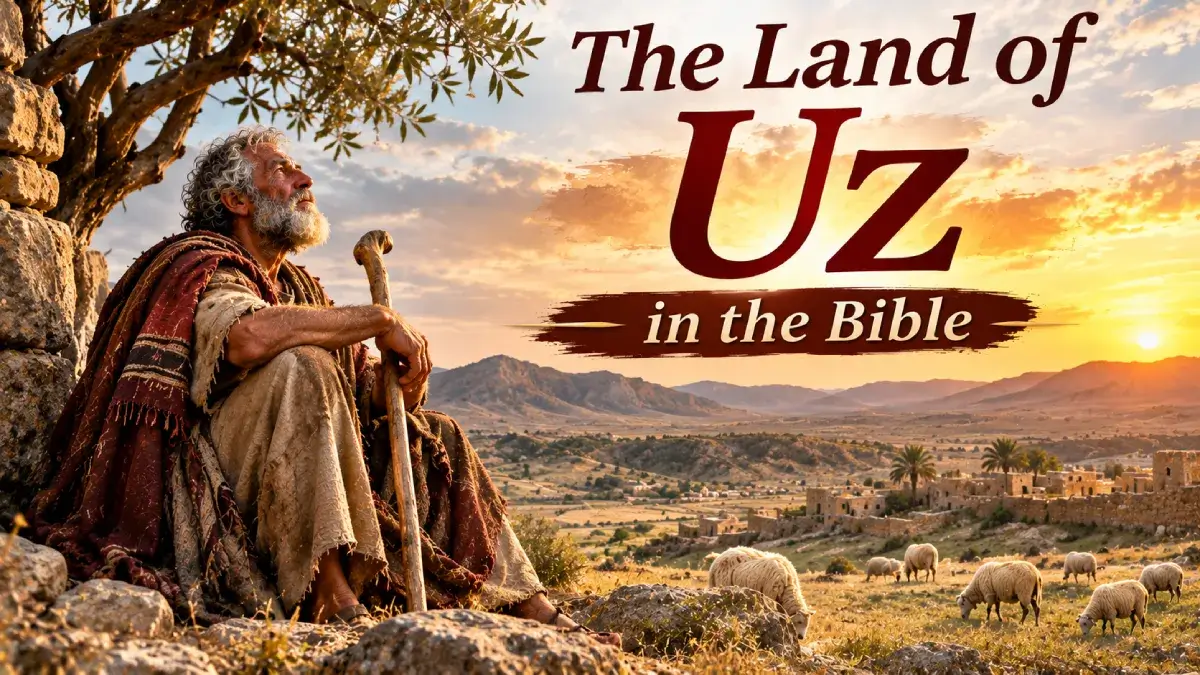
The land of Uz was the homeland of Job, according to Job 1:1. Its exact geographical location is uncertain, but biblical references connect the name Uz with regions associated with Edom and the broader area east or southeast of Israel.
Lamentations 4:21 mentions the land of Uz in connection with Edom, while Jeremiah 25:20 also refers to the land of Uz in a list of nations and peoples facing judgment.
The Bible does not provide enough information to identify Uz with certainty on a modern map. However, it is generally understood to have been somewhere in the ancient Near East, possibly in or near the region of Edom.
The land of Uz is a fascinating place mentioned in the Bible, most notably in the opening verse of the book of Job. It is introduced as the homeland of Job, a man described as blameless, upright, and one who feared God. Although Uz appears only a few times in Scripture, its connection with Job makes it an important location in biblical history.
But where was the land of Uz? Was it part of Edom, located in Arabia, or somewhere else in the ancient Near East? Who lived there, and why is it significant that Job came from this particular place?
The Bible provides some geographical and historical clues, but it does not give an exact location for Uz. By examining the relevant passages, we can better understand what Scripture reveals about this ancient land and its connection to one of the Bible’s most remarkable stories.
What Is the Land of Uz in the Bible?
The land of Uz is best known as the place where Job lived.
Job 1:1 (KJV):
There was a man in the land of Uz, whose name was Job; and that man was perfect and upright, and one that feared God, and eschewed evil.
This verse introduces Job and establishes the setting of his story.
Job is described through four important characteristics:
- Perfect: He was presented as a man of integrity or blameless character.
- Upright: He sought to live according to what was right.
- Feared God: He had reverence for the Lord.
- Eschewed evil: He turned away from wickedness.
The verse does not describe Uz as a city or kingdom. It calls it a land, suggesting a broader geographical region.
The significance of Uz comes primarily from its connection with Job. It was the setting from which the story of his faith, suffering, and restoration begins.
Where Was the Land of Uz Located?
One of the most common questions about Uz is its geographical location.
Unfortunately, the Bible does not provide precise boundaries, a capital city, or recognizable geographical landmarks that allow us to identify it with certainty.
Nevertheless, several biblical references offer clues.
1. Uz May Have Been Near Edom
One important clue appears in Lamentations.
Lamentations 4:21 (KJV):
Rejoice and be glad, O daughter of Edom, that dwellest in the land of Uz; the cup also shall pass through unto thee: thou shalt be drunken, and shalt make thyself naked.
This passage connects the land of Uz with Edom.
The prophet addresses Edom and describes its inhabitants as dwelling in the land of Uz. This has led many readers and scholars to associate Uz with the territory of Edom or a neighboring region.
Edom was located southeast of Judah, in the area generally associated with the mountainous region south of the Dead Sea.
However, this verse does not establish that all of Uz was identical to Edom. It provides a geographical association, not a complete map.
2. Uz May Have Been East or Southeast of Israel
The references to Edom and the broader setting of Job have contributed to the view that Uz was located east or southeast of Israel.
Some historical proposals place it in or near Edom, while others suggest a broader region extending toward northern Arabia or areas farther north.
These proposals remain uncertain because Scripture does not provide enough geographical detail to settle the question.
3. Jeremiah Also Mentions the Land of Uz
Jeremiah 25:20 (KJV):
And all the mingled people, and all the kings of the land of Uz, and all the kings of the land of the Philistines, and Ashkelon, and Azzah, and Ekron, and the remnant of Ashdod,
This passage appears in Jeremiah’s prophecy concerning judgment upon various nations and peoples.
The mention of the kings of Uz suggests that the name was associated with a region that had political or local rulers.
It also appears in a list alongside other territories and peoples.
However, Jeremiah does not provide a precise location for Uz.
What Is the Most Likely Location of Uz?
The safest conclusion is that Uz was an ancient region associated in some biblical passages with Edom and the areas surrounding it.
Its exact boundaries remain unknown, and proposed modern identifications should be treated as possibilities rather than established facts.
Who Was Job, and Why Did He Live in Uz?
Job is the most important biblical figure connected with the land of Uz.
The book of Job begins by introducing him as a man of exceptional integrity and faith.
Job 1:3 (KJV):
His substance also was seven thousand sheep, and three thousand camels, and five hundred yoke of oxen, and five hundred she asses, and a very great household; so that this man was the greatest of all the men of the east.
This verse describes Job as a wealthy and influential man.
His possessions included:
- 7,000 sheep
- 3,000 camels
- 500 yoke of oxen
- 500 female donkeys
- A large household
The passage also identifies him as one of the greatest men of the East.
This description provides an important clue about the setting of Job’s story. The language connects him with the eastern world known to the biblical writers.
Job Was Known for His Faith
Job’s wealth was not the most important part of his character.
The opening chapter emphasizes his relationship with God.
Job 1:8 (KJV):
And the LORD said unto Satan, Hast thou considered my servant Job, that there is none like him in the earth, a perfect and an upright man, one that feareth God, and escheweth evil?
Job is presented as a faithful man whose character is recognized by God.
His story becomes especially significant because he experiences severe suffering despite his integrity.
Job’s Suffering in the Land of Uz
Job 1–2 describes how Job lost his possessions, his children, and his health.
Despite these devastating events, he continued to wrestle with questions about suffering, justice, and God’s purposes.
His friends came to comfort him, but their explanations often failed to understand his situation.
The book of Job explores profound questions:
- Why do righteous people suffer?
- Does suffering always mean someone has sinned?
- How should a person respond when life becomes painful?
- Can people continue trusting God without understanding His ways?
The land of Uz is therefore more than a geographical detail. It is the setting where one of Scripture’s deepest explorations of faith and suffering begins.
Who Was Uz in the Bible? Was He a Person or a Place?
An interesting detail is that the name Uz appears in biblical genealogies as well as in references to a geographical region.
This can create confusion because the same name may refer to different individuals or places.
1. Uz, a Descendant of Shem
Genesis 10:22–23 (KJV):
The children of Shem; Elam, and Asshur, and Arphaxad, and Lud, and Aram.
And the children of Aram; Uz, and Hul, and Gether, and Mash.
This passage identifies Uz as a descendant of Aram, who was a son of Shem.
In this genealogy, Uz is the name of a person or ancestral figure.
2. Uz, a Descendant of Nahor
Genesis 22:20–21 records the family of Nahor, Abraham’s brother.
Genesis 22:21 (KJV):
Huz his firstborn, and Buz his brother, and Kemuel the father of Aram,
The KJV uses the spelling “Huz” in this passage. Other translations may render the name differently.
This is another genealogical reference that should not automatically be identified with the Uz mentioned in Job.
3. Uz, a Descendant of Seir
Genesis 36:28 (KJV):
The children of Dishan are these; Uz, and Aran.
This passage places Uz within the genealogy of Seir the Horite, whose descendants were associated with the region of Edom.
This is particularly interesting because Lamentations 4:21 connects the land of Uz with Edom.
Some interpreters therefore associate the geographical name Uz with this Edomite genealogy.
However, the Bible does not explicitly state that the Uz in Genesis 36:28 founded the land where Job lived.
Why Are There Different People Named Uz?
Ancient biblical names were sometimes shared by different individuals and could also become associated with family groups or territories.
The genealogies preserve several people named Uz or Huz. It is important not to assume that every reference identifies the same person.
What Is the Connection Between Uz and Edom?
The connection between Uz and Edom is one of the most important clues for understanding the land’s possible location.
Edom was the territory associated with the descendants of Esau, Jacob’s brother.
Genesis 36:8 (KJV):
Thus dwelt Esau in mount Seir: Esau is Edom.
The descendants of Esau became associated with the Edomites, whose territory lay southeast of the land of Judah.
Lamentations 4:21 directly mentions Edom in connection with the land of Uz.
This association has encouraged scholars to consider whether Uz was located within Edom or in a neighboring territory.
Genesis 36:28 also includes an individual named Uz in the genealogy of Seir’s descendants.
Together, these references make an Edomite connection plausible.
However, they do not conclusively establish the exact location of Job’s homeland.
Why Is the Land of Uz Important in the Bible?
Although Uz receives limited attention in Scripture, it has several important connections to biblical history and theology.
1. It Is the Setting of Job’s Story
The most significant reason Uz matters is that Job lived there.
The book of Job explores the relationship between faith, suffering, righteousness, and God’s sovereignty.
Without the opening reference to Uz, readers would not know the geographical setting in which Job’s story begins.
2. It Shows That God’s Work Was Not Limited to Israel
The book of Job does not introduce Job as an Israelite living in the land of Israel.
Instead, he is presented as a man living in Uz, a region associated with the broader ancient Near East.
This reminds readers that the Bible’s account of God’s dealings with humanity extends beyond the geographical boundaries of Israel.
The story of Job addresses questions about human suffering and faith that are relevant to people everywhere.
3. It Connects With the Biblical World of Edom
The reference in Lamentations 4:21 connects Uz with Edom, while Genesis 36 records the family of Seir and an individual named Uz.
These references provide useful geographical and genealogical background for studying the ancient world of the Bible.
4. It Reminds Us That Some Biblical Locations Are Uncertain
Not every place mentioned in Scripture can be identified precisely today.
The land of Uz is an example of a location whose general regional associations can be discussed, even though its exact boundaries remain uncertain.
This encourages careful Bible study rather than forcing conclusions that Scripture does not establish.
What Spiritual Lessons Can We Learn From Job in the Land of Uz?
The land of Uz is closely associated with Job’s experience. His story offers several powerful lessons for believers.
1. Faithfulness Does Not Mean a Life Without Suffering
Job was described as a righteous and God-fearing man, yet he experienced tremendous loss.
His story challenges the assumption that every hardship is punishment for personal sin.
Job 1:1 establishes his integrity before the account of his suffering begins.
The lesson is that faithful people can experience painful circumstances without those circumstances proving that they have abandoned God.
2. Trust God Even When You Do Not Understand
Job struggled to understand why he was suffering.
He asked difficult questions and expressed his grief, but his story ultimately points readers toward God’s wisdom and sovereignty.
Job 42:2 (KJV):
I know that thou canst do every thing, and that no thought can be withholden from thee.
Job’s response reflects a deeper recognition of God’s power and wisdom.
We may not understand every event in our lives, but we can continue seeking God.
3. Be Careful About Judging Other People’s Suffering
Job’s friends repeatedly suggested that his suffering must have been connected to wrongdoing.
Their explanations were not an accurate understanding of his situation.
The book warns readers against making quick judgments about why someone is experiencing hardship.
Instead of assuming, we should listen, show compassion, and offer support.
4. God Is Greater Than Human Understanding
At the end of the book, God responds to Job by drawing attention to the complexity and greatness of creation.
Job learns that human understanding is limited compared with God’s wisdom.
This does not mean that asking questions is wrong. Rather, it reminds us that God’s knowledge is greater than our own.
5. Suffering Does Not Have to Be the End of the Story
Job’s story concludes with restoration.
Job 42:10 (KJV):
And the LORD turned the captivity of Job, when he prayed for his friends: also the LORD gave Job twice as much as he had before.
The ending shows God’s restoration of Job after his suffering.
It should not be interpreted as a promise that every believer will receive double material possessions after hardship. Instead, it is part of Job’s particular story and demonstrates God’s power to restore.
Frequently Asked Questions About the Land of Uz in the Bible
Where is the land of Uz located in the Bible?
The exact location of Uz is unknown. Lamentations 4:21 connects it with Edom, leading many to place it in or near the region of Edom, southeast of Judah. Other geographical proposals extend toward neighboring areas of the ancient Near East.
Was Job from the land of Uz?
Yes. Job 1:1 clearly states that Job lived in the land of Uz. The verse introduces him as a man who was blameless, upright, God-fearing, and one who turned away from evil.
Is the land of Uz part of Edom?
The Bible connects Uz with Edom in Lamentations 4:21. This suggests a geographical relationship, but Scripture does not explicitly state that the entire land of Uz was part of Edom.
Who was Uz in Genesis?
Genesis contains several genealogical references to individuals named Uz or Huz. Genesis 10:23 identifies Uz as a descendant of Aram, Genesis 22:21 mentions Huz in Nahor’s family, and Genesis 36:28 identifies Uz as a descendant of Seir.
These references should not automatically be treated as describing the same individual.
Is Uz mentioned outside the book of Job?
Yes. Uz is mentioned in Genesis 10:23, Genesis 36:28, Jeremiah 25:20, and Lamentations 4:21. A related spelling, Huz, appears in Genesis 22:21 in the KJV.
Was Job an Israelite?
The book of Job identifies him as a man from the land of Uz, but it does not explicitly identify him as an Israelite. His story is set outside the usual geographical setting of Israel’s national history.
Why is the land of Uz important?
Uz is important because it is the homeland of Job, whose story explores suffering, faith, righteousness, and God’s sovereignty. It is also connected with geographical and genealogical references elsewhere in the Old Testament.
What does the name Uz mean?
The Bible does not provide a clear explanation of the meaning of the geographical name Uz. Its appearance in several genealogies and place references makes it difficult to establish one definitive meaning.
Final Thoughts
The land of Uz is an important but geographically uncertain location in the Bible. It is best known as the homeland of Job, the man whose story provides one of Scripture’s deepest examinations of suffering, faith, and trust in God.
The Bible offers several clues about Uz. Job 1:1 identifies it as Job’s home, Jeremiah 25:20 includes it among regions mentioned in a prophecy of judgment, and Lamentations 4:21 connects it with Edom. Genesis also records several individuals named Uz or Huz in different genealogies.
Although these passages help us understand the ancient world, they do not establish the exact location or boundaries of the land.
The greatest significance of Uz is not simply where it was on an ancient map. It is the story of faith that begins there. Job’s experience reminds us that suffering does not always mean wrongdoing, that human understanding is limited, and that God remains sovereign even when life is difficult.
The land of Uz may remain a geographical mystery, but the lessons from Job’s life continue to encourage people to trust God through uncertainty and suffering.