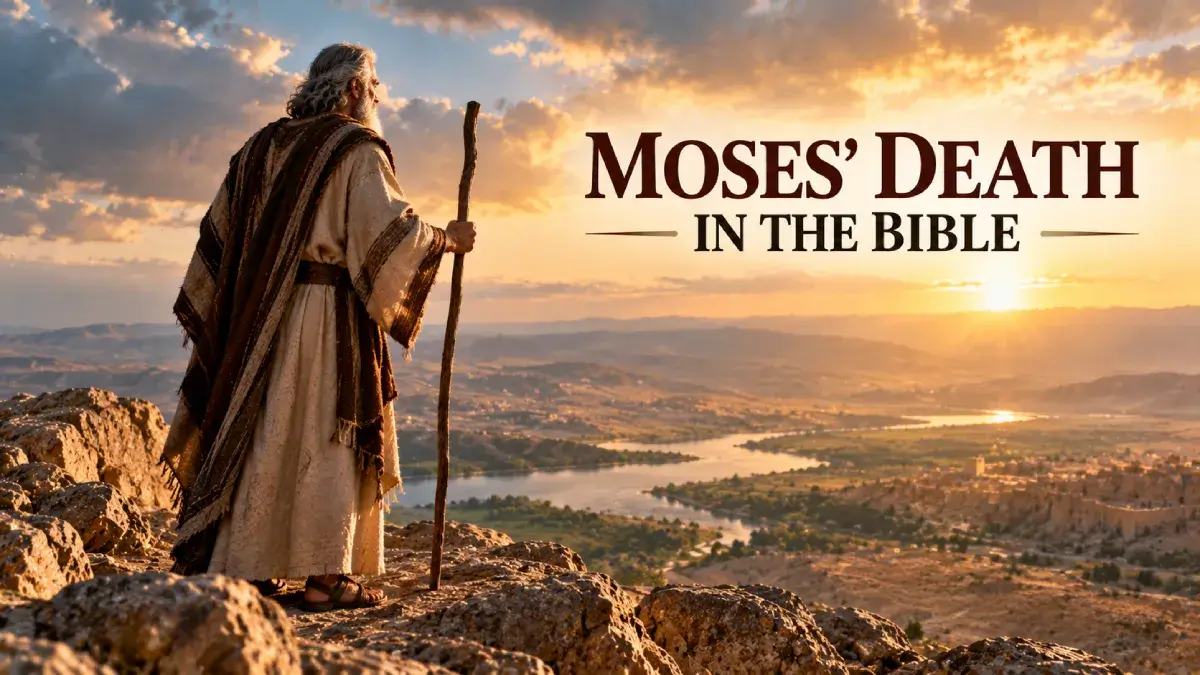
Moses died in the land of Moab, on Mount Nebo, at the age of 120. According to Deuteronomy 34:5–6, Moses died there according to the word of the Lord, and God buried him in a valley in Moab opposite Beth-peor. The exact location of his grave remains unknown.
Moses was not permitted to enter the Promised Land because he disobeyed God’s command at the waters of Meribah. Instead of honoring God as holy before the Israelites, Moses struck the rock when God had instructed him to speak to it (Numbers 20:7–12).
Before his death, God allowed Moses to see the land promised to Abraham, Isaac, and Jacob. Moses then blessed the tribes of Israel, and Joshua succeeded him as the leader of the people.
Moses is one of the most significant figures in the Bible. God called him to lead the Israelites out of slavery in Egypt, gave him the Ten Commandments, and guided him as he led God’s people through the wilderness. Yet despite his extraordinary role, Moses did not enter the Promised Land with the Israelites.
The account of Moses’ death raises several important questions. How did Moses die? Why did God prevent him from entering Canaan? Where was he buried? How old was he when he died? And what can Christians learn from the final chapter of his life?
The Bible provides clear answers to many of these questions, especially in Deuteronomy 32–34. It describes Moses’ final journey, his view of the Promised Land, his death on Mount Nebo, and the unique way God cared for him after his death.
1. Where Is the Death of Moses Recorded in the Bible?
The primary account of Moses’ death appears in Deuteronomy 34:1–12. This chapter concludes the book of Deuteronomy and describes Moses’ final moments before Israel entered Canaan.
Deuteronomy 34:1 says:
“And Moses went up from the plains of Moab unto the mountain of Nebo, to the top of Pisgah, that is over against Jericho.” — Deuteronomy 34:1, KJV
From this elevated location, God showed Moses the Promised Land. Moses could see the land that God had promised to Israel, even though he would not enter it himself.
Other passages help explain the circumstances surrounding his death:
- Numbers 20:7–12: Explains why Moses was not permitted to enter the Promised Land.
- Deuteronomy 32:48–52: Records God’s instruction for Moses to climb Mount Nebo and explains the reason he would die there.
- Deuteronomy 34:1–8: Describes Moses viewing the land, dying, being buried, and being mourned by Israel.
- Joshua 1:1–2: Records God’s instructions to Joshua after Moses’ death.
- Jude 1:9: Refers to a dispute involving Michael the archangel and the devil over the body of Moses.
Together, these passages provide the biblical picture of Moses’ final days and the transition of leadership to Joshua.
2. How Old Was Moses When He Died?
Moses was 120 years old when he died.
Deuteronomy 34:7 says:
“And Moses was an hundred and twenty years old when he died: his eye was not dim, nor his natural force abated.” — Deuteronomy 34:7, KJV
This verse emphasizes that Moses retained his sight and strength until the end of his life. His death was not described as the result of a long period of physical decline.
The Bible does not provide a medical explanation for Moses’ death. Instead, it states that he died according to the word of the Lord, emphasizing the completion of his appointed life and leadership.
Moses’ life can be understood in three broad periods:
- The first 40 years: Moses grew up in Egypt and eventually fled to Midian after killing an Egyptian who was beating a Hebrew (Exodus 2:11–15; Acts 7:23–29).
- The next 40 years: Moses lived in Midian, married Zipporah, and worked as a shepherd before God called him at the burning bush (Exodus 2:16–22; Acts 7:30).
- The final 40 years: Moses led Israel out of Egypt and through the wilderness toward the Promised Land. Deuteronomy 34:7 records his death at 120.
The three periods are supported by passages such as Acts 7:23, Acts 7:30, and Deuteronomy 34:7, though the Bible does not present the entire timeline in one single verse.
3. Why Did God Not Allow Moses to Enter the Promised Land?
One of the most important questions about Moses’ death is why God did not allow him to enter Canaan.
The answer is found in Numbers 20:1–13, in the account of the waters of Meribah.
Moses struck the rock instead of speaking to it
During the wilderness journey, the Israelites complained because they had no water. God instructed Moses to take the rod and gather the people. He was told to speak to the rock so that it would provide water.
Numbers 20:8 records God’s instruction:
“Speak ye unto the rock before their eyes; and it shall give forth his water.” — Numbers 20:8, KJV
However, Moses became angry with the people. He addressed them harshly and struck the rock twice with his rod.
Water came out, and the congregation and their animals were able to drink. Nevertheless, Moses had failed to follow God’s instruction.
Moses failed to honor God as holy
Numbers 20:12 explains God’s judgment:
“Because ye believed me not, to sanctify me in the eyes of the children of Israel, therefore ye shall not bring this congregation into the land which I have given them.” — Numbers 20:12, KJV
The issue was more than the physical act of striking the rock. God specifically identified Moses’ failure to trust and honor Him as holy before the Israelites.
As Israel’s leader, Moses had a responsibility to represent God’s word faithfully before the people. His disobedience had serious consequences.
Deuteronomy 32:51–52 later refers to this same incident and confirms that Moses would see the land from a distance but would not enter it.
Was Moses’ punishment unfair?
Readers sometimes wonder why Moses faced such a serious consequence after serving God for so many years.
The biblical account emphasizes both Moses’ extraordinary service and God’s holiness. Moses was a faithful servant in many respects, but his position did not exempt him from accountability.
The incident also reminds readers that leadership carries responsibility. Those who represent God before others are called to handle that responsibility carefully.
The Bible does not suggest that Moses’ entire life was defined by this single failure. Instead, it records his disobedience honestly while continuing to honor his role in Israel’s history.
4. What Happened Before Moses Died?
Moses’ death did not occur without warning. God told him that his time was near and directed him to climb Mount Nebo.
Deuteronomy 32:48–50 describes God’s command to Moses to go up the mountain in the land of Moab, where he would die.
Before that moment, Moses had several important responsibilities to complete.
God showed Moses the Promised Land
Deuteronomy 34:1–4 describes God showing Moses the land of Canaan from Mount Nebo.
Moses saw the regions associated with the tribes of Israel, including areas connected with Gilead, Naphtali, Ephraim, Manasseh, Judah, and the plain near Jericho.
God reminded Moses that this was the land He had promised to Abraham, Isaac, and Jacob.
Although Moses would not enter the land, he was allowed to see it before his death. This moment marked the fulfillment of part of God’s promise while also reminding Moses of the consequence of his disobedience.
Moses blessed the tribes of Israel
Before his death, Moses pronounced blessings over the tribes of Israel. These blessings are recorded in Deuteronomy 33.
Moses spoke of God’s care for His people and described the special responsibilities and blessings associated with the tribes.
His final words served as a spiritual legacy for Israel as the people prepared to enter Canaan under Joshua’s leadership.
Joshua was prepared to lead Israel
Moses’ death was also a transition in Israel’s leadership.
Deuteronomy 31:7–8 records Moses encouraging Joshua before the people. God had already identified Joshua as the man who would lead Israel into the Promised Land.
After Moses died, God spoke directly to Joshua and instructed him to lead the Israelites across the Jordan River.
Joshua 1:2 records God’s command:
“Moses my servant is dead; now therefore arise, go over this Jordan, thou, and all this people, unto the land which I do give to them.” — Joshua 1:2, KJV
Moses’ leadership ended, but God’s purpose for Israel continued.
5. Where Was Moses Buried?
According to Deuteronomy 34:5–6, Moses died in the land of Moab and was buried in a valley opposite Beth-peor.
Deuteronomy 34:6 states:
“And he buried him in a valley in the land of Moab, over against Beth-peor: but no man knoweth of his sepulchre unto this day.” — Deuteronomy 34:6, KJV
This passage makes two important points.
First, Moses was buried in the territory of Moab, near the region from which he had viewed the Promised Land.
Second, the exact location of his grave was not known to the Israelites.
Why is Moses’ burial place unknown?
The Bible does not explicitly explain why Moses’ grave was kept unknown. Any claim about God’s precise reason would go beyond what the text directly says.
Some readers suggest that the unknown location may have prevented the grave from becoming an object of worship. However, this is an interpretation, not a reason explicitly given in Deuteronomy 34.
What the passage does establish is that Moses received a burial, but his grave could not be identified.
Was Moses buried by God Himself?
The wording of Deuteronomy 34:6 in the KJV says, “he buried him,” with the Lord as the subject in the surrounding passage. Many readers therefore understand the text to mean that God Himself buried Moses.
Other translations and discussions examine the wording differently, but the passage presents Moses’ burial as unique and emphasizes that his grave remained unknown.
The Bible does not provide further details about the burial ceremony or the exact location of the grave.
6. Did Anyone Mourn the Death of Moses?
Yes. The Israelites mourned Moses for thirty days.
Deuteronomy 34:8 says:
“And the children of Israel wept for Moses in the plains of Moab thirty days: so the days of weeping and mourning for Moses were ended.” — Deuteronomy 34:8, KJV
Moses had led the people through the wilderness, mediated between them and God, and delivered God’s instructions to them. His death marked the end of a significant era in Israel’s history.
The thirty days of mourning gave the people time to grieve the loss of their leader before moving forward under Joshua.
The Bible does not suggest that the Israelites stopped needing leadership or that their journey was complete. Instead, their mourning was followed by a new chapter in which Joshua led them toward the land God had promised.
This moment reminds us that grief and continued responsibility can exist together. The Israelites mourned Moses while preparing to continue the journey.
7. What Does Deuteronomy 34:10 Mean When It Says No Prophet Like Moses Arose?
Deuteronomy 34 concludes by honoring Moses’ unique relationship with God.
Verse 10 says:
“And there arose not a prophet since in Israel like unto Moses, whom the LORD knew face to face.” — Deuteronomy 34:10, KJV
This statement highlights Moses’ exceptional role as a prophet and servant of God.
Moses received the law, confronted Pharaoh, led Israel out of Egypt, and served as the mediator through whom God communicated many of His commands to the nation.
The expression “face to face” emphasizes the unique closeness and directness of Moses’ relationship with God. It should not necessarily be understood as a literal description of seeing God’s full divine nature, since other passages explain that human beings cannot see God in His fullness and live (Exodus 33:18–23).
Deuteronomy 34:11–12 continues by recalling the signs and wonders God performed through Moses in Egypt and the mighty deeds he carried out before Israel.
The chapter therefore closes with a strong statement about Moses’ importance in biblical history.
8. What Does Jude 1:9 Say About the Body of Moses?
Jude 1:9 contains a brief and unusual reference to Moses’ body.
The verse says:
“Yet Michael the archangel, when contending with the devil he disputed about the body of Moses, durst not bring against him a railing accusation, but said, The Lord rebuke thee.” — Jude 1:9, KJV
This passage refers to a dispute between Michael the archangel and the devil concerning Moses’ body.
It is a distinct reference from the account in Deuteronomy 34. Deuteronomy tells readers that Moses died and was buried, but Jude provides no detailed explanation of the dispute.
Because the passage is brief, Christians and biblical scholars have offered different interpretations of its background and significance.
The main point Jude makes in its immediate context concerns humility and restraint when confronting spiritual evil. Jude contrasts Michael’s response with the arrogant speech of false teachers.
Readers should therefore be careful not to present speculative details about Moses’ body or burial as if the Bible explicitly revealed them.
9. Did Moses Go to Heaven After He Died?
The Bible does not provide a detailed description of Moses’ immediate experience after death in Deuteronomy 34. However, other passages include Moses in significant spiritual events.
Moses appeared at the Transfiguration
Matthew 17:1–3 and Luke 9:28–31 describe Jesus’ Transfiguration. Moses and Elijah appeared and spoke with Jesus.
Luke 9:30–31 says that they appeared in glory and spoke about Jesus’ departure, which He was about to accomplish at Jerusalem.
This event shows Moses appearing with Jesus long after his death. Christians commonly understand the Transfiguration as a revelation of Jesus’ glory and the continuity between Jesus’ mission and the Law and the Prophets.
However, the passage does not give a full explanation of the intermediate state of the dead or provide a detailed account of Moses’ experience between death and the Transfiguration.
What can we conclude?
The Transfiguration gives Christians reason to see Moses as an important figure in God’s unfolding plan. But it is best to distinguish what the passage clearly describes from questions it does not directly answer.
The Bible records Moses’ death and burial, and later records his appearance at the Transfiguration. It does not provide every detail about what happened between those events.
10. What Can We Learn From the Death of Moses?
Moses’ death teaches several important lessons about obedience, leadership, faith, and God’s purposes.
1. God takes obedience seriously
Moses served God faithfully for many years, yet his disobedience at Meribah had real consequences.
Numbers 20:12 explains that Moses failed to honor God as holy before the Israelites. His story reminds us that spiritual responsibility should not be treated lightly.
Obedience is not merely about outward actions. It also involves trusting God’s instructions and representing His character faithfully.
2. Great leaders are still accountable
Moses was one of the greatest leaders in Israel’s history, but he was not exempt from God’s judgment.
This is an important lesson for pastors, teachers, parents, and anyone entrusted with responsibility. Influence does not remove the need for humility, repentance, and accountability.
3. God can continue His work after one person’s life ends
Moses died before Israel entered the Promised Land, but God’s purpose for the nation continued through Joshua.
Joshua 1:1–2 shows that Moses’ death did not bring God’s promise to an end.
This reminds us that no human leader is indispensable to God’s ultimate purposes. People may complete their assignments, but God remains faithful to His plan.
4. A person’s failures do not erase their entire legacy
Moses made a serious mistake at Meribah, yet Scripture continues to honor him as a faithful servant in many respects.
Hebrews 11:24–29 recalls Moses’ faith and his decision to identify with God’s people rather than enjoy the temporary pleasures of Egypt.
His life demonstrates that Scripture can acknowledge both faithfulness and failure without ignoring either one.
5. God’s promises are larger than one lifetime
Moses saw the Promised Land, but Joshua led the people into it. The promise extended beyond the life of the leader who had brought Israel out of Egypt.
This encourages readers to remain faithful even when they do not see every desired outcome during their own lifetime. God may continue His work through others and across generations.
6. Grief is a natural part of saying goodbye
The Israelites mourned Moses for thirty days. Their grief reflected the significance of his leadership and the relationship they had with him.
The account reminds us that mourning is not a sign of weak faith. It is a natural response to loss, and it can coexist with hope and the responsibility to move forward.
Frequently Asked Questions About Moses’ Death in the Bible
How did Moses die in the Bible?
Deuteronomy 34:5 says that Moses died in the land of Moab according to the word of the Lord. The Bible does not provide a medical cause of death. It records that Moses was 120 years old and that his strength and eyesight had not failed.
Why did Moses die before entering the Promised Land?
Moses was not allowed to enter Canaan because of his disobedience at the waters of Meribah. In Numbers 20:7–12, God instructed Moses to speak to the rock, but Moses struck it twice. God said Moses had failed to honor Him as holy before Israel.
Where did Moses die?
Moses died on Mount Nebo in the land of Moab, opposite Jericho. Deuteronomy 34:1–5 records that he climbed Mount Nebo and viewed the Promised Land before his death.
Where is Moses buried?
Deuteronomy 34:6 says that Moses was buried in a valley in Moab opposite Beth-peor. The exact location of his grave remains unknown.
How old was Moses when he died?
Moses was 120 years old when he died, according to Deuteronomy 34:7. The verse also says that his eye was not dim and his natural strength had not diminished.
Who took over after Moses died?
Joshua succeeded Moses as the leader of Israel. God instructed Joshua to lead the people across the Jordan River and into the Promised Land, as recorded in Joshua 1:1–2.
How long did Israel mourn Moses?
The Israelites mourned Moses for thirty days in the plains of Moab, according to Deuteronomy 34:8.
Did Moses see the Promised Land before he died?
Yes. God showed Moses the land from Mount Nebo. Deuteronomy 34:1–4 describes the regions Moses saw before he died.
Does the Bible say God buried Moses?
Deuteronomy 34:6 says, “he buried him,” in a passage where the Lord is the subject. This is commonly understood to mean that God buried Moses. The same verse states that no one knew the location of his grave.
Did Moses appear after his death?
Yes. Moses appeared with Elijah during Jesus’ Transfiguration, recorded in Matthew 17:1–3 and Luke 9:28–31. The event reveals Jesus’ glory and Moses’ continuing significance in the biblical narrative, though it does not explain every detail about the state of the dead.
Final Thoughts: The Legacy of Moses’ Death
The death of Moses marks one of the most significant transitions in the Old Testament. After leading Israel out of Egypt and guiding the people through the wilderness, Moses died on Mount Nebo at the age of 120. God allowed him to see the Promised Land, but he was not permitted to enter it because of his disobedience at Meribah.
Moses was buried in Moab, and the location of his grave remained unknown. Israel mourned him for thirty days before Joshua led the people forward into the land God had promised.
His final chapter reminds us that obedience matters, leaders remain accountable, and God’s purposes continue beyond any one person’s lifetime.
Moses’ story contains both failure and faithfulness. His disobedience had consequences, but it did not erase his important role in God’s plan or the lessons his life continues to teach.
The story of Moses’ death reminds us to honor God in our responsibilities, trust His purposes, and remain faithful even when we cannot see the full outcome of our journey.