If you have ever read the New Testament carefully, you may have noticed something interesting: the name Mary appears again and again.
Mary was a common Jewish woman’s name during the time of Jesus, and several different women in the New Testament are identified by it. This can make Bible passages confusing, especially when two or more Marys appear in the same Gospel account.
So, how many Marys are in the Bible?
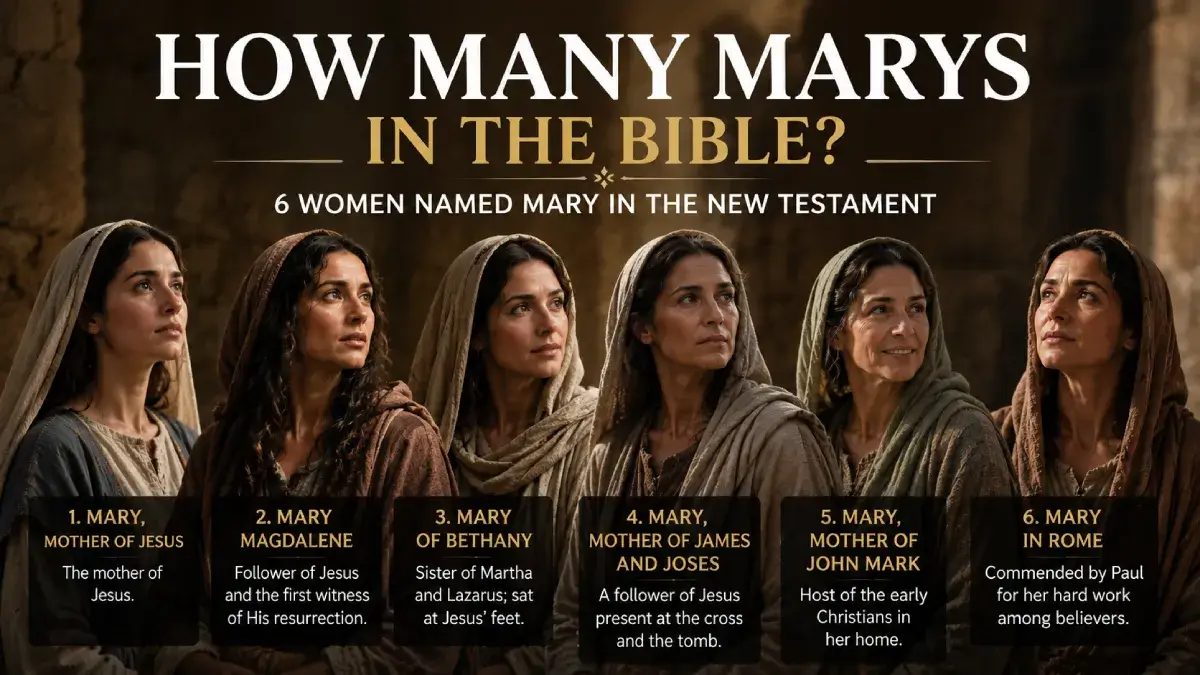
Most commonly, biblical studies identify six different women named Mary in the New Testament:
- Mary, the mother of Jesus
- Mary Magdalene
- Mary of Bethany
- Mary, the mother of James and Joses/Joseph
- Mary, the mother of John Mark
- Mary, a Christian woman in Rome mentioned by Paul
These women had very different lives and played different roles in the biblical story.
One was the mother of Jesus.
One witnessed the crucifixion and resurrection.
One sat at Jesus’ feet and later saw Him raise her brother Lazarus.
One was associated with the women who witnessed Jesus’ death and resurrection.
One opened her home to believers during the early church.
And one was personally commended by Paul for her work among Christians.
Understanding who each Mary was makes many New Testament passages much easier to read.
How Many Marys Are in the Bible?
There are six distinct women named Mary commonly identified in the New Testament.
They are:
| Mary | Where She Appears | What She Is Known For |
|---|---|---|
| Mary, mother of Jesus | Matthew, Mark, Luke, John, Acts | Mother of Jesus |
| Mary Magdalene | Gospels | Follower of Jesus and resurrection witness |
| Mary of Bethany | Gospels | Sister of Martha and Lazarus |
| Mary, mother of James and Joses/Joseph | Gospels | Follower of Jesus present at His death and burial |
| Mary, mother of John Mark | Acts | Hosted believers in her home |
| Mary in Rome | Romans 16 | Commended by Paul for her work |
There is an important qualification, however.
Some details concerning the identity of the women named Mary are debated. In particular, the Gospel references to “Mary the mother of James and Joses/Joseph” are sometimes discussed in relation to other Marys mentioned in the crucifixion and resurrection accounts.
Therefore, when people ask how many Marys are in the Bible, six is the standard number used when distinguishing the named women in the New Testament.
1. Mary, the Mother of Jesus
The most famous Mary in the Bible is Mary, the mother of Jesus.
She was a young Jewish woman from Nazareth who was chosen by God to become the mother of the Messiah.
Her story begins prominently in Luke 1.
The angel Gabriel appeared to Mary and announced that she would conceive and give birth to a son who would be called the Son of the Most High.
Mary responded with humility and faith.
One of her most memorable statements is:
“I am the Lord’s servant.”
Mary’s response demonstrates remarkable willingness to trust God even though she did not know everything that would happen.
Mary and the Birth of Jesus
Mary was present throughout the events surrounding Jesus’ birth.
She traveled to Bethlehem with Joseph.
She gave birth to Jesus and laid Him in a manger.
She also encountered shepherds who came after hearing the angelic announcement.
Luke 2:19 says that Mary treasured these things and pondered them in her heart.
This verse provides an important glimpse into Mary’s character.
She did not simply experience extraordinary events.
She reflected on them.
Mary at the Cross
Mary’s relationship with Jesus continued throughout His earthly ministry.
John 19:25 records Mary near the cross during Jesus’ crucifixion.
Watching her son die would have been an extraordinarily painful experience.
Simeon’s earlier prophecy in Luke 2:35 had spoken of a sword piercing Mary’s soul.
The Gospel accounts therefore present Mary not merely as the mother of Jesus at His birth but also as someone who remained connected to Him through His suffering.
Mary After Jesus’ Resurrection
Mary appears with other believers after Jesus’ ascension.
Acts 1:14 specifically mentions Mary the mother of Jesus among those who were gathered together in prayer with the disciples.
Her story therefore extends from the birth of Christ into the early Christian community.
2. Mary Magdalene
The second major Mary in the New Testament is Mary Magdalene.
She is one of the most important women in the Gospel accounts.
Mary Magdalene came from Magdala, which is why she is known as Mary Magdalene.
Luke 8:2 identifies her as a woman from whom seven demons had gone out.
She subsequently became a devoted follower of Jesus.
Mary Magdalene Followed Jesus
Mary Magdalene was among the women who followed Jesus and supported His ministry.
She was not simply a minor background character.
The Gospel accounts repeatedly place her near important events in the final days of Jesus’ earthly ministry.
Mary Magdalene at the Crucifixion
Mary Magdalene witnessed Jesus’ crucifixion.
The Gospel writers identify her among the women who watched from a distance or remained near the cross.
She therefore saw the death of Jesus.
Mary Magdalene at the Tomb
Mary Magdalene also witnessed Jesus’ burial and went to the tomb after the Sabbath.
This becomes one of the most important moments in her story.
The tomb was empty.
In John’s Gospel, Mary initially thought someone had taken Jesus’ body.
Then the risen Jesus appeared to her.
John 20:16 records Jesus calling her by name:
“Mary.”
She recognized Him.
Mary Magdalene and the Resurrection
Mary Magdalene became one of the earliest witnesses to the risen Christ.
Jesus instructed her to go and tell His disciples.
She therefore carried the message of the resurrection to the disciples.
This makes Mary Magdalene an important witness in the Gospel story.
3. Mary of Bethany
Another Mary was Mary of Bethany, the sister of Martha and Lazarus.
She lived in Bethany, a village near Jerusalem.
Mary of Bethany is especially remembered for her devotion to Jesus.
Mary Sat at Jesus’ Feet
Luke 10:38–42 describes Jesus visiting the home of Martha and Mary.
Martha was busy serving.
Mary, however, sat at Jesus’ feet and listened to His teaching.
Martha became frustrated because she was doing the work alone and asked Jesus to tell Mary to help her.
Jesus responded by affirming Mary’s choice to focus on listening to Him.
This passage gives us an important spiritual lesson:
Being busy for Jesus is not the same as being attentive to Jesus.
Service matters.
But relationship with Christ matters too.
Mary and Lazarus
Mary of Bethany was also the sister of Lazarus.
John 11 describes Lazarus becoming sick and dying.
When Jesus arrived, Mary expressed her grief.
She said:
“Lord, if you had been here, my brother would not have died.”
Jesus responded by raising Lazarus from the dead.
This event became one of the most powerful signs recorded in John’s Gospel.
Mary Anoints Jesus
Mary of Bethany also appears in John 12.
She took expensive perfume and anointed Jesus’ feet.
She then wiped His feet with her hair.
The act demonstrated extraordinary devotion.
Jesus defended Mary when Judas objected to what he considered wasteful.
Her story shows the importance of sacrificial devotion to Christ.
4. Mary, the Mother of James and Joses/Joseph
A fourth woman is identified as Mary the mother of James and Joses/Joseph.
Different Gospel passages use slightly different forms of the second son’s name depending on the translation.
Matthew 27:56 refers to Mary the mother of James and Joseph.
Mark 15:40 refers to Mary the mother of James the younger and of Joses.
She was among the women who witnessed Jesus’ crucifixion.
Mary at Jesus’ Crucifixion
Matthew 27:55–56 identifies her among the women who had followed Jesus and cared for His needs.
She therefore appears as part of the group of faithful women who remained connected to Jesus during His final suffering.
Mary at the Burial and Resurrection
Mary also appears in the burial and resurrection narratives.
Matthew 27:61 says that she was sitting opposite the tomb after Jesus was buried.
Matthew 28:1 then identifies Mary Magdalene and “the other Mary” as going to see the tomb.
This “other Mary” is commonly understood to be Mary the mother of James and Joses.
Her presence across the crucifixion, burial, and resurrection narratives makes her an important witness to the events surrounding Jesus’ death.
5. Mary, the Mother of John Mark
A fifth Mary appears in the book of Acts.
She was the mother of John Mark.
Acts 12:12 says that believers were gathered at her house and praying after Peter’s miraculous escape from prison.
Her home appears to have been an important gathering place for early Christians.
Mary’s House and the Early Church
Acts 12 describes Peter arriving at Mary’s house after escaping from prison.
A group of believers had gathered there and were praying.
This gives us an interesting glimpse into the early Christian community.
Mary’s home apparently provided a place where believers could gather.
Her role reminds us that not every important person in the early church was a public preacher or apostle.
Some served through hospitality, prayer, and opening their homes.
Mary and John Mark
Mary was the mother of John Mark, who later became associated with Paul and Barnabas.
Acts 12:25 says Barnabas and Saul took John Mark with them after returning from Jerusalem.
John Mark later became associated with the Gospel of Mark according to early Christian tradition, although the biblical text itself does not explicitly identify him as the author.
The important point for this article is that Acts clearly identifies Mary as his mother.
6. Mary Mentioned by Paul in Romans
The sixth Mary is found in Romans 16:6.
Paul writes:
“Greet Mary, who worked very hard for you.”
Very little information is provided about her.
We do not know as much about this Mary as we know about the mother of Jesus or Mary Magdalene.
But Paul specifically remembers her service.
Mary’s Faithful Work
Paul’s brief statement is significant.
Mary had apparently worked hard among the believers in Rome.
The Bible does not tell us exactly what her work involved.
Therefore, we should not speculate about details that Scripture does not provide.
What we do know is that Paul recognized her labor.
Her story reminds us that faithful Christian service does not have to be famous to be valuable.
Are There Really Six Marys in the Bible?
Yes, six different women named Mary are commonly identified in the New Testament.
However, this answer comes with an important qualification.
Some passages contain descriptions that have led interpreters to debate whether certain women are the same person.
For example, the Gospel accounts mention:
- Mary Magdalene
- Mary the mother of James and Joses/Joseph
- “the other Mary”
- Mary connected with the family of Jesus
- Other women named Mary
The Gospel writers sometimes identify women through their relatives or locations rather than simply using their names.
Because of this, some traditional interpretations attempt to combine or distinguish certain Marys differently.
For a straightforward study of the New Testament’s named women, however, six Marys is the commonly given answer.
Is Mary the Mother of Jesus the Same as Mary Magdalene?
No.
Mary the mother of Jesus and Mary Magdalene are two different women.
The Bible clearly distinguishes them.
Mary the mother of Jesus was the mother of Christ.
Mary Magdalene was a follower of Jesus from whom seven demons had gone out.
Mary Magdalene later became a witness to Jesus’ resurrection.
Confusing these two women can create significant problems when reading the Gospel accounts.
Is Mary of Bethany the Same as Mary Magdalene?
No.
Mary of Bethany and Mary Magdalene are also two different women.
Mary of Bethany was the sister of Martha and Lazarus.
She lived in Bethany and appears prominently in Luke 10, John 11, and John 12.
Mary Magdalene came from Magdala and appears frequently in the Gospel accounts surrounding Jesus’ crucifixion and resurrection.
The Bible does not identify them as the same person.
Is Mary the Mother of Jesus the Same as Mary of Bethany?
No.
These are also different women.
Mary the mother of Jesus lived in Nazareth and was the mother of Christ.
Mary of Bethany was the sister of Martha and Lazarus.
Their stories are completely different.
Why Was the Name Mary So Common?
The name Mary was common among Jewish women during the Second Temple period.
The Greek form Maria or Mariam reflects the Hebrew/Aramaic name associated with Miriam.
This helps explain why several women in the New Testament shared the same name.
It is similar to how several people today can share a common first name.
The Gospel writers therefore often needed additional information to distinguish one Mary from another.
They might identify a woman by:
- Her hometown
- Her children
- Her husband
- Her relatives
- Her relationship to Jesus
- Her connection with another person
For example:
Mary Magdalene = Mary associated with Magdala.
Mary of Bethany = Mary associated with Bethany.
Mary, mother of James and Joses = identified through her sons.
This naming practice helps us distinguish the women when studying the text.
Why Does the Bible Mention So Many Marys?
The repeated appearance of the name Mary gives us an interesting insight into the social world of the New Testament.
More importantly, it reminds us that the women named Mary were individual people with individual stories.
They were not simply interchangeable characters.
Each one had a distinct relationship to the events surrounding Jesus and the early church.
Their stories include:
- Motherhood
- Discipleship
- Hospitality
- Sacrificial worship
- Suffering
- Witness
- Prayer
- Service
Together, they demonstrate the significant role women played in the biblical narrative.
The Six Marys Compared
Here is a simple way to remember them:
Mary, Mother of Jesus
Remember her as: The mother of Christ.
Key passages: Matthew 1–2; Luke 1–2; John 2; John 19; Acts 1.
Mary Magdalene
Remember her as: The resurrection witness.
Key passages: Matthew 27–28; Mark 15–16; Luke 8; Luke 24; John 19–20.
Mary of Bethany
Remember her as: The sister of Martha and Lazarus.
Key passages: Luke 10; John 11–12.
Mary, Mother of James and Joses/Joseph
Remember her as: A woman present at Jesus’ crucifixion, burial, and resurrection narratives.
Key passages: Matthew 27–28; Mark 15–16.
Mary, Mother of John Mark
Remember her as: A Christian woman whose house hosted believers.
Key passage: Acts 12:12.
Mary in Rome
Remember her as: A woman commended by Paul for her hard work.
Key passage: Romans 16:6.
What Can We Learn From the Marys in the Bible?
The six Marys provide several important lessons.
1. God Uses Ordinary People
Not every Mary is famous.
Some appear only briefly.
Yet each contributes something to the biblical story.
This reminds us that God sees faithful service even when it receives little public recognition.
2. Faith Can Take Different Forms
Mary the mother of Jesus demonstrated surrender.
Mary Magdalene demonstrated faithful discipleship and witness.
Mary of Bethany demonstrated devotion.
Mary the mother of John Mark demonstrated hospitality.
Mary in Romans demonstrated hard work.
Faith does not always look exactly the same.
3. Women Played Important Roles in the Story of Jesus
The Gospel accounts repeatedly include women among Jesus’ followers and witnesses.
Several Marys were present during the crucifixion and resurrection narratives.
Mary Magdalene became a witness to the risen Christ.
Mary the mother of Jesus was present with the disciples after the ascension.
These accounts demonstrate the significant role women played in the New Testament narrative.
4. Faithfulness Does Not Require Fame
Mary in Romans 16 receives only one short verse.
Yet Paul remembered her.
That should encourage Christians who serve quietly.
God does not measure significance by public recognition.
5. Devotion Requires Attention
Mary of Bethany sat at Jesus’ feet and listened.
Her example challenges a culture that often measures productivity by how busy we are.
Christian service should flow from relationship with Christ.
6. God Is Present in Suffering
Several Marys appear around the crucifixion.
They remained near Jesus during an extremely painful moment.
Their presence demonstrates the importance of faithful endurance.
What Is the Most Important Mary in the Bible?
If by “most important” we mean the Mary with the largest role in the biblical story, Mary the mother of Jesus receives the greatest overall attention.
She was chosen to give birth to Jesus and appears at significant moments throughout His life.
However, the Bible does not present the other Marys as unimportant.
Mary Magdalene played a crucial role as a resurrection witness.
Mary of Bethany demonstrated remarkable devotion.
Mary the mother of John Mark appears in the early church.
Mary in Romans was recognized for her hard work.
Each woman has a distinct place in Scripture.
Bible Verses About the Marys
Here are key passages to read when studying the women named Mary.
Luke 1:26–38
The angel Gabriel announces to Mary that she will become the mother of Jesus.
Luke 1:46–55
Mary responds with a song of praise commonly called the Magnificat.
Luke 10:38–42
Mary of Bethany sits at Jesus’ feet while Martha serves.
Luke 8:1–3
Mary Magdalene is identified among the women who followed Jesus.
John 11:1–44
Mary and Martha mourn the death of their brother Lazarus, whom Jesus raises.
John 12:1–8
Mary of Bethany anoints Jesus’ feet.
John 19:25
Mary, the mother of Jesus, is present near the cross.
John 20:1–18
Mary Magdalene encounters the risen Jesus.
Acts 1:14
Mary the mother of Jesus is gathered with the disciples in prayer.
Acts 12:12
Believers gather at the house of Mary, the mother of John Mark.
Romans 16:6
Paul greets Mary and commends her for working hard among the believers.
How to Tell the Marys Apart When Reading the Bible
When you encounter the name Mary in the New Testament, look for the identifying information around her.
Ask:
Where is she from?
Mary Magdalene is connected with Magdala.
Who are her relatives?
Mary of Bethany is the sister of Martha and Lazarus.
Mary in Acts is identified through her son John Mark.
What is she doing?
Mary Magdalene is frequently associated with Jesus’ death and resurrection.
Mary of Bethany is associated with listening to Jesus and anointing Him.
Mary in Romans is remembered for her hard work.
Who is she connected to?
Mary the mother of Jesus is identified through Jesus Himself.
These clues make it much easier to distinguish the women.
A Quick Timeline of the Marys
The stories of these women overlap with different periods of Jesus’ life and the early church.
Before Jesus’ birth:
Mary, the mother of Jesus, receives the announcement of Christ’s coming birth.
During Jesus’ ministry:
Mary Magdalene follows Jesus.
Mary of Bethany listens to Jesus and later witnesses Lazarus being raised.
During Jesus’ crucifixion:
Mary Magdalene and Mary the mother of James and Joses/Joseph are among the women connected with the events.
Mary, the mother of Jesus, is also present near the cross.
At the resurrection:
Mary Magdalene encounters the risen Jesus.
Mary the mother of James and Joses/Joseph is associated with the women who visit the tomb.
After Jesus’ ascension:
Mary the mother of Jesus joins the disciples in prayer.
During the early church:
Mary, the mother of John Mark, provides a gathering place for believers.
During Paul’s ministry:
Mary in Rome is commended for her hard work.
This timeline helps demonstrate that the name Mary appears across multiple stages of the New Testament story.
FAQ: How Many Marys Are in the Bible?
How many Marys are in the Bible?
There are commonly understood to be six distinct women named Mary in the New Testament: Mary the mother of Jesus, Mary Magdalene, Mary of Bethany, Mary the mother of James and Joses/Joseph, Mary the mother of John Mark, and Mary mentioned by Paul in Romans 16:6.
Are there six Marys in the New Testament?
Yes. Six different women named Mary are commonly identified in the New Testament, although some details about the identities of certain Marys are debated by interpreters.
Who are the six Marys in the Bible?
The six commonly identified Marys are Mary the mother of Jesus, Mary Magdalene, Mary of Bethany, Mary the mother of James and Joses/Joseph, Mary the mother of John Mark, and Mary mentioned in Romans 16:6.
Is Mary Magdalene the mother of Jesus?
No. Mary Magdalene and Mary the mother of Jesus are two different women. Mary Magdalene was a follower of Jesus and a witness to His resurrection.
Is Mary of Bethany Mary Magdalene?
No. Mary of Bethany was the sister of Martha and Lazarus. Mary Magdalene was a follower of Jesus associated with Magdala.
How many Marys were at Jesus’ crucifixion?
The Gospel accounts mention several women named Mary in connection with the crucifixion. Mary the mother of Jesus is specifically mentioned in John 19:25, while Mary Magdalene and Mary the mother of James and Joses/Joseph appear in the Synoptic accounts. The exact identification of some women varies by Gospel passage and interpretation.
Which Mary was at the empty tomb?
Mary Magdalene was at the empty tomb and is prominently featured in the resurrection accounts. Other women, including another Mary, are also mentioned in the Gospel accounts.
Which Mary was the sister of Lazarus?
Mary of Bethany was the sister of Martha and Lazarus. She appears prominently in John 11 and John 12.
Which Mary sat at Jesus’ feet?
Mary of Bethany sat at Jesus’ feet and listened to His teaching in Luke 10:38–42.
Which Mary anointed Jesus?
Mary of Bethany anointed Jesus’ feet with expensive perfume in John 12:1–8.
Which Mary was the mother of John Mark?
Acts 12:12 identifies Mary as the mother of John Mark. Her house was a place where believers gathered for prayer.
Which Mary is mentioned in Romans 16?
Romans 16:6 mentions a Christian woman named Mary whom Paul commends for working hard among the believers.
Why are there so many Marys in the Bible?
Mary was a common name among Jewish women during the period of the New Testament. Because several women shared the name, the Gospel writers often distinguished them by their hometown, relatives, or relationship to other people.
Is Mary the mother of Jesus the most important Mary in the Bible?
Mary the mother of Jesus has the most prominent overall role among the women named Mary, but each Mary has a distinct place in the biblical narrative and provides important examples of faith, service, devotion, witness, or perseverance.
Final Reflection
So, how many Marys are in the Bible?
The commonly accepted answer is six different women named Mary in the New Testament.
They are:
- Mary, the mother of Jesus
- Mary Magdalene
- Mary of Bethany
- Mary, the mother of James and Joses/Joseph
- Mary, the mother of John Mark
- Mary mentioned by Paul in Romans 16:6
These women were not the same person.
They came from different places, had different family connections, and played different roles in the story of Scripture.
One gave birth to Jesus.
One witnessed His resurrection.
One sat at His feet and anointed Him.
One remained connected to the events surrounding His crucifixion and burial.
One opened her home to believers.
And one was remembered for working hard among God’s people.
Their stories remind us that faithfulness can take many forms.
Some served publicly.
Some served quietly.
Some were witnesses to extraordinary events.
Others are mentioned only briefly.
Yet each Mary reminds us that God sees and values faithful people.
The next time you encounter the name Mary while reading the New Testament, slow down and look at the context.
Ask who she is, where she is from, who her relatives are, and what she is doing.
Once you learn to distinguish the six Marys, the Gospel narratives become much clearer—and their individual stories become much more meaningful.