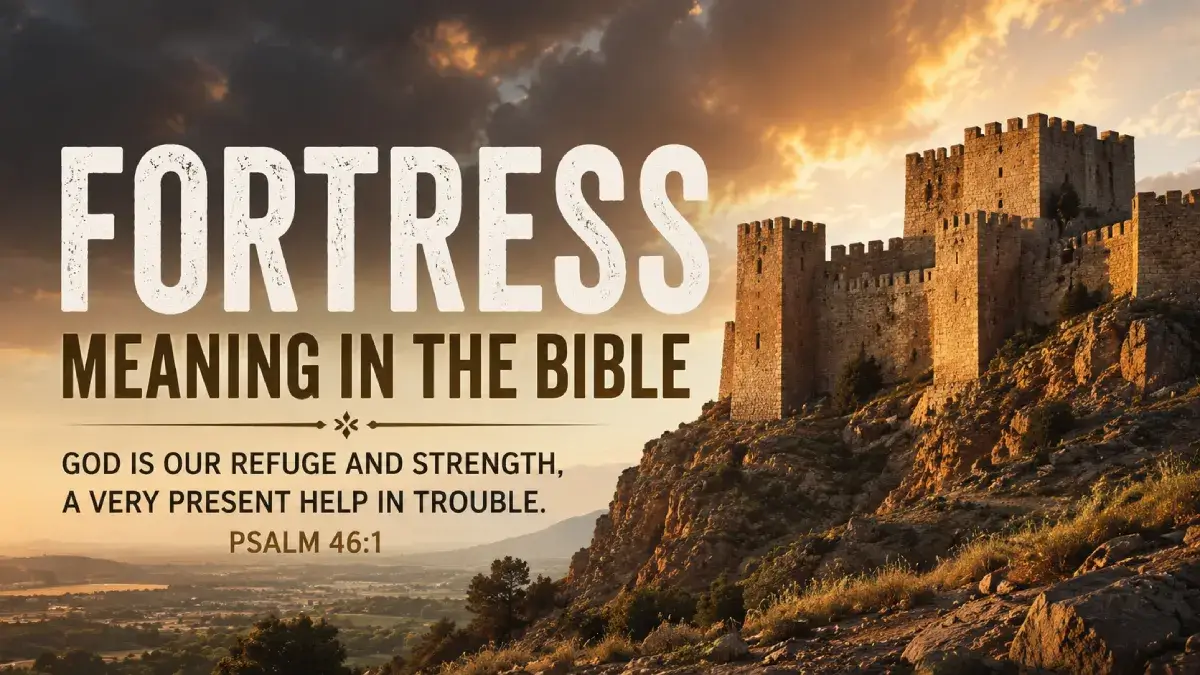
The word fortress appears throughout the Bible as an image of strength, safety, protection, and security. In the ancient world, a fortress was a strong, defended place where people could find protection from enemies.
But Scripture often takes this physical image and applies it to God Himself.
David repeatedly described the Lord as his fortress when he was surrounded by enemies and facing danger. Instead of trusting only in physical defenses, David learned to place his confidence in God’s protection.
So, what does fortress mean in the Bible?
A fortress represents a place of security, strength, refuge, and protection. When God is called a fortress, Scripture is emphasizing that He is the believer’s ultimate source of safety and strength.
The image is especially powerful because a fortress is not simply a hiding place. It is a stronghold that can withstand attack.
What Does Fortress Mean in the Bible?
In the Bible, a fortress is a strong and protected place that provides safety from enemies.
The word can refer to an actual fortified location, but it is also frequently used figuratively to describe God’s protection.
A fortress can symbolize:
- Protection
- Security
- Strength
- Refuge
- Safety
- Stability
- Deliverance
- Confidence in God
When David says that God is his fortress, he is not saying that God merely makes life comfortable.
He is declaring that God is the One he can depend on when danger surrounds him.
What Does God as a Fortress Mean?
When Scripture describes God as a fortress, it presents Him as a secure refuge for those who trust Him.
One of the clearest examples is Psalm 18:2:
“The LORD is my rock, my fortress and my deliverer.”
David uses several images together:
- Rock
- Fortress
- Deliverer
- Shield
- Stronghold
Each image emphasizes a different aspect of God’s character.
A rock suggests stability.
A shield suggests protection.
A fortress suggests security.
A deliverer suggests rescue.
Together, these images communicate a powerful truth:
God is strong enough to protect His people and faithful enough to sustain them.
Why Is a Fortress Important in the Bible?
To understand the biblical metaphor, it helps to understand what a fortress meant in the ancient world.
A fortress was designed to withstand attack.
It could have:
- Strong walls
- Defensive towers
- Secure entrances
- Elevated positions
- Protected areas for people
- Supplies for times of siege
When an enemy approached, people could seek safety inside.
This makes the biblical image especially meaningful.
When David called God his fortress, he was using an image that his audience could immediately understand.
God is a secure place when trouble comes.
Fortress Meaning in Hebrew
Several Hebrew words can be translated with ideas such as fortress, stronghold, fortified place, or defense.
One important Hebrew term is metsudah, which can refer to a stronghold, fortress, or fortified place.
Another related term, maoz, carries the idea of a place of strength, protection, or refuge.
The exact meaning depends on the context and the Hebrew word used in a particular verse.
This is important because “fortress” is not always functioning as a technical description of one specific kind of building.
Often, it is an image communicating strength and security.
God Is Our Fortress
One of the most comforting themes in Scripture is that God Himself is the believer’s fortress.
Psalm 18:2
David declares:
“The LORD is my rock, my fortress and my deliverer.”
David had experienced danger, opposition, and persecution.
Yet he did not ultimately place his security in military strength or human allies.
He trusted God.
Psalm 46:1
Psalm 46 begins with another powerful declaration:
“God is our refuge and strength, an ever-present help in trouble.”
The message is closely related to the fortress image.
When trouble comes, God’s people have somewhere to turn.
God is not distant from suffering.
He is presented as a refuge in the midst of trouble.
Psalm 91:2
The psalmist says:
“I will say of the LORD, ‘He is my refuge and my fortress, my God, in whom I trust.'”
Notice the connection between fortress and trust.
The fortress image ultimately points beyond physical safety to a relationship of confidence in God.
Fortress vs. Refuge in the Bible
The words fortress and refuge are closely related, but they emphasize slightly different aspects of God’s protection.
A refuge is a place where someone can flee for safety.
A fortress emphasizes strength and defense.
Together, they create a fuller picture of God.
He is:
- The place we run to.
- The One who protects us.
- The source of our strength.
- The One who remains secure when circumstances are unstable.
This is why Scripture frequently places these images side by side.
Is God a Physical Fortress?
No.
When the Bible describes God as a fortress, it is using figurative language.
God is not a stone building with walls and towers.
The metaphor communicates His character.
Just as a physical fortress can provide protection against an attacking army, God provides spiritual security and strength to those who trust Him.
The image therefore teaches us something about who God is, rather than describing God’s physical appearance.
Fortress as a Symbol of Protection
One of the primary meanings of a fortress in Scripture is protection.
Life can bring circumstances that make people feel vulnerable:
- Fear
- Persecution
- Loss
- Opposition
- Uncertainty
- Temptation
- Grief
- Conflict
The Bible does not promise that believers will never experience these things.
Instead, Scripture repeatedly points believers toward God as their refuge and strength.
This is an important distinction.
God being our fortress does not necessarily mean that every difficult situation will immediately disappear.
It means that we do not face difficulty without God.
Fortress as a Symbol of Strength
A fortress is strong because it is designed to withstand attack.
In the same way, Scripture presents God as stronger than the circumstances that threaten His people.
Psalm 18:32–34 describes God as the One who equips and strengthens David.
This reminds us that God’s strength is not merely defensive.
He also gives His people strength to continue, endure, and persevere.
When you feel weak, the biblical fortress image points you toward God’s strength rather than your own.
Fortress as a Symbol of Security
A fortress creates a sense of security because it provides a protected place.
The Bible uses this imagery to teach that ultimate security does not come from possessions, wealth, status, or human power.
Those things can change.
God does not.
Psalm 9:9 describes the Lord as a stronghold for the oppressed and a stronghold in times of trouble.
The emphasis is not on a trouble-free life.
It is on God’s faithfulness during trouble.
Fortress as a Symbol of Refuge
The fortress image also teaches us where to turn when we are afraid.
Fear often causes people to look for immediate solutions.
We may try to control everything ourselves.
But the psalms repeatedly teach another response:
Run to God.
A fortress is somewhere you enter for protection.
Spiritually, this can remind us to bring our fears, questions, burdens, and uncertainties to God through prayer and trust.
David and the Fortress Image
David is one of the biblical figures most closely associated with the fortress imagery.
Before becoming king, David spent significant periods of his life fleeing from Saul.
He lived in wilderness areas and strongholds while Saul pursued him.
These experiences help explain why David’s language about God as a fortress is so vivid.
David knew what it meant to seek physical shelter.
But he also learned that physical protection alone was not enough.
His ultimate confidence was in God.
This gives additional depth to passages such as Psalm 18.
David’s description of God as a fortress was not merely poetic language.
It came from experience.
The Lord as David’s Stronghold
Psalm 144:2 describes God as David’s loving God, fortress, stronghold, and deliverer.
These words show how David understood his relationship with God.
He did not see God as merely a distant Creator.
He knew God as the One who sustained him through danger.
The repeated fortress imagery throughout the Psalms therefore reflects personal trust developed through difficult circumstances.
What Does “God Is My Fortress” Mean Personally?
When someone says, “God is my fortress,” they are expressing confidence in God.
It can mean:
“I may not know what will happen, but I know where I can turn.”
It can also mean:
- God is stronger than my fears.
- God is greater than my circumstances.
- God is faithful when people fail.
- God can sustain me when I feel weak.
- God is worthy of my trust.
This does not mean that Christians should ignore practical responsibilities or refuse appropriate help from other people.
Rather, it means that God remains the ultimate source of security.
What Is the Difference Between God as a Fortress and God as a Shield?
The Bible uses both images.
A shield is something that protects a person during an attack.
A fortress is a protected stronghold where someone can find safety.
Both metaphors communicate God’s protection, but from different perspectives.
The shield emphasizes God’s protection around us.
The fortress emphasizes God’s protection as a secure place to which we can flee.
Both images encourage trust.
Fortress and Spiritual Warfare
The fortress metaphor can also help Christians think about spiritual opposition.
The New Testament teaches believers to stand firm in faith and put on the armor of God in Ephesians 6:10–18.
The emphasis is not that Christians should live in fear.
Instead, believers are called to remain strong in the Lord.
God’s strength provides the foundation for spiritual perseverance.
The fortress image therefore fits naturally with the biblical call to stand firm.
Can God Be Your Fortress When You Are Afraid?
Yes.
Fear is one of the situations in which the fortress metaphor becomes especially meaningful.
When fear arises, the question is not whether fear exists.
The question is where we take that fear.
The Psalms repeatedly model bringing fear to God.
Psalm 56:3 says:
“When I am afraid, I put my trust in you.”
This is a simple but powerful pattern:
Fear → Trust → God
The fortress is not the absence of danger.
It is the presence of a secure place in the middle of danger.
What Does the Bible Say About God Being Our Stronghold?
Scripture repeatedly describes God as a stronghold.
Psalm 9:9
God is described as a stronghold for the oppressed and a stronghold in times of trouble.
Psalm 18:2
God is called a rock, fortress, deliverer, shield, and stronghold.
Psalm 46:7
The Lord is described as a refuge and strength for His people.
Psalm 59:16
David praises God as his fortress and refuge in the day of trouble.
Psalm 62:6
The psalmist describes God as his rock, salvation, and fortress.
Psalm 144:2
David describes God as his fortress, stronghold, deliverer, shield, and refuge.
These verses demonstrate that the fortress metaphor is not isolated to one passage.
It is part of a larger biblical picture of God’s faithfulness and protection.
Bible Verses About Fortress
Here are some key passages to study when exploring the fortress meaning in the Bible:
Psalm 9:9
God is described as a stronghold for those experiencing trouble and oppression.
Psalm 18:2
The Lord is called a rock, fortress, deliverer, shield, and stronghold.
Psalm 46:1
God is described as refuge and strength and an ever-present help in trouble.
Psalm 59:16
David praises God as his fortress and refuge during trouble.
Psalm 62:6
The psalmist declares that God is his rock, salvation, and fortress.
Psalm 91:2
The Lord is described as refuge and fortress, followed by a declaration of trust.
Psalm 144:2
David calls God his fortress, stronghold, deliverer, shield, and refuge.
Proverbs 18:10
The name of the Lord is described as a strong tower into which the righteous run and find safety.
Nahum 1:7
The Lord is described as good, a stronghold in the day of trouble, and one who knows those who take refuge in Him.
These passages provide a strong foundation for understanding the biblical meaning of fortress imagery.
What Is the Spiritual Meaning of Fortress?
The spiritual meaning of fortress can be summarized in several ideas.
1. God Is Our Protection
God is presented as the One we can trust when we are vulnerable.
2. God Is Our Strength
When our own strength is insufficient, God’s strength remains dependable.
3. God Is Our Refuge
We can turn toward Him rather than allowing fear to control us.
4. God Is Our Security
Circumstances change, but God’s character remains faithful.
5. God Helps Us Stand Firm
The fortress image reminds us that believers do not have to be spiritually defenseless.
6. God Is Worthy of Trust
The fortress metaphor repeatedly leads to the same response:
Trust God.
Does the Fortress Mean God Will Prevent Every Problem?
No.
This is an important biblical balance.
The Bible contains many examples of faithful people who experienced persecution, suffering, imprisonment, loss, and even death.
Calling God a fortress does not mean that believers will never face hardship.
Instead, it means that God remains faithful through hardship.
David still faced enemies.
Paul still experienced imprisonment.
The early Christians still experienced persecution.
Yet Scripture repeatedly points them toward God’s strength and faithfulness.
The fortress is not necessarily a promise that the storm will never come.
It is a reminder that God is with us when the storm comes.
How Can You Make God Your Fortress?
God is not literally a building that we enter.
So what does it mean practically to make God your fortress?
Pray
Bring your fears and burdens to God.
Trust
Choose to depend on God’s character even when circumstances are uncertain.
Read Scripture
The Word of God reminds us of His promises and character.
Obey
Trust becomes visible through faithful obedience.
Worship
Worship redirects our attention from the size of our problems to the greatness of God.
Seek Christian Community
God often provides encouragement and support through other believers.
Remember God’s Faithfulness
Look back at what God has already done.
Remembering God’s faithfulness can strengthen trust during present difficulties.
What Does “The Lord Is My Fortress” Mean?
The statement “The Lord is my fortress” means that God is the believer’s secure refuge and source of strength.
It expresses confidence that:
God is stronger than what threatens me.
It does not mean:
Nothing difficult will ever happen to me.
This distinction is important.
Biblical faith does not deny difficulty.
It declares that God is greater than difficulty.
Fortress Meaning in the Bible: A Simple Explanation
If you want to explain the biblical meaning of fortress in one sentence, you could say:
A fortress in the Bible represents a place of strength, protection, refuge, and security, and when God is called a fortress, it emphasizes His faithfulness and power to sustain those who trust Him.
The image is especially powerful because a fortress is designed to remain secure even when enemies attack.
Likewise, Scripture invites believers to build their confidence on the unchanging character of God.
FAQ: Fortress Meaning in the Bible
What does fortress mean in the Bible?
A fortress is a strong and protected place. Biblically, it can symbolize protection, strength, refuge, security, and God’s ability to sustain His people during trouble.
What does it mean when God is called a fortress?
When God is called a fortress, Scripture is using figurative language to describe Him as a secure refuge and source of strength. It communicates that believers can trust God when facing danger, fear, or hardship.
What Bible verse says God is our fortress?
Psalm 18:2 says, “The LORD is my rock, my fortress and my deliverer.” Psalm 91:2 also describes the Lord as a refuge and fortress.
What is the spiritual meaning of a fortress?
Spiritually, a fortress represents security, protection, strength, refuge, and confidence in God. It reminds believers that their ultimate security is found in God rather than circumstances or human strength.
Is a fortress the same as a refuge in the Bible?
They are closely related. A refuge emphasizes a place of safety, while a fortress emphasizes strength and defense. Scripture often uses both images to describe God’s protection.
Why does David call God his fortress?
David experienced danger, persecution, and opposition, especially during the years when Saul pursued him. His experience of God’s faithfulness led him to describe the Lord as his fortress, refuge, rock, and deliverer.
Does God being our fortress mean Christians will never suffer?
No. The Bible contains many examples of faithful people who suffered. Calling God a fortress means that He remains a source of strength and refuge during suffering, not that believers will never experience hardship.
What is the difference between a fortress and a stronghold in the Bible?
The terms overlap considerably. Both can describe a fortified or secure place. When applied to God, both images communicate His strength, protection, and reliability.
What does Psalm 18:2 teach about God as a fortress?
Psalm 18:2 combines several images—rock, fortress, deliverer, shield, and stronghold—to emphasize God’s protection, strength, and faithfulness.
What does Proverbs 18:10 mean about God’s name being a strong tower?
Proverbs 18:10 uses the image of a strong tower to communicate safety in the name of the Lord. The verse emphasizes confidence in God’s character and power.
Final Reflection
The fortress meaning in the Bible is a beautiful picture of who God is.
A fortress is strong when everything outside its walls is uncertain.
It provides protection when danger approaches.
It gives people somewhere to run when they are afraid.
And it stands firm when enemies attack.
The Bible repeatedly uses this imagery to describe God.
David could say:
“The LORD is my rock, my fortress and my deliverer.” — Psalm 18:2
The message is not that life will always be easy.
It is that God remains faithful when life is difficult.
When fear comes, God can be our refuge.
When weakness comes, He can be our strength.
When uncertainty comes, He remains secure.
When opposition comes, we can stand firm in Him.
The next time you read about God as a fortress, picture what that meant to someone living in the ancient world—a place strong enough to withstand an attack and secure enough to provide refuge.
Then remember the spiritual truth behind the image:
Our circumstances may change, but our God remains a secure place of refuge.