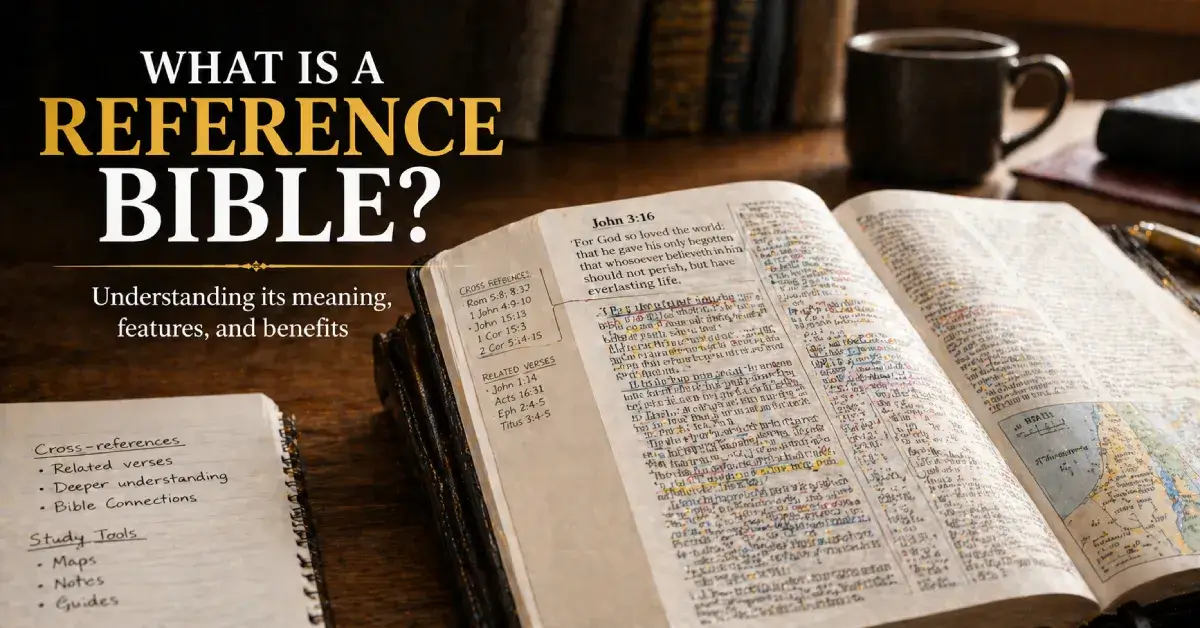
If you’ve ever opened a Bible and noticed small notes, cross-references, or study helps in the margins, you may have been looking at a reference Bible.
But what exactly is a reference Bible—and how is it different from a regular Bible?
👉 A reference Bible is designed to help you understand Scripture by connecting related verses and ideas.
“All Scripture is God-breathed and useful for teaching…” — 2 Timothy 3:16
What Is a Reference Bible?
A reference Bible is a Bible that includes additional tools to help you:
- Find related verses
- Understand context
- Study themes across Scripture
- Navigate the Bible more easily
👉 It keeps the biblical text central, but adds helpful references alongside it.
Key Features of a Reference Bible
🔗 1. Cross-References
Cross-references connect one verse to another related verse.
👉 Example:
- A verse about faith may link to other faith-related passages
This helps you see how the Bible explains itself.
📝 2. Marginal Notes
Small notes appear in the margins or center column.
They may include:
- Related verses
- Short explanations
- Alternate wording
📚 3. Concordance (in some editions)
A concordance is like a mini dictionary of Bible words.
👉 It helps you:
- Find verses by keyword
- Study specific topics
🗺️ 4. Maps and Charts
Many reference Bibles include:
- Maps of biblical locations
- Timelines
- Historical context
🔍 5. Footnotes
Footnotes provide:
- Clarification
- Cultural background
- Translation insights
Reference Bible vs Study Bible
Many people confuse these two. Here’s the difference:
| Reference Bible | Study Bible |
|---|---|
| Focuses on cross-references | Includes detailed explanations |
| Minimal commentary | Extensive teaching notes |
| Lets Scripture interpret Scripture | Includes human interpretation |
| Simpler | More detailed |
👉 A reference Bible is ideal for pure Bible study. 👉 A study Bible is better for learning explanations.
Why Use a Reference Bible?
1. Understand the Bible More Deeply
You see how verses connect across different books.
2. Study Themes Easily
Topics like faith, love, or forgiveness become clearer.
3. Let the Bible Interpret Itself
Instead of relying only on outside opinions.
4. Improve Bible Navigation
You find verses faster.
“The unfolding of your words gives light.” — Psalm 119:130
How to Use a Reference Bible
📖 Step 1: Read a Verse
Start with the main passage.
🔗 Step 2: Check Cross-References
Look at the small references next to the verse.
🔍 Step 3: Compare Verses
Read the related verses.
🧠 Step 4: Understand the Theme
Notice how the same idea appears in different places.
🙏 Step 5: Apply It
Ask how the message applies to your life.
Example of Using a Reference Bible
Let’s say you read:
“Trust in the LORD with all your heart.” — Proverbs 3:5
Your reference Bible may point you to:
- Psalm 37:5
- Isaiah 26:3
- Jeremiah 17:7
👉 Now you can study trust across the Bible.
Who Should Use a Reference Bible?
A reference Bible is perfect for:
- Beginners
- Serious Bible students
- Teachers and pastors
- Anyone wanting deeper understanding
👉 It works for both simple reading and deep study.
Types of Reference Bibles
Some popular types include:
- Center-column reference Bibles
- Wide-margin reference Bibles
- Chain-reference Bibles
- Compact reference Bibles
Each offers different layouts but similar features.
Benefits of a Reference Bible
✔ Helps you connect Scripture
✔ Encourages deeper study
✔ Builds stronger understanding
✔ Keeps focus on God’s Word
✔ Easy to use
FAQ: What Is a Reference Bible?
What is the purpose of a reference Bible?
To help you understand Scripture by linking related verses.
Is a reference Bible good for beginners?
Yes, it is very helpful.
What is the difference between reference and study Bible?
Reference Bibles focus on verse connections, while study Bibles include explanations.
Do all Bibles have references?
No, only specific editions include them.
Which is better: study or reference Bible?
It depends on your goal—study for teaching, reference for connections.
Final Reflection
A reference Bible is a powerful tool that helps you see the Bible as one connected story. Instead of reading verses in isolation, you begin to understand how everything fits together.
“All Scripture is God-breathed…” — 2 Timothy 3:16
If you want to grow deeper in your faith and understanding, a reference Bible can be an invaluable companion.