The Bible contains several references to prostitutes, prostitution, and sexual immorality. Some passages describe actual women who practiced prostitution, while others use prostitution as a metaphor for spiritual unfaithfulness.
These passages can be difficult to read because they involve sin, exploitation, sexual relationships, repentance, judgment, and redemption.
Yet one of the most important themes throughout Scripture is that a person’s past does not place them beyond God’s mercy.
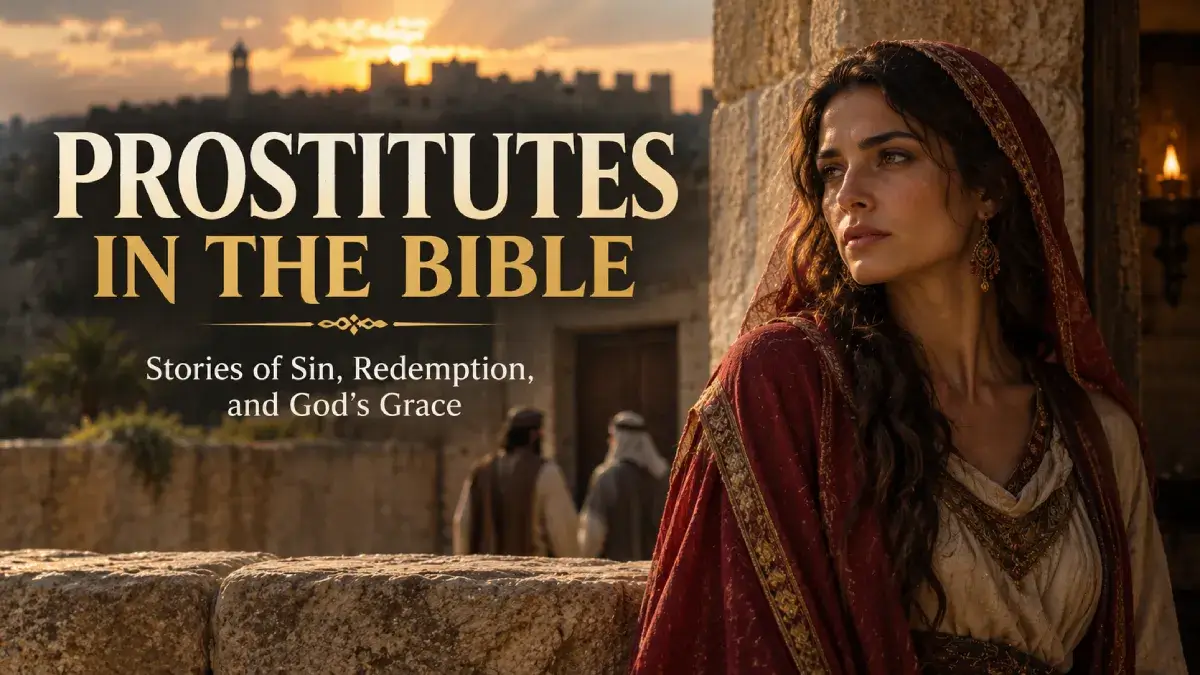
Perhaps the clearest example is Rahab, a prostitute in Jericho who placed her faith in the God of Israel. She protected the Israelite spies, was spared when Jericho fell, and later became part of the family line of Jesus.
Jesus also made a remarkable statement about prostitutes and repentance. Speaking to religious leaders, He said that tax collectors and prostitutes were entering the kingdom of God ahead of those who refused to believe and repent.
So, what exactly does the Bible say about prostitutes?
Let’s examine the major passages and people connected with prostitution and discover what Scripture teaches about sin, repentance, mercy, faith, justice, and redemption.
Does the Bible Mention Prostitutes?
Yes.
Prostitution is mentioned in both the Old and New Testaments.
The Bible refers to prostitutes using several different terms depending on the translation, including:
- Prostitute
- Harlot
- Sexual immorality
- Prostitution
- Adultery
- Fornication
Some passages describe literal prostitution, while others use prostitution as a picture of spiritual unfaithfulness toward God.
For example, Israel’s worship of foreign gods is repeatedly compared to prostitution or adultery because God’s people had broken their covenant relationship with Him.
Therefore, it is important to consider the context of each passage rather than assuming every biblical reference to a “prostitute” has the same meaning.
1. Rahab — The Most Famous Prostitute in the Bible
The most famous prostitute in the Bible is Rahab.
Her story is found primarily in Joshua 2 and Joshua 6.
Rahab lived in Jericho, a city that stood in the path of Israel’s conquest of Canaan.
Joshua sent two spies to investigate Jericho.
They came to Rahab’s house, which Scripture identifies as the house of a prostitute.
When the king of Jericho learned that Israelite spies had entered the city, he ordered Rahab to bring them out.
Instead, Rahab hid them.
She then misdirected the king’s men and helped the spies escape.
Rahab Believed in the God of Israel
Rahab’s actions were motivated by something deeper than simply protecting strangers.
She had heard about what God had done for Israel.
She told the spies that the people of Jericho had heard how the Lord had dried up the Red Sea and given Israel victory over other peoples.
Rahab then made an extraordinary declaration:
“The LORD your God is God in heaven above and on the earth below.”
— Joshua 2:11
Her confession demonstrates faith in the God of Israel.
She recognized God’s power even though she came from a pagan city.
Rahab Was Spared
Rahab asked the spies to spare her family when Israel attacked Jericho.
They agreed.
When Jericho eventually fell, Rahab and her household were preserved.
Joshua 6:25 says that Rahab and her family were spared because she had hidden the messengers.
Her story is remarkable because the Bible does not make her former occupation the defining feature of her future.
Instead, Rahab becomes remembered as a woman who believed God and acted in faith.
2. Rahab Is Mentioned in the New Testament
Rahab’s story does not end in Joshua.
She is mentioned in the New Testament.
The book of Hebrews includes Rahab among people remembered for faith.
Hebrews 11:31 says:
“By faith the prostitute Rahab, because she welcomed the spies, was not killed with those who were disobedient.”
Notice how Scripture identifies her.
It does not hide her past.
Rahab is still called the prostitute Rahab.
But her past is not the end of her story.
She is remembered for faith.
That is a powerful biblical message.
Rahab and James 2
James also mentions Rahab.
James 2:25 points to her actions in welcoming the spies and helping them escape as an example of faith demonstrated through works.
Her story illustrates an important principle:
Genuine faith produces action.
Rahab believed what she had heard about God, and her belief affected what she did.
3. Rahab Appears in the Genealogy of Jesus
Rahab’s story becomes even more remarkable in Matthew 1.
Matthew’s genealogy of Jesus includes Rahab.
Matthew 1:5 identifies her as the mother of Boaz, who became the father of Obed.
Obed was the father of Jesse, and Jesse was the father of King David.
This places Rahab within the ancestry of David and ultimately within the genealogy of Jesus Christ.
The woman once known as a prostitute in Jericho became part of the family line through which the Messiah came.
What Does Rahab Teach Us?
Rahab teaches several important lessons:
- Your past does not have to determine your future.
- Faith can lead to courageous action.
- God sees people beyond their former identity.
- Repentance and faith can lead to a completely different life.
- God’s grace can reach people from every background.
- A person’s former occupation does not make them permanently unworthy of God’s mercy.
Rahab is one of Scripture’s clearest pictures of redemption.
4. The Two Prostitutes Who Came Before Solomon
Another well-known passage involving prostitutes appears in 1 Kings 3:16–28.
Two women came before King Solomon.
The Bible identifies both women as prostitutes.
Each woman had given birth to a son.
Tragically, one of the babies died during the night.
Both women claimed that the surviving baby belonged to her.
There were no witnesses who could settle the dispute.
Solomon’s Wisdom
Solomon faced an impossible situation.
He famously ordered that the living child be divided, with half given to each woman.
He did not actually intend to harm the child.
Instead, he was testing their responses.
The true mother immediately pleaded for the baby’s life and offered to give him to the other woman.
The other woman accepted the proposed division.
Solomon therefore recognized the woman who was willing to sacrifice her claim to save the child as the true mother.
The people of Israel were amazed by his wisdom.
Why Does the Bible Mention Their Occupation?
The passage identifies the women as prostitutes because that was part of their social context.
But the central point of the story is Solomon’s God-given wisdom, not the women’s occupation.
The passage demonstrates that God’s wisdom can reveal truth even in circumstances where ordinary evidence is unavailable.
5. Judah and Tamar
One of the more complicated passages involving prostitution is the story of Judah and Tamar in Genesis 38.
Tamar disguised herself and sat beside the road.
Judah encountered her and assumed she was a prostitute.
The story is morally and socially complex, and it should not be reduced to a simple lesson about prostitution.
Judah became involved with Tamar without recognizing her identity.
Later, when Tamar’s pregnancy became known, Judah initially condemned her.
But when he discovered that he himself was responsible for her pregnancy, he acknowledged:
“She is more righteous than I.”
Was Tamar Actually a Prostitute?
This distinction matters.
Genesis 38 presents Tamar as disguising herself so that Judah would think she was a prostitute.
Therefore, it is more accurate to say that Judah believed Tamar was a prostitute rather than simply describing Tamar as a professional prostitute.
The story involves deception, sexual relations, family obligations, injustice, and Judah’s eventual recognition of his own wrongdoing.
It is one of the Bible’s more complicated narratives and should be read carefully in its historical and literary context.
6. Samson and the Prostitute of Gaza
The book of Judges contains another explicit reference to a prostitute.
Judges 16:1 says that Samson went to Gaza, where he saw a prostitute and spent the night with her.
The passage is brief and does not identify the woman by name.
The focus quickly shifts to Samson’s enemies, who surrounded the city in an attempt to capture him.
Samson escaped by pulling up the city gate and carrying it away.
What Is the Lesson?
This passage is not presented as an endorsement of prostitution.
Instead, it forms part of the larger story of Samson’s complicated relationship with sexual temptation, violence, and his calling as a judge of Israel.
The narrative ultimately points toward Samson’s repeated failure to exercise wisdom and self-control.
7. Prostitutes in the Book of Proverbs
The book of Proverbs frequently warns young men about sexual temptation.
Proverbs describes the dangers of being drawn toward an immoral woman and repeatedly emphasizes the destructive consequences of sexual sin.
Proverbs 6:26 says:
“For a prostitute can be had for a loaf of bread, but another man’s wife preys on your very life.”
Proverbs is presenting wisdom about sexual behavior, temptation, and consequences.
The broader message is that sexual sin can destroy relationships, reputation, resources, and ultimately one’s life.
Proverbs Is About More Than Prostitutes
The warnings in Proverbs should not be interpreted as suggesting that only prostitutes are capable of sexual immorality.
The book repeatedly addresses the heart, temptation, wisdom, self-control, and faithfulness.
Its message is directed toward the person being tempted as much as toward the person presenting the temptation.
8. Jesus and Prostitutes
One of the most powerful passages about prostitutes occurs in the teaching of Jesus.
In Matthew 21, Jesus was speaking to religious leaders who questioned His authority.
Jesus told them that tax collectors and prostitutes were entering the kingdom of God ahead of them.
Why?
Jesus explained that these people had believed and responded, while the religious leaders had seen what was happening but refused to repent and believe.
What Did Jesus Mean?
Jesus was not saying prostitution was morally acceptable.
He was making a point about repentance and spiritual pride.
The people whom religious leaders considered morally inferior were responding to John’s message and turning toward God.
Meanwhile, people who considered themselves righteous were refusing to repent.
The issue was not that prostitutes were automatically righteous.
The issue was that repentant sinners can receive God’s grace, while self-righteous people can reject it.
This is central to Jesus’ ministry.
9. Jesus Came for Sinners
Jesus repeatedly demonstrated compassion toward people who were considered sinful or socially unacceptable.
He ate with tax collectors.
He welcomed sinners.
He called people to repentance.
He offered forgiveness.
This does not mean Jesus ignored sin.
Quite the opposite.
Jesus’ message consistently involved turning away from sin and turning toward God.
His grace was not permission to continue living in sin.
It was an invitation to a transformed life.
10. The Woman Caught in Sexual Sin
John 8 tells the story of a woman accused of adultery.
Religious leaders brought her before Jesus and challenged Him concerning what should happen to her.
Jesus responded by confronting the hypocrisy of her accusers.
Eventually, the woman’s accusers left.
Jesus then told the woman:
“Go now and leave your life of sin.”
This passage captures an important biblical balance:
Mercy does not mean calling sin good.
Jesus showed compassion while also calling the woman toward a changed life.
It is a useful framework for understanding many biblical passages concerning sexual sin.
Prostitutes and the Theme of Redemption
One of the most beautiful themes connected with prostitutes in Scripture is redemption.
Rahab’s story makes this especially clear.
Her past was real.
Her occupation was real.
Her sinful environment was real.
But God was not finished with her.
She demonstrated faith.
She was rescued.
She became part of Israel.
She became part of the genealogy of David.
And she ultimately appears in the genealogy of Jesus.
Her story demonstrates that God’s grace is greater than a person’s past.
Does the Bible Say Prostitutes Cannot Be Saved?
No.
The Bible does not teach that prostitutes are beyond salvation.
In fact, Rahab is one of the clearest examples against such an idea.
Hebrews remembers Rahab for her faith.
James remembers her actions.
Matthew places her in the genealogy of Jesus.
Jesus specifically mentioned prostitutes in His teaching about people entering the kingdom of God through repentance and belief.
The biblical message is that salvation is available to sinners who turn to God in faith.
Does the Bible Condemn Prostitution?
The Bible consistently presents prostitution and sexual immorality negatively.
Prostitution is associated with sexual sin and, in some passages, with idolatry and spiritual unfaithfulness.
However, Scripture’s treatment of individual people is more nuanced.
The Bible can condemn sinful behavior while still showing compassion toward sinners.
This distinction is important.
Condemning sin is not the same as despising people.
The Gospel calls people away from sin and toward God’s mercy.
What Does the Bible Say About Prostitutes Repenting?
The Bible does not give us a detailed conversion story for every prostitute mentioned.
But Rahab provides a powerful example of a woman whose life turned toward God.
Jesus’ statement in Matthew 21 also shows that prostitutes could respond to the call to repentance.
The biblical pattern is:
Sin → repentance → faith → transformation.
The Bible does not teach that someone’s previous occupation permanently defines their spiritual identity.
Does God Forgive Prostitutes?
Yes.
The Christian message is that God forgives those who genuinely repent and place their faith in Him.
This applies to sexual sin just as it applies to every other category of sin.
1 Corinthians 6:9–11 is particularly important.
Paul lists several categories of sinful behavior and then tells the believers:
“And that is what some of you were.”
The emphasis is transformation.
Their former lives did not have to remain their present identity.
Paul says they had been washed, sanctified, and justified.
Can a Former Prostitute Become a Christian?
Yes.
Rahab demonstrates that someone with a background in prostitution can become a person of faith.
The Bible does not place a permanent spiritual label on people because of their former occupation.
A person who turns to Christ is called to a new life.
Their past may remain part of their testimony, but it does not have to remain their identity.
What Is the Difference Between Prostitution and Adultery in the Bible?
These are related but distinct concepts.
Prostitution generally involves sexual activity in exchange for payment or material benefit.
Adultery involves sexual relations with someone who is married to another person.
The Bible condemns both, but they are not identical.
A person can commit adultery without being a prostitute.
A prostitute may have sexual relations with someone who is not married.
Understanding these distinctions helps us read biblical passages more accurately.
Prostitution as a Symbol of Spiritual Unfaithfulness
The Bible sometimes uses prostitution as a metaphor.
The prophets repeatedly describe Israel’s idolatry as prostitution or harlotry.
Why?
Israel had entered into a covenant relationship with God but repeatedly turned toward other gods.
The prophets used the imagery of marital unfaithfulness to communicate how seriously God viewed idolatry.
For example, the book of Hosea uses marriage and sexual unfaithfulness as a powerful prophetic picture of Israel’s relationship with God.
The point is not primarily about prostitution itself.
The imagery communicates betrayal of covenant faithfulness.
The Prostitute in Revelation
The book of Revelation also uses prostitution symbolically.
Revelation 17 describes a figure known as Babylon the Great, portrayed as a woman called a prostitute.
She represents a corrupt system associated with immorality, power, luxury, and opposition to God.
This is not a description of an ordinary individual prostitute.
It is apocalyptic symbolism.
Therefore, Revelation’s prostitute imagery should not be used as though it were simply describing the occupation of a woman.
The symbolism communicates spiritual and moral corruption on a much larger scale.
Why Does the Bible Use Prostitution as a Spiritual Metaphor?
Marriage is a covenant relationship.
When one spouse betrays that covenant, the betrayal is deeply personal.
The prophets used this familiar relationship to explain Israel’s covenant relationship with God.
In this imagery:
God = faithful husband
Israel = unfaithful wife
Idolatry = spiritual adultery/prostitution
The metaphor emphasizes how deeply God desires faithfulness from His people.
What Can We Learn From Rahab?
Rahab’s story provides several important lessons.
1. Your Past Does Not Have to Define You
Rahab’s occupation was part of her past, but faith became central to her story.
2. Faith Requires Action
Rahab believed what she had heard about God and acted courageously.
3. God Sees Beyond Social Labels
Others may have known Rahab primarily by her occupation.
Scripture ultimately remembers her as a woman of faith.
4. God’s Grace Is Available to Outsiders
Rahab was a Canaanite living in Jericho.
Yet she became connected to Israel’s story and ultimately to the genealogy of Jesus.
5. Redemption Can Change a Life
Rahab’s story moves from Jericho to the people of God and ultimately into the Messianic family line.
What Can We Learn From Jesus’ Teaching About Prostitutes?
Jesus’ teaching in Matthew 21 provides another important lesson.
Religious appearance does not automatically equal righteousness.
A person can appear respectable while refusing to repent.
Another person may have a deeply broken past yet genuinely turn toward God.
Jesus therefore challenges us to examine our hearts rather than simply judging other people’s histories.
Should Christians Judge Prostitutes?
Christians are called to take sin seriously, but Scripture also warns against hypocritical judgment.
Jesus consistently showed compassion toward sinners while calling them to repentance.
That means Christians should not:
- Mock people
- Dehumanize people
- Treat someone as permanently dirty
- Assume someone’s past determines their worth
- Use someone’s former occupation as an excuse for hatred
Instead, Christians are called to show truth and grace.
The biblical model is not:
“Your sin makes you worthless.”
It is:
“Your sin is serious, but God’s grace is greater.”
What About People Who Are Exploited Through Prostitution?
It is also important to distinguish prostitution as an occupation from situations involving coercion, trafficking, abuse, or exploitation.
Modern prostitution can involve circumstances that the biblical texts do not directly address.
A person may be exploited or forced into sexual activity against their will.
Such situations involve serious injustice and should not be treated simply as ordinary personal moral choices.
The Bible consistently condemns exploitation and calls God’s people to defend the vulnerable and pursue justice.
Therefore, Christians should approach people involved in prostitution with compassion, dignity, truth, and concern for their safety, rather than reducing them to a label.
Prostitutes in the Bible: Key People and Passages
| Person/Passage | What Scripture Says | Main Theme |
|---|---|---|
| Rahab | A prostitute in Jericho who protected the spies | Faith and redemption |
| Two prostitutes before Solomon | Came before Solomon over a dispute concerning a baby | Wisdom and justice |
| Tamar | Disguised herself so Judah would think she was a prostitute | Justice, deception, and Judah’s responsibility |
| Prostitute of Gaza | Samson spent the night with her | Samson’s moral failures |
| Proverbs | Warns against sexual temptation and prostitution | Wisdom and self-control |
| Matthew 21 | Jesus mentions prostitutes responding to John’s message | Repentance and faith |
| Revelation 17 | A prostitute symbolizes corrupt Babylon | Spiritual corruption and judgment |
Bible Verses About Prostitutes
Here are several important passages for further study.
Joshua 2:1
Rahab is introduced as a prostitute who welcomed the Israelite spies.
Joshua 6:25
Rahab and her family are spared after Jericho falls.
Judges 16:1
Samson encounters a prostitute in Gaza.
1 Kings 3:16
Two prostitutes come before Solomon with a dispute concerning a child.
Proverbs 6:26
The book of Proverbs warns about the destructive consequences of sexual immorality.
Matthew 21:31–32
Jesus teaches that tax collectors and prostitutes responded to John’s message while religious leaders refused to repent.
Hebrews 11:31
Rahab is remembered as an example of faith.
James 2:25
Rahab’s actions are presented as an example of faith demonstrated through works.
Revelation 17
The image of a prostitute represents the corrupt spiritual and political power called Babylon the Great.
Frequently Asked Questions About Prostitutes in the Bible
Who was the prostitute in the Bible?
The best-known prostitute in the Bible was Rahab, who lived in Jericho. Her story is found in Joshua 2 and Joshua 6.
Was Rahab a prostitute?
Yes. Joshua 2:1 explicitly identifies Rahab as a prostitute.
Did Rahab become a believer in God?
Rahab expressed faith in the God of Israel and acted on that faith by protecting the Israelite spies. Hebrews 11:31 later remembers her for her faith.
Was Rahab related to Jesus?
Yes. Matthew 1:5 includes Rahab in the genealogy leading to Jesus.
Were there two prostitutes before Solomon?
Yes. 1 Kings 3:16 describes two women who were prostitutes and came before King Solomon to settle a dispute over a living child.
Was Tamar a prostitute?
Genesis 38 presents Tamar as disguising herself so that Judah would think she was a prostitute. The text does not simply describe her as a professional prostitute.
Did Samson visit a prostitute?
Judges 16:1 says that Samson went to Gaza, where he saw a prostitute and spent the night with her.
Did Jesus forgive prostitutes?
Jesus taught that prostitutes who responded to the call to repentance could enter the kingdom of God ahead of religious people who refused to believe and repent. His teaching emphasized repentance and faith, not approval of prostitution.
Does the Bible say prostitutes can go to heaven?
The Bible teaches that salvation is available to sinners who repent and place their faith in God. Rahab is a major biblical example of a prostitute who demonstrated faith.
Does God hate prostitutes?
The Bible condemns sexual sin but does not teach that people involved in prostitution are beyond God’s love or mercy. Scripture repeatedly calls sinners toward repentance and redemption.
Is prostitution a sin according to the Bible?
The Bible consistently treats prostitution and sexual immorality negatively. However, Scripture also distinguishes between condemning sinful behavior and showing compassion toward the people involved.
Why did Jesus mention prostitutes?
Jesus mentioned prostitutes in Matthew 21 to confront religious hypocrisy. He emphasized that people who had been publicly identified as sinners were responding to God’s message, while some religious leaders were refusing to repent.
What does Rahab teach Christians today?
Rahab demonstrates that faith can transform a person’s direction in life and that a person’s past does not have to determine their future with God.
Does the Bible talk about male prostitutes?
Yes. Some translations use terms such as male prostitutes or cult prostitutes in certain passages. The terminology and interpretation can vary by translation and context, particularly in passages concerning pagan religious practices.
What does prostitution symbolize in the Bible?
In prophetic literature, prostitution can symbolize spiritual unfaithfulness, especially Israel’s turning away from God toward idolatry.
Who is the prostitute in Revelation?
The prostitute in Revelation 17 is a symbolic figure representing Babylon the Great, associated with corruption, immorality, worldly power, and opposition to God.
What Does the Bible Ultimately Teach About Prostitutes?
When all these passages are considered together, an important pattern emerges.
The Bible does not minimize sexual sin.
Sexual sin is treated seriously.
But the Bible also does not teach that people who have committed sexual sins are permanently beyond God’s grace.
Rahab’s story demonstrates this beautifully.
She had a sinful past.
Yet she responded to the knowledge of God with faith.
Her life changed.
Her story became part of Israel’s history.
She became an ancestor of David.
And she appears in the genealogy of Jesus.
That is the power of redemption.
Final Thoughts: Prostitutes in the Bible
The Bible’s references to prostitutes are ultimately about much more than prostitution.
They address sin and holiness, justice and injustice, repentance and pride, faith and unbelief, judgment and mercy, and ultimately redemption.
Rahab may be the most powerful example.
Scripture does not hide her past.
It tells us plainly that she was a prostitute.
But it also tells us that she believed God.
Hebrews remembers her faith.
James points to her actions.
Matthew places her in the genealogy of Jesus.
Her story reminds us that God does not define a person only by their worst chapter.
Jesus’ teaching reinforces the same truth from another direction: people whom society considers sinful can respond to God’s call, while people who consider themselves righteous can refuse to repent.
The biblical message is therefore both challenging and hopeful:
Sin should not be excused.
People should not be dehumanized.
Repentance is possible.
Forgiveness is available.
Faith can transform a life.
And above all, God’s grace can reach people whose past seems too broken to redeem.
Rahab’s story stands as a lasting reminder that when a person turns toward God in faith, their past does not have to be the final word about who they are.