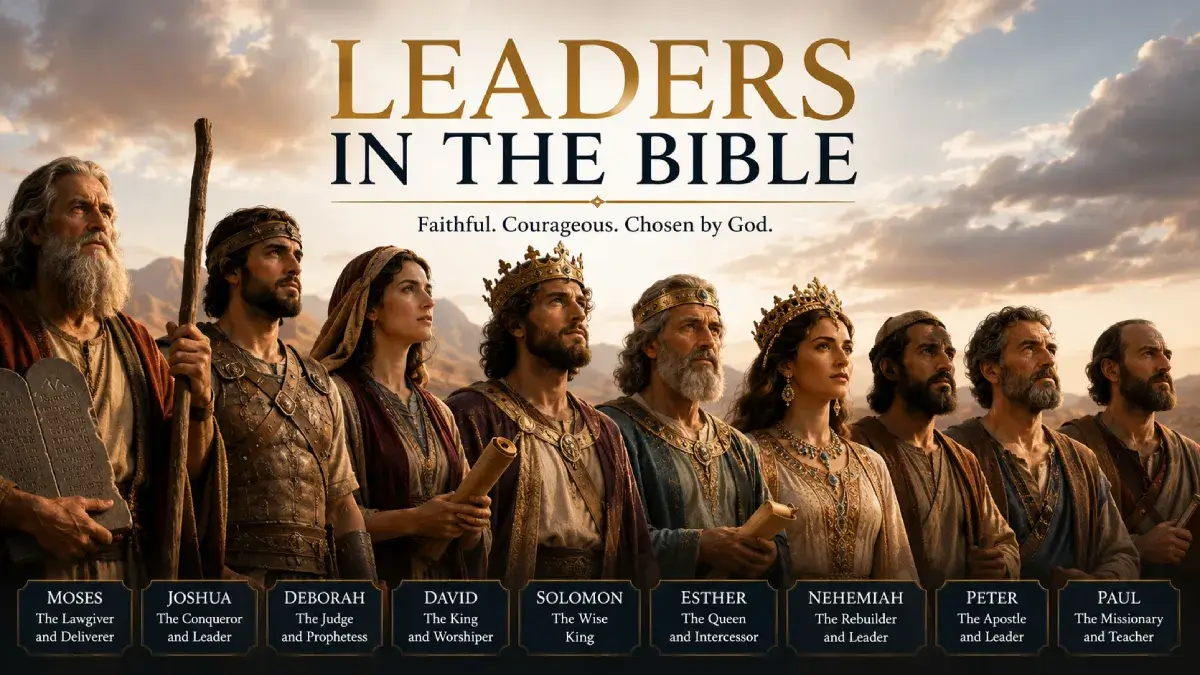
The Bible is filled with stories of remarkable leaders.
Some were kings. Some were prophets. Some were judges, apostles, and ordinary people whom God called for extraordinary purposes.
Despite their different backgrounds, these leaders shared one important characteristic:
They were willing to follow God’s calling.
Biblical leadership was never about power, fame, or personal success. Instead, it centered on serving God and guiding others according to His purposes.
“Whoever wants to become great among you must be your servant.” — Matthew 20:26
The stories of biblical leaders continue to inspire believers today because they reveal timeless lessons about faith, courage, humility, and obedience.
What Does the Bible Say About Leadership?
The Bible presents leadership as a sacred responsibility.
Godly leaders are called to:
🙏 Serve others
❤️ Lead with integrity
✨ Trust God’s guidance
🕊️ Demonstrate humility
📖 Teach and obey God’s truth
Biblical leadership is not about being perfect.
It is about being faithful.
Why Leaders Matter in the Bible
Throughout Scripture, God raised up leaders to:
✔ Guide His people
✔ Deliver His messages
✔ Protect and shepherd others
✔ Encourage faithfulness
✔ Point people toward God’s purposes
Their stories reveal both successes and failures, helping believers understand what true leadership looks like.
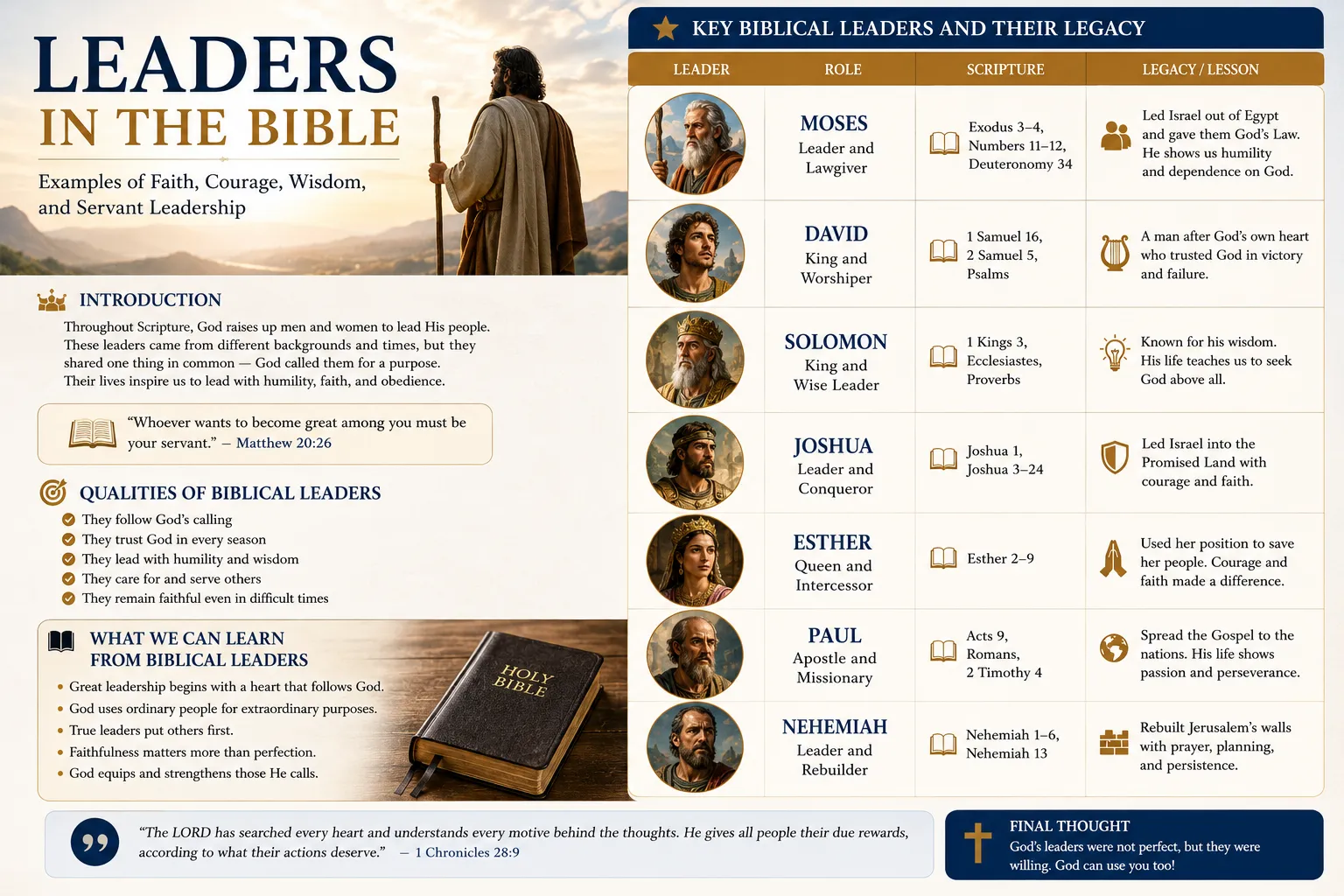
1. Moses – The Humble Deliverer
Key Scriptures:
Exodus–Deuteronomy
Moses is one of the Bible’s greatest leaders.
God called him to lead Israel out of slavery in Egypt and toward the Promised Land.
Although Moses initially doubted himself, God equipped him for the task.
Leadership Lessons from Moses
✔ Depend on God
✔ Lead with humility
✔ Persevere through challenges
✔ Intercede for others
Numbers 12:3
“Now Moses was a very humble man, more humble than anyone else on the face of the earth.”
Humility became one of Moses’ greatest strengths.
2. Joshua – The Courageous Successor
Key Scriptures:
Joshua 1–24
After Moses’ death, Joshua became Israel’s leader.
His assignment seemed impossible.
Yet God repeatedly encouraged him.
Joshua 1:9
“Be strong and courageous.”
Joshua faithfully led Israel into the Promised Land.
Leadership Lessons from Joshua
✔ Courage comes from trusting God
✔ Faith requires action
✔ Obedience brings blessing
3. Deborah – The Wise Judge
Key Scriptures:
Judges 4–5
Deborah served as both prophet and judge during a difficult period in Israel’s history.
She demonstrated wisdom, courage, and strong faith.
Leadership Lessons from Deborah
✔ Wisdom strengthens leadership
✔ Courage inspires others
✔ God uses both men and women for His purposes
Deborah’s leadership brought peace and victory to Israel.
4. David – The Shepherd King
Key Scriptures:
1 Samuel–2 Samuel
David began as a shepherd boy but became Israel’s greatest king.
He defeated Goliath, united the nation, and wrote many Psalms.
Yet David also made serious mistakes.
Even so, he continually returned to God in repentance.
Acts 13:22
“A man after my own heart.”
Leadership Lessons from David
✔ Trust God during challenges
✔ Lead with courage
✔ Admit mistakes
✔ Practice repentance
5. Solomon – The Wise King
Key Scriptures:
1 Kings 1–11
Solomon became famous for his wisdom.
When given the opportunity to ask God for anything, he requested wisdom to lead God’s people.
1 Kings 3:9
“Give your servant a discerning heart.”
Leadership Lessons from Solomon
✔ Wisdom is essential for leadership
✔ Seek God before making decisions
✔ Knowledge must be accompanied by obedience
Solomon’s later failures also remind leaders not to drift from God.
6. Esther – The Courageous Queen
Key Scriptures:
Book of Esther
Esther risked her life to save her people.
Her story contains one of the Bible’s most famous statements:
“For such a time as this.”
Leadership Lessons from Esther
✔ Courage often requires sacrifice
✔ God places people where they are for a purpose
✔ Influence should be used wisely
Esther teaches believers to trust God’s timing.
7. Nehemiah – The Visionary Rebuilder
Key Scriptures:
Book of Nehemiah
Nehemiah led the rebuilding of Jerusalem’s walls after the exile.
He combined prayer, planning, and perseverance.
Leadership Lessons from Nehemiah
✔ Pray before acting
✔ Lead with vision
✔ Persevere despite opposition
Great leadership often requires patience and determination.
8. Peter – The Transformed Leader
Key Scriptures:
Matthew, Acts
Peter was impulsive and sometimes fearful.
He even denied Jesus three times.
Yet after Jesus restored him, Peter became one of the early church’s most influential leaders.
Leadership Lessons from Peter
✔ Failure is not final
✔ God’s grace restores people
✔ Spiritual growth transforms leadership
9. Paul – The Missionary Leader
Key Scriptures:
Acts and New Testament Letters
Paul once persecuted Christians.
After encountering Christ, he became one of Christianity’s greatest missionaries and teachers.
He planted churches and wrote much of the New Testament.
Leadership Lessons from Paul
✔ God can transform anyone
✔ Leadership requires perseverance
✔ Suffering can advance God’s purposes
2 Timothy 4:7
“I have fought the good fight, I have finished the race.”
Paul’s life demonstrates faithful endurance.
Qualities of Great Leaders in the Bible
Although these leaders lived in different times, they shared several characteristics.
🙏 Faith
They trusted God despite uncertainty.
❤️ Humility
They depended on God rather than themselves.
🕊️ Courage
They acted despite fear.
📖 Wisdom
They sought God’s guidance.
✨ Servanthood
They used their influence to help others.
What Biblical Leadership Is Not
The Bible also corrects several misconceptions.
Leadership is not:
❌ Seeking power
❌ Demanding recognition
❌ Self-promotion
❌ Perfection
Jesus redefined greatness.
Matthew 20:26
“Whoever wants to become great among you must be your servant.”
True leadership begins with serving.
Leadership Lessons for Christians Today
Modern believers can learn valuable principles from biblical leaders.
🙏 Seek God’s guidance.
❤️ Serve others with humility.
📖 Build character before seeking influence.
✨ Trust God’s calling.
🕊️ Remain faithful through difficulties.
God often uses ordinary people who are willing to trust Him.
A Devotional Reflection
One of the most encouraging truths about biblical leadership is that none of these leaders were perfect.
Moses doubted. David failed. Peter denied Jesus. Jonah ran away.
Yet God still used them.
Their stories remind us that leadership does not require perfection.
It requires faithfulness.
God delights in working through imperfect people who depend upon Him.
The same God who empowered Moses, Esther, and Paul still equips believers today.
“I can do all this through him who gives me strength.” — Philippians 4:13
When God calls someone to lead, He also provides the wisdom, strength, and grace needed to fulfill that calling.
A Prayer for Godly Leadership
🙏 “Lord, thank You for the examples of leadership found in Scripture. Help me lead with humility, wisdom, courage, and love. Teach me to trust You in every situation and use my influence to serve others and bring glory to Your name. Amen.”
Frequently Asked Questions
Who was the greatest leader in the Bible?
Many consider Moses one of the greatest leaders because he led Israel out of Egypt and faithfully served God.
Who was a courageous leader in the Bible?
Joshua and Esther are excellent examples of courage.
Which leader in the Bible was known for wisdom?
King Solomon is most famous for his wisdom.
Who was a servant leader in the Bible?
Jesus is the ultimate example of servant leadership.
What qualities make a godly leader?
Faith, humility, wisdom, integrity, courage, and a heart for serving others.
Final Reflection
The leaders in the Bible remind us that God uses ordinary people to accomplish extraordinary purposes.
🙏 Moses teaches humility.
⚔️ Joshua teaches courage.
👑 David teaches repentance.
👑 Esther teaches boldness.
⛪ Paul teaches perseverance.
Their lives point us to an even greater Leader—Jesus Christ.
“Whoever wants to become great among you must be your servant.” — Matthew 20:26
May these examples inspire you to lead with faith, humility, and a heart devoted to serving God and others.