The Bible is the most widely read and influential book in history.
Yet for many people, opening the Bible for the first time can feel overwhelming.
Questions often arise:
- Why are there so many books?
- Why are they arranged this way?
- What is the difference between the Old and New Testaments?
- How do all the books fit together?
The good news is that the Bible is beautifully organized and tells one unified story:
God’s plan to redeem humanity through Jesus Christ.
“All Scripture is God-breathed and is useful for teaching, rebuking, correcting and training in righteousness.” — 2 Timothy 3:16
Understanding how the Bible is organized makes it easier to study, understand, and appreciate God’s Word.
What Is the Bible?
The word Bible comes from a Greek word meaning “books.”
The Bible is not a single book but a collection of inspired writings composed by many authors over approximately 1,500 years.
Although written by different people in different periods, the Bible tells one consistent story:
👉 Creation
👉 Humanity’s fall into sin
👉 God’s plan of redemption
👉 Jesus Christ’s life and ministry
👉 The future restoration of all things
How Many Books Are in the Bible?
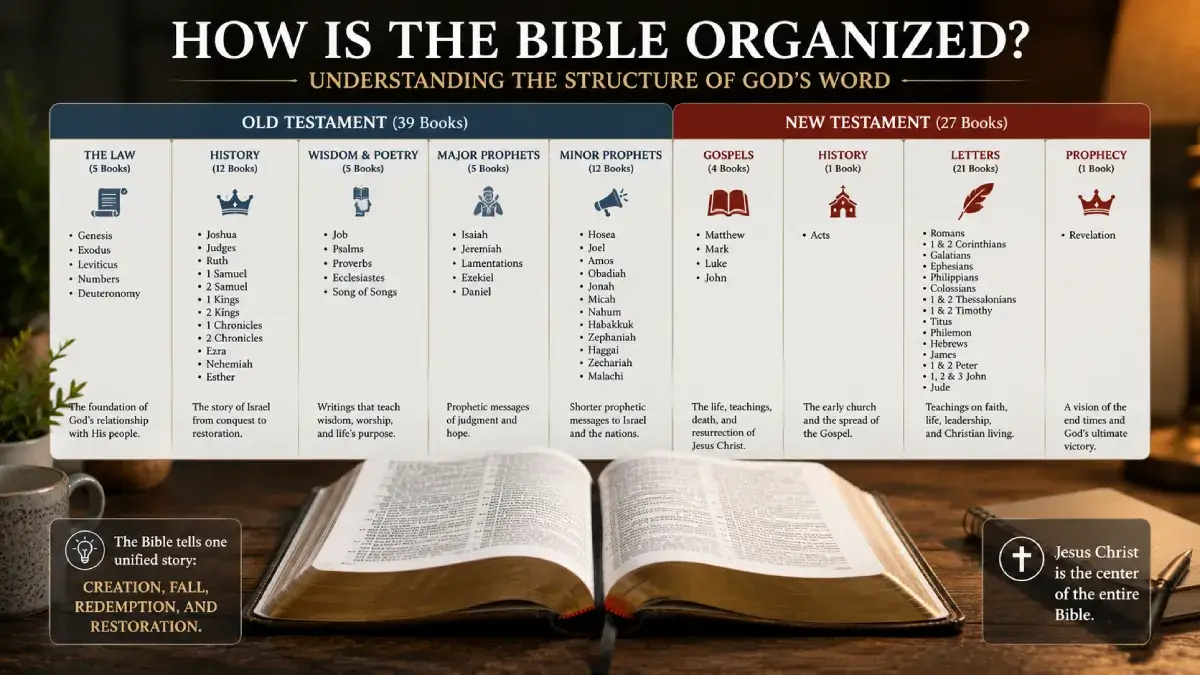
The Protestant Bible contains:
📖 66 books total
- 39 books in the Old Testament
- 27 books in the New Testament
These books are divided into several sections according to their literary style and purpose.
The Two Main Divisions of the Bible
📖 Old Testament
Contains 39 books.
It primarily focuses on:
- Creation
- God’s covenant with Israel
- The Law
- Israel’s history
- Wisdom literature
- Prophecies concerning the Messiah
The Old Testament points forward to Jesus.
✝️ New Testament
Contains 27 books.
It focuses on:
- The life of Jesus
- His death and resurrection
- The early church
- Christian teaching
- Future hope
The New Testament reveals the fulfillment of God’s promises through Christ.
How the Old Testament Is Organized
The Old Testament is generally divided into five sections.
1. The Law (Pentateuch)
Books:
- Genesis
- Exodus
- Leviticus
- Numbers
- Deuteronomy
Main Themes:
🌎 Creation
🌿 The Fall
🙏 God’s covenant with Abraham
👨👩👧👦 Israel’s beginnings
📜 God’s Law
Genesis and Exodus are often the starting point for understanding the entire Bible.
2. Historical Books
Books:
- Joshua
- Judges
- Ruth
- 1 Samuel
- 2 Samuel
- 1 Kings
- 2 Kings
- 1 Chronicles
- 2 Chronicles
- Ezra
- Nehemiah
- Esther
Main Themes:
👑 Kings of Israel
⚔️ Victories and failures
🏛️ The Temple
🏞️ Exile and return
These books tell Israel’s national story.
3. Wisdom and Poetry Books
Books:
- Job
- Psalms
- Proverbs
- Ecclesiastes
- Song of Songs
Main Themes:
🙏 Worship
🧠 Wisdom
❤️ Relationships
😔 Suffering
🎵 Praise
Psalms and Proverbs are especially popular for daily devotions.
4. Major Prophets
Books:
- Isaiah
- Jeremiah
- Lamentations
- Ezekiel
- Daniel
Main Themes:
⚠️ Repentance
✨ Hope
👑 The coming Messiah
🌎 God’s sovereignty
These books contain some of the Bible’s most powerful prophecies.
5. Minor Prophets
Books:
- Hosea
- Joel
- Amos
- Obadiah
- Jonah
- Micah
- Nahum
- Habakkuk
- Zephaniah
- Haggai
- Zechariah
- Malachi
Main Themes:
⚠️ Judgment
❤️ God’s mercy
🙏 Repentance
✨ Restoration
They are called “minor” because of their length, not their importance.
How the New Testament Is Organized
The New Testament is usually divided into four sections.
1. The Gospels
Books:
- Matthew
- Mark
- Luke
- John
Main Themes:
✝️ Jesus’ birth
🙏 His teachings
✨ Miracles
✝️ Crucifixion
🌅 Resurrection
The Gospels introduce Jesus Christ, the central figure of Scripture.
2. History
Book:
- Acts
Main Themes:
🔥 The Holy Spirit
⛪ Birth of the church
🌍 Missionary journeys
Acts bridges the Gospels and the letters.
3. Letters (Epistles)
Books Include:
- Romans
- Corinthians
- Galatians
- Ephesians
- Philippians
- Colossians
- Thessalonians
- Timothy
- Titus
- Philemon
- Hebrews
- James
- Peter
- John
- Jude
Main Themes:
🙏 Faith
❤️ Christian living
⛪ Church leadership
✨ Spiritual growth
The letters explain how believers should live.
4. Prophecy
Book:
- Revelation
Main Themes:
👑 Jesus’ return
⚖️ Final judgment
🌎 New creation
✨ Eternal hope
The Bible ends with God’s ultimate victory.
Is the Bible Arranged Chronologically?
Not entirely.
The books are grouped mainly by:
✔ Literary type
✔ Purpose
✔ Historical significance
For example:
Job may describe events that occurred before many historical books, yet it appears later because it belongs to Wisdom Literature.
Likewise, Paul’s letters are generally arranged by length rather than by the exact dates they were written.
Why Understanding the Bible’s Organization Matters
Knowing the Bible’s structure helps readers:
✔ Understand context
✔ Follow the storyline of redemption
✔ Study books more effectively
✔ Avoid confusion
✔ Read with greater confidence
The Bible becomes much easier to navigate once you understand its organization.
The Bible’s One Unified Story
Although the Bible contains 66 books, it ultimately tells one story:
🌎 Creation
God creates the world.
🍎 The Fall
Humanity sins and becomes separated from God.
📜 Redemption Promised
God promises a Savior.
✝️ Redemption Accomplished
Jesus dies and rises again.
👑 Restoration
God will make all things new.
Jesus is the center of this story.
Luke 24:27
“Beginning with Moses and all the Prophets, he explained to them what was said in all the Scriptures concerning himself.”
Every section of the Bible ultimately points to Christ.
How Beginners Can Start Reading the Bible
Many people do not know where to begin.
A simple approach:
Step 1
Start with the Gospel of John.
Step 2
Read Genesis.
Step 3
Read Acts.
Step 4
Explore Psalms and Proverbs.
Step 5
Continue through the New Testament letters.
This approach provides both the big picture and practical application.
A Devotional Reflection
At first glance, the Bible may appear to be a collection of separate books and stories.
Yet the more you read, the more you discover its remarkable unity.
Written by dozens of authors over many centuries, Scripture consistently reveals one message:
God loves His people and has provided redemption through Jesus Christ.
Every section of the Bible contributes to that story.
Every book reveals something about God’s character.
Every page ultimately points toward Christ.
“All Scripture is God-breathed.” — 2 Timothy 3:16
Understanding how the Bible is organized helps us appreciate the beauty and purpose of God’s Word.
A Prayer for Understanding Scripture
🙏 “Lord, thank You for giving us Your Word. Help me understand the structure of the Bible and grow in wisdom as I read it. Open my eyes to see Your truth and help me recognize how every part of Scripture points to Your love and redemption through Jesus Christ. Amen.”
Frequently Asked Questions
How many books are in the Bible?
The Protestant Bible contains 66 books.
How many books are in the Old Testament?
Thirty-nine books.
How many books are in the New Testament?
Twenty-seven books.
Is the Bible in chronological order?
Not completely. The books are mostly organized by literary type and purpose.
What is the best book for beginners?
The Gospel of John is often recommended for new readers.
Final Reflection
The Bible may seem large and complex, but its organization is beautifully intentional.
📖 The Old Testament prepares for Christ.
✝️ The New Testament reveals Christ.
🌎 The entire Bible tells one story of redemption.
The more we understand how Scripture is organized, the easier it becomes to read, study, and treasure God’s Word.
“Your word is a lamp for my feet, a light on my path.” — Psalm 119:105
May your journey through the Bible deepen your understanding of God’s truth and draw you closer to Him every day.