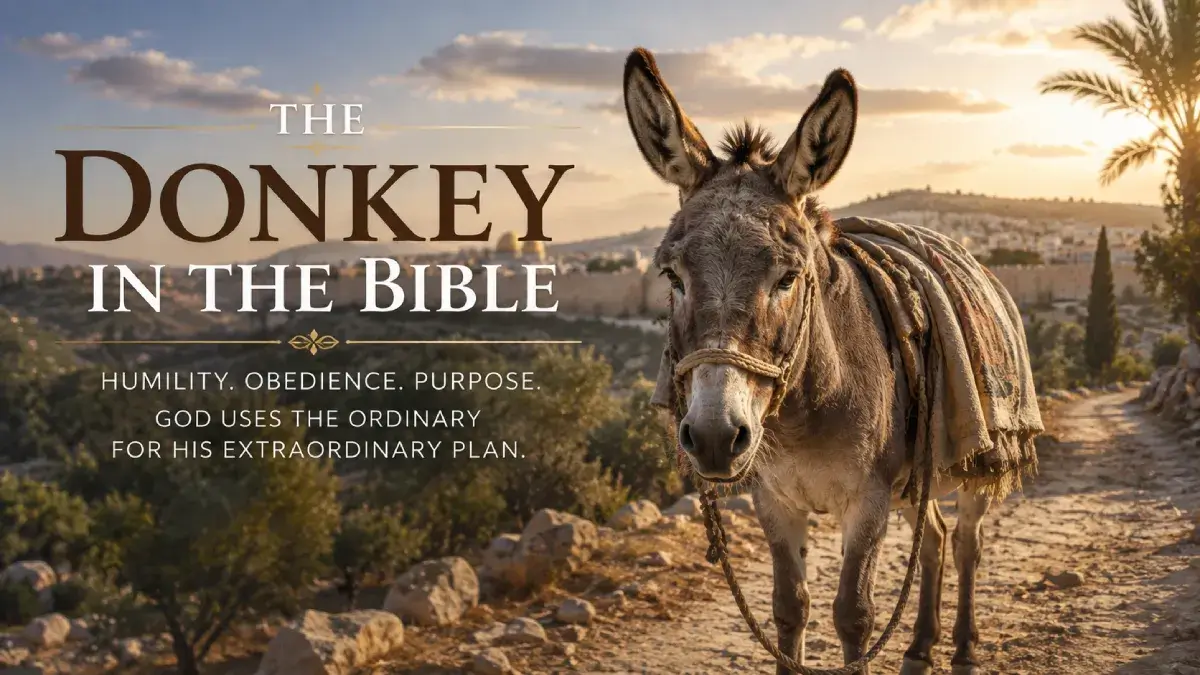
The donkey may seem like a small detail in the Bible, but this humble animal appears in several important stories throughout Scripture. From Balaam’s unusual encounter with a donkey to Jesus riding a donkey into Jerusalem, these passages reveal themes of humility, obedience, service, peace, and God’s ability to use ordinary things for extraordinary purposes.
So, what does a donkey represent in the Bible?
The answer depends on the passage. Sometimes a donkey is simply an ordinary working animal used for transportation or carrying burdens. In other places, the donkey becomes part of a much bigger message about God’s purposes.
One of the most memorable examples is Jesus’ triumphal entry into Jerusalem. The Gospel of Matthew connects Jesus riding a donkey with the prophecy in Zechariah 9:9, where Israel’s King is described as coming humbly and riding on a donkey.
What Does a Donkey Represent in the Bible?
Throughout Scripture, donkeys can be associated with several ideas:
- Humility — A donkey could represent a humble rather than militaristic arrival.
- Service — Donkeys were commonly used for transportation and carrying loads.
- Obedience — Biblical stories sometimes place a donkey in situations where God’s purposes are being carried out.
- Peace — The donkey contrasts with the imagery of a powerful war horse in certain biblical contexts.
- God using ordinary things — The story of Balaam’s donkey especially demonstrates that God can use an unexpected instrument to accomplish His purposes.
It is important not to assume that every mention of a donkey has the same symbolic meaning. In many passages, the animal is simply part of everyday life in the biblical world.
Where Is the Donkey Mentioned in the Bible?
Donkeys appear throughout both the Old and New Testaments. Some of the best-known passages include:
- Genesis 22:3 — Abraham saddles his donkey before traveling with Isaac.
- Genesis 49:11 — Jacob’s blessing of Judah includes imagery involving a donkey and a colt.
- Judges 15:15–16 — Samson uses the jawbone of a donkey against the Philistines.
- Numbers 22:21–35 — Balaam’s donkey sees the angel of the Lord and speaks.
- 1 Samuel 9:3–10 — Saul goes searching for his father’s lost donkeys.
- Zechariah 9:9 — The coming King is described as riding on a donkey.
- Matthew 21:1–7 — Jesus rides into Jerusalem on a donkey and colt.
- Mark 11:1–7 — Jesus’ entry into Jerusalem includes a colt.
- Luke 19:28–38 — Jesus enters Jerusalem amid public praise.
- John 12:12–16 — Jesus’ entry fulfills the prophetic picture of the King coming on a donkey.
These passages show that donkeys were not unusual or insignificant animals in biblical times. They were part of transportation, agriculture, travel, and daily life.
Balaam’s Donkey: When God Used an Unlikely Animal
One of the most unusual donkey stories in the Bible is found in Numbers 22:21–35.
Balaam was traveling on his donkey when the animal suddenly stopped because it saw the angel of the Lord standing in the road. Balaam could not see what the donkey saw.
The donkey tried to avoid the angel three times. Balaam became angry and struck the animal. Then God allowed the donkey to speak to Balaam.
This strange story makes an important point: God can use unexpected means to get someone’s attention.
Balaam believed he understood what was happening, but his donkey perceived a spiritual danger that he did not. The story ultimately forced Balaam to recognize that he could not simply proceed according to his own plans.
What Is the Meaning of Balaam’s Donkey?
Balaam’s donkey can remind believers of several truths:
- God sees what we cannot see.
- God can use unexpected people or circumstances to warn us.
- Our plans are not always God’s plans.
- Pride can prevent us from recognizing what God is doing.
- God is sovereign over His creation.
The story is not primarily teaching that donkeys normally speak. Instead, the extraordinary event draws attention to God’s power and Balaam’s spiritual blindness.
Jesus Riding a Donkey: The Most Important Donkey in the Bible
The most significant reference to a donkey in the Bible is arguably Jesus’ entry into Jerusalem.
Before entering the city, Jesus instructed His disciples to find a donkey and its colt. Matthew specifically connects the event with the prophecy of Zechariah 9:9, which describes Zion’s King coming humbly and riding on a donkey.
The disciples placed their cloaks on the animals, and Jesus rode into Jerusalem.
This was not simply a convenient method of transportation. The Gospel account presents the event as a fulfillment of Scripture and a deliberate revelation of Jesus’ identity as King.
Why Did Jesus Ride a Donkey Instead of a Horse?
The Bible emphasizes the humble character of the event.
A horse could be associated with warfare and military power, while the prophetic image in Zechariah presents the coming King as humble. Jesus’ entrance therefore communicates a different kind of kingship.
He was coming as King, but not in the manner people might expect from an earthly military ruler.
The donkey becomes part of the picture of humble kingship.
Zechariah 9:9 and the Prophecy of the Donkey
Zechariah 9:9 is one of the most important Old Testament passages connected with the donkey.
The verse describes Jerusalem’s King as coming in righteousness and salvation, riding humbly on a donkey and its colt. Matthew 21 explicitly connects this prophecy with Jesus’ entry into Jerusalem.
This connection helps explain why the donkey matters so much in the New Testament.
The animal itself is not the center of the prophecy. The King is.
The donkey serves as part of the sign pointing toward the nature of the King’s arrival: humble, peaceful, and purposeful.
Donkey vs. Horse in the Bible
The Bible uses both horses and donkeys, but they can create very different pictures depending on the context.
Horses are frequently connected with warfare, armies, and military strength. Donkeys, by contrast, are often associated with ordinary transportation, work, and peaceful travel.
This does not mean that every biblical reference to a horse represents war or every donkey represents peace. Context matters.
However, the contrast is especially meaningful in Zechariah 9:9, where the coming King is portrayed riding humbly on a donkey.
Jesus’ use of this imagery reinforces the message that His kingdom would not be established through the kind of military display people might expect from an earthly ruler.
Donkeys Were Valuable Working Animals
In the ancient biblical world, donkeys were useful animals.
They could carry people and goods and were particularly practical for everyday travel. This explains why donkeys appear in many ordinary biblical stories.
For example, Abraham traveled with a donkey in Genesis 22, Saul’s family owned donkeys, and other biblical narratives involve people riding or transporting goods with them.
So when we read about a donkey in Scripture, we should not automatically assume that the animal has a hidden spiritual meaning.
Sometimes a donkey is simply a donkey.
But when the biblical writer intentionally connects the animal with a larger event or prophecy, its significance becomes much greater.
Samson and the Donkey’s Jawbone
Another memorable reference appears in Judges 15:15–16.
Samson encounters the Philistines and finds a fresh jawbone of a donkey. He uses it as a weapon against them.
The story demonstrates Samson’s extraordinary physical strength, but it also belongs to the larger narrative of Israel’s conflict with the Philistines.
Unlike Balaam’s donkey or Jesus’ donkey, this passage is not primarily about humility or kingship.
It is a reminder that context matters when interpreting biblical symbols.
Not every biblical donkey carries the same symbolic message.
Donkeys in the Story of Saul
Donkeys also appear in the story of Saul in 1 Samuel 9.
Saul’s father loses some donkeys, and Saul is sent to look for them. His search eventually leads him to Samuel.
What appears at first to be an ordinary task becomes part of God’s providential direction for Saul’s life.
This gives us another interesting lesson: God can use ordinary circumstances to lead people toward significant moments.
Saul did not begin his journey expecting to encounter the prophet Samuel. He was simply looking for lost donkeys.
Yet that ordinary assignment became connected with the beginning of his journey toward kingship.
What Can We Learn From Donkeys in the Bible?
The biblical stories involving donkeys offer several practical lessons.
1. God Can Use Ordinary Things
Balaam’s donkey was an ordinary animal, yet God used it in an extraordinary moment.
We should not assume that something is insignificant simply because it appears ordinary.
God can use ordinary people, ordinary circumstances, and ordinary acts of obedience in ways we do not expect.
2. Humility Matters
Jesus’ entry into Jerusalem provides one of the clearest examples.
The King comes humbly, riding on a donkey rather than arriving with the appearance of military domination.
Christian leadership is therefore not ultimately about appearing powerful. It is about reflecting the character of Christ.
3. God May Interrupt Our Plans
Balaam was traveling in one direction, but God stopped him.
Sometimes an interruption is frustrating because we do not understand it.
The story of Balaam reminds us that there may be things happening beyond our immediate perspective.
4. Obedience Is More Important Than Appearance
The donkey carrying Jesus into Jerusalem did not look impressive by worldly standards.
Yet that humble animal became part of one of the most important moments in the Gospel story.
God does not need impressive appearances to accomplish His purposes.
5. Pay Attention to What God Is Teaching You
Balaam was so focused on his journey that he failed to see what was directly in front of him.
His donkey saw the angel before he did.
The lesson is simple: spiritual awareness requires humility.
Sometimes God may be trying to get our attention through circumstances we initially find inconvenient or confusing.
What Does the Donkey Symbolize in Christianity?
In Christian interpretation, the donkey is especially associated with humility and Jesus’ kingship because of the triumphal entry.
The image of Jesus riding a donkey points back to Zechariah’s prophecy and emphasizes the humble nature of His arrival as King.
The donkey can therefore serve as a reminder that:
- God’s ways may differ from worldly expectations.
- True greatness can be expressed through humility.
- Jesus is King, but His kingdom is not built on earthly pride.
- God can use ordinary things for extraordinary purposes.
- Scripture often finds its fullest meaning when passages are read in context.
Is a Donkey a Symbol of Stubbornness in the Bible?
People sometimes associate donkeys with stubbornness, but the Bible does not present “donkey = stubbornness” as a universal biblical symbol.
The story of Balaam is sometimes interpreted that way because Balaam’s donkey refuses to continue down the road. However, the text actually shows that the donkey stops because it sees the angel of the Lord.
In other words, the donkey’s behavior is not simply stubbornness.
In fact, Balaam is the one who fails to understand what is happening.
This is an important reminder to avoid forcing modern stereotypes onto biblical passages.
What Does the Bible Say About a Donkey Carrying Jesus?
The Gospel accounts describe Jesus entering Jerusalem riding on a donkey, with Matthew connecting the event directly to Zechariah’s prophecy.
The event is often called the Triumphal Entry.
People placed cloaks on the animal and publicly welcomed Jesus as He entered Jerusalem. The scene communicates both His kingship and His humility.
The donkey therefore becomes part of the biblical picture of Jesus as the promised King who comes in a humble manner.
Bible Verses About Donkeys
Here are some key passages to study if you want to learn more about donkeys in the Bible:
Old Testament
- Genesis 22:3 — Abraham travels with a donkey on his journey with Isaac.
- Genesis 49:11 — Judah’s blessing includes a donkey and colt.
- Exodus 23:5 — God’s law addresses helping an enemy’s donkey under a heavy load.
- Judges 15:15–16 — Samson uses a donkey’s jawbone against the Philistines.
- 1 Samuel 9:3–10 — Saul searches for his father’s lost donkeys.
- Numbers 22:21–35 — Balaam’s donkey sees the angel of the Lord.
- Zechariah 9:9 — The coming King is described as riding on a donkey.
New Testament
- Matthew 21:1–7 — Jesus enters Jerusalem on a donkey and colt.
- Mark 11:1–7 — Jesus’ disciples bring Him a colt for His entry into Jerusalem.
- Luke 19:28–38 — Jesus enters Jerusalem while the crowd praises God.
- John 12:12–16 — Jesus rides into Jerusalem in fulfillment of Scripture.
A Simple Spiritual Lesson From the Donkey
Perhaps one of the most encouraging lessons from the donkey passages is this:
You do not have to be impressive for God to use you.
The donkey that carried Jesus was not powerful, glamorous, or important by worldly standards.
Yet it had a role to play in God’s purpose.
Balaam’s donkey was also an ordinary animal, but God used it to deliver a message that Balaam desperately needed to hear.
The lesson is not that every person has a spectacular destiny. Rather, it is that faithfulness matters even when the task seems ordinary.
You may feel like you are simply carrying a burden, serving someone, doing your daily work, or walking through an ordinary season.
God can still work through it.
FAQ: Donkey in the Bible
What does a donkey symbolize in the Bible?
A donkey can represent different things depending on the passage. In the story of Jesus entering Jerusalem, it is strongly associated with humility and the coming King. In other passages, a donkey is simply an ordinary working or transportation animal.
Who rode a donkey in the Bible?
Several biblical figures rode or used donkeys. One of the most important examples is Jesus, who rode a donkey into Jerusalem. Other passages involve Abraham, Saul, and various biblical figures using donkeys for travel.
What is the story of Balaam’s donkey?
In Numbers 22, Balaam’s donkey sees an angel of the Lord blocking the road. Balaam cannot see the angel and becomes angry when the donkey refuses to move. God then allows the donkey to speak, bringing Balaam’s attention to what is happening.
Why did Jesus ride a donkey?
Jesus rode a donkey into Jerusalem as part of His triumphal entry. Matthew connects this event with Zechariah 9:9, which describes the coming King arriving humbly on a donkey.
Is a donkey a symbol of Jesus?
The donkey itself is not Jesus, nor does the Bible say that a donkey universally symbolizes Jesus. However, the donkey Jesus rode is an important part of the biblical story of His entry into Jerusalem and the fulfillment of Zechariah’s prophecy.
What does a donkey represent spiritually?
Depending on the passage, it can remind Christians of humility, service, obedience, God’s providence, and the fact that God can use ordinary things for His purposes.
Was Jesus’ donkey mentioned in prophecy?
Yes. Zechariah 9:9 describes the coming King riding on a donkey, and Matthew 21 presents Jesus’ entry into Jerusalem as fulfilling that prophetic picture.
What can Christians learn from Balaam’s donkey?
The story encourages humility and spiritual attentiveness. Balaam could not see what his donkey saw, reminding readers that human understanding is limited and that God can use unexpected means to correct or guide us.
Final Reflection
The donkey in the Bible is much more than a minor animal mentioned in passing.
Sometimes the donkey appears in ordinary stories of travel and work. At other times, it becomes part of an extraordinary demonstration of God’s power, as in the story of Balaam.
Most importantly, the donkey plays a memorable role in Jesus’ entry into Jerusalem. Through the fulfillment of Zechariah 9:9, the humble animal becomes part of the picture of Jesus as the promised King who comes with humility rather than worldly display.
Perhaps that is one of the simplest lessons we can take from these passages:
God can use ordinary things in extraordinary ways.
The next time you read about a donkey in Scripture, don’t rush past the detail. Look at the surrounding passage, consider its context, and ask what the story reveals about God, His purposes, and the people He chooses to use.