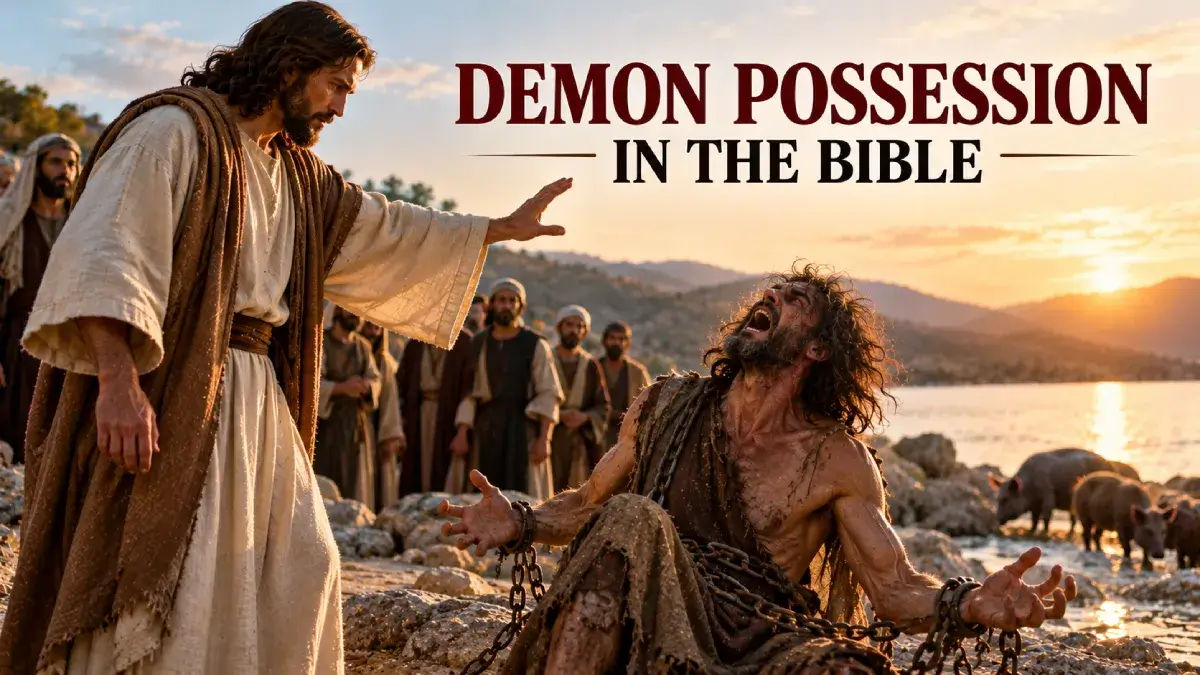
Demon possession in the Bible is a subject that raises many questions for Christians. The Gospels describe people suffering under the influence of evil spirits, Jesus commanding demons to leave, and His disciples participating in acts of deliverance. These accounts reveal the reality of spiritual opposition within the biblical worldview and, above all, demonstrate the authority of Jesus Christ over evil.
One of the most well-known examples is the man living among the tombs in the region of the Gadarenes, who was described as being possessed by an unclean spirit. Jesus commanded the spirits to leave him, and the man was restored. Other passages describe a person who could not speak, a boy suffering from destructive seizures attributed in the narrative to a spirit, and a woman whom Jesus healed after eighteen years of infirmity.
But what does demon possession mean in the Bible? What signs appear in these accounts? How did Jesus respond to people suffering under demonic influence, and what can Christians learn from these passages today?
This article examines the key biblical accounts, explains important terms, and explores the spiritual lessons of these encounters while distinguishing what Scripture explicitly says from conclusions that should not be assumed.
What Is Demon Possession According to the Bible?
In the biblical accounts, demon possession refers to a condition in which a person is described as being under the influence or control of one or more evil spirits. The New Testament frequently uses expressions such as “unclean spirit,” “evil spirit,” and “demon.”
The Gospels describe different experiences associated with demonic influence. Some people were unable to speak, others experienced severe physical distress, and one man lived in isolation among tombs. Jesus confronted the spirits and delivered people from their influence.
These accounts should be understood within the biblical narrative rather than treated as a universal checklist for identifying possession today.
What does the word “demon” mean in the Bible?
In the New Testament, demons are presented as spiritual beings opposed to God’s purposes. The Gospels portray Jesus exercising authority over them, commanding them to leave people and demonstrating that their power is subordinate to His.
For example, Mark 1:23–27 describes Jesus commanding an unclean spirit to come out of a man in a synagogue. Those who witnessed the event were amazed at His authority.
The passage emphasizes that Jesus did not need to rely on elaborate rituals to demonstrate His authority. He commanded the spirit, and the spirit obeyed.
Is demon possession the same as spiritual oppression?
Christians often use the terms demon possession and demonic oppression to distinguish between different forms of spiritual influence.
- Demon possession: Commonly used to describe the cases in which the New Testament says a person had a demon or unclean spirit.
- Demonic oppression: A broader Christian term for spiritual opposition, temptation, or distress attributed to demonic activity without necessarily describing possession.
The Bible does not present a single, systematic definition of these modern categories. Different Christian traditions interpret them differently.
It is therefore important to study the actual wording of each passage rather than assume that every spiritual struggle, illness, or troubling experience is evidence of demonic activity.
1. The Man Possessed by a Legion of Demons
Bible references: Mark 5:1–20; Matthew 8:28–34; Luke 8:26–39
One of the most dramatic accounts of demon possession in the Bible concerns a man living among the tombs.
When Jesus arrived in the region across the Sea of Galilee, He encountered a man described as having an unclean spirit. The man lived among tombs, could not be restrained by chains, and experienced severe distress.
Mark 5:5 describes his suffering:
“And always, night and day, he was in the mountains, and in the tombs, crying, and cutting himself with stones.” — Mark 5:5, KJV
When Jesus confronted the spirit, the response identified the name as “Legion,” because many demons had entered the man.
The spirits begged Jesus not to send them away and asked to enter a nearby herd of pigs. Jesus permitted them to enter the animals, and the herd rushed down a steep place into the sea.
Afterward, people came to see what had happened. They found the man who had been tormented sitting, clothed, and in his right mind.
What does this story teach us?
Jesus has authority over evil spirits. The demons recognized Jesus’ authority and could not resist His command.
People suffering should not be forgotten. The man had lived in isolation and distress. After his encounter with Jesus, he was restored and able to return to his community.
Restoration is central to the story. Jesus did not merely confront the spirits; the narrative also shows the man’s changed condition.
The man received a new purpose. Jesus instructed him to return home and tell others what the Lord had done for him (Mark 5:19–20).
This account is a powerful reminder that the biblical story focuses not only on the reality of spiritual evil but also on the authority and compassion of Jesus.
2. The Man in the Synagogue With an Unclean Spirit
Bible reference: Mark 1:21–28; see also Luke 4:31–37
Another example appears early in Jesus’ public ministry.
Jesus was teaching in a synagogue in Capernaum when a man with an unclean spirit cried out. The spirit recognized Jesus and spoke about His identity.
Jesus rebuked the spirit and commanded it to come out of the man.
Mark 1:27 records the reaction of the people:
“What thing is this? what new doctrine is this? for with authority commandeth he even the unclean spirits, and they do obey him.” — Mark 1:27, KJV
The crowd was astonished because Jesus taught and acted with authority.
Why is this account important?
The encounter demonstrates that Jesus’ authority was not limited to teaching or healing physical illnesses. The Gospel of Mark also portrays Him exercising authority over unclean spirits.
It further shows that Jesus did not need to be intimidated by the spirit’s outburst. He responded with a direct command.
For Christians, this passage highlights the central place of Jesus in biblical teaching about spiritual opposition.
3. The Boy With a Spirit That Caused Severe Suffering
Bible references: Mark 9:14–29; Matthew 17:14–20; Luke 9:37–43
The Gospels also describe a father who brought his suffering son to Jesus’ disciples for help.
In Mark’s account, the father explains that a spirit caused the boy to lose control of his body, fall down, and experience dangerous episodes. The father had already sought help from the disciples, but they had been unable to deliver him.
Jesus rebuked the unclean spirit and commanded it to leave the boy. After a dramatic episode, the boy was restored.
The disciples later asked Jesus privately why they had been unable to cast the spirit out. Jesus’ response emphasized their need for dependence on God; Mark 9:29 records His teaching about prayer, with a textual variation in some translations concerning fasting.
What can we learn from this passage?
Human ability has limits. The disciples were unable to help the boy in this instance, reminding readers that spiritual ministry is not about personal power or prestige.
Jesus responds to suffering with compassion. The boy’s father pleaded for help, and Jesus addressed the situation.
Faith can coexist with struggle. In Mark 9:24, the father cries out, “Lord, I believe; help thou mine unbelief.” His words express a desire to trust Jesus even while wrestling with doubt.
This account encourages Christians to seek God sincerely, acknowledge their limitations, and bring their struggles to Him.
It is important to note that the story explicitly attributes the boy’s condition to a spirit within the Gospel narrative. It should not be used to conclude that people experiencing seizures or similar symptoms today are demon-possessed.
4. The Man Who Could Not Speak
Bible references: Matthew 9:32–34; Matthew 12:22–28; Luke 11:14–20
The Gospel of Matthew records an occasion when people brought Jesus a man who was unable to speak because he was described as demon-possessed.
After Jesus cast out the demon, the man spoke. The crowd was amazed, while some Pharisees accused Jesus of casting out demons by the power of the ruler of demons.
Jesus responded by challenging the logic of their accusation. He explained that a kingdom divided against itself cannot stand and spoke of the significance of casting out demons by the Spirit of God.
Matthew 12:28 says:
“But if I cast out devils by the Spirit of God, then the kingdom of God is come unto you.” — Matthew 12:28, KJV
What is the significance of this miracle?
The account connects Jesus’ acts of deliverance with the arrival of God’s kingdom.
His miracles were not merely displays of power. They demonstrated that God’s reign was breaking into the world and that the forces opposing His purposes did not have the final word.
The passage also warns against rejecting God’s work through hardened assumptions. Rather than celebrating the man’s restoration, Jesus’ critics challenged the source of His authority.
For Christians, this account encourages careful discernment, humility, and recognition of the importance of Jesus’ ministry.
5. Mary Magdalene and the Seven Demons
Bible references: Luke 8:1–3; Mark 16:9
Mary Magdalene is another person associated with deliverance from demonic influence.
Luke 8:2 describes several women who accompanied Jesus and supported His ministry. Among them was Mary Magdalene, “out of whom went seven devils.”
Mark 16:9 also refers to Jesus casting seven demons out of Mary Magdalene.
The Bible does not provide a detailed account of the circumstances surrounding her deliverance. It does not describe the symptoms she experienced or explain precisely what the number seven signifies in her case.
What the passages do establish is that Mary experienced deliverance and subsequently became one of the women associated with Jesus’ ministry.
She is also an important figure in the resurrection narratives. John 20:11–18 describes her encounter with the risen Jesus and her role in telling the disciples that she had seen the Lord.
What can we learn from Mary Magdalene?
Mary’s story reminds us that a person’s past suffering does not define their entire life.
After her deliverance, she became a devoted follower of Jesus and a witness to His resurrection.
Her example encourages Christians to recognize the dignity of people who have experienced hardship and to remember that their lives should not be reduced to their past struggles.
The Bible does not identify Mary Magdalene as a prostitute, despite a common tradition that has sometimes associated her with that description. The Gospel passages cited here do not make that claim.
6. Jesus Sends Out His Disciples to Cast Out Demons
Bible references: Matthew 10:1, 7–8; Mark 6:7, 12–13; Luke 9:1–2
The Gospels do not describe deliverance as something Jesus did exclusively on His own.
He also commissioned His disciples to participate in His ministry.
Matthew 10:1 says that Jesus gave His twelve disciples authority over unclean spirits and the ability to heal diseases and sicknesses.
Mark 6:7 describes Jesus sending the twelve out two by two and giving them authority over unclean spirits. Mark 6:13 then reports that they cast out many demons and anointed sick people with oil.
These passages show that Jesus’ ministry included preparing and sending others to serve.
However, the authority described in these accounts belongs within the specific mission Jesus gave His disciples. Christians differ in how they understand the continuation and practice of these gifts in the church today.
The passages should not be treated as permission for reckless or harmful attempts at deliverance.
What do these passages teach Christians?
- Christian ministry depends on God’s authority rather than personal pride.
- Jesus prepared His disciples and sent them out with a purpose.
- Spiritual service should be carried out responsibly and in accordance with Scripture.
- The Gospels connect deliverance with a broader ministry of preaching, healing, and announcing God’s kingdom.
What Are the Signs of Demon Possession in the Bible?
The Bible describes several experiences in accounts that explicitly identify demonic influence. These include unusual physical distress, inability to speak, episodes of destructive behavior, extreme isolation, and extraordinary strength in particular narratives.
Examples include:
| Biblical account | What the passage describes | Reference |
|---|---|---|
| Man among the tombs | Isolation, cries of distress, self-injury, and unusual strength | Mark 5:1–20 |
| Man in the synagogue | A spirit cries out during Jesus’ teaching | Mark 1:21–28 |
| Boy with a spirit | Episodes involving falls and severe physical distress | Mark 9:14–29 |
| Man unable to speak | Inability to speak, followed by speech after deliverance | Matthew 9:32–34 |
| Mary Magdalene | Deliverance from seven demons | Luke 8:1–3 |
These are descriptions of specific biblical narratives, not a diagnostic checklist for identifying possession in modern life.
Can these signs be used to diagnose someone today?
No. The biblical narratives do not establish a medically validated set of signs that can be used to diagnose demon possession today.
Many physical, behavioral, and psychological symptoms can have medical or psychological causes. Seizures, hallucinations, unusual speech, agitation, self-injury, or major changes in behavior should not automatically be attributed to demons.
If someone is experiencing these symptoms, they deserve compassionate support and appropriate assessment by qualified healthcare professionals. Spiritual care may be meaningful to them as well, but it should not replace medical attention or involve coercion, restraint, or harm.
The biblical accounts can be studied on their own terms without making unsafe assumptions about people experiencing distress.
What Is the Difference Between Demon Possession and Mental Illness?
This is an important question when discussing demon possession in the Bible.
The Gospels describe some conditions as involving demons, while other passages describe illnesses without attributing them to demonic influence. For example, Matthew 4:24 distinguishes people suffering from various diseases and pains from those described as demon-possessed.
That distinction matters.
The Bible does not teach that every illness is caused by a demon. Nor does it provide a modern medical framework for differentiating neurological, psychiatric, and spiritual experiences.
Christians may hold different beliefs about the reality of spiritual opposition, but they should avoid assuming that mental illness is evidence of demonic activity.
A responsible approach includes:
- Treating people who are suffering with dignity and compassion.
- Seeking qualified medical or mental health care when symptoms occur.
- Avoiding fear-based labels or accusations.
- Offering prayer and pastoral support when welcomed by the person.
- Never stopping prescribed treatment solely because someone suspects a spiritual cause.
Faith and appropriate healthcare do not need to be treated as enemies. Christians can pray for people while also encouraging them to receive competent care.
How Did Jesus Deal With Demon Possession?
The Gospel accounts present several recurring features of Jesus’ encounters with demons.
1. He Exercised Authority
Jesus commanded unclean spirits to leave, and the Gospel writers portray them as subject to His authority.
Mark 1:27 emphasizes this theme by recording the people’s astonishment at His authority over unclean spirits.
2. He Addressed the Person’s Suffering
In the account of the man among the tombs, the man’s condition changes after Jesus delivers him. Mark 5:15 describes him sitting, clothed, and in his right mind.
The story draws attention to restoration rather than leaving the man defined by his distress.
3. He Challenged Evil Without Fear
Jesus did not treat demons as equal rivals to God. The Gospel narratives consistently place His authority above theirs.
This theme supports the Christian belief that evil does not have ultimate power over God’s purposes.
4. He Directed People Toward a Changed Life
After the man among the tombs was restored, Jesus instructed him to return home and tell his people what the Lord had done for him.
Deliverance became part of a larger story of restoration, testimony, and renewed connection with the community.
What Does the Bible Say About Casting Out Demons in Jesus’ Name?
Several New Testament passages describe people casting out demons in connection with Jesus’ name and authority.
In Mark 16:17, Jesus’ words about signs accompanying believers include casting out demons in His name. This passage is interpreted differently across Christian traditions, and the longer ending of Mark has a well-known textual history: many modern Bibles note that Mark 16:9–20 is absent from some of the earliest surviving Greek manuscripts.
Other passages, such as Acts 16:16–18, describe Paul commanding a spirit to leave a slave girl in the name of Jesus Christ.
These accounts emphasize the authority associated with Jesus rather than the idea that a particular phrase functions as a magical formula.
Christians should therefore approach spiritual ministry with humility, sound judgment, and care for the person involved. The passages do not justify violence, intimidation, or the rejection of medical care.
Does Every Christian Need Deliverance From Demons?
The Bible does not teach that every Christian is demon-possessed or requires an exorcism.
New Testament teaching encourages believers to resist temptation, stand firm in faith, pray, and rely on God. Ephesians 6:10–18 describes spiritual warfare through the imagery of God’s armor, emphasizing truth, righteousness, faith, salvation, the Word of God, and prayer.
James 4:7 says:
“Submit yourselves therefore to God. Resist the devil, and he will flee from you.” — James 4:7, KJV
This verse emphasizes submission to God and resistance to evil. It does not state that every Christian is possessed by a demon.
Christians may differ about how spiritual warfare should be understood in relation to particular experiences. Nevertheless, the central biblical emphasis is on devotion to God, resistance to evil, and steadfastness in faith.
What Can Christians Learn From Demon Possession in the Bible?
The biblical accounts of demon possession provide several lessons for Christian life.
1. Jesus Has Authority Over Evil
The Gospels portray Jesus exercising authority over unclean spirits. His encounters with demons demonstrate that evil is not beyond His power.
This gives Christians a reason to approach spiritual questions with faith rather than panic.
2. Compassion Matters More Than Sensationalism
The people in these accounts experienced serious suffering. They should not be reduced to frightening stories or objects of curiosity.
Jesus’ encounters point toward deliverance and restoration. Christians should likewise treat people experiencing distress with compassion, dignity, and practical care.
3. Spiritual Discernment Requires Wisdom
Not every unusual experience has the same explanation. Scripture itself describes different kinds of suffering and does not attribute every illness to demons.
Believers should avoid careless conclusions and seek wise guidance when confronting difficult situations.
4. Faith Should Not Be Used to Harm Others
The authority of Jesus in the Gospels is not a justification for abuse, forced rituals, dangerous restraint, or denial of healthcare.
Any approach to spiritual care should respect a person’s safety and dignity.
5. Restoration Includes Life Beyond a Crisis
In Mark 5, the restored man is instructed to return home and share what the Lord has done for him.
This reminds us that helping someone involves more than addressing a single crisis. Relationships, community, ongoing support, and a renewed sense of purpose also matter.
6. Christians Should Remain Grounded in Scripture
Questions about demons can generate fear and speculation. Studying the actual biblical passages helps readers distinguish what the text says from ideas that have been added through tradition or popular culture.
The aim should be understanding Scripture faithfully and applying its teaching wisely.
A Prayer for God’s Protection, Peace, and Wisdom
Heavenly Father,
Thank You for Your Word and for the truth it reveals about the authority of Jesus Christ. Help me to approach difficult spiritual questions with faith, wisdom, and a heart grounded in Scripture.
When I feel afraid or uncertain, remind me to seek You in prayer and to trust in Your goodness. Give me discernment to recognize what is true, compassion for people who are suffering, and humility to seek wise counsel when I need help.
Please bring comfort to those who are struggling, strength to those who feel overwhelmed, and hope to those who need encouragement. Guide families, pastors, and healthcare professionals as they care for people experiencing distress.
Help me to walk in truth, resist evil, love others well, and keep my eyes fixed on Jesus.
In Jesus’ name, Amen.
Frequently Asked Questions About Demon Possession in the Bible
What is the most famous story of demon possession in the Bible?
One of the best-known accounts is the man possessed by a Legion of demons in Mark 5:1–20, also recorded in Matthew 8:28–34 and Luke 8:26–39. Jesus delivers the man, who is later found restored and in his right mind.
How many cases of demon possession are recorded in the Bible?
The Gospels contain several distinct accounts of Jesus delivering people from demons, but the Bible does not provide a single definitive count of all cases. Some passages describe individual encounters, while others summarize Jesus’ ministry of healing and deliverance.
What are the signs of demon possession in the Bible?
Specific accounts describe experiences such as severe distress, unusual physical behavior, inability to speak, isolation, and extraordinary strength. These descriptions belong to the individual biblical narratives and should not be used as a modern diagnostic checklist.
Did Jesus cast out demons?
Yes. The Gospels repeatedly describe Jesus commanding demons or unclean spirits to leave people. Examples include Mark 1:21–28, Mark 5:1–20, and Mark 9:14–29.
Did Jesus’ disciples cast out demons?
Yes. Matthew 10:1 and Mark 6:7 describe Jesus giving His disciples authority over unclean spirits. Mark 6:13 reports that they cast out many demons during their mission.
Is demon possession the same as mental illness?
No. The terms describe different frameworks for understanding human experiences. The biblical accounts attribute certain conditions to demons, but similar symptoms today can have medical or psychological causes. A person experiencing distress should not automatically be labeled demon-possessed and should receive appropriate healthcare.
Can a Christian be demon-possessed?
Christians differ in their theological interpretations of this question. The Bible does not explicitly provide a systematic answer using all the modern categories associated with possession and oppression. It does encourage believers to resist evil, remain steadfast in faith, and rely on God.
What does the Bible say about casting out demons in Jesus’ name?
The New Testament records deliverance associated with Jesus’ authority, including Acts 16:16–18. These passages point to His authority rather than treating His name as a magical formula.
What does the story of Mary Magdalene teach us?
Luke 8:1–3 says that seven demons had gone out of Mary Magdalene. She subsequently accompanied Jesus’ ministry, and the resurrection accounts identify her as an important witness to the risen Christ. Her story highlights restoration and faithful discipleship.
What is the main lesson of demon possession in the Bible?
A central lesson is that Jesus has authority over evil and that His ministry brings deliverance and restoration. The accounts also encourage compassion, discernment, and a responsible approach to people experiencing physical or psychological distress.
Final Thoughts: The Authority of Jesus Over Evil
Demon possession in the Bible is described through several significant encounters in the ministry of Jesus and the early church.
The man living among the tombs, the man in the synagogue, the suffering boy, the man who could not speak, and Mary Magdalene all appear in passages that highlight the seriousness of spiritual opposition within the biblical narrative.
Yet the central message is not simply about demons. It is about Jesus Christ, whose authority the Gospels repeatedly emphasize.
These accounts invite Christians to trust God, study Scripture carefully, resist evil, and show compassion toward people who suffer. They also remind us not to assume that every unusual behavior or medical condition has a spiritual cause.
As we study these passages, we should keep our focus on the biblical message: Jesus’ ministry brings hope, His authority surpasses that of evil spirits, and His followers are called to live with faith, wisdom, and love.
Rather than responding to this subject with fear or speculation, let us approach it through Scripture, prayer, discernment, and compassionate care for others.
Key Bible passages to study: Mark 1:21–28, Mark 5:1–20, Mark 9:14–29, Luke 8:1–3, Luke 8:26–39, Matthew 12:22–28, and Acts 16:16–18.