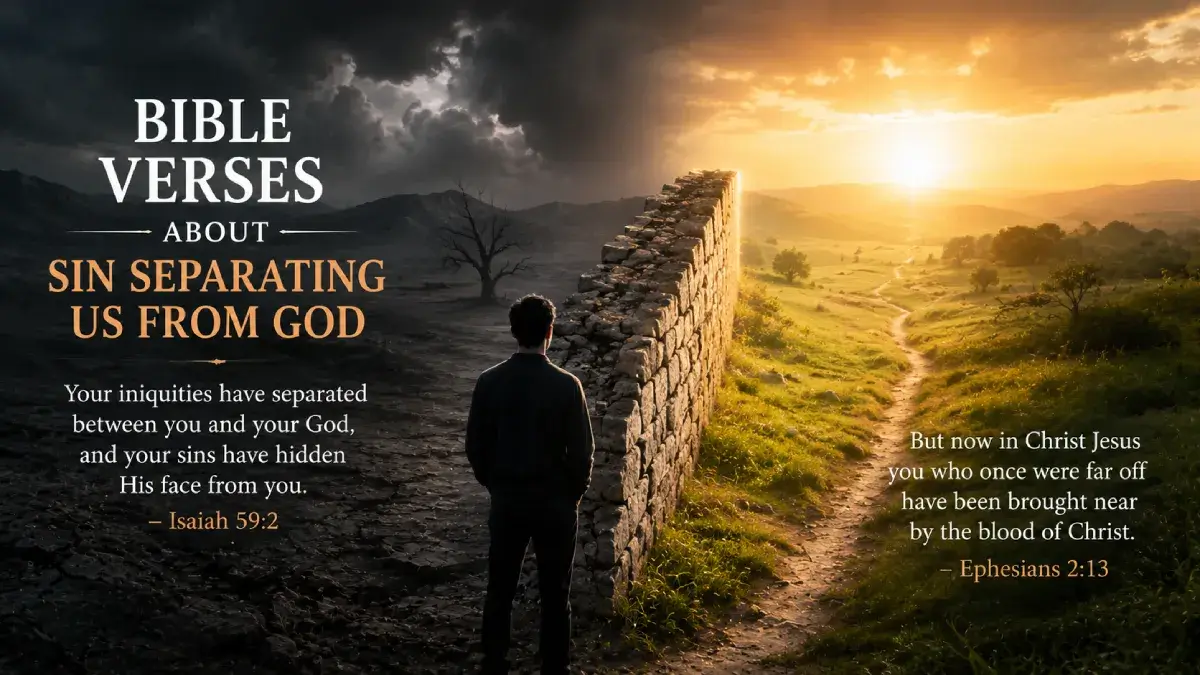
Sin affects our relationship with God.
From the opening chapters of Genesis to the message of the gospel, Scripture shows that sin brings separation, broken fellowship, guilt, and death. Yet the Bible’s message doesn’t end with separation.
God desires reconciliation.
He calls people back to Himself, offers forgiveness, and provides a way for sinners to be restored through Jesus Christ.
One of the clearest verses on this subject is:
“Your iniquities have separated between you and your God, and your sins have hid his face from you.” – Isaiah 59:2
This verse captures an important biblical truth: sin creates a barrier between humanity and a holy God.
But Scripture also reveals the wonderful answer to that problem.
Through Christ, those who were once far away can be brought near.
“But now in Christ Jesus ye who sometimes were far off are made nigh by the blood of Christ.” – Ephesians 2:13
In this article, we’ll explore 25 Bible verses about sin separating us from God, what these Scriptures mean, and how the Bible explains the way back to God.
Does Sin Really Separate Us From God?
Yes, Scripture teaches that sin separates people from God.
However, we need to understand what “separation” means biblically.
God is everywhere, so sin does not mean that God literally stops existing near someone.
Instead, sin creates spiritual and relational separation.
Sin damages fellowship with God because God is holy and righteous.
Isaiah 59:2 describes this separation directly:
“Your iniquities have separated between you and your God.”
Sin affects our relationship with our Creator.
It produces guilt, spiritual death, alienation, and a need for reconciliation.
The good news is that God Himself provides the way of reconciliation through Jesus Christ.
25 Bible Verses About Sin Separating Us From God
1. Isaiah 59:2 – Sin Separates Us From God
“Your iniquities have separated between you and your God.”
This is one of the clearest Bible verses about sin separating us from God.
Israel’s sinful actions had created a barrier between the people and God.
The problem wasn’t that God had become unfaithful.
The problem was sin.
Lesson
When we experience spiritual distance from God, Scripture calls us to examine our relationship with Him and take sin seriously.
2. Romans 3:23 – Everyone Has Sinned
“For all have sinned, and come short of the glory of God.”
Sin isn’t merely a problem affecting a small group of particularly bad people.
According to Paul, everyone has sinned.
That means every human being needs God’s grace.
Lesson
The gospel begins with recognizing that we cannot make ourselves righteous through our own efforts.
3. Habakkuk 1:13 – God Is Pure and Holy
Habakkuk describes God as being so pure that He cannot approve of evil.
Lesson
Understanding God’s holiness helps us understand why sin is such a serious problem.
Sin isn’t simply breaking a rule.
It is rebellion against a holy God.
4. Psalm 66:18 – Cherishing Sin Affects Prayer
“If I regard iniquity in my heart, the Lord will not hear me.”
The psalmist recognizes that deliberately holding onto sin affects one’s relationship with God.
Lesson
We shouldn’t knowingly cling to sin while expecting our spiritual relationship with God to remain unaffected.
5. Genesis 3:8–10 – Adam and Eve Hide From God
After Adam and Eve sinned, they hid themselves from God’s presence in the garden.
This is one of the earliest biblical pictures of the effects of sin.
Before sin, they enjoyed fellowship with God.
Afterward, they experienced fear and shame.
Lesson
Sin often causes people to hide from the very God they need most.
6. Genesis 3:23–24 – Humanity Is Removed From Eden
Following the fall, Adam and Eve were sent out of the Garden of Eden.
Their disobedience resulted in separation from the place where they had enjoyed unhindered fellowship with God.
Lesson
The story of Eden introduces one of Scripture’s central themes: sin disrupts humanity’s relationship with God.
7. Romans 6:23 – The Wages of Sin
“For the wages of sin is death; but the gift of God is eternal life through Jesus Christ our Lord.”
Sin leads to death.
But Paul immediately presents the good news:
God offers eternal life through Jesus Christ.
Lesson
The Bible doesn’t merely warn us about sin. It points us toward God’s solution.
8. Romans 5:12 – Sin Entered the World
Paul explains that sin entered the world through one man and that death came through sin.
Lesson
Sin has affected humanity at a fundamental level.
We don’t simply need better circumstances.
We need redemption.
9. Ephesians 2:1–3 – Dead in Sin
Paul describes people apart from Christ as being spiritually dead because of their trespasses and sins.
Lesson
Sin isn’t merely a minor imperfection.
It represents a serious spiritual condition that requires God’s intervention.
10. Ephesians 2:12 – Separated From Christ
Paul reminds Gentile believers what their condition was before Christ.
They were:
- Separated from Christ
- Foreigners to God’s covenant promises
- Without hope
- Without God in the world
Lesson
Life apart from God ultimately leaves humanity without the hope that comes through reconciliation with Him.
11. Colossians 1:21 – Alienated Because of Sin
Paul says that believers were once alienated from God and hostile in their minds because of their evil behavior.
Lesson
Sin can produce alienation from God.
But Paul doesn’t stop there.
He immediately explains how Christ changes everything.
12. Colossians 1:22 – Reconciled Through Christ
“Yet now hath he reconciled in the body of his flesh through death.”
This is the beautiful answer to the problem of separation.
Jesus died to reconcile sinners to God.
Lesson
The Christian message isn’t simply that sin separates us from God.
It is that Christ brings sinners back to God.
13. 2 Corinthians 5:17 – A New Creation
Anyone who is in Christ becomes a new creation.
Lesson
God doesn’t merely cover up our past.
He begins transforming us.
14. 2 Corinthians 5:18 – God Reconciles Us to Himself
Paul says that God reconciled us to Himself through Christ and gave believers the ministry of reconciliation.
Lesson
Reconciliation isn’t something humanity accomplishes alone.
God takes the initiative.
15. 2 Corinthians 5:19 – God Was Reconciling the World
“God was in Christ, reconciling the world unto himself.”
This verse reveals the heart of the gospel.
God’s response to humanity’s sin was not abandonment.
It was a plan of redemption.
Lesson
God desires reconciliation with sinners.
16. 2 Corinthians 5:21 – Christ Took Our Sin
“For he hath made him to be sin for us, who knew no sin.”
Paul explains the heart of Christ’s sacrificial work.
Jesus, who was without sin, took upon Himself what sinners could never remove on their own.
Lesson
Our reconciliation with God rests on Christ’s work, not our ability to become perfect.
17. Romans 5:8 – Christ Died for Sinners
“But God commendeth his love toward us, in that, while we were yet sinners, Christ died for us.”
God didn’t wait for humanity to become worthy before showing love.
Christ died for sinners.
Lesson
God’s grace reaches us even in our broken condition.
18. Romans 5:10 – Reconciled to God
Paul writes that while we were enemies, we were reconciled to God through the death of His Son.
Lesson
The cross is God’s answer to the hostility created by sin.
19. 1 Peter 2:24 – Jesus Bore Our Sins
“Who his own self bare our sins in his own body on the tree.”
Jesus took our sins upon Himself at the cross.
Lesson
Christ’s sacrifice makes forgiveness and reconciliation possible.
20. 1 John 1:8 – We Cannot Claim Sinlessness
“If we say that we have no sin, we deceive ourselves.”
John doesn’t encourage believers to pretend they are perfect.
Instead, he tells us to acknowledge our sin honestly.
Lesson
We cannot experience genuine repentance while pretending we have nothing to repent of.
21. 1 John 1:9 – Confession Brings Forgiveness
“If we confess our sins, he is faithful and just to forgive us our sins, and to cleanse us from all unrighteousness.”
This is one of the most encouraging promises in Scripture.
God invites us to confess.
And He promises forgiveness.
Lesson
When sin creates distance, confession is a step toward restored fellowship with God.
22. Proverbs 28:13 – Confess and Forsake Sin
“He that covereth his sins shall not prosper: but whoso confesseth and forsaketh them shall have mercy.”
The Bible encourages both confession and turning away from sinful behavior.
Lesson
Biblical repentance involves more than saying, “I’m sorry.”
It involves turning toward God and away from sin.
23. Psalm 32:5 – David Confesses His Sin
David describes the relief of confessing his sin rather than hiding it.
Lesson
Hiding sin creates a heavy spiritual burden.
Honest confession opens the way for forgiveness and restoration.
24. Hebrews 10:19–22 – Draw Near to God
Because of Jesus, believers are invited to approach God with confidence.
Lesson
The gospel doesn’t leave us permanently separated.
Through Christ, we can draw near to God.
25. James 4:8 – Draw Near to God
“Draw nigh to God, and he will draw nigh to you.”
James follows this statement with a call to cleanse our hands and purify our hearts.
Lesson
When we recognize that sin has pulled us away, the proper response isn’t despair.
Draw near to God.
How Does Sin Separate Us From God?
Scripture shows several consequences of sin.
1. Sin Damages Fellowship
Sin disrupts our relationship with God.
Like any relationship, disobedience affects fellowship.
2. Sin Produces Guilt
When we violate God’s commands, our conscience can accuse us.
Adam and Eve experienced shame after their sin.
3. Sin Produces Spiritual Death
Romans 6:23 teaches that sin leads to death.
Sin separates humanity from the source of life.
4. Sin Creates Alienation
Colossians 1:21 describes humanity as alienated from God because of sinful behavior.
5. Sin Distorts Our Desires
James 1:14–15 explains how desires can draw people toward temptation and eventually sin.
6. Sin Hinders Fellowship
Psalm 66:18 shows that deliberately cherishing sin affects our relationship with God.
Does Sin Mean God Completely Leaves Us?
No.
This is an important distinction.
The Bible teaches that sin separates us relationally and spiritually, but God does not cease to be present or cease to care about sinners.
In fact, God’s response to human sin demonstrates His desire for reconciliation.
Romans 5:8 says:
“While we were yet sinners, Christ died for us.”
God pursued humanity even in its sinful condition.
The separation caused by sin is real, but God’s invitation to reconciliation is also real.
Can Sin Separate a Christian From God?
This question requires some biblical nuance.
Sin can certainly damage a Christian’s fellowship with God.
When believers knowingly persist in sin, their relationship with God is affected.
That’s why Scripture repeatedly calls Christians to:
- Confess sin
- Repent
- Pursue holiness
- Walk in the Spirit
- Obey God’s Word
- Restore broken relationships
At the same time, the New Testament teaches that salvation rests on God’s grace and Christ’s finished work.
Romans 8:38–39 gives believers the powerful assurance that nothing in creation can separate those who belong to Christ from God’s love.
So Christians should take sin seriously without living in constant fear that every failure means God has abandoned them.
What Is the Difference Between Sin and Separation?
It’s helpful to distinguish these ideas.
Sin is rebellion or disobedience against God’s will.
Separation describes the relational and spiritual consequences of sin.
Think of it this way:
Sin creates the problem.
Separation describes part of the consequence.
Reconciliation is God’s answer.
And the center of that reconciliation is Jesus Christ.
How Does Jesus Reconcile Us to God?
The Bible’s answer is the gospel.
Human beings cannot remove their own sin through good works.
We need a Savior.
Jesus lived without sin, died on the cross for sinners, and rose again.
Through faith in Christ, sinners can receive forgiveness and reconciliation with God.
Paul summarizes this message in 2 Corinthians 5:19:
“God was in Christ, reconciling the world unto himself.”
The cross demonstrates both the seriousness of sin and the depth of God’s love.
What Should We Do When Sin Makes Us Feel Far From God?
If you feel spiritually distant from God, Scripture gives you a path forward.
1. Confess Your Sin
Don’t hide from God.
Bring your sin honestly before Him.
1 John 1:9 promises forgiveness to those who confess.
2. Repent
Turn away from the sinful behavior.
Repentance means changing direction.
3. Receive God’s Forgiveness
Don’t continually punish yourself for sins God has forgiven.
Receive His mercy.
4. Return to God’s Word
Scripture reminds us of God’s character and promises.
5. Pray Honestly
You don’t need impressive words.
Talk to God honestly about your struggle.
6. Seek Accountability
If you repeatedly struggle with the same sin, seek help from mature, trustworthy Christians.
7. Draw Near to God
James 4:8 gives us a beautiful invitation:
“Draw nigh to God, and he will draw nigh to you.”
Bible Verses About Sin and Forgiveness
The Bible doesn’t merely explain how sin separates us from God.
It also gives us tremendous promises of forgiveness.
Psalm 103:12
God removes our transgressions far from us.
Isaiah 1:18
God promises cleansing and forgiveness.
Micah 7:18–19
God delights in mercy and casts sins into the depths of the sea.
Acts 3:19
Repentance is connected with having sins blotted out.
Ephesians 1:7
In Christ, believers have redemption and forgiveness.
Colossians 3:13
Christians are called to forgive others as the Lord has forgiven them.
1 John 1:9
God faithfully forgives those who confess their sins.
Sin Separates, But Jesus Brings Us Near
This is perhaps the most important truth to remember.
The Bible does not teach:
“You sinned, therefore stay away from God.”
Instead, Scripture says:
“You sinned, therefore turn back to God.”
Sin creates separation.
Christ provides reconciliation.
Sin produces guilt.
Christ provides forgiveness.
Sin brings death.
Christ offers life.
Sin alienates.
Christ brings us near.
Ephesians 2:13 captures this beautifully:
“But now in Christ Jesus ye who sometimes were far off are made nigh by the blood of Christ.”
The gospel is the story of God bringing people who were far away back into fellowship with Himself.
A Prayer for Reconciliation With God
“Heavenly Father, I recognize that sin separates me from You and that I cannot overcome sin through my own strength. Thank You for sending Jesus Christ to make reconciliation possible. Help me confess my sins honestly, turn away from what dishonors You, and walk in obedience. When I feel distant from You, remind me not to hide but to draw near. Thank You for Your mercy, forgiveness, and grace. Help me live each day in fellowship with You and keep my heart sensitive to Your voice. In Jesus’ name, Amen.“
Frequently Asked Questions
What Bible verse says sin separates us from God?
Isaiah 59:2 is the clearest verse: “Your iniquities have separated between you and your God.” It directly connects human sin with separation from God.
What is the best Bible verse about sin and God?
Several passages are especially important, including Isaiah 59:2, Romans 3:23, Romans 6:23, 1 John 1:9, and 2 Corinthians 5:18–21. Together, they explain the problem of sin and God’s plan of reconciliation.
Does sin make God stop loving us?
No. Scripture demonstrates that God’s love is greater than human sin. Romans 5:8 says that Christ died for us while we were still sinners. God’s love doesn’t make sin insignificant; instead, His love provides a way for sinners to be forgiven and reconciled.
Can God forgive every sin?
Scripture repeatedly presents God’s mercy and forgiveness as available to those who genuinely repent and turn to Him. 1 John 1:9 promises forgiveness and cleansing for those who confess their sins.
What should I do when I feel separated from God because of sin?
Confess your sin, repent, receive God’s forgiveness, pray, return to Scripture, and draw near to God. James 4:8 says, “Draw nigh to God, and he will draw nigh to you.”
Does God leave us when we sin?
God does not abandon people simply because they have sinned. Scripture instead shows God calling sinners to repentance and reconciliation. For Christians, sin can seriously damage fellowship with God, but God’s grace and forgiveness remain available.
What brings us back to God after sin?
Ultimately, reconciliation with God comes through Jesus Christ. His death and resurrection provide the basis for forgiveness and restored relationship with God.
Final Reflection
Sin is serious.
It separates us from God, damages fellowship, produces spiritual death, and reveals our need for a Savior.
But sin is not the end of the story.
The Bible’s message is ultimately one of hope.
God did not abandon humanity in its sin.
He pursued us.
He sent His Son.
Jesus died for sinners.
And through Christ, those who were far away can be brought near.
So if you feel distant from God today, don’t hide.
Come back.
Confess.
Repent.
Receive His mercy.
Draw near.
Remember the promise:
“Draw nigh to God, and he will draw nigh to you.” – James 4:8
The same God who exposes our sin is the God who provides our forgiveness.
Sin separates – but Jesus reconciles.