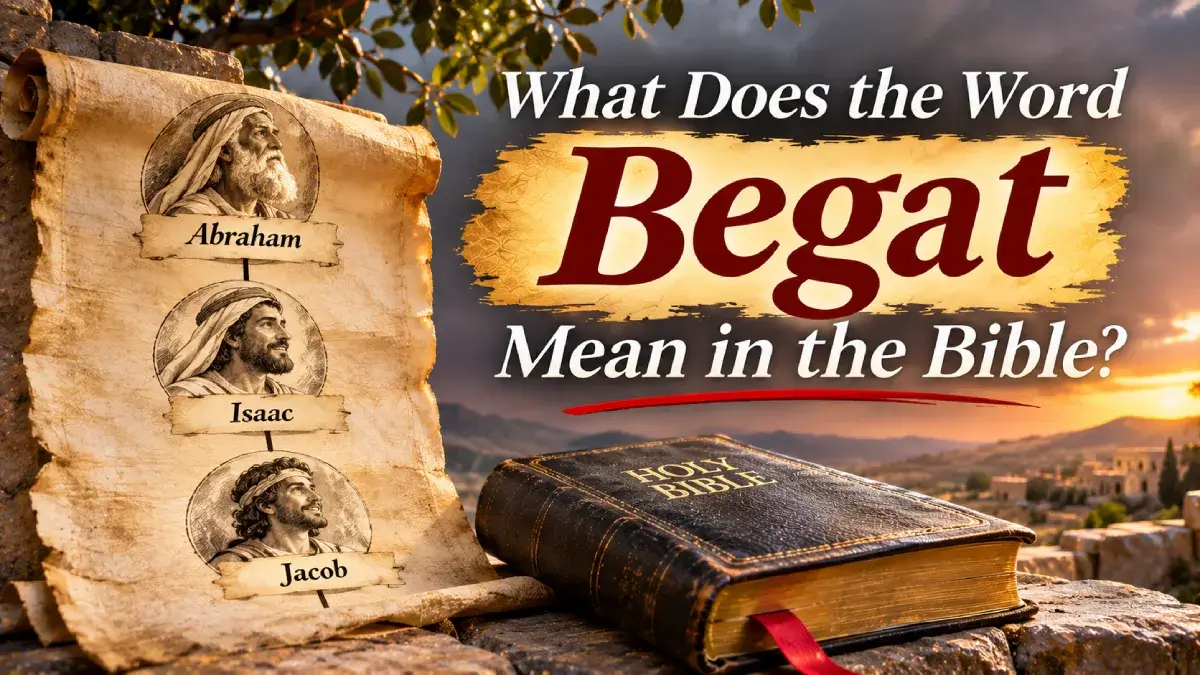
The word begat is the past tense of beget, meaning to father a child or become the parent of offspring. In the King James Version, it is commonly used in genealogies to describe a family relationship between a father and his descendant.
For example, “Abraham begat Isaac” means that Abraham became the father of Isaac.
However, in some biblical genealogies, the expression can describe a broader ancestral relationship rather than an immediate father-and-son connection. Therefore, the surrounding passage and genealogy should be considered when interpreting it.
If you have ever read the King James Version (KJV) of the Bible, you have probably come across the word begat. It appears frequently in genealogies, especially in Genesis and the opening chapter of Matthew.
For example, Matthew 1:2 says, “Abraham begat Isaac; and Isaac begat Jacob; and Jacob begat Judas and his brethren.”
But what does the word begat mean in the Bible? Why does Scripture use this old-fashioned expression instead of simply saying “had a son” or “became the father of”?
Understanding this word can make biblical genealogies much easier to read. It also helps us understand the family relationships connecting important people throughout Scripture, from Adam and Noah to Abraham, David, and Jesus Christ.
In this article, we will explore the biblical meaning of begat, its original-language background, examples from Scripture, and the significance of genealogies in the Bible.
What Is the Meaning of the Word Begat?
The word begat is an older English form of the verb beget.
To beget means to father, produce offspring, or become the parent of a child.
In simple terms:
- Beget: To father or produce offspring.
- Begat: The past tense of beget.
- Begotten: The past participle of beget, often used in older English expressions.
For example:
“Abraham begat Isaac” means “Abraham fathered Isaac.”
The word was common in older English translations and writing. The King James Version uses it frequently because its language reflects the English of the early seventeenth century.
Today, most modern Bible translations use expressions such as “became the father of,” “was the father of,” or “fathered” instead of begat.
The meaning remains essentially the same, although the exact wording depends on the translation.
What Does Begat Mean in the King James Version?
The King James Version uses begat especially in passages that list family lines and generations.
One of the clearest examples is found in Genesis 5, which records the generations from Adam to Noah.
Genesis 5:3 (KJV):
And Adam lived an hundred and thirty years, and begat a son in his own likeness, after his image; and called his name Seth:
This verse tells us that Adam became the father of Seth.
The chapter continues by recording the descendants of Adam through Seth.
The repeated use of begat creates a clear connection between one generation and the next.
Similarly, Matthew 1 uses the word to trace the ancestry of Jesus Christ.
Matthew 1:2 (KJV):
Abraham begat Isaac; and Isaac begat Jacob; and Jacob begat Judas and his brethren;
Here, the word identifies the family relationships connecting Abraham, Isaac, Jacob, and the next generation.
Therefore, when you see begat in the KJV, it generally means that one person fathered or was an ancestor of another person in the family line.
What Is the Original Hebrew Meaning of Begat?
In the Old Testament, the Hebrew verb commonly translated as begat is yalad (יָלַד).
This verb has meanings connected with giving birth, bearing children, fathering, and bringing forth offspring.
Its meaning depends on the grammatical form and context in which it appears.
For example, Genesis 5 repeatedly uses forms of this Hebrew verb when describing the generations of Adam’s family.
The word is not limited to the action of a mother giving birth. It can also describe a father becoming the parent of a child.
This helps explain why the King James translators used begat in genealogical passages.
The Hebrew word also appears in other contexts involving birth and family relationships.
Understanding yalad helps readers recognize that biblical genealogies are concerned with family descent and the continuation of generations.
What Is the Greek Meaning of Begat in the New Testament?
In the New Testament, the Greek verb commonly translated as begat in genealogical passages is gennaō (γεννάω).
It can mean to beget, give birth to, or become the parent of someone.
Matthew 1 provides several examples of this word in the Greek text.
For instance, Matthew 1:2 records the family line from Abraham to Isaac and from Isaac to Jacob.
The King James Version translates the repeated genealogical relationship using the English word begat.
The same Greek verb can also appear in contexts discussing spiritual birth or being born again.
For example, John 3:3 uses language about being born again in Jesus’ conversation with Nicodemus.
This is an important distinction: the word’s basic idea involves birth or coming into existence through a parent, but its precise meaning depends on the context.
Examples of the Word Begat in the Bible
Here are some important examples that show how the word is used in Scripture.
1. Adam Begat Seth – Genesis 5:3
Genesis 5:3 (KJV):
And Adam lived an hundred and thirty years, and begat a son in his own likeness, after his image; and called his name Seth:
This verse describes the birth of Seth, Adam and Eve’s son.
Seth’s birth is significant because the biblical genealogy continues through his descendants.
Genesis 5 records the family line from Adam through Seth to Noah.
2. Noah Begat Shem, Ham, and Japheth – Genesis 5:32
Genesis 5:32 (KJV):
And Noah was five hundred years old: and Noah begat Shem, Ham, and Japheth.
Here, begat means that Noah became the father of three sons.
These three sons are important in the biblical account of the flood and the repopulation of the earth after it.
Genesis 10 later describes their descendants and the nations associated with them.
3. Abraham Begat Isaac – Genesis 25:19
Genesis 25:19 (KJV):
And these are the generations of Isaac, Abraham’s son: Abraham begat Isaac:
This verse identifies Isaac as Abraham’s son and introduces the next section of the Genesis family history.
Isaac was the son God had promised Abraham and Sarah.
His birth was significant to God’s covenant promises and the family line through which the nation of Israel would develop.
4. Isaac Begat Jacob and Esau – Genesis 25:26
Genesis 25:26 (KJV):
And after that came his brother out, and his hand took hold on Esau’s heel; and his name was called Jacob: and Isaac was threescore years old when she bare them.
Although this verse does not use the word begat, it describes the birth of Jacob and Esau, the twin sons of Isaac and Rebekah.
This example helps readers understand the family relationships recorded in the genealogies.
Jacob later became the father of the twelve sons associated with the tribes of Israel.
5. Jacob Begat the Twelve Sons – Genesis 35:22–26
Genesis 35 records the sons born to Jacob.
These include Reuben, Simeon, Levi, Judah, Dan, Naphtali, Gad, Asher, Issachar, Zebulun, Joseph, and Benjamin.
These sons became the ancestors of the twelve tribes of Israel.
The genealogical records help establish the family history and tribal identity of God’s people.
6. Abraham Begat Isaac in Matthew’s Genealogy – Matthew 1:2
Matthew 1:2 (KJV):
Abraham begat Isaac; and Isaac begat Jacob; and Jacob begat Judas and his brethren;
Matthew begins his Gospel by presenting the genealogy of Jesus Christ.
The repeated word begat connects Jesus’ ancestry with important figures in Israel’s history.
The genealogy establishes Jesus’ connection to Abraham and David, both significant figures in God’s covenant promises.
7. David the King Begat Solomon – Matthew 1:6
Matthew 1:6 (KJV):
And Jesse begat David the king; and David the king begat Solomon of her that had been the wife of Urias;
This verse identifies David as the father of Solomon.
It also refers to Bathsheba as the woman who had been the wife of Uriah.
Solomon became king after David and was known for his wisdom and the building of the temple in Jerusalem.
The verse connects the royal family line to the genealogy of Jesus.
8. Jacob Begat Joseph – Matthew 1:16
Matthew 1:16 (KJV):
And Jacob begat Joseph the husband of Mary, of whom was born Jesus, who is called Christ.
This verse requires special attention.
Matthew identifies Joseph as the husband of Mary, but the wording changes when it describes the birth of Jesus.
It does not say that Joseph begat Jesus. Instead, it says Jesus was born of Mary.
This distinction is important because Matthew’s account presents Jesus’ birth as extraordinary and explains that Mary conceived through the Holy Spirit (Matthew 1:18–25).
Does Begat Always Mean a Direct Father-Son Relationship?
Not necessarily.
Although begat commonly describes a father becoming the parent of a child, biblical genealogies sometimes use family language to describe a more distant ancestral relationship.
A particularly clear example appears in Matthew 1:8.
Matthew 1:8 (KJV):
And Asa begat Josaphat; and Josaphat begat Joram; and Joram begat Ozias;
At first glance, this may appear to mean that Joram was the immediate father of Ozias, also known as Uzziah.
However, when Matthew’s genealogy is compared with the Old Testament records, some generations between Joram and Uzziah are not listed.
The family history in 1 Chronicles 3:11–12 includes Ahaziah, Joash, and Amaziah between Joram and Uzziah.
This demonstrates that Matthew’s genealogy is selective.
The word begat in a genealogy can therefore express descent or ancestral connection without necessarily listing every generation.
This is an important point for understanding biblical family records.
Key lesson: Do not assume that every occurrence of begat means the next immediate generation. Examine the complete genealogy and compare related passages when necessary.
Why Does the Bible Use the Word Begat So Often?
There are several reasons genealogies are important in Scripture.
1. To Record Family History
Genealogies preserve the family lines of important biblical figures.
They help readers understand who belonged to which family and how generations were connected.
Genesis 5 and Genesis 10 are examples of chapters devoted to genealogical records.
2. To Show God’s Promises Through Generations
The Bible frequently connects God’s promises with particular families and descendants.
God promised Abraham that his descendants would become a great nation (Genesis 12:2).
The genealogies help trace the family line through which these promises unfolded.
3. To Establish Jesus’ Ancestry
Matthew 1 traces Jesus’ genealogy through Abraham and David.
This is important because the New Testament presents Jesus as the promised Messiah connected with the history and promises of Israel.
4. To Preserve Tribal and Family Identity
Genealogies were important in identifying family heritage and tribal relationships in ancient Israel.
For example, the descendants of Jacob became associated with the twelve tribes of Israel.
5. To Connect Biblical Events Across Generations
Genealogies help readers see the connection between people and events separated by many years.
They show that the biblical story is not a collection of unrelated accounts but a connected history of families, nations, promises, and God’s dealings with humanity.
What Is the Difference Between Begat, Born, and Begotten?
These words are related, but they are not used in exactly the same way.
| Word | Meaning | Example or use |
|---|---|---|
| Begat | Past tense of beget; fathered or produced offspring | Abraham begat Isaac (Matthew 1:2). |
| Born | Brought into life through birth | Jesus was born of Mary (Matthew 1:16). |
| Begotten | Past participle of beget; fathered or generated | “Only begotten Son” (John 3:16, KJV). |
The word begotten is especially important in some familiar New Testament passages.
John 3:16 (KJV):
For God so loved the world, that he gave his only begotten Son, that whosoever believeth in him should not perish, but have everlasting life.
In this verse, the expression “only begotten Son” is traditionally used in the KJV to describe Jesus’ unique relationship with the Father.
The underlying Greek word is monogenēs, commonly understood in modern translations as “one and only” or “unique.” It is not simply the same Greek verb gennaō used in genealogical statements.
This distinction helps prevent confusion when studying different biblical expressions involving birth and family relationships.
What Can We Learn From Biblical Genealogies?
Genealogies may seem repetitive, especially when reading long lists of names in Genesis or Chronicles. However, they contain several important lessons.
1. God Works Through Generations
The Bible shows how God’s purposes unfold across generations.
The lives of Abraham, Isaac, Jacob, and their descendants form an important part of the history of God’s covenant people.
2. Every Generation Matters
Genealogies remind us that individuals are part of a larger family and historical story.
Although some names receive more attention than others, every generation contributes to the continuation of the family line.
3. God’s Promises Are Important
The genealogy of Jesus connects the New Testament with the promises and history recorded in the Old Testament.
Matthew 1 reminds readers that Jesus’ coming is connected with God’s long-established purposes.
4. Jesus Is Central to the Biblical Story
Matthew begins his Gospel with Jesus’ genealogy rather than treating His birth as an isolated event.
This shows the importance of understanding Jesus within the wider story of God’s relationship with Israel.
5. Scripture Preserves Historical Connections
Genealogies help readers understand family relationships, ancestry, and the historical setting of biblical events.
They also encourage careful reading rather than skipping passages simply because they contain unfamiliar names.
Frequently Asked Questions About Begat in the Bible
What does begat mean in simple terms?
Begat means fathered or became the parent of a child. It is the past tense of the older English word beget. For example, “Abraham begat Isaac” means Abraham was Isaac’s father.
Why does the King James Bible use the word begat?
The King James Version uses older English language. Begat was a familiar word in the English of that period and was used to translate biblical expressions describing family relationships and generations.
What is another word for begat?
Modern alternatives include fathered, had a child, became the father of, or produced offspring. The best replacement depends on the sentence and its context.
What is the Hebrew word for begat?
The Hebrew verb commonly translated as begat in the Old Testament is yalad (יָלַד). It can refer to giving birth, bearing children, or fathering offspring, depending on the context.
What is the Greek word for begat?
The Greek verb commonly translated as begat in New Testament genealogies is gennaō (γεννάω). It means to beget, give birth to, or become the parent of someone.
Does begat always mean someone was the immediate father?
No. In some biblical genealogies, begat can express a broader ancestral relationship. Matthew 1:8 is an example where several generations are omitted between Joram and Uzziah.
What does only begotten mean in the Bible?
The KJV expression “only begotten” appears in passages such as John 3:16. The underlying Greek word monogenēs is commonly understood as meaning unique or one and only. It describes the unique relationship of Jesus with the Father.
Why is the word begat important in Matthew 1?
Matthew 1 uses genealogical language to trace Jesus’ ancestry through Abraham and David. This establishes His connection to Israel’s history and the biblical promises associated with these important figures.
Final Thoughts
So, what does the word begat mean in the Bible?
It is the past tense of beget, meaning to father a child or become the parent of offspring. The King James Version uses it frequently in genealogies to describe family relationships and the continuation of generations.
From Adam begetting Seth in Genesis 5:3 to Abraham begetting Isaac in Matthew 1:2, the word helps readers follow the family lines recorded throughout Scripture.
However, begat does not always refer to the immediate next generation. Some biblical genealogies are selective and use the expression to describe broader ancestral relationships.
Understanding this simple but important word makes biblical genealogies easier to follow and reveals how Scripture connects generations throughout the story of God’s people.
The next time you encounter the word begat while reading the Bible, remember that it is simply an older way of describing fatherhood, family descent, and the continuation of generations.