Myrtle trees in the Bible are associated with restoration, blessing, celebration, and God’s enduring purposes. Isaiah 55:13 uses the myrtle tree to illustrate the transformation of a desolate landscape into something fruitful and beautiful. Zechariah 1:8–11 describes myrtle trees in a vision involving a man riding a red horse and other horses, while Nehemiah 8:15 mentions myrtle branches used during the Feast of Tabernacles.
The myrtle is also mentioned in Isaiah 41:19 as part of a picture of God’s provision in the wilderness.
These passages do not establish one universal meaning for the myrtle tree. Instead, each reference contributes to a broader biblical picture of God’s care, restoration, and faithfulness to His people.
Myrtle trees in the Bible appear in several meaningful passages that connect this plant with restoration, beauty, celebration, and God’s promises. Although the myrtle tree may seem like a small detail in Scripture, its appearances help illustrate important themes in Israel’s history and the hope God offered His people.
The myrtle is mentioned in the books of Isaiah, Zechariah, Nehemiah, and other passages associated with Israel’s worship and restoration. In some verses, it appears as a sign of transformation and blessing. In others, it is part of a vision or a practical instruction for celebrating a religious festival.
But what does the myrtle tree mean in the Bible? Why did God use it in prophetic imagery? And what can Christians learn from these passages today?
To understand its significance, we need to examine the biblical references in context rather than assume that every mention carries exactly the same symbolic meaning.
1. What Is a Myrtle Tree?
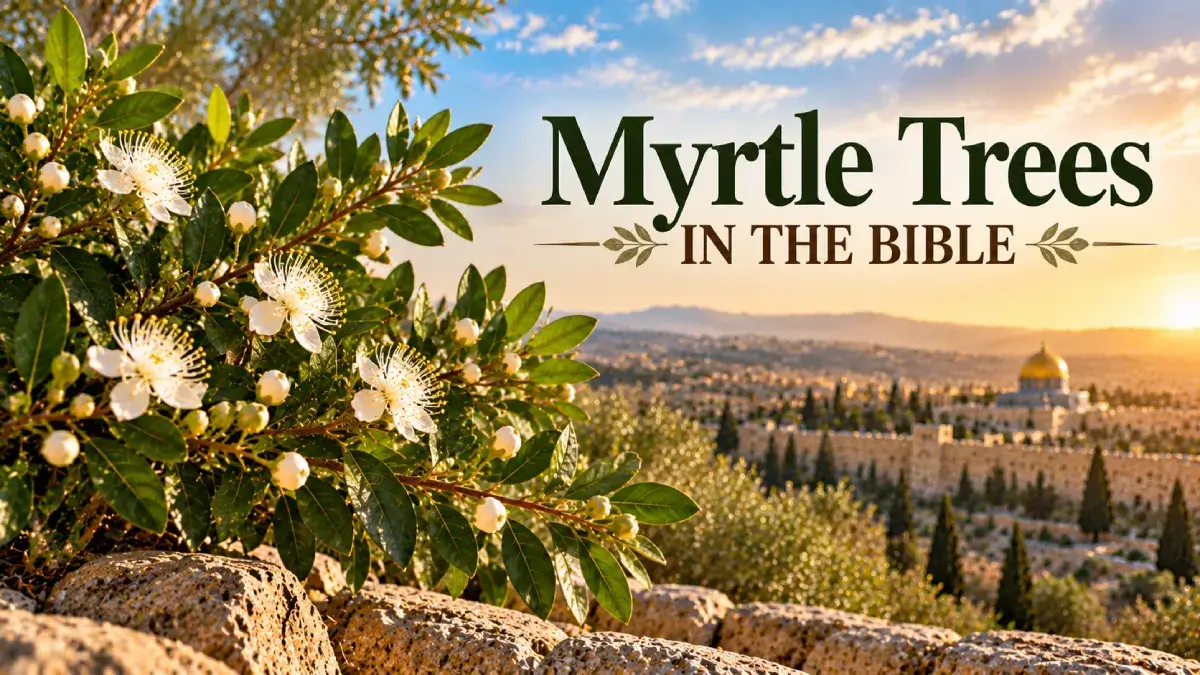
The myrtle tree is an evergreen shrub or small tree known for its aromatic leaves and delicate flowers. The common myrtle, Myrtus communis, grows naturally in parts of the Mediterranean region.
Myrtle plants typically have small, dark green leaves and white or pale flowers. Their fragrant foliage makes them distinctive, and their evergreen character means they retain their leaves throughout much of the year in suitable climates.
In the biblical world, the myrtle was familiar in the landscapes of the region. It appears in several Old Testament passages, sometimes as a plant growing in a particular setting and sometimes as part of a symbolic picture.
What is the Hebrew word for myrtle?
The Hebrew word commonly translated as myrtle is hadas (הֲדַס).
The name appears in passages such as Isaiah 41:19, Isaiah 55:13, Zechariah 1:8–11, and Nehemiah 8:15.
Understanding the original term can help readers identify the plant across different passages and translations. However, the meaning of each passage still depends on its context.
2. Myrtle Trees in Isaiah 55:13 — A Sign of Restoration
One of the most important references to the myrtle tree appears in Isaiah 55:13.
The verse says:
“Instead of the thorn shall come up the fir tree, and instead of the brier shall come up the myrtle tree: and it shall be to the LORD for a name, for an everlasting sign that shall not be cut off.” — Isaiah 55:13, KJV
This verse presents a striking contrast between thorny plants and useful, beautiful trees.
Thorns and briers often suggest an unpleasant or unproductive landscape. In this passage, they are replaced by trees that contribute beauty and fruitfulness to the scene.
The myrtle is part of this transformation.
A picture of change and hope
Isaiah 55 describes God’s invitation to receive His provision and His assurance that His word will accomplish His purposes.
Earlier in the chapter, God compares His word to rain and snow that water the earth and make it fruitful (Isaiah 55:10–11). The chapter concludes with creation responding to God’s work, as mountains and hills break into singing and trees clap their hands (Isaiah 55:12).
Verse 13 continues this picture of renewal by describing the replacement of thorns and briers with trees.
The myrtle therefore contributes to the imagery of restoration, beauty, and God’s faithfulness.
What does this teach us today?
Isaiah 55:13 reminds readers that God can bring renewal where there has been desolation. The passage originally speaks within Isaiah’s prophetic message to God’s people, so it should not be reduced to a promise that every personal difficulty will disappear immediately.
Nevertheless, its picture of transformation can encourage Christians to trust God’s ability to bring about His purposes even when circumstances seem barren or hopeless.
3. Myrtle Trees in Isaiah 41:19 — God’s Provision in the Wilderness
Another significant reference appears in Isaiah 41:19.
The verse says:
“I will plant in the wilderness the cedar, the shittah tree, and the myrtle, and the oil tree; I will set in the desert the fir tree, and the pine, and the box tree together.” — Isaiah 41:19, KJV
This passage describes God planting a variety of trees in the wilderness and desert.
The surrounding verses are important. Isaiah 41:17–18 describes God responding to the needs of the poor and thirsty, opening rivers and fountains, and making water available in dry places.
The planting of trees is part of this larger picture of God’s provision.
The myrtle as part of a renewed landscape
A wilderness is often associated with scarcity, difficulty, and a lack of water. In Isaiah 41, God promises to provide what is needed for life.
The myrtle appears alongside cedar, pine, and other trees. Together, these plants represent the transformation of an environment that would otherwise seem unable to sustain them.
The verse does not separately assign a different spiritual meaning to every tree. Instead, the list contributes to the larger image of God’s power to provide and renew.
A lesson about God’s faithfulness
Isaiah 41:19 encourages readers to recognize God’s ability to provide in places of need.
The passage originally addresses God’s assurance to His people. For Christians today, it can serve as a reminder to seek God in difficult circumstances while trusting His wisdom and care.
It should not be interpreted as a guarantee that every hardship will end in the exact way or at the time we desire.
4. Myrtle Trees in Zechariah 1:8–11 — A Prophetic Vision
The book of Zechariah contains another important reference to myrtle trees.
Zechariah 1:8 describes a vision in which the prophet sees a man riding a red horse among myrtle trees in a valley, with other horses behind him.
Zechariah 1:10 explains that the riders are those whom the Lord has sent to walk to and fro through the earth. In verse 11, the riders report that they have walked through the earth and found it at rest and quiet.
This vision is part of Zechariah’s message to the Jewish community after the exile, when the people were rebuilding their lives and the temple in Jerusalem.
What was happening when Zechariah received this vision?
Zechariah ministered during the period when the Jewish people had returned from exile and were working to rebuild the temple.
The opening of the book calls the people to return to God (Zechariah 1:1–6). The visions that follow communicate God’s concern for Jerusalem and His purposes for His people.
In Zechariah 1:12, the angel of the Lord asks how long God will withhold mercy from Jerusalem and the cities of Judah. The Lord responds with comforting words in verses 13–17.
The vision therefore belongs to a broader message of divine concern, future restoration, and hope for Jerusalem.
What do the myrtle trees represent?
The text explicitly places the vision’s riders among the myrtle trees, but it does not directly state that the myrtle itself has one fixed symbolic meaning.
Some readers associate the setting with restoration and hope because of the surrounding message. However, the safest interpretation is to distinguish the setting from the vision’s explicit explanation.
The central message of the passage concerns God’s awareness of the nations, His concern for Jerusalem, and His promise to show mercy to His people.
What can Christians learn from this vision?
Zechariah 1 reminds readers that God’s people are not forgotten during seasons of uncertainty. Even when restoration seems incomplete, the Lord remains aware of what is happening and continues to work according to His purposes.
The myrtle trees help establish the setting of the vision, while the surrounding verses provide its primary theological message.
5. Myrtle Branches in Nehemiah 8:15 — A Tree Used in Celebration
The myrtle tree appears in a different setting in Nehemiah 8:15.
During the time of Nehemiah, the people gathered to hear the Law of Moses read aloud. As they studied the instructions, they discovered that the Israelites were to live in booths during the Feast of Tabernacles.
Nehemiah 8:15 includes myrtle branches among the materials the people were instructed to gather.
The verse mentions branches from several kinds of trees, including olive, wild olive, myrtle, palm, and thick trees, to make booths according to the commandment.
What was the Feast of Tabernacles?
The Feast of Tabernacles, also called the Feast of Booths, was an Israelite festival during which the people lived in temporary shelters.
Leviticus 23:33–43 provides instructions for the feast. The festival included gathering branches, dwelling in booths, and remembering how God had provided for the Israelites during their journey from Egypt.
Nehemiah 8 describes the people rediscovering these instructions and putting them into practice.
Why were myrtle branches used?
The passage identifies myrtle as one of the plants used in constructing the booths. It does not explicitly assign the myrtle a separate spiritual meaning within the festival.
The main emphasis is on the people’s renewed obedience to God’s instructions and their celebration of the feast.
Nehemiah 8:17 says that the Israelites had not celebrated the festival in this manner since the days of Joshua son of Nun, and the occasion brought great gladness.
A lesson about worship and obedience
This passage reminds us that studying Scripture should lead to a deeper understanding of God’s instructions and a willingness to respond.
The myrtle is part of a practical act of worship, showing that plants and other ordinary materials can have a place in biblical celebrations without every item necessarily representing a separate doctrine.
6. What Does the Myrtle Tree Symbolize in the Bible?
The Bible does not give a single definition stating that the myrtle tree always symbolizes one particular spiritual truth. Its significance emerges from the passages in which it appears.
Several themes can be drawn from these references, provided we keep their contexts in mind.
1. Restoration and renewal
Isaiah 55:13 presents the myrtle as part of a landscape transformed from thorny growth to beautiful trees.
This supports an association with restoration and renewal within the chapter’s prophetic imagery.
2. God’s provision
In Isaiah 41:19, the myrtle is among the trees God promises to plant in the wilderness.
The wider passage emphasizes water, life, and God’s provision for people in need.
3. Hope during difficult times
Zechariah’s vision takes place during a period of restoration after exile. Although the text does not explicitly define the myrtle as a symbol of hope, the vision’s wider message encourages God’s people to trust His continuing concern for Jerusalem.
4. Celebration and worship
Nehemiah 8:15 mentions myrtle branches used to build booths for the Feast of Tabernacles.
This connects the plant with a biblical act of worship and celebration, although the passage does not assign it an independent symbolic meaning.
5. Beauty in God’s creation
Myrtle trees contribute to the imagery of a renewed and fruitful landscape. Their presence in Isaiah’s prophetic descriptions helps readers picture the beauty and abundance associated with God’s provision.
These themes are useful for Bible study, but they should not be turned into rigid rules about what every myrtle tree must represent.
7. Is the Myrtle Tree a Symbol of God’s Blessing?
The myrtle appears in passages that describe God’s provision, restoration, and care for His people. For this reason, readers often associate it with blessing.
Isaiah 41:19 pictures God planting trees in the wilderness, while Isaiah 55:13 describes the myrtle replacing thorny growth. Both passages portray a change from an unproductive or difficult landscape toward something more beautiful and life-giving.
However, it is important to recognize that the Bible does not explicitly state that the myrtle always represents blessing in every context.
In Nehemiah 8, the tree is mentioned as material for constructing booths. In Zechariah 1, it is part of the setting of a prophetic vision.
The broader lesson is that God is able to provide, restore, and fulfill His purposes. The myrtle contributes to that message in certain passages, but the meaning must be understood from the surrounding text.
8. What Can Christians Learn From Myrtle Trees in the Bible?
Although myrtle trees are mentioned only in a limited number of biblical passages, these references offer several lessons when read in context.
1. God can bring renewal after difficult seasons
Isaiah 55:13 describes thorny plants being replaced by the myrtle and other trees. The image encourages readers to consider God’s power to bring restoration.
It does not promise that every personal difficulty will disappear immediately, but it points toward the hope found in God’s purposes.
2. God provides what His people need
Isaiah 41:17–19 describes God’s response to thirsty and needy people. The planting of trees in the wilderness forms part of a picture of provision and renewal.
This passage encourages trust in God’s care while reminding readers that His promises should be understood in their original context.
3. God’s people should respond to Scripture
In Nehemiah 8, the people heard the Law, understood its instructions, and acted on what they learned.
The mention of myrtle branches is part of a larger account of renewed obedience and worship.
Christians can apply this principle by studying Scripture carefully and seeking to put its teachings into practice.
4. God has not forgotten His people
Zechariah 1 presents a vision that reassures the people of God’s continuing concern for Jerusalem.
The setting among the myrtle trees is part of a prophetic message that points toward God’s mercy and the restoration of His people.
When life feels uncertain, the passage encourages believers to remember that God’s purposes are not limited by what they can currently see.
5. Pay attention to context when studying biblical symbols
One of the most important lessons from studying the myrtle is that not every biblical detail has the same meaning in every passage.
The tree appears in prophecy, a vision, and instructions for a festival. Understanding its significance requires reading the surrounding verses rather than relying only on a symbolic definition.
This approach can help readers study other biblical plants, animals, objects, and numbers more accurately.
9. Bible Verses About Myrtle Trees
Here are the main passages to read when studying myrtle trees in the Bible.
| Bible reference | Context and significance |
|---|---|
| Isaiah 41:19 | The myrtle is among the trees God promises to plant in the wilderness. |
| Isaiah 55:13 | The myrtle replaces thorny growth in an image of restoration and transformation. |
| Zechariah 1:8 | Myrtle trees form the setting for Zechariah’s vision of a man riding a red horse. |
| Zechariah 1:10–11 | The riders explain their mission and report that the earth is at rest. |
| Nehemiah 8:15 | Myrtle branches are gathered for constructing booths during the Feast of Tabernacles. |
These passages are the primary references for understanding the biblical role of the myrtle. Reading each passage in full will provide a clearer picture than studying an isolated verse.
Frequently Asked Questions About Myrtle Trees in the Bible
What does a myrtle tree symbolize in the Bible?
Myrtle trees are associated with restoration, provision, and renewal in certain biblical passages. Isaiah 41:19 and Isaiah 55:13 are especially important. However, the Bible does not assign one universal symbolic meaning to the myrtle in every passage.
How many times is the myrtle tree mentioned in the Bible?
The myrtle is mentioned in a small number of Old Testament passages, including Isaiah 41:19, Isaiah 55:13, Zechariah 1:8–11, and Nehemiah 8:15. Exact word counts can vary depending on the translation and whether repeated references within a passage are counted separately.
What does Isaiah 55:13 mean when it mentions the myrtle tree?
Isaiah 55:13 describes the myrtle replacing thorny plants as part of a picture of transformation. In the wider context, the chapter emphasizes God’s word, His purposes, and the restoration associated with His promises.
Why are myrtle trees mentioned in Zechariah 1?
Zechariah 1:8–11 describes a vision involving a man riding a red horse among myrtle trees. The vision belongs to a larger message about God’s concern for Jerusalem and His promise to show mercy to His people. The passage does not explicitly define the myrtle itself as a separate symbol.
Were myrtle branches used in biblical worship?
Yes. Nehemiah 8:15 mentions myrtle branches among the materials gathered to construct booths for the Feast of Tabernacles. The passage emphasizes the people’s obedience to the Law and their celebration of the festival.
Is the myrtle tree the same as the cedar or olive tree in the Bible?
No. The myrtle, cedar, and olive are different plants. Isaiah 41:19 mentions several kinds of trees together, but each has its own botanical identity. They should not be treated as interchangeable simply because they appear in the same passage.
Does the Bible say myrtle trees represent eternal life?
The Bible does not explicitly identify the myrtle tree as a symbol of eternal life. Some readers may associate evergreen plants with enduring life, but that is a symbolic interpretation rather than a direct definition given in the myrtle passages.
What is the Hebrew word for myrtle?
The Hebrew word is hadas. It appears in several Old Testament passages where the myrtle is mentioned, including Isaiah 41:19, Isaiah 55:13, Zechariah 1, and Nehemiah 8:15.
Final Thoughts: The Meaning of Myrtle Trees in the Bible
Myrtle trees in the Bible appear in several passages that highlight God’s provision, restoration, and continuing purposes for His people.
Isaiah 41:19 pictures God planting trees in the wilderness. Isaiah 55:13 uses the myrtle as part of an image of transformation. Zechariah 1 places myrtle trees within a prophetic vision concerning Jerusalem, and Nehemiah 8 records their use in constructing booths for the Feast of Tabernacles.
Together, these passages show that the myrtle has a meaningful place in biblical imagery and Israel’s religious history. However, Scripture does not assign the tree one fixed symbolic meaning that applies to every reference.
The most reliable way to understand the myrtle is to study each passage in context and pay attention to the message it communicates.
The myrtle tree reminds us, through the passages in which it appears, of God’s power to provide, restore, and fulfill His purposes.