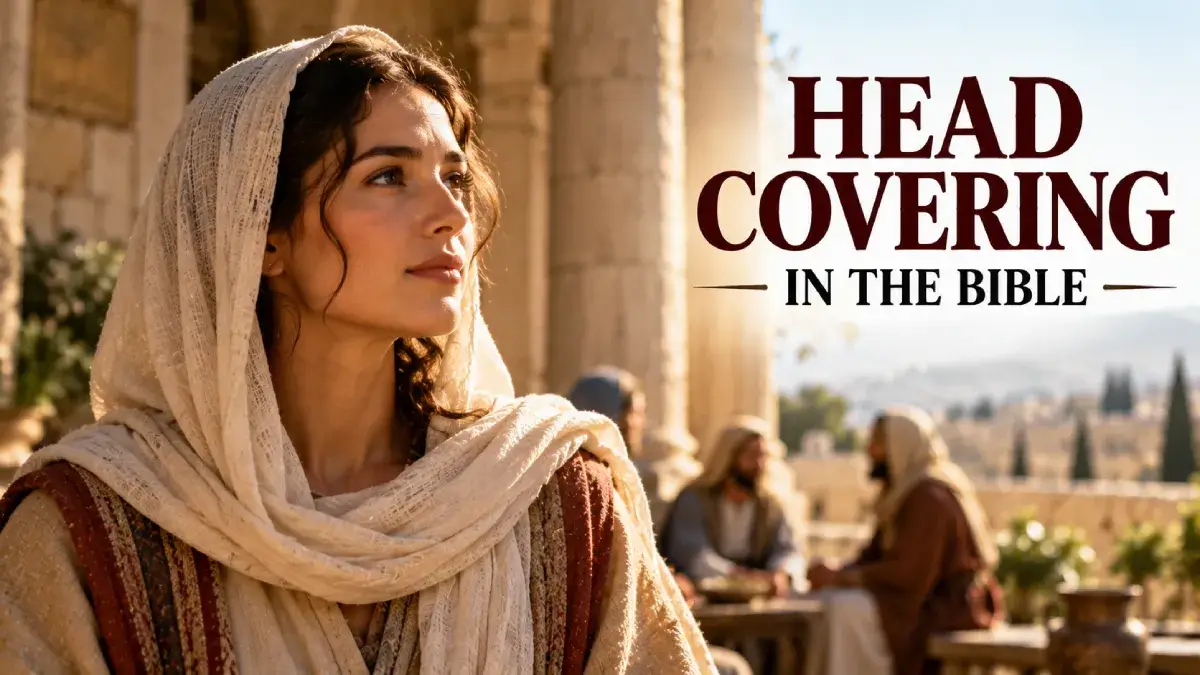
Head covering in the Bible refers to the practice of covering the head with a garment or other covering in particular religious, cultural, or personal circumstances. The main New Testament passage is 1 Corinthians 11:2–16, where Paul discusses men and women praying or prophesying and addresses whether their heads should be covered. Christians interpret this passage differently: some believe women should wear a physical head covering during prayer and worship, while others understand the covering instructions in relation to first-century cultural customs and the enduring principles of honor, modesty, and proper conduct in worship.
What Does the Bible Say About Head Covering?
Head covering is an important topic in biblical studies because it connects to worship, prayer, modesty, cultural practices, and the relationship between men and women in the church. Some Christian traditions believe women should cover their heads during prayer and worship, while others understand the relevant passages as addressing principles that can be expressed in different ways today.
The most detailed New Testament teaching about head covering appears in 1 Corinthians 11:2–16. In this passage, the apostle Paul discusses men and women praying or prophesying, the covering of the head, honor, and the order of relationships within the Christian community.
One of the central verses is 1 Corinthians 11:5:
“But every woman that prayeth or prophesieth with her head uncovered dishonoureth her head…” — 1 Corinthians 11:5 (KJV)
The Old Testament also contains examples of people covering their heads in particular circumstances, including mourning, humility, and expressions of reverence. However, these passages do not all describe the same practice or give the same command.
Understanding head covering in the Bible requires examining each passage in its historical and literary context rather than assuming that every reference to a covered head has an identical meaning.
In this article, we will explore what head covering means in the Bible, why Paul addressed it, what the Scriptures say about men and women, and how Christians interpret these teachings today.
What Is Head Covering in the Bible?
Head covering generally means using cloth or another garment to cover the head. In biblical passages, the practice appears in different contexts and should be interpreted according to the situation being described.
For example:
- In 1 Corinthians 11:2–16, Paul discusses head covering in connection with prayer, prophecy, honor, and worship.
- In Genesis 24:65, Rebekah covers herself with a veil when she sees Isaac.
- In 2 Samuel 15:30, David covers his head while mourning as he leaves Jerusalem.
- In Esther 6:12, Haman covers his head and returns home in grief and humiliation.
These examples show that covering the head could communicate different things in biblical settings. It might be associated with customary dress, mourning, shame, or other circumstances.
Therefore, it is important not to assume that every biblical head covering was a religious command or that every passage teaches the same symbolism.
The central question for Christians is how to understand Paul’s specific instructions in 1 Corinthians 11 and apply them faithfully.
What Does 1 Corinthians 11 Say About Head Covering?
First Corinthians 11:2–16 is the primary passage Christians study when discussing head coverings in worship.
Paul begins by commending the Corinthians for remembering the traditions he had delivered to them. He then discusses the relationship between Christ, man, and woman, followed by instructions concerning covered and uncovered heads during prayer and prophecy.
1 Corinthians 11:3 — The Order Paul Describes
“But I would have you know, that the head of every man is Christ; and the head of the woman is the man; and the head of Christ is God.” — 1 Corinthians 11:3 (KJV)
This verse introduces Paul’s discussion of head covering.
The meaning of the word “head” has been debated. Some interpreters understand it primarily in terms of authority or leadership, while others emphasize ideas such as source or relational order. The interpretation affects how readers understand the rest of the passage.
Christians should therefore recognize that this verse has been understood in different ways across Christian traditions.
1 Corinthians 11:4 — A Man Praying With His Head Covered
“Every man praying or prophesying, having his head covered, dishonoureth his head.” — 1 Corinthians 11:4 (KJV)
Paul states that a man who prays or prophesies with his head covered dishonors his head.
The verse is part of Paul’s specific instructions to the Corinthian church. It indicates that the outward appearance of men and women during prayer or prophecy mattered within the setting he was addressing.
Some Christians connect this instruction to the cultural customs of the ancient Mediterranean world. Others believe Paul establishes a practice intended to remain applicable in Christian worship.
The passage itself should be read alongside the verses that follow rather than treated as an isolated rule.
1 Corinthians 11:5 — A Woman Praying With Her Head Uncovered
“But every woman that prayeth or prophesieth with her head uncovered dishonoureth her head…” — 1 Corinthians 11:5 (KJV)
This verse is central to the Christian discussion of women’s head coverings.
Paul refers to women praying or prophesying, which means he is discussing women participating in religious activity rather than simply describing their everyday clothing.
Some Christians understand the instruction as requiring women to wear a physical covering when praying or worshipping. Others believe the practice was tied to the social customs of Corinth and that the enduring principle is to honor God and behave appropriately in worship.
Both interpretations seek to take the passage seriously, although they differ over how its instructions apply today.
1 Corinthians 11:6 — The Importance of the Covering
“For if the woman be not covered, let her also be shorn: but if it be a shame for a woman to be shorn or shaven, let her be covered.” — 1 Corinthians 11:6 (KJV)
Paul connects being uncovered with having the hair cut or shaved.
His argument suggests that the Corinthians understood a connection between head covering, hair, and honor. The exact social meaning of these practices in Corinth is debated, but Paul treats them as significant within his discussion.
This verse also raises a question about whether the covering is distinct from the hair itself. Some interpreters believe it clearly refers to a separate cloth covering, while others give greater emphasis to the relationship between hair and covering throughout the passage.
The interpretation of this verse is one reason Christian traditions differ on the practice.
1 Corinthians 11:7–10 — Glory, Creation, and Authority
In these verses, Paul refers to the creation account, the relationship between man and woman, and the language of authority.
Verse 10 states:
“For this cause ought the woman to have power on her head because of the angels.” — 1 Corinthians 11:10 (KJV)
The expression “power on her head” has been interpreted in several ways. Some understand it as a sign of authority or an appropriate covering. Others emphasize the broader discussion of honor, creation, and order.
The reference to angels is also debated. The passage does not provide a detailed explanation of precisely what Paul intends by mentioning them.
Because these verses contain difficult expressions, responsible interpretation requires acknowledging where Christians disagree rather than presenting one explanation as universally settled.
1 Corinthians 11:11–12 — Men and Women Need One Another
“Nevertheless neither is the man without the woman, neither the woman without the man, in the Lord.” — 1 Corinthians 11:11 (KJV)
Paul follows his discussion of creation and order by emphasizing mutual dependence.
He explains that although woman came from man in the creation account, men are born through women, and ultimately everything comes from God.
These verses are important because they prevent the passage from being reduced to a claim that one sex has no value or importance. Paul emphasizes the relationship between men and women within God’s purposes.
Lesson: Whatever position Christians take on head coverings, this passage also calls attention to mutual dependence and the fact that both men and women depend on God.
1 Corinthians 11:13–15 — Nature, Hair, and Honor
Paul asks the Corinthians to judge whether it is appropriate for a woman to pray to God uncovered. He then discusses the difference between the hair of men and women.
Verse 15 states:
“But if a woman have long hair, it is a glory to her: for her hair is given her for a covering.” — 1 Corinthians 11:15 (KJV)
This verse is central to the debate over whether Paul means a cloth covering, the hair itself, or both in different parts of the passage.
Those who support a separate cloth covering often point to verses 5–6, where the act of covering or uncovering appears to be distinct from cutting or shaving the hair.
Other interpreters emphasize verse 15 and argue that hair itself plays an important role in Paul’s explanation of covering.
The relationship between these verses remains a major point of disagreement among Christians.
1 Corinthians 11:16 — Paul’s Conclusion
“But if any man seem to be contentious, we have no such custom, neither the churches of God.” — 1 Corinthians 11:16 (KJV)
The meaning of Paul’s concluding statement is also debated. Some understand it as rejecting the practice of contentiousness or dispute. Others interpret it in relation to the customs discussed in the passage.
Because the wording and context have generated different readings, this verse should be considered alongside the entire passage rather than used by itself to settle the debate.
Why Did Paul Teach About Head Covering?
Paul’s discussion addresses worship, honor, gender relationships, creation, hair, and conduct in the Corinthian church.
Although interpreters disagree about the precise application of the covering instruction, several themes are clear from the passage.
1. Worship Should Honor God
Paul discusses men and women praying or prophesying. His concern is not merely fashion but how people conduct themselves in a religious setting.
The passage reminds Christians that worship involves both the heart and the way believers participate in their community.
2. Outward Practices Can Communicate Meaning
Clothing and appearance can communicate messages within a particular culture. Paul treats head covering as meaningful to the Corinthians rather than as an entirely private fashion preference.
This is one reason historical context matters when applying the passage today.
3. Men and Women Should Be Considered Within God’s Order
Paul refers to creation and the relationship between Christ, man, and woman. Christian traditions interpret this language differently, but the discussion is clearly theological rather than merely practical.
4. Christian Worship Should Avoid Unnecessary Dishonor
Paul repeatedly uses the language of honor and dishonor. His instructions aim to address what he considered appropriate conduct within the church.
Christians can reflect on whether their worship practices are thoughtful, respectful, and consistent with their understanding of Scripture.
Does the Bible Command Women to Cover Their Heads?
The answer depends on how Christians interpret 1 Corinthians 11:2–16.
The passage explicitly says that a woman praying or prophesying with her head uncovered dishonors her head, and Paul instructs her to be covered. The disagreement is not about whether Paul discussed head covering; it is about the nature and continuing application of the practice.
View 1: Women Should Wear a Physical Head Covering
Some Christian traditions understand Paul’s instruction as a continuing command for women to wear a physical covering during prayer, worship, or both.
They often point out that Paul appeals to creation and refers to churches generally. They also argue that the distinction between covering the head and cutting the hair suggests that a separate covering is intended.
In these communities, women may wear a veil, scarf, mantilla, or another form of head covering during worship.
View 2: The Instruction Reflects First-Century Cultural Customs
Other Christians believe the passage addresses social conventions in Corinth concerning hair, clothing, honor, and gender.
According to this view, the enduring principles are reverence for God, appropriate conduct in worship, and respect within the Christian community. The specific outward practice may differ across cultures.
These Christians may not require women to wear a cloth covering in modern worship services.
How Should Readers Approach the Question?
A careful approach should begin by reading all of 1 Corinthians 11:2–16, paying attention to Paul’s reasoning and the historical context.
Christians should also recognize that sincere believers have reached different conclusions. It is better to explain the relevant biblical arguments fairly than to claim that everyone who disagrees is deliberately disobeying Scripture.
What Does the Bible Say About Men Covering Their Heads?
The main passage is 1 Corinthians 11:4:
“Every man praying or prophesying, having his head covered, dishonoureth his head.” — 1 Corinthians 11:4 (KJV)
Within this passage, Paul says that a man praying or prophesying with his head covered dishonors his head.
Some Christians apply this instruction to public prayer and worship, believing that men should remove hats or other coverings in church. Others understand it in relation to specific first-century practices.
It is important to note that the Bible also contains other contexts in which men cover their heads.
For example, 2 Samuel 15:30 describes David covering his head while mourning as he leaves Jerusalem. That event concerns grief and humiliation, not the instructions for men praying or prophesying in 1 Corinthians.
The different contexts show why biblical references should be interpreted individually rather than combined into one universal rule about every situation.
Head Covering in the Old Testament
The Old Testament includes several references to veils, coverings, and covered heads. These passages do not all describe the same practice.
Genesis 24:65 — Rebekah Covers Herself
“For she had said unto the servant, What man is this that walketh in the field to meet us? And the servant had said, It is my master: therefore she took a vail, and covered herself.” — Genesis 24:65 (KJV)
Rebekah covers herself when she learns that the man approaching is Isaac, whom she is about to meet.
The passage presents a particular moment in the account of Isaac and Rebekah. It does not give a universal command that every woman must cover her head in every setting.
It does, however, illustrate the use of a veil in the social world described in Genesis.
Genesis 38:14–15 — Tamar Uses a Veil
In Genesis 38, Tamar covers herself with a veil, and Judah mistakes her identity.
The passage concerns a complicated family story involving deception and injustice. The veil functions within that narrative, but the text does not present it as a religious instruction about worship.
This is a useful reminder that a garment or covering can appear in Scripture without being prescribed as a rule for all believers.
2 Samuel 15:30 — David Covers His Head in Mourning
“And David went up by the ascent of mount Olivet, and wept as he went up, and had his head covered, and he went barefoot…” — 2 Samuel 15:30 (KJV)
David is grieving as he leaves Jerusalem during Absalom’s rebellion.
His covered head is part of a scene of sorrow and humiliation. The passage illustrates a different use of head covering from Paul’s instructions concerning worship.
Esther 6:12 — Haman Covers His Head in Grief
“And Mordecai came again to the king’s gate. But Haman hasted to his house mourning, and having his head covered.” — Esther 6:12 (KJV)
After being publicly humiliated, Haman returns home mourning with his head covered.
Here, the covering is associated with distress and shame. It does not establish a universal religious practice.
Is Head Covering a Symbol of Modesty?
Modesty is sometimes associated with head covering, but 1 Corinthians 11 does not use the word “modesty” as its main explanation.
Paul’s discussion focuses on honor, dishonor, creation, hair, and conduct during prayer and prophecy. Some Christian traditions connect these themes with modesty and appropriate dress, while others emphasize the cultural setting of the instructions.
It is therefore more accurate to say that some Christians understand head covering as an expression of modesty and reverence, rather than claiming that the Bible explicitly defines every head covering as a symbol of modesty.
Modesty more broadly involves humility and thoughtful conduct, not merely a particular garment.
Christians can apply the general principle by considering whether their appearance and behavior reflect respect for God and consideration for others.
Is Head Covering a Symbol of Submission?
Some Christian traditions interpret women’s head covering in 1 Corinthians 11 as a sign of submission or recognition of God’s order.
This understanding draws especially on verse 3, where Paul discusses the relationship between Christ, man, woman, and God, and verse 10, which refers to authority on the woman’s head.
However, the meaning of “head” in verse 3 and the phrase “power on her head” in verse 10 are debated. Christians differ on how these expressions should be interpreted and applied.
It is important not to use this passage to justify mistreatment, coercion, or the idea that women have less worth than men. The wider biblical message affirms that both men and women are created by God and are accountable to Him.
Whatever view a Christian holds on head covering, it should be discussed with care, humility, and respect for the dignity of others.
What Is the Difference Between a Head Covering and Long Hair?
This is one of the central questions in interpreting 1 Corinthians 11.
Verse 15 says that a woman’s long hair is given to her for a covering. Yet earlier verses discuss a woman being covered or uncovered while praying or prophesying and compare being uncovered with having the hair cut or shaved.
The Separate-Covering Interpretation
Those who believe Paul requires a cloth covering argue that the passage distinguishes between the hair and a covering placed over the head. They point to verses 5–6 as evidence that the two are not identical.
The Hair-Focused Interpretation
Other interpreters emphasize verse 15 and understand the hair as playing a central role in Paul’s argument about covering and gender distinction.
Why Context Matters
The passage uses related language about covering, hair, and honor, but interpreters disagree about how the terms fit together.
Readers should study the whole section rather than relying on a single verse. This helps explain why Christians who accept the authority of Scripture may still differ about whether a separate head covering is required today.
Should Christian Women Wear Head Coverings Today?
There is no single answer accepted by every Christian denomination.
Some churches and Christian communities practice head covering during worship, prayer, or throughout daily life. Others do not require it, understanding Paul’s instructions as tied to cultural conventions in Corinth while seeking to preserve the passage’s broader principles.
If you are considering this practice, these questions may help:
- What does the whole passage in 1 Corinthians 11:2–16 say?
- How does my church tradition understand Paul’s instructions?
- Am I approaching the topic with a sincere desire to understand Scripture?
- Can I discuss differing views respectfully without judging another person’s faith?
- Does my practice reflect genuine devotion rather than a desire to appear more spiritual than others?
The goal should be faithful biblical understanding rather than pressure, shame, or competition over outward appearance.
Practical Lessons From Head Covering in the Bible
Even among Christians who disagree about the modern practice of head covering, several useful lessons emerge from the relevant passages.
1. Read Difficult Passages in Context
First Corinthians 11 contains references to creation, hair, honor, authority, and worship. Understanding the passage requires considering how these ideas fit together.
Avoid building an entire doctrine from a single phrase without examining the surrounding verses.
2. Distinguish Biblical Commands From Cultural Practices
Some biblical instructions were given to particular people in particular settings. Christians need to study the context carefully when deciding how an instruction applies today.
This does not mean dismissing Scripture as merely cultural. It means understanding what the text says before drawing conclusions.
3. Avoid Judging Faith by Appearance Alone
Matthew 23:5 warns against religious displays performed to gain human admiration.
A head covering may be a sincere expression of faith for someone who practices it. But wearing one should not automatically be treated as proof of spiritual maturity, nor should not wearing one automatically be treated as proof of weak faith.
4. Worship With Reverence and Sincerity
Paul’s discussion takes place in the context of prayer and prophecy. It reminds Christians that their participation in worship should be thoughtful and respectful.
5. Treat Other Believers With Respect
Christians should be able to discuss difficult biblical topics without mocking, pressuring, or condemning one another unnecessarily.
A sincere search for biblical truth should encourage careful study, humility, and love.
Frequently Asked Questions About Head Covering in the Bible
What Bible verse talks about head covering?
The main passage is 1 Corinthians 11:2–16. It discusses men and women praying or prophesying, the covering of the head, and the relationship between hair, honor, and worship.
Does the Bible say women must cover their heads?
First Corinthians 11:5–6 instructs women who pray or prophesy to be covered. Christians disagree about whether this requires a physical covering for women today or addresses a practice shaped by first-century cultural customs.
Does the Bible say men should cover their heads?
First Corinthians 11:4 says that a man who prays or prophesies with his head covered dishonors his head. Christians differ on how directly this instruction applies to modern worship practices.
Is a woman’s hair her head covering according to the Bible?
First Corinthians 11:15 says that a woman’s long hair is given to her for a covering. Some Christians understand this as referring to the hair itself, while others believe Paul distinguishes long hair from a separate cloth covering in the earlier verses.
What is the spiritual meaning of head covering?
Depending on the passage and interpretation, head covering may be associated with honor, worship, authority, or customary dress. In 1 Corinthians 11, Paul discusses these themes in connection with prayer and prophecy. The precise application remains debated among Christians.
Did women in the Old Testament wear head coverings?
The Old Testament contains examples of women using veils or other coverings. Genesis 24:65 describes Rebekah covering herself with a veil when she sees Isaac. However, not every mention of a veil is a command requiring all women to cover their heads.
Is head covering required in church today?
Christian traditions differ. Some require or encourage women to cover their heads during worship, while others understand 1 Corinthians 11 in its historical context and do not require a physical covering. Reading the full passage and understanding your church’s interpretation can help you consider the issue carefully.
What does 1 Corinthians 11:10 mean by “power on her head”?
The phrase is difficult and has been interpreted in different ways. Some understand it as a sign of authority or an appropriate covering, while others emphasize the wider discussion of honor and relationships. The verse should be read alongside the entire passage.
Does head covering mean a woman is more holy?
The Bible does not say that wearing a head covering automatically makes a woman more holy. Christian holiness involves faithfulness to God in the whole of life, including character, conduct, love, and obedience.
What is the main lesson about head covering in the Bible?
The central lesson of 1 Corinthians 11 is that worship and Christian conduct should honor God. The passage also addresses gender relationships and the meaning of outward practices in the Corinthian church. Christians should study these teachings carefully and apply them with humility.
Final Thoughts: Understanding Head Covering Through Scripture
Head covering in the Bible is a subject that requires careful study, especially because Christians interpret 1 Corinthians 11:2–16 differently.
The passage clearly discusses head covering in connection with prayer, prophecy, honor, hair, and relationships between men and women. The Old Testament also provides examples of veils and covered heads in settings such as customary dress, mourning, and humiliation.
For some Christians, wearing a physical head covering remains an important expression of biblical obedience and reverence. Others believe the specific practice addressed by Paul reflected the customs of his time, while its enduring principles should guide Christian worship today.
Whatever conclusion you reach, approach the Scriptures thoughtfully. Read the full passages, consider their context, and recognize the difference between what the text explicitly states and what interpreters infer from it.
The goal is not simply to focus on outward appearance, but to seek a life that honors God through sincere faith, humility, reverence, and love.