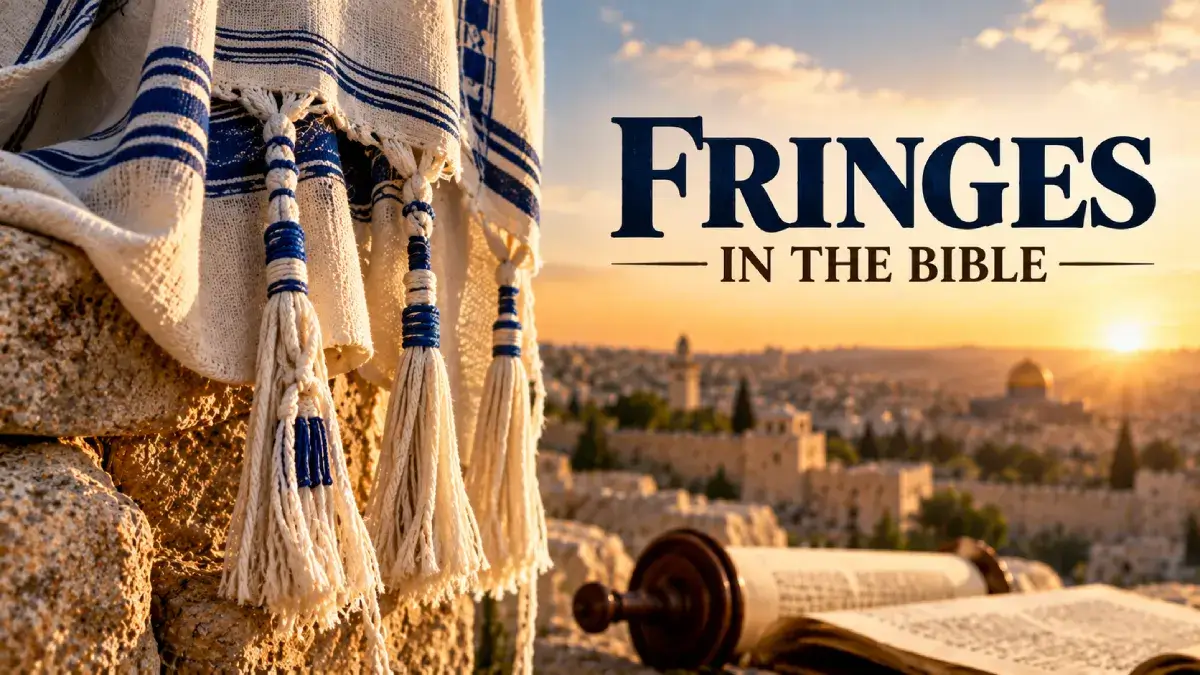
Fringes in the Bible were tassels God commanded the Israelites to attach to the corners or borders of their garments as a reminder to remember and obey His commandments. Numbers 15:38–40 connects the fringes and blue cord with remembering God’s instructions and living as His holy people. In the New Testament, the borders of garments appear in passages about Jesus and the religious leaders of His time. The fringes primarily served as a visible reminder of covenant obedience, rather than as objects with magical or independent spiritual power.
What Are Fringes in the Bible?
Have you ever wondered why the Bible mentions fringes on clothing and why a woman with an issue of blood reached for the hem of Jesus’ garment? These details may seem small, but they connect to important biblical teachings about obedience, remembrance, faith, and God’s commandments.
In the Old Testament, God instructed the Israelites to put fringes on the borders of their garments. These fringes were not simply decorative features. They served as reminders of God’s commandments and the responsibility of His people to live in obedience to Him.
Numbers 15:38–39 gives the instruction:
“Speak unto the children of Israel, and bid them that they make them fringes in the borders of their garments throughout their generations, and that they put upon the fringe of the borders a ribband of blue:
And it shall be unto you for a fringe, that ye may look upon it, and remember all the commandments of the LORD, and do them…” — Numbers 15:38–39 (KJV)
Fringes in the Bible are closely associated with the Hebrew word tzitzit, which refers to tassels or fringes attached to the corners of a garment. The blue cord mentioned in Numbers was part of this command.
The subject also appears in the New Testament, where Jesus criticizes religious leaders who enlarge the borders of their garments to be seen by others, and where people seek healing by touching the border of His garment.
In this article, we will explore the meaning of fringes in the Bible, why God commanded them, what the blue cord represented, how they relate to Jesus’ garment, and what Christians can learn from these passages today.
What Does the Word “Fringes” Mean in the Bible?
In everyday English, a fringe can refer to a decorative edge made of hanging threads or strands. In the Bible, the word commonly refers to tassels or cords attached to the borders of garments.
The Hebrew term commonly associated with these tassels is tzitzit. The King James Version uses the word “fringes” in Numbers 15:38 and Deuteronomy 22:12.
These were physical reminders that Israelites could see and touch as they went about their daily lives.
The command appears in two important passages:
- Numbers 15:38–40: God commands the Israelites to make fringes with a blue cord and explains their purpose.
- Deuteronomy 22:12: The Israelites are instructed to make fringes on the four quarters of the garment with which they covered themselves.
The fringes therefore had a specific place in Israel’s religious life. They reminded the people of their relationship with God and their responsibility to follow His commandments.
Were Biblical Fringes the Same as Modern Decorative Fringes?
Not necessarily. Modern decorative fringes can be added to clothing for fashion, but the biblical fringes were connected to a particular command given to Israel.
Their importance came from their intended purpose, not simply their appearance. God instructed the people to use them as reminders of His commandments.
This distinction helps us understand why the Bible mentions them in passages about obedience, holiness, and religious conduct.
Why Did God Command the Israelites to Wear Fringes?
The main reason is explained directly in Numbers 15:39–40.
“And it shall be unto you for a fringe, that ye may look upon it, and remember all the commandments of the LORD, and do them;
And that ye seek not after your own heart and your own eyes, after which ye use to go a whoring:
That ye may remember, and do all my commandments, and be holy unto your God.” — Numbers 15:39–40 (KJV)
This passage identifies three important purposes.
1. Fringes Reminded the Israelites of God’s Commandments
God knew that His people needed continual reminders of His instructions.
The Israelites lived in a world filled with competing influences, temptations, and pressures. The fringes provided a visible reminder of the commandments they were called to remember.
They could see the fringes during ordinary activities, making the reminder part of everyday life.
Lesson: Remembering God’s Word should not be limited to a weekly worship service. His truth should influence our daily decisions.
2. Fringes Encouraged Obedience Rather Than Following Every Desire
Numbers 15:39 warns against following the desires of one’s own heart and eyes without regard for God’s commands.
The problem was not that every desire or personal preference was wrong. Rather, the passage warned against allowing personal desires to lead people away from God’s instructions.
The fringes served as a reminder to evaluate their choices in light of God’s commandments.
Lesson: Faithfulness involves more than knowing what God says. It requires allowing His Word to shape our actions.
3. Fringes Reminded Israel of Its Call to Holiness
Numbers 15:40 concludes with the purpose of remembering and obeying God’s commandments so that Israel might be holy to God.
In the Old Testament, Israel had a covenant relationship with God and was called to live as His distinct people.
The fringes were one visible expression of that calling. They reminded the Israelites that their lives belonged to the Lord.
Lesson: God’s people are called to live in a way that reflects their relationship with Him.
What Was the Blue Cord on the Biblical Fringes?
One distinctive detail in Numbers 15:38 is the instruction to place a blue cord or ribbon on the fringe of the garment.
The KJV says:
“…and that they put upon the fringe of the borders a ribband of blue.” — Numbers 15:38 (KJV)
The blue cord was part of the specific instruction God gave Israel. The following verse explains the overall purpose of the fringes: to remember God’s commandments and do them.
Does the Bible Explain the Exact Symbolism of the Blue Cord?
The passage does not explicitly give a separate symbolic interpretation of the blue color. It does, however, explain the purpose of the fringes as a whole.
Some modern explanations associate blue with the heavens or God’s presence, but those associations should not be presented as the explicit meaning stated in Numbers 15.
It is best to distinguish between what Scripture directly says and later interpretations.
The text clearly teaches that the fringes, including the blue cord, were intended to remind Israel of God’s commandments.
What Can Christians Learn From the Blue Cord?
The main lesson is that reminders can help us keep God’s truth before us.
Christians today might use Scripture reading plans, written Bible verses, prayer reminders, or regular times of reflection to keep God’s Word in mind.
These practices are not equivalent to the specific command given to Israel, but they can serve a similar practical purpose: helping us remember biblical truth and live according to it.
Fringes in Deuteronomy 22:12
Another important reference appears in Deuteronomy 22:12:
“Thou shalt make thee fringes upon the four quarters of thy vesture, wherewith thou coverest thyself.” — Deuteronomy 22:12 (KJV)
This verse instructs the Israelites to place fringes on the four corners or quarters of their garments.
The verse is brief and does not repeat the full explanation given in Numbers 15. However, read alongside Numbers 15:38–40, it belongs to the same broader biblical subject of fringes on Israelite clothing.
The instruction shows that fringes were an identifiable feature of the garments described in the law.
Why Were the Fringes Placed on the Corners?
The text specifically refers to the four quarters of the garment. It does not give a detailed explanation of why this placement was chosen beyond the instruction itself.
Numbers 15 provides the central explanation for the practice: the fringes were to remind the Israelites of God’s commandments.
This illustrates an important principle when studying biblical details. We should distinguish between the specific information Scripture provides and explanations that go beyond the text.
Fringes on Jesus’ Garment in the New Testament
Fringes and garment borders appear in several New Testament passages. These references help readers understand how the borders of clothing featured in the religious and cultural life of the period.
Two themes stand out: Jesus’ criticism of religious showmanship and the faith of people who sought healing by touching His garment.
1. Jesus Criticized Those Who Enlarged Their Garment Borders
Matthew 23:5 records Jesus saying:
“But all their works they do for to be seen of men: they make broad their phylacteries, and enlarge the borders of their garments,” — Matthew 23:5 (KJV)
Jesus was criticizing certain scribes and Pharisees for practicing their religion to gain public admiration.
Phylacteries were small containers holding Scripture passages, while the enlarged borders referred to features of their garments. In the context of Matthew 23, Jesus was confronting outward displays of righteousness that were motivated by a desire for recognition.
The issue was not simply wearing fringes or making a garment’s borders larger. The problem was using religious appearance to attract attention while failing to practice the humility and righteousness God desired.
What does this teach us?
Religious practices should reflect genuine devotion to God rather than a desire to impress other people.
A person can display religious symbols, quote Scripture, or participate in public worship while still needing to grow in humility, mercy, and obedience.
Jesus’ teaching challenges believers to examine the motives behind their actions.
2. People Touched the Border of Jesus’ Garment for Healing
Matthew 9:20–22 tells the story of a woman who had suffered from an issue of blood for twelve years.
“And, behold, a woman, which was diseased with an issue of blood twelve years, came behind him, and touched the hem of his garment:” — Matthew 9:20 (KJV)
The woman believed that touching Jesus’ garment would help her. Jesus turned, spoke to her, and told her that her faith had made her whole.
Matthew 14:36 also describes people bringing the sick to Jesus:
“And besought him that they might only touch the hem of his garment: and as many as touched were made perfectly whole.” — Matthew 14:36 (KJV)
These passages describe people approaching Jesus in faith and seeking healing.
The word translated “hem” or “border” in these accounts is associated with the edge or fringe of a garment. Some translations make this connection more explicit.
Did the Fringes Themselves Have Healing Power?
The Gospel accounts do not teach that fringes possessed independent magical power.
Instead, they describe Jesus as the One who healed. The woman in Matthew 9 approached Him in faith, and Jesus acknowledged her faith.
The distinction matters because the biblical accounts direct attention to Jesus rather than treating a piece of clothing as an object that automatically produces miracles.
Lesson: Faith should lead us toward Christ, who is the focus of these healing accounts, rather than toward superstition about physical objects.
What Is the Connection Between Jesus’ Garment and the Old Testament Fringes?
Numbers 15 and Deuteronomy 22 describe the fringes commanded for Israelite garments. The New Testament later refers to the borders of garments in the accounts of Jesus’ ministry.
This connection is historically and textually meaningful. It places Jesus’ clothing within the wider world of Jewish life and religious practice during His earthly ministry.
However, it is important not to claim more than the passages establish.
The Gospels describe people touching the border of Jesus’ garment, but they do not provide a detailed description of the garment’s construction in each healing account. The connection with the Old Testament practice of fringes is a reasonable historical explanation, not a reason to assign magical power to the garment.
The central focus of the Gospel stories remains Jesus’ compassion, authority, and healing.
Were Biblical Fringes a Symbol of Holiness?
Numbers 15:40 directly connects the command to remember and obey God’s commandments with the call to be holy to God.
This makes holiness an important part of understanding the fringes.
However, the fringes themselves did not automatically make a person righteous. They were a reminder intended to encourage obedience.
A person could wear the prescribed garment and still disobey God’s commandments. This is part of the wider biblical distinction between outward religious practices and genuine faithfulness.
Jesus’ criticism in Matthew 23:5 reinforces this point. He challenged people who used religious appearances to gain admiration while neglecting deeper matters of righteousness.
The lesson is that outward reminders should point toward inward devotion and faithful living.
Should Christians Wear Fringes Today?
Christians have different views on whether they should wear fringes or tassels based on the command in Numbers 15.
The question should be considered carefully by distinguishing the original instruction to Israel from how Christians understand their obligations under the new covenant.
The Command Was Given to the Children of Israel
Numbers 15:38 begins:
“Speak unto the children of Israel…” — Numbers 15:38 (KJV)
The instruction was explicitly given to Israel and was part of the law governing the covenant community.
Some Christians, including groups that seek to follow particular Old Testament practices, choose to wear fringes or tassels as a reminder of God’s commandments.
Other Christians understand the command as a specific covenant instruction for Israel rather than a requirement for all Christians.
Does the New Testament Command Every Christian to Wear Fringes?
The New Testament passages discussed here do not give a universal command that every Christian must wear fringes.
The emphasis in the Gospel accounts is on Jesus’ ministry and on the motives of people who display religious practices. The New Testament also emphasizes faith in Christ, love, obedience, and inward transformation.
Christians who are considering this practice should study the relevant passages in context and consider how their church tradition understands the relationship between the Old Testament law and the new covenant.
It is wise to avoid judging another believer’s faithfulness solely by whether that person wears a particular garment.
Can Wearing Fringes Help Someone Remember God’s Word?
A person may choose to wear a physical reminder of Scripture as a personal devotional practice. However, it is important to distinguish a voluntary practice from a universal biblical requirement.
Wearing fringes does not replace prayer, repentance, love, obedience, or faith in Christ.
The central principle of Numbers 15 remains clear: God’s people should remember His commandments and live in faithfulness to Him.
Spiritual Lessons Christians Can Learn From Fringes in the Bible
Although Christians differ in how they apply the Old Testament instruction about fringes, the passages offer several valuable lessons.
1. Keep God’s Word Before You
The fringes reminded Israel to remember God’s commandments. Christians can also benefit from regular reminders of Scripture.
Reading the Bible, memorizing verses, praying, and reflecting on God’s Word can help keep biblical truth at the center of daily life.
2. Put God’s Word Into Practice
Remembering a commandment is not the same as obeying it.
Numbers 15:39 repeatedly connects remembrance with action. The people were to remember God’s commandments and do them.
Similarly, James 1:22 encourages believers to be doers of the Word rather than hearers only.
3. Do Not Confuse Religious Appearance With Genuine Faith
Matthew 23:5 warns against religious behavior performed to gain attention.
Church attendance, religious clothing, Christian language, and public acts of devotion should be accompanied by sincere faith and a life that reflects God’s character.
4. Examine Your Motives
The same outward action can be performed for different reasons.
Someone might participate in a religious practice out of sincere devotion, while another person might do it to gain admiration. Jesus’ teaching encourages us to examine our hearts rather than focus only on outward appearances.
5. Approach Jesus With Faith
The accounts of people touching Jesus’ garment direct our attention to His compassion and authority.
The woman in Matthew 9 had suffered for years, yet she approached Jesus believing that He could help her. Her story reminds readers to bring their needs to Christ in faith.
6. Remember That Holiness Involves the Whole Life
Numbers 15:40 connects the fringes with the calling to be holy to God.
Holiness is not merely about clothing or outward religious customs. It involves belonging to God and seeking to live according to His will.
7. Treat Scripture With Care and Accuracy
Small details in the Bible can carry important meaning, but we should not invent symbolism that Scripture does not explicitly provide.
For example, Numbers 15 clearly explains the purpose of the fringes, while it does not give a separate symbolic explanation for the blue color. Recognizing this distinction helps us study the Bible faithfully.
Frequently Asked Questions About Fringes in the Bible
What are fringes in the Bible?
Fringes are tassels or cords attached to the borders or corners of garments. In Numbers 15:38–40, God instructed the Israelites to wear them as reminders of His commandments and their calling to holiness.
What is the Hebrew word for fringes in the Bible?
The Hebrew word commonly associated with the biblical fringes is tzitzit. It refers to tassels or fringes attached to a garment. The term is especially associated with the instructions in Numbers 15:38 and Deuteronomy 22:12.
Why did God command Israel to wear fringes?
Numbers 15:39–40 explains that the fringes were intended to help the Israelites remember God’s commandments, obey them, and live as a holy people belonging to Him.
What does the blue cord on the fringes represent?
Numbers 15:38 instructs the Israelites to include a blue cord or ribbon with the fringes. The passage explains the purpose of the fringes as a whole but does not explicitly give a separate symbolic meaning for the color blue.
Did Jesus wear fringes on His garment?
The Gospels refer to people touching the border or hem of Jesus’ garment. Given the Jewish clothing practices of the period and the Old Testament instructions concerning fringes, these references are commonly understood in connection with garment fringes. However, the healing accounts do not provide a detailed description of the garment’s construction.
Why did the woman with the issue of blood touch Jesus’ garment?
Matthew 9:20–22 describes a woman who had suffered from an issue of blood for twelve years. She approached Jesus in faith and touched the hem of His garment. Jesus acknowledged her faith and healed her.
Did the fringes themselves have miraculous power?
The Bible does not teach that fringes possessed independent magical power. In the Gospel accounts, Jesus is the One who heals. The stories emphasize His authority and the woman’s faith rather than the independent power of clothing.
Should Christians wear fringes today?
Christians differ in their understanding of whether the command in Numbers 15 applies directly to them today. Some choose to wear fringes as a devotional reminder, while others understand the instruction as a specific command given to Israel. The New Testament passages discussed here do not issue a universal command requiring every Christian to wear fringes.
What is the difference between fringes and phylacteries?
Fringes were tassels attached to garment borders. Phylacteries were small containers holding Scripture passages, worn according to Jewish religious practice. Matthew 23:5 mentions both when Jesus criticizes religious leaders who enlarged these items to gain attention.
What is the main spiritual lesson of fringes in the Bible?
The central lesson is the importance of remembering God’s Word and obeying His commandments. The fringes served as a visible reminder of Israel’s covenant responsibilities, showing how everyday reminders can direct attention toward faithful living.
Final Thoughts: Remember God’s Word and Walk in Faithfulness
Fringes in the Bible may seem like a small detail, but they help us understand an important theme in Scripture: God’s people are called to remember His Word and live according to His commandments.
Numbers 15:38–40 explains that the fringes and blue cord were intended to remind Israel of God’s instructions and its calling to holiness. Deuteronomy 22:12 reinforces the command, while the New Testament references to garment borders provide a connection to the clothing and religious practices of Jesus’ time.
Matthew 23:5 warns against using religious appearances to seek human admiration. Meanwhile, the healing accounts in Matthew remind us that Jesus—not a physical object—was the focus of the people’s hope.
For Christians today, the lasting lesson is to keep God’s Word before us, examine our motives, and seek a life shaped by genuine faith and obedience.
Remember: The value of a biblical reminder lies in the truth it points us toward. Let Scripture guide your heart, influence your decisions, and help you walk faithfully with God.