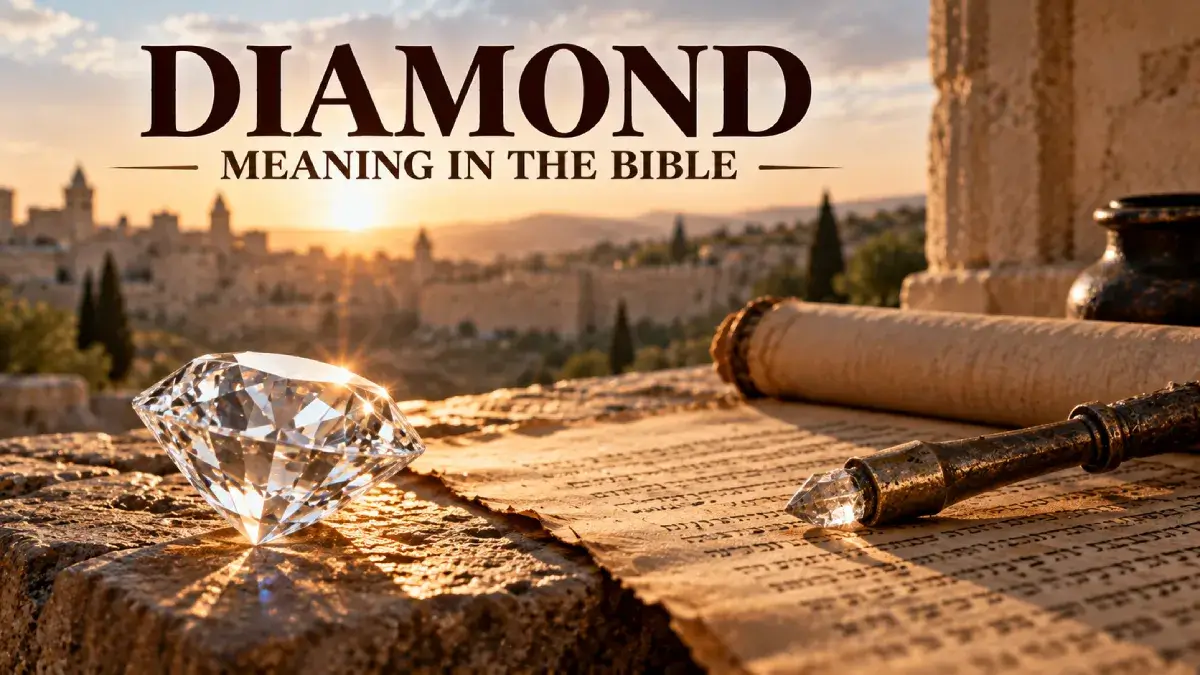
What does a diamond mean in the Bible? Diamonds are commonly associated with strength, beauty, purity, value, and endurance. When people study the Bible’s references to precious stones, they often connect these qualities with spiritual truths about God’s wisdom, the beauty of His creation, and the lasting value of a faithful life.
However, there is an important distinction to understand: the Bible does not give diamonds one clearly defined, universal spiritual meaning. Some English Bible translations use the word diamond in certain passages, while others translate the same underlying Hebrew term differently. Ancient precious stones also cannot always be identified with certainty using modern mineral names.
Nevertheless, the biblical passages involving diamonds, precious stones, and precious materials offer meaningful themes to explore. Jeremiah uses a diamond-like substance as an image of hardness, while Ezekiel and Revelation describe precious stones in settings associated with beauty, glory, and heavenly imagery.
In this article, we will explore the meaning of diamond in the Bible, examine the relevant Scriptures, consider the symbolism of precious stones, and discover practical lessons Christians can apply to their lives.
1. Diamond in the Bible: Jeremiah 17:1
Key Scripture: Jeremiah 17:1
One of the most meaningful biblical references to a diamond appears in Jeremiah 17:1.
“The sin of Judah is written with a pen of iron, and with the point of a diamond: it is graven upon the table of their heart, and upon the horns of your altars.” — Jeremiah 17:1, KJV
In this passage, the prophet Jeremiah describes the sin of Judah as something deeply engraved, as though it had been carved into a hard surface with an iron tool and a diamond point.
The image communicates how deeply the people’s sin had become rooted in their lives. Their rebellion was not a temporary mistake that could easily be forgotten. It had become firmly established in their hearts and religious practices.
What does the diamond symbolize in Jeremiah 17:1?
The diamond imagery emphasizes hardness, permanence, and the difficulty of removing what has been deeply engraved.
The verse does not present the diamond as a symbol of beauty or wealth. Instead, it uses the idea of an extremely hard cutting point to illustrate the seriousness of Judah’s sin.
This gives the passage a sobering spiritual message: repeated choices can shape our hearts and influence our relationship with God.
Spiritual lesson
We should be careful about the habits and attitudes we allow to become deeply rooted in our lives.
Dishonesty, pride, bitterness, and persistent disobedience can become difficult to change when we repeatedly make room for them. Jeremiah’s imagery encourages us to examine our hearts honestly and turn toward God rather than allowing destructive patterns to become established.
The good news is that Scripture also speaks about God giving His people a new heart and a renewed spirit (Ezekiel 36:26).
2. Diamond in the High Priest’s Breastplate
Key Scriptures: Exodus 28:18; Exodus 39:11
Another reference to a diamond appears in the instructions for the high priest’s breastplate.
Exodus 28 describes the garments worn by Aaron, Israel’s high priest. The breastplate contained twelve precious stones arranged in four rows, with the names of the twelve tribes of Israel engraved on the stones.
Exodus 28:18 lists the stones in the second row:
“And the second row shall be an emerald, a sapphire, and a diamond.” — Exodus 28:18, KJV
Exodus 39:11 repeats the description when explaining how the priestly garments were made.
The diamond is therefore included in a list of precious stones used in a sacred garment associated with Israel’s worship.
What does the diamond represent in this passage?
The Bible does not assign a separate spiritual meaning to each stone in the breastplate. It is therefore better not to claim that the diamond specifically represents faith, purity, protection, or any other quality in this passage.
However, the broader context provides important meaning.
The stones were associated with the twelve tribes of Israel. Exodus 28:21 explains that the stones bore the names of Israel’s sons, representing the tribes.
The breastplate was part of the high priest’s sacred clothing. Its design belonged to the instructions God gave for Israel’s worship.
The stones demonstrated beauty and craftsmanship. The use of precious materials contributed to the dignity and beauty of the priestly garments.
One important detail is that the exact identity of the stone translated as diamond is uncertain. The Hebrew word yahalom appears in Exodus 28:18, Exodus 39:11, and Ezekiel 28:13. Biblical reference works note that it may refer to another precious stone, such as onyx or jasper, rather than the modern diamond with certainty.
The safest interpretation is to focus on the stone’s place in the biblical description rather than build an entire spiritual doctrine around its modern name.
3. Diamond Among the Precious Stones in Ezekiel 28:13
Key Scripture: Ezekiel 28:13
Ezekiel 28:13 includes the diamond in a description of precious stones:
“Thou hast been in Eden the garden of God; every precious stone was thy covering, the sardius, topaz, and the diamond, the beryl, the onyx, and the jasper, the sapphire, the emerald, and the carbuncle, and gold.” — Ezekiel 28:13, KJV
The verse appears in a prophetic lament concerning the king of Tyre. The surrounding passage uses imagery of Eden, precious stones, beauty, and exaltation before describing pride and downfall.
The diamond is one of several valuable stones included in the description.
What is the significance of the diamond here?
In this passage, the precious stones contribute to an image of exceptional beauty, wealth, and splendor.
However, the central message of Ezekiel 28 is not simply about gemstones. The passage moves from a picture of greatness and beauty toward a warning about pride and judgment.
The diamond’s presence in the list helps establish the richness of the imagery, but the Bible does not explicitly identify it as a symbol of eternal life or spiritual perfection.
Spiritual lesson
External beauty and worldly success do not guarantee humility or faithfulness.
A person may possess wealth, influence, or impressive abilities and still fall into pride. Ezekiel’s message reminds readers that greatness must not become an excuse for self-exaltation.
For Christians, the passage encourages humility and a recognition that every good gift should be handled responsibly.
4. Is a Diamond a Symbol of Strength in the Bible?
Diamonds are famous today for their hardness and durability. Because of this quality, people often associate them with strength, perseverance, and resilience.
There is a biblical basis for connecting the word diamond with hardness, particularly in Jeremiah 17:1. However, the exact mineral behind the biblical term is uncertain, and the passage uses hardness as part of a warning about sin rather than as a general symbol of spiritual strength.
Other passages use the imagery of hard stone to communicate firmness.
For example, Ezekiel 3:9 says that God made the prophet’s forehead like a diamond, harder than flint, so that he would not be afraid of the rebellious people to whom he was sent.
In this context, the hard stone represents the firmness God gives Ezekiel to carry out his prophetic assignment.
What can Christians learn from this imagery?
The broader lesson is that faithfulness sometimes requires courage and determination.
Christians may encounter criticism, discouragement, or pressure to abandon their convictions. Scripture encourages believers to remain faithful to God while speaking and acting with wisdom.
Yet firmness should not become stubbornness toward correction. The hardness imagery in these passages serves particular purposes in their contexts; it does not mean that Christians should become emotionally unresponsive or refuse to listen to others.
5. Does a Diamond Represent Purity in the Bible?
In modern culture, diamonds are often associated with purity, innocence, and lasting love. These associations are especially common in jewelry and wedding traditions.
However, the Bible does not explicitly teach that diamonds symbolize purity.
The biblical passages mentioning the stone focus on different themes:
- Jeremiah 17:1 uses diamond-point imagery to describe the deep engraving of sin.
- Exodus 28:18 and Exodus 39:11 list a diamond among the stones of the high priest’s breastplate.
- Ezekiel 28:13 includes the diamond in a description of precious stones and splendor.
Therefore, if you are studying the diamond meaning in the Bible, it is important to distinguish modern symbolism from the meaning of the original passage.
Christians may use a diamond as an illustration of purity in a devotional message, but that application should be identified as a modern analogy rather than a direct biblical definition.
For the biblical teaching on purity, passages such as Matthew 5:8 and Psalm 51:10 provide a clearer foundation.
Matthew 5:8 says:
“Blessed are the pure in heart: for they shall see God.” — Matthew 5:8, KJV
This verse directly teaches about purity of heart without assigning that meaning to a diamond.
6. What Does a Diamond Symbolize Spiritually Today?
Although the Bible does not provide a single universal symbolism for diamonds, the qualities associated with the gemstone can serve as illustrations for personal reflection.
Here are four ways Christians may use diamond imagery in a devotional context, while remembering that these are applications rather than explicit biblical definitions.
1. Endurance through hardship: A diamond’s durability can remind us of the importance of perseverance. James 1:12 speaks of the blessing associated with enduring trials faithfully.
2. Living with integrity: A diamond’s clarity can serve as a modern illustration of honesty and integrity. Proverbs 10:9 teaches that those who walk in integrity walk securely.
3. Recognizing lasting value: A precious stone can remind us to seek what matters most. Matthew 6:19–21 teaches Jesus’ followers to focus on heavenly treasure rather than earthly possessions.
4. Reflecting God’s light: A diamond reflecting light can illustrate how believers can live in ways that honor God. Matthew 5:16 encourages disciples to let their light shine before others.
These illustrations can be useful in sermons, Bible studies, and personal devotionals. The important distinction is that the Scriptures cited teach endurance, integrity, heavenly priorities, and faithful witness; they do not specifically identify diamonds as symbols of these qualities.
7. What Is the Difference Between Diamonds and Other Precious Stones in the Bible?
The Bible mentions numerous precious stones, including sapphire, emerald, jasper, onyx, beryl, and other stones. These appear in descriptions of priestly garments, royal splendor, prophetic imagery, and the heavenly city in Revelation.
Not every stone can be identified confidently with a modern mineral. Ancient gemstone names were based on historical languages and classifications that do not always match current gemological terminology.
Here is a simple comparison of the biblical contexts in which some precious stones appear.
| Precious stone | Biblical reference | Context |
|---|---|---|
| Diamond | Exodus 28:18 | High priest’s breastplate |
| Diamond | Jeremiah 17:1 | Hardness imagery used to describe engraved sin |
| Sapphire | Exodus 28:18; Revelation 21:19 | Priestly garment and heavenly-city imagery |
| Emerald | Exodus 28:18; Revelation 21:19 | Precious-stone lists |
| Jasper | Ezekiel 28:13; Revelation 21:19 | Precious-stone imagery |
| Onyx | Genesis 2:12; Exodus 28:9 | Precious material and priestly garments |
The most important point is that the Bible uses precious stones in different contexts. Their meaning must be understood from the passage in which they appear, not from a universal symbolic dictionary.
8. Does the Bible Say Diamonds Have Special Spiritual Power?
No biblical passage teaches that diamonds possess supernatural power, protect people from evil, guarantee prosperity, or bring blessings simply because someone owns or wears them.
The Bible does describe precious stones as valuable materials, but their value does not make them objects of spiritual power.
Christian faith is centered on God, not on gemstones.
Deuteronomy 18:10–12 warns against various forms of divination and occult practice. Although the passage does not specifically discuss diamonds, it reminds readers not to seek supernatural guidance through practices that Scripture condemns.
A diamond can be appreciated for its beauty or used as a meaningful personal reminder. However, Christians should not confuse a gemstone’s physical properties or cultural associations with God’s promises.
9. What Can Christians Learn From Diamonds in the Bible?
The biblical references to diamonds provide several lessons when read in their proper context.
Lesson 1: Examine What Is Engraved on Your Heart
Jeremiah 17:1 uses a diamond point to describe how deeply sin had been engraved in the lives of Judah’s people.
This image encourages us to examine our habits, motivations, and choices.
Are we allowing bitterness, dishonesty, pride, or resentment to become deeply rooted? Are we willing to seek forgiveness and make changes when God reveals something that needs attention?
The goal is not to become hardened in wrongdoing but to allow God to renew our hearts.
Lesson 2: Value What Is Truly Important
The diamond appears among precious stones in descriptions of the high priest’s breastplate and the splendor associated with the king of Tyre.
These passages remind us that precious materials can have significant value in human life and religious settings.
Yet Scripture also warns against placing too much confidence in wealth and possessions. Jesus teaches in Matthew 6:19–21 that our hearts are connected to what we treasure.
Christians can appreciate material beauty while keeping their priorities centered on God.
Lesson 3: Remain Firm in Your Calling
The hard-stone imagery in Ezekiel 3:9 illustrates the firmness God gave the prophet as he faced a rebellious audience.
This can encourage Christians to remain faithful when they encounter opposition.
Faithfulness does not require hostility or arrogance. It involves continuing to speak truth, act with integrity, and follow God’s direction with courage and humility.
Lesson 4: Do Not Judge Spiritual Worth by Outward Beauty
Diamonds may be rare, beautiful, and expensive, but outward appearance is not the measure of a person’s spiritual value.
First Samuel 16:7 reminds readers that people look on the outward appearance, but the Lord looks on the heart.
This principle encourages us to value character, compassion, faithfulness, and humility rather than judging people by their possessions or appearance.
Lesson 5: Read Scripture in Context
Perhaps the most important lesson is to interpret biblical symbols carefully.
A diamond is not automatically a sign of blessing, purity, wealth, or divine protection every time it appears in a sermon or devotional illustration.
Jeremiah’s diamond imagery concerns the hardness of an engraving point, while Exodus lists a precious stone used in priestly garments.
Understanding the context helps us appreciate Scripture without assigning meanings that the text does not establish.
10. Bible Verses to Read Alongside the Meaning of Diamonds
If you are studying the diamond meaning in the Bible, the following passages provide useful context.
- Exodus 28:18: The diamond appears in the list of stones on the high priest’s breastplate.
- Exodus 39:11: The breastplate’s second row of stones is described again.
- Jeremiah 17:1: A diamond point illustrates the deep engraving of Judah’s sin.
- Ezekiel 3:9: God makes the prophet’s forehead hard like a diamond, emphasizing firmness in his mission.
- Ezekiel 28:13: The diamond appears in a description of precious stones and splendor.
- Matthew 5:8: Jesus teaches about purity of heart.
- Matthew 6:19–21: Jesus teaches about heavenly treasure and the relationship between treasure and the heart.
- James 1:12: The verse speaks of perseverance under trial.
The first five passages directly relate to diamond or hard-stone imagery. The final three provide related spiritual teachings that can be explored alongside modern devotional applications.
A Prayer for a Pure Heart and Enduring Faith
Heavenly Father,
Thank You for the wisdom found in Your Word. Help me to understand Scripture faithfully and to recognize the difference between what the Bible teaches directly and the lessons I draw from its imagery.
Search my heart and reveal any attitude or habit that has become deeply rooted in me. Give me the humility to repent, the courage to change, and the strength to remain faithful when life becomes difficult.
Teach me to value what matters most to You rather than placing my confidence in possessions, appearance, or worldly success. Help me to live with integrity, reflect Your goodness, and encourage others through my words and actions.
May my life honor You in every season, and may my heart remain devoted to Jesus Christ.
In Jesus’ name, Amen.
Frequently Asked Questions About the Diamond Meaning in the Bible
What does a diamond mean in the Bible?
The Bible does not assign diamonds one universal spiritual meaning. In Jeremiah 17:1, a diamond point illustrates the deep engraving of sin. In Exodus 28:18 and Ezekiel 28:13, a stone translated as diamond appears among lists of precious stones.
What does a diamond symbolize spiritually?
In modern Christian reflection, diamonds may be used to illustrate endurance, integrity, value, or purity. These are devotional applications rather than a universal symbolism explicitly established by Scripture.
Where is diamond mentioned in the Bible?
The King James Version uses the word diamond in Exodus 28:18, Exodus 39:11, Jeremiah 17:1, and Ezekiel 28:13. The underlying Hebrew terms are not the same in all these passages, and the identity of the ancient stones is uncertain.
What does Jeremiah 17:1 mean by the point of a diamond?
Jeremiah compares Judah’s sin to writing engraved with an iron tool and a hard stone point. The imagery emphasizes how deeply the people’s rebellion had become rooted in their hearts and religious practices.
Was a diamond on the high priest’s breastplate?
The King James Version identifies a diamond as one of the stones in the second row of the high priest’s breastplate in Exodus 28:18 and Exodus 39:11. However, scholars cannot identify the ancient stone with certainty as a modern diamond.
Does a diamond represent purity in the Bible?
The Bible does not explicitly teach that diamonds symbolize purity. Christians may use a diamond as a modern illustration of purity, but passages such as Matthew 5:8 speak directly about purity of heart.
Does wearing a diamond bring God’s protection?
The Bible does not teach that wearing a diamond provides supernatural protection or guarantees blessings. Christians can appreciate gemstones for their beauty without treating them as sources of spiritual power.
What is the Hebrew word for diamond in the Bible?
The Hebrew word yahalom is translated as diamond in Exodus 28:18, Exodus 39:11, and Ezekiel 28:13. Jeremiah 17:1 uses a different Hebrew term, shamir, for the hard point used in the engraving imagery.
What does Ezekiel 28:13 teach about diamonds?
Ezekiel 28:13 includes the diamond in a description of precious stones associated with the king of Tyre. The passage uses imagery of beauty and splendor before addressing pride and downfall.
What is the main spiritual lesson of diamonds in the Bible?
A central lesson is to read biblical imagery in context. The diamond references invite reflection on the seriousness of sin, the use of precious materials in sacred settings, and the danger of pride. Modern applications about endurance or integrity can be helpful, provided they are not mistaken for direct biblical definitions.
Final Thoughts: Understanding the Diamond Meaning in the Bible
The diamond meaning in the Bible is more nuanced than a simple list of spiritual symbols.
In Jeremiah 17:1, a diamond point illustrates how deeply sin had been engraved in Judah’s life. In Exodus, a stone translated as diamond appears in the high priest’s breastplate. In Ezekiel 28:13, it forms part of a description of precious stones and splendor.
These passages show that the Bible uses gemstone imagery for different purposes. They also remind us that the exact identity of some ancient stones is uncertain, so we should be careful about equating every biblical reference with a modern diamond.
Although Christians may use diamonds as illustrations of endurance, integrity, or lasting value, those applications should be distinguished from the direct teaching of Scripture.
Ultimately, the most important question is not what a diamond can symbolize in our culture, but what God’s Word actually teaches us about our hearts, our priorities, and our relationship with Him.
As you study these passages, seek to understand their context, apply their lessons wisely, and remember that true spiritual value is found in a life devoted to God rather than in material possessions.