Quick Answer
The word “ban” in a biblical context can have a very different meaning from the modern English word “ban,” which usually means to prohibit or forbid something.
In Bible study, “the ban” can refer to the Hebrew concept of ḥērem (herem), meaning something devoted, set apart, or placed under a ban, particularly for destruction in certain Old Testament contexts.
A major example appears in the account of Jericho. Israel was commanded to devote the city and its possessions to destruction as part of God’s judgment.
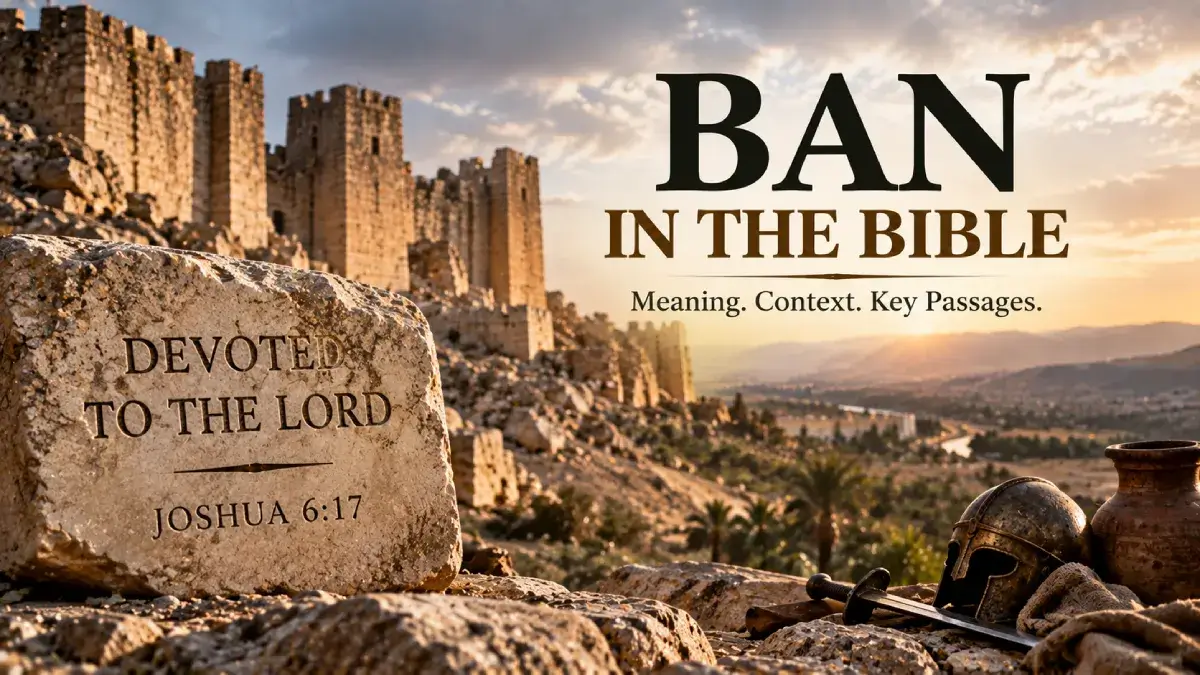
Joshua 6:17 says:
“And the city shall be accursed, even it, and all that are therein, to the LORD.” — Joshua 6:17, KJV
In many modern translations, the underlying concept is rendered “devoted to destruction” or “devoted” rather than “ban.”
So, when someone searches for “ban in the Bible,” it is important to distinguish between:
- A modern ban — prohibiting something.
- The biblical concept of ḥērem — something placed under a sacred ban or devoted to God, sometimes specifically for destruction.
What Does “Ban” Mean in the Bible?
The biblical idea commonly associated with “ban” is being set apart or devoted for a particular purpose, especially in connection with God’s judgment.
The Hebrew term ḥērem can refer to something devoted to God and, depending on context, something designated for destruction.
This concept appears especially in passages concerning Israel’s conquest of Canaan.
For example, God commanded Israel concerning certain cities and peoples that they were to be placed under the ban.
This was not simply a military policy created by Israel.
Within the biblical narrative, these commands are presented as specific divine judgments connected with particular peoples and circumstances.
That historical and theological context is essential when interpreting the passages.
Is “Ban” the Same as “Forbidden” in the Bible?
Not necessarily.
This is one of the most important distinctions to make.
In modern English:
Ban = prohibit something.
For example, if an activity is banned, people are forbidden from doing it.
But the biblical concept of ḥērem has a different meaning.
It can involve something being:
- devoted,
- set apart,
- consecrated,
- placed under a ban,
- or devoted to destruction.
Therefore, if you see the word “ban” in a Bible study or commentary, you should examine the context and the original Hebrew concept rather than automatically interpreting it as “forbidden.”
What Is the Hebrew Word for “Ban” in the Bible?
The Hebrew word commonly associated with this concept is ḥērem (חרם).
It comes from a Hebrew root associated with something being devoted or set apart.
Depending on the context, it can describe something that is:
- devoted to God,
- placed under a ban,
- removed from ordinary use,
- or devoted to destruction.
This is why different English Bible translations may use different wording.
One translation may say:
“accursed”
Another may say:
“devoted”
Another may say:
“devoted to destruction.”
These different translations are attempting to communicate the meaning of the Hebrew term within its particular context.
1. Joshua 6:17 — The Ban at Jericho
One of the clearest examples is the fall of Jericho.
Joshua 6:17 says:
“And the city shall be accursed, even it, and all that are therein, to the LORD.”
The KJV uses “accursed” here.
The concept is connected with the Hebrew ḥērem.
The Israelites were instructed that Jericho was not ordinary spoil to be taken for personal use.
It was devoted to God.
The following verses explain that certain things were to be destroyed, while precious metals such as silver, gold, brass, and iron were to be placed into the treasury of the LORD.
This demonstrates that the command involved devotion to God, not simply destruction for its own sake.
2. Joshua 6:18 — Israel Was Warned Not to Take the Accursed Thing
Joshua gives the Israelites a serious warning:
“And ye, in any wise keep yourselves from the accursed thing…” — Joshua 6:18, KJV
The “accursed thing” refers to something that had been placed under the ban.
Israel was forbidden from taking what God had designated for destruction or sacred use.
The warning was important because taking something devoted to God would violate His command.
This becomes significant in the next chapter.
3. Achan and the Ban in Joshua 7
After the victory at Jericho, an Israelite named Achan secretly took items that God had forbidden Israel to take.
Joshua 7:1 says:
“But the children of Israel committed a trespass in the accursed thing.”
Achan confessed that he had taken:
- a beautiful Babylonian garment,
- silver,
- and a wedge of gold.
He hid them beneath his tent.
The story demonstrates the seriousness with which the biblical narrative treats something placed under the ban.
Achan treated what had been devoted to God as though it were available for personal possession.
4. Deuteronomy 7:2 — The Ban and the Nations of Canaan
The concept also appears before Israel entered Canaan.
Deuteronomy 7:2 says:
“And when the LORD thy God shall deliver them before thee; thou shalt smite them, and utterly destroy them.”
The passage continues by instructing Israel not to make certain covenant arrangements with those nations.
The context is Israel’s entrance into the land God had promised them.
The command is presented within the Old Testament’s particular covenant and judgment context.
It should not be separated from that historical setting.
5. Deuteronomy 20:16–18 — The Special Command Concerning Canaan
Deuteronomy 20 contains instructions concerning warfare.
Regarding particular Canaanite cities, the Israelites were told:
“But of the cities of these people, which the LORD thy God doth give thee for an inheritance, thou shalt save alive nothing that breatheth.” — Deuteronomy 20:16, KJV
The passage then lists several peoples and explains why the command was given.
Verse 18 says:
“That they teach you not to do after all their abominations, which they have done unto their gods.”
This shows that the command is presented in Scripture as part of divine judgment and covenant protection, rather than as a general instruction for God’s people to destroy people they consider sinful.
That distinction is crucial.
Why Was the Ban Used in the Old Testament?
The biblical passages connect the ban with several ideas.
Divine Judgment
Certain peoples and cities were subject to God’s judgment within the Old Testament narrative.
Holiness
Israel was repeatedly commanded to remain distinct from practices associated with idolatry and the surrounding nations.
Devotion to God
Things placed under the ban were not to be treated as ordinary possessions.
Covenant Obedience
Israel’s relationship with God included specific commands concerning the land and its inhabitants.
The ban therefore cannot be understood correctly by looking at the word alone.
The historical and covenant context is essential.
Was Everything Under the Ban Destroyed?
Not necessarily.
The biblical concept could involve different forms of devotion.
For example, in Joshua 6, Jericho was devoted to destruction, but certain valuable materials were specifically designated for the treasury of the LORD.
Joshua 6:19 says:
“But all the silver, and gold, and vessels of brass and iron, are consecrated unto the LORD.”
Therefore, the concept was not simply:
“Destroy absolutely everything.”
Rather, different things could be assigned different purposes according to God’s command.
6. Leviticus 27:28 — Things Devoted to the Lord
The concept appears outside warfare as well.
Leviticus 27:28 says:
“Notwithstanding no devoted thing, that a man shall devote unto the LORD of all that he hath… shall be sold or redeemed.”
This is important because it shows that the concept of ḥērem is broader than warfare.
Something could be devoted to the LORD.
This helps us understand why translations sometimes use words such as:
- devoted,
- dedicated,
- consecrated,
- or banned.
The specific meaning depends upon the context.
7. The Ban Was Not a General Command for Christians
A crucial point for modern Bible readers is that Old Testament commands concerning the ban were given within specific historical circumstances.
Christians should not take passages about ancient Israel’s conquest of Canaan and treat them as instructions for modern religious violence.
The New Testament gives Christians a fundamentally different mission.
Jesus told His disciples:
“Love your enemies, bless them that curse you, do good to them that hate you.” — Matthew 5:44, KJV
Christians are not commanded to recreate the military conquest narratives of ancient Israel.
The biblical context matters.
8. “Ban” Versus “Accursed Thing”
If you are reading the King James Bible, you may encounter phrases such as:
“accursed thing”
This can be confusing because the modern English word accursed may suggest something demonic or magically cursed.
But in passages such as Joshua 6–7, the expression is connected with the Hebrew concept of ḥērem.
It refers to something that has been placed under a ban or devoted according to God’s command.
Therefore, “accursed thing” in these passages should be understood in its biblical context rather than simply according to modern English usage.
9. Why Did Achan’s Sin Matter So Much?
Achan’s story illustrates another important aspect of the ban.
He saw something valuable.
He desired it.
He took it.
Then he hid it.
Joshua 7:20–21 records his confession.
His actions were serious because the items were not simply ordinary possessions.
They had been specifically designated by God.
Achan’s story teaches a broader biblical principle:
God’s people are called to respect what God has commanded.
The issue was not merely the material value of the gold, silver, and garment.
It was disobedience.
10. The Ban and the Holiness of Israel
Israel was called to be a distinct people.
God warned Israel repeatedly about adopting the religious practices of the surrounding nations.
Deuteronomy 7:6 says:
“For thou art an holy people unto the LORD thy God.”
Israel’s distinct identity was connected to its covenant relationship with God.
The commands surrounding the ban therefore belonged to a much larger biblical theme of:
holiness + covenant + obedience + separation from idolatry.
11. Does “Ban” Mean Something Is Evil?
Not necessarily.
The word ḥērem does not simply mean “evil.”
It describes something that has been devoted or placed under a special restriction.
The purpose and result depend on the context.
For example:
- A city could be devoted to destruction.
- Possessions could be devoted to God.
- Objects could be dedicated to sacred use.
- Something could be removed from ordinary human ownership.
Therefore, the most helpful basic definition is:
Something placed under a sacred ban or devoted to a particular purpose, especially to God.
12. Why Do Bible Translations Use Different Words?
Hebrew words do not always have one English equivalent.
The Hebrew ḥērem has a range of meaning that can require different English expressions depending on context.
You may encounter:
- accursed thing
- devoted
- devoted thing
- devoted to destruction
- ban
- destroyed
These are related translations of the underlying concept.
When studying an important passage, comparing several translations can help reveal the meaning.
It is also useful to consult the surrounding verses rather than interpreting a single word in isolation.
13. The Ban in Joshua 7: A Warning About Greed
The story of Achan gives the concept a personal application.
Achan’s downfall followed a recognizable progression:
He saw
He noticed valuable possessions.
He coveted
He wanted what he saw.
He took
He acted on his desire.
He hid
He attempted to conceal his disobedience.
This resembles the broader biblical warning about the danger of uncontrolled desire.
James 1:14–15 describes a similar progression in discussing temptation and sin.
The lesson is that greed can turn something attractive into a spiritual trap.
14. What Can Christians Learn From These Passages?
Although Christians are not under the Old Testament conquest commands, these passages still contain principles worth studying.
Obedience Matters
Israel was expected to obey God’s specific instructions.
Greed Can Lead to Sin
Achan’s desire for material possessions led him into disobedience.
God Is Holy
The Old Testament repeatedly emphasizes God’s holiness.
Context Matters
Biblical commands must be understood within the covenant and historical setting in which they were given.
God’s Commands Are Not Arbitrary Human Rules
The biblical narrative presents the ban as something commanded by God within particular circumstances.
15. Does the Bible Say “Ban” Means Prohibit?
If you mean the modern English definition of ban, then the Bible certainly contains many commands that prohibit particular behaviors.
For example, Scripture prohibits:
- idolatry,
- murder,
- theft,
- adultery,
- false worship,
- and many other actions.
But that is different from the technical biblical concept of ḥērem.
Therefore, when searching for “ban in the Bible,” it helps to ask:
Are we talking about something being forbidden, or the Old Testament concept of something being placed under the ban?
Those are related ideas but are not identical.
Ban in the Bible: Key Verses
Here are several important passages to study:
Joshua 6:17
“And the city shall be accursed, even it, and all that are therein, to the LORD.”
Theme: Jericho placed under the ban.
Joshua 6:18
“Keep yourselves from the accursed thing.”
Theme: Israel warned not to take what was devoted.
Joshua 7:1
“The children of Israel committed a trespass in the accursed thing.”
Theme: Achan’s disobedience.
Leviticus 27:28
“No devoted thing, that a man shall devote unto the LORD…”
Theme: Devoted things.
Deuteronomy 7:2
“Thou shalt smite them, and utterly destroy them.”
Theme: The Old Testament conquest context.
Deuteronomy 20:16
“Thou shalt save alive nothing that breatheth.”
Theme: Specific commands concerning Canaanite cities.
Frequently Asked Questions
What does “ban” mean in the Bible?
In biblical studies, “ban” commonly refers to the Hebrew concept ḥērem, meaning something devoted or set apart, sometimes specifically for destruction. It is different from the ordinary modern meaning of “ban” as simply prohibiting something.
What is the ban in Joshua?
In Joshua, certain cities and possessions were placed under a sacred ban. At Jericho, for example, the city was devoted to destruction while certain valuable materials were designated for the LORD’s treasury.
What does “accursed thing” mean in Joshua?
The KJV’s “accursed thing” refers to something placed under the ban or devoted according to God’s command. It does not simply mean something that is magically cursed.
What is the Hebrew word for ban in the Bible?
The Hebrew term commonly associated with the biblical “ban” is ḥērem (חרם). Depending on context, it can be translated with words such as “devoted,” “devoted thing,” “accursed thing,” or “devoted to destruction.”
What happened when Achan broke the ban?
Achan secretly took possessions that had been placed under the ban at Jericho. His disobedience resulted in judgment and became a serious issue for the Israelite community in Joshua 7.
Does ban mean forbidden in the Bible?
Not always. A modern ban means something is prohibited, while the biblical concept of ḥērem can mean something is devoted or set apart, including devotion to destruction in certain contexts.
Does the Bible command Christians to put people under a ban?
No. The Old Testament commands concerning the ban belong to specific historical and covenant circumstances involving ancient Israel. Christians are not instructed to reproduce those conquest commands.
Why did God command the ban?
Within the biblical narrative, the ban concerning particular Canaanite peoples is presented as an act of divine judgment and as part of Israel’s covenant occupation of the land. Deuteronomy also connects the command with avoiding the religious practices and idolatry of those nations.
Is “ban” a bad word in the Bible?
The word itself is not inherently good or bad. Its meaning depends on the context. The biblical concept describes something devoted or set apart according to a particular purpose.
Final Thoughts on the Meaning of Ban in the Bible
The phrase “ban in the Bible” can be confusing because the word ban has a very different meaning in modern English than the biblical concept commonly associated with it.
In biblical studies, the idea is often connected with the Hebrew word ḥērem, which describes something devoted or set apart, and in certain Old Testament passages, something devoted to destruction.
The clearest examples appear in Joshua, especially the account of Jericho and the story of Achan.
Joshua 6:17 describes Jericho as:
“accursed… to the LORD.”
Joshua 6:18 then warns Israel to stay away from the “accursed thing.”
The concept also appears in passages such as Leviticus 27:28, demonstrating that it was not limited exclusively to warfare.
Most importantly, these passages need to be understood within their specific Old Testament historical and covenant context. They should not be turned into general commands for modern religious violence.
For Christians, these difficult passages also invite careful Bible study: God’s holiness, the seriousness of obedience, the danger of greed, the consequences of sin, and the importance of reading Scripture in its proper context.
The key takeaway is simple:
In the Bible, “the ban” generally refers to something devoted or set apart, sometimes for destruction, rather than simply something prohibited in the modern sense.