The Bible has a great deal to say about judgment.
God is described as righteous, holy, and just. Scripture teaches that God sees human actions, knows the heart, holds people accountable, disciplines His people, and will ultimately judge the world.
But what does the Bible mean when it talks about judgment?
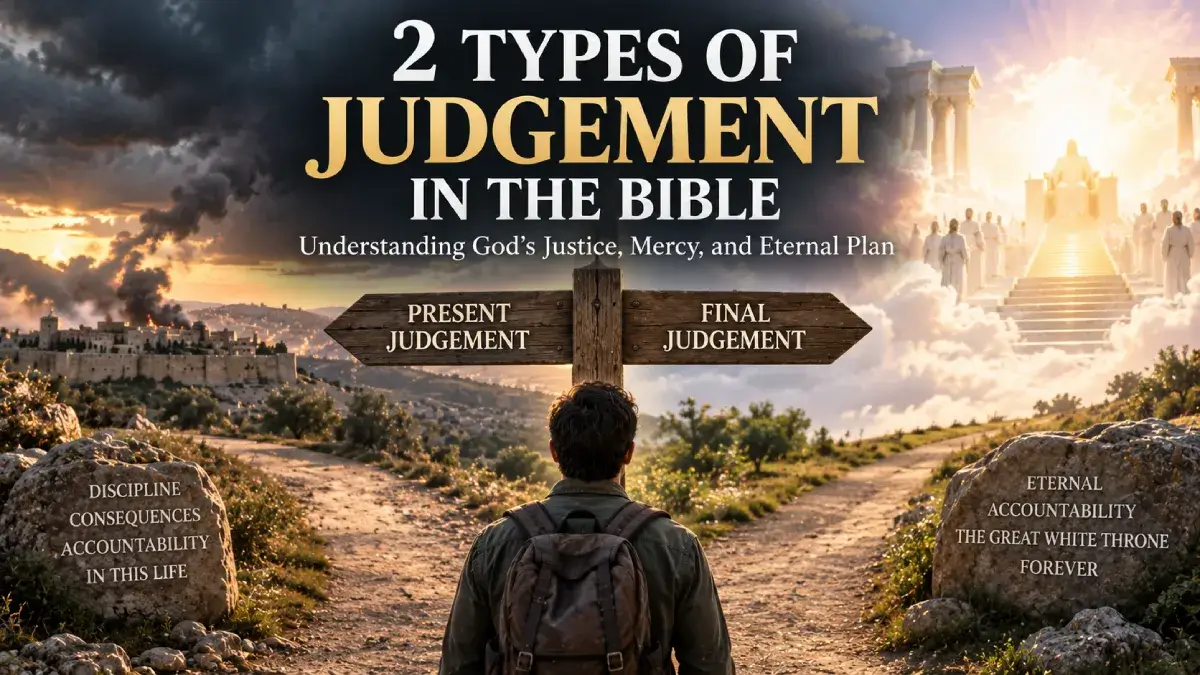
A common way of organizing the Bible’s teaching is into two broad types of judgment:
- Present or temporal judgment
- Final or eternal judgment
These categories help us understand the different ways Scripture describes God’s judgment. However, the Bible does not present a single verse that explicitly says, “There are exactly two types of judgment.” The two-category framework is a way of organizing several biblical teachings.
It is also important to distinguish God’s judgment of sin from His loving discipline of His children and from the final judgment of all humanity.
So, what are the 2 types of judgment in the Bible, and what does Scripture teach about each one?
Let’s explore them carefully.
What Is Judgment in the Bible?
Biblical judgment involves God evaluating people, actions, and motives according to His righteousness and justice.
Depending on the context, judgment can involve:
- Evaluation
- Justice
- Accountability
- Discipline
- Punishment
- Separation
- Reward
- Condemnation
- Vindication
The Bible teaches that God is the ultimate Judge.
Deuteronomy 32:4 describes Him as:
“A God of truth and without iniquity, just and right is he.”
Because God is perfectly righteous, His judgment is never corrupt or unfair.
Human judgment can be mistaken.
God’s judgment is not.
What Are the 2 Types of Judgment in the Bible?
A helpful biblical framework is:
1. Present or Temporal Judgment
This refers to God’s judgments that occur within human history.
These can include consequences for sin, divine discipline, national judgments, and other forms of God’s righteous dealings with people during earthly life.
2. Final or Eternal Judgment
This refers to the future judgment of humanity, when God brings His final judgment and establishes the eternal consequences of people’s relationship with Him.
These two categories help us distinguish between God’s judgment during this present life and God’s ultimate judgment at the end of the age.
But there are additional distinctions within these categories, especially concerning believers and unbelievers.
1. Present or Temporal Judgment
The first broad type is present judgment.
Throughout Scripture, God sometimes judges people or nations within history.
These judgments can take different forms.
Sometimes they involve consequences for sinful behavior.
Sometimes God disciplines His own people.
Sometimes He judges nations.
Sometimes judgment takes place through natural or political circumstances.
The important point is that God’s judgment is not limited to the end of history.
Scripture contains many examples of God acting in judgment during earthly life.
Examples of Present Judgment in the Bible
The Flood
Genesis 6–9 describes God’s judgment on the world in Noah’s generation.
Human wickedness had become widespread, and God brought judgment through the Flood.
At the same time, Noah and his family were preserved.
This story demonstrates both God’s judgment and God’s salvation.
Sodom and Gomorrah
Genesis 18–19 describes God’s judgment upon Sodom and Gomorrah.
The cities became associated with severe wickedness, and God ultimately destroyed them.
Lot and members of his household were brought out before the destruction.
Again, the story demonstrates that biblical judgment can occur within history.
Israel’s Exile
The Old Testament repeatedly explains Israel and Judah’s exile in terms of God’s judgment for persistent rebellion and idolatry.
The prophets warned God’s people that continued disobedience would bring consequences.
The exile therefore represents an example of historical or temporal judgment.
God’s Discipline of His Children
Not every difficult circumstance in the Bible should be described as punishment.
Scripture also speaks about discipline.
Hebrews 12:6 says:
“For whom the Lord loveth he chasteneth.”
The passage compares God’s discipline to the discipline of a loving father.
This is different from final condemnation.
For Christians, God’s discipline is intended to produce spiritual growth and holiness.
Hebrews 12:10 says that God disciplines His children:
“for our profit, that we might be partakers of his holiness.”
This distinction is important.
Punishment and discipline are not always the same thing.
A loving parent may discipline a child not because the child has been rejected, but because the parent wants the child to grow.
Is Every Bad Thing That Happens God’s Judgment?
No.
The Bible does not teach that every tragedy, illness, financial loss, or difficult circumstance is necessarily a direct judgment from God.
This is an important principle.
Job suffered tremendously, but his friends repeatedly assumed his suffering must have resulted from some hidden sin.
The book of Job challenges that simplistic assumption.
Likewise, in John 9, Jesus’ disciples asked whether a man’s blindness was caused by his sin or his parents’ sin.
Jesus rejected their assumption that the man’s condition could simply be explained as punishment for a specific sin.
Therefore, Christians should be cautious about declaring:
“This happened because God is judging that person.”
Scripture does not give us permission to make that conclusion about every hardship.
2. Final or Eternal Judgment
The second broad category is final judgment.
This refers to the future judgment that Scripture associates with the return of Christ, resurrection, and the end of the age.
The Bible teaches that human beings will ultimately stand before God.
Hebrews 9:27 says:
“It is appointed unto men once to die, but after this the judgment.”
Death is not presented as the end of accountability.
There is a future judgment.
The Judgment Seat of Christ
For Christians, one important passage concerning future judgment is 2 Corinthians 5:10:
“For we must all appear before the judgment seat of Christ…”
Paul says that believers will appear before Christ and that each person will receive according to what they have done.
This passage is often called the Judgment Seat of Christ.
It emphasizes accountability for believers.
Christians are saved by God’s grace through faith, but salvation does not make their lives meaningless.
Their actions, service, and faithfulness still matter.
Is the Judgment Seat of Christ About Salvation?
This distinction is important.
The New Testament teaches that salvation is by grace through faith rather than by earning God’s favor through good works.
Ephesians 2:8–9 says:
“For by grace are ye saved through faith…”
Yet the very next verse says:
“For we are his workmanship, created in Christ Jesus unto good works.”
Therefore, good works are not the basis of salvation.
They are the fruit of a transformed life.
When Scripture speaks of believers appearing before Christ for judgment, it should not automatically be interpreted as meaning that Christians must earn their salvation through their performance.
Instead, the New Testament emphasizes accountability, reward, and faithfulness.
The Great White Throne Judgment
Another major passage concerning final judgment is Revelation 20:11–15.
John sees a great white throne and the dead standing before God.
Books are opened.
The dead are judged according to what is written in the books.
The passage culminates in the judgment of those whose names are not found in the book of life.
This is commonly called the Great White Throne Judgment.
It represents the seriousness of final accountability before God.
Judgment of Believers and Unbelievers
Another way Christians sometimes describe biblical judgment is by distinguishing between:
The judgment of believers
and
the judgment of unbelievers.
This distinction fits within the broader category of final judgment but focuses on different biblical passages.
Believers
Believers appear before Christ’s judgment seat.
Their lives and works are evaluated.
Unbelievers
Scripture describes a final judgment in which those who reject God face condemnation.
John 3:18 says:
“He that believeth on him is not condemned: but he that believeth not is condemned already…”
This is why the Bible’s teaching about judgment is inseparable from its teaching about salvation.
Judgment Is Based on Truth
Romans 2:2 says:
“But we are sure that the judgment of God is according to truth…”
Human beings can be deceived.
We can misunderstand someone’s motives.
We can judge based on appearances.
God does not.
He knows:
- What people do
- Why they do it
- What they believe
- What they think
- What is hidden
- What is publicly visible
God’s judgment is therefore completely informed.
God Does Not Show Partiality
Romans 2:11 says:
“For there is no respect of persons with God.”
God does not judge people according to wealth, social position, reputation, race, influence, or status.
A powerful person cannot manipulate God.
A wealthy person cannot purchase God’s favor.
A poor person is not overlooked.
God judges righteously.
Jesus Is the Judge
The New Testament teaches that Jesus has been given authority to judge.
John 5:22 says:
“For the Father judgeth no man, but hath committed all judgment unto the Son.”
This is an important Christian belief.
The One who came to save is also the One who will judge.
Jesus’ authority over judgment demonstrates His divine authority.
Why Does God Judge?
God’s judgment is connected with His character.
He is:
Holy.
Righteous.
Just.
Truthful.
Good.
Because God is righteous, He cannot simply declare evil to be acceptable.
Judgment demonstrates that God takes sin seriously.
If God never judged evil, justice would ultimately have no meaning.
Judgment and God’s Mercy
The Bible presents God’s judgment alongside His mercy.
This is one of the most important truths to understand.
God is just.
But God is also merciful.
Psalm 103:8 says:
“The LORD is merciful and gracious, slow to anger, and plenteous in mercy.”
God’s willingness to forgive does not mean that sin is insignificant.
Instead, the Gospel demonstrates how God’s justice and mercy meet through Jesus Christ.
The Cross and God’s Judgment
The cross is central to understanding Christian teaching about judgment.
Human sin deserves judgment.
Yet Jesus willingly gave Himself for sinners.
Isaiah 53:5 says:
“He was wounded for our transgressions, he was bruised for our iniquities…”
The Gospel therefore offers forgiveness to those who trust in Christ.
The cross demonstrates both:
The seriousness of sin
and
the greatness of God’s mercy.
Why Does the Bible Warn About Judgment?
The Bible’s warnings about judgment are not designed merely to frighten people.
They are intended to call people to:
- Repentance
- Faith
- Holiness
- Obedience
- Reconciliation with God
Paul says in Acts 17:30–31 that God commands people everywhere to repent because He has appointed a day on which He will judge the world in righteousness.
The warning is therefore also an invitation.
Turn to God while there is opportunity.
What Is the Judgment of Believers?
Christians sometimes ask:
“If I am saved, will God still judge me?”
The New Testament indicates that believers will appear before Christ’s judgment seat.
2 Corinthians 5:10 says:
“For we must all appear before the judgment seat of Christ…”
Romans 14:10 similarly says:
“For we shall all stand before the judgment seat of Christ.”
This does not mean that Christians should live in constant fear that God will suddenly reject them.
Rather, believers should understand that their lives have eternal significance.
Will Christians Be Rewarded?
The New Testament speaks about rewards for faithful service.
Paul writes in 1 Corinthians 3:8:
“Every man shall receive his own reward according to his own labour.”
Jesus also taught about heavenly rewards.
These passages encourage believers to live faithfully because God sees what others may not see.
Faithful service is never wasted.
What About the Judgment of Unbelievers?
Scripture also teaches a future judgment for those who reject God.
The final judgment is associated with condemnation and eternal consequences.
Revelation 20:15 says:
“And whosoever was not found written in the book of life was cast into the lake of fire.”
This is one of the Bible’s most serious warnings.
The reality of final judgment demonstrates that our response to God matters eternally.
Is God’s Judgment Fair?
Yes.
The Bible consistently presents God’s judgment as perfectly righteous.
Genesis 18:25 asks:
“Shall not the Judge of all the earth do right?”
The answer is understood to be yes.
God has perfect knowledge.
He knows every circumstance.
He knows every motive.
He knows every hidden action.
Therefore, His judgment will be completely just.
What Is the Difference Between Judgment and Condemnation?
These concepts are related but not identical.
Judgment involves evaluation and the administration of justice.
Condemnation refers to a negative judgment resulting in guilt or punishment.
For example, Romans 8:1 says:
“There is therefore now no condemnation to them which are in Christ Jesus…”
This does not mean Christians are never accountable.
It means those who are in Christ are not under the condemnation from which Christ saves them.
What Does “Judge Not” Mean?
One of the most misunderstood passages about judgment is Matthew 7:1:
“Judge not, that ye be not judged.”
Does this mean Christians should never make moral judgments?
No.
The surrounding passage is about hypocritical judgment.
Jesus warns against focusing on another person’s sin while ignoring your own.
He says:
“First cast out the beam out of thine own eye…”
Jesus is not commanding His followers to call evil good.
Instead, He teaches them to examine themselves before attempting to correct others.
Can Christians Judge Right From Wrong?
Yes.
The Bible repeatedly calls believers to distinguish between good and evil.
Christians are expected to:
- Recognize sin
- Follow God’s commands
- Exercise wisdom
- Correct wrongdoing appropriately
- Discern false teaching
- Pursue righteousness
But Christians are not called to assume God’s role as the ultimate Judge of another person’s eternal destiny.
There is a difference between:
“This behavior is contrary to Scripture.”
and:
“I know exactly what God’s final judgment on this person’s soul will be.”
The first can be a biblical moral judgment.
The second can go beyond what we know.
What Does the Bible Say About Judging Other Christians?
Paul addresses this issue in Romans 14.
Believers were disagreeing over matters such as food and special days.
Paul tells them not to despise or condemn one another over disputable matters.
Romans 14:10 asks:
“Why dost thou judge thy brother?”
The broader principle is that Christians should not turn every personal disagreement into a spiritual condemnation.
There are essential matters of biblical truth.
There are also matters where faithful Christians can disagree.
Wisdom is required to distinguish between them.
Judgment and Accountability
One reason biblical judgment matters is that our choices matter.
The Bible does not teach that actions are meaningless.
Ecclesiastes 12:14 says:
“For God shall bring every work into judgment, with every secret thing…”
This is a sobering statement.
God sees what people do in secret.
Nothing is ultimately hidden from Him.
Judgment Should Lead Us to Humility
Understanding God’s judgment should make Christians more humble, not more arrogant.
Why?
Because every person needs God’s grace.
Romans 3:23 says:
“For all have sinned, and come short of the glory of God.”
Nobody stands before God because of personal perfection.
The Gospel is a message of grace.
Therefore, the Christian response to judgment should include:
Humility.
Repentance.
Gratitude.
Holiness.
Mercy toward others.
2 Types of Judgment in the Bible: A Simple Comparison
| Type of Judgment | When? | Examples | Purpose/Result |
|---|---|---|---|
| Present/Temporal Judgment | During earthly life | Flood, Sodom, Israel’s exile, divine discipline | Justice, consequences, correction, or judgment within history |
| Final/Eternal Judgment | At the end of the age | Judgment before Christ, Great White Throne | Final accountability and eternal consequences |
This framework is useful, but remember that Scripture also discusses different aspects of judgment within these categories, including God’s discipline of believers, the judgment seat of Christ, and the final judgment of unbelievers.
7 Important Bible Verses About Judgment
1. Genesis 18:25
“Shall not the Judge of all the earth do right?”
God’s judgment is perfectly just.
2. Ecclesiastes 12:14
“For God shall bring every work into judgment…”
God sees even what is hidden.
3. Matthew 7:1
“Judge not, that ye be not judged.”
Jesus warns against hypocritical judgment.
4. John 5:22
“The Father judgeth no man, but hath committed all judgment unto the Son.”
Jesus has authority to judge.
5. Romans 2:2
“The judgment of God is according to truth…”
God’s judgment is based on truth.
6. 2 Corinthians 5:10
“For we must all appear before the judgment seat of Christ…”
Believers are accountable to Christ.
7. Revelation 20:12
John describes the dead standing before God’s throne as books are opened.
This passage points to the seriousness of final judgment.
Judgment in the Old Testament
The Old Testament contains many examples of God’s judgment.
God judged:
- Individuals
- Families
- Cities
- Nations
- Israel
- Judah
- Pagan kingdoms
Yet the Old Testament also repeatedly emphasizes God’s mercy.
For example, the prophets often warned people of coming judgment while simultaneously calling them to repentance.
The message was not simply:
“Judgment is coming.”
It was also:
“Return to God.”
Judgment in the New Testament
The New Testament continues the teaching about judgment but places enormous emphasis on Jesus Christ.
Jesus speaks frequently about:
- Final judgment
- Repentance
- Hell
- Accountability
- The kingdom of God
- Eternal life
- Resurrection
- His authority as Judge
The apostles continue this teaching.
Paul emphasizes the coming day of judgment.
John describes final judgment in Revelation.
Therefore, judgment is not merely an Old Testament concept.
It is an important part of New Testament teaching as well.
Why Is Judgment Good?
At first, judgment may not sound like something good.
But imagine a world where:
- Murder is never judged.
- Abuse is never addressed.
- Corruption is never exposed.
- Oppression is never punished.
- Lies always triumph.
- Evil never has consequences.
Such a world would not be just.
Biblical judgment means that evil will not ultimately escape accountability.
For victims of injustice, this can actually be a source of hope.
God sees.
God knows.
God will judge righteously.
What Should Christians Do in Light of God’s Judgment?
Understanding biblical judgment should affect how we live.
1. Repent of Sin
Do not ignore what God calls wrong.
2. Trust in Christ
The Gospel offers salvation through Jesus.
3. Live With Integrity
Remember that God sees what others do not.
4. Show Mercy
Because we have received mercy, we should show mercy.
5. Avoid Hypocrisy
Do not condemn others while ignoring your own sins.
6. Pursue Holiness
God’s grace should lead to transformed living.
7. Leave Ultimate Judgment to God
We can pursue justice without pretending to be the final Judge.
What Is the Relationship Between Judgment and Grace?
Grace does not mean that God ignores sin.
Grace means that God provides a way for sinners to be reconciled to Him.
Romans 5:8 says:
“But God commendeth his love toward us, in that, while we were yet sinners, Christ died for us.”
The cross demonstrates that God takes sin seriously while simultaneously extendinggment involves evaluation and justice. Condemnation refers to a negative verdict and its consequences. Romans 8:1 teaches that there1 and a logical H2 → H3 → H4 structure without unnecessarily mercy to sinners.
This is the heart of the Gospel.
Frequently Asked Questions About the 2 Types of Judgment in the Bible
What are the 2 types of judgment in the Bible?
A useful broad framework is present/temporal judgment and final/eternal judgment. Scripture also contains more specific categories, such as God’s discipline of believers and the judgment seat of Christ.
Does the Bible explicitly say there are exactly two types of judgment?
No. The Bible does not contain a verse stating that there are exactly two types. The two-type framework is a way of organizing the Bible’s teaching about judgment.
What is temporal judgment?
Temporal judgment refers to God’s righteous judgment or discipline occurring during earthly history. Biblical examples include the Flood, the judgment of Sodom and Gomorrah, Israel’s exile, and God’s discipline of His people.
What is eternal judgment?
Eternal or final judgment refers to God’s ultimate judgment at the end of the age, when humanity faces final accountability and eternal consequences.
What is the Judgment Seat of Christ?
The Judgment Seat of Christ refers to the appearance of believers before Christ for evaluation of their lives and works. 2 Corinthians 5:10 teaches that believers will appear before Christ’s judgment seat.
Will Christians be judged?
Yes. The New Testament teaches that believers will appear before Christ’s judgment seat. This should be distinguished from the condemnation from which believers are saved through Christ.
Will unbelievers be judged?
Yes. Scripture teaches that those who reject God face final judgment. Revelation 20 describes the Great White Throne judgment.
What is the Great White Throne Judgment?
The Great White Throne Judgment is described in Revelation 20:11–15. It depicts the dead standing before God’s throne and being judged, with the passage ultimately describing the lake of fire for those not found in the book of life.
Is God’s judgment always punishment?
No. Biblical judgment can involve evaluation, justice, consequences, discipline, correction, reward, or condemnation depending on the context.
Is God’s discipline the same as judgment?
They are related but should not automatically be treated as identical. Hebrews 12 describes God’s discipline of His children as an expression of love intended for their spiritual growth.
Does every bad thing that happens mean God is judging someone?
No. Scripture does not support the idea that every tragedy or hardship is a direct punishment for a specific sin. The book of Job and John 9 provide important warnings against simplistic assumptions.
What does Jesus mean by “Judge not”?
Jesus warns against hypocritical and self-righteous judgment in Matthew 7. He does not teach that Christians should abandon moral discernment or call evil good.
Can Christians judge right and wrong?
Yes. Scripture calls believers to discern good and evil and to live according to God’s truth. However, ultimate judgment of a person’s eternal destiny belongs to God.
Why does God judge people?
God judges because He is holy and just. Judgment demonstrates that sin and evil matter and that God will ultimately establish justice.
Is God’s judgment fair?
Yes. Scripture presents God’s judgment as completely righteous and based on truth. God knows every action, motive, and circumstance.
How are judgment and salvation connected?
The Bible teaches that humanity faces judgment because of sin, while the Gospel offers salvation through Jesus Christ. God’s grace provides forgiveness and reconciliation to those who trust in Him.
Does God’s judgment mean He is not loving?
No. Scripture presents God’s justice and love together. God’s judgment demonstrates His commitment to righteousness, while His mercy provides a way of salvation through Christ.
What Bible verse says everyone will be judged?
Hebrews 9:27 says that people die once and afterward comes judgment. Ecclesiastes 12:14 also teaches that God will bring every work into judgment.
What is the difference between judgment and condemnation?
Judgment involves evaluation and justice. Condemnation refers to a negative verdict and its consequences. Romans 8:1 teaches that there is no condemnation for those who are in Christ Jesus.
Final Thoughts: Understanding the 2 Types of Judgment in the Bible
When people search for the “2 types of judgment in the Bible,” they are often trying to understand how God’s judgment works and whether all biblical references to judgment mean the same thing.
A helpful broad framework is:
1. Present or temporal judgment — God’s righteous dealings, consequences, and discipline within human history.
2. Final or eternal judgment — God’s ultimate judgment at the end of the age.
But Scripture gives us additional distinctions within these categories. Believers are described as appearing before the judgment seat of Christ, while the Bible also describes a final judgment involving those who reject God.
The most important truth is that God’s judgment is always righteous.
He does not judge based on appearances.
He does not overlook injustice.
He does not forget hidden sins.
And He does not make mistakes.
Yet the Bible’s teaching about judgment is not intended to leave us without hope.
The same Scriptures that warn about judgment also proclaim mercy, forgiveness, repentance, and salvation through Jesus Christ.
That is why understanding judgment should not merely make us afraid.
It should lead us to humility, repentance, faith, holiness, and gratitude for God’s grace.
And for those who have experienced injustice, there is another powerful truth:
God sees.
God knows.
God is just.
And ultimately, the Judge of all the earth will do what is right.