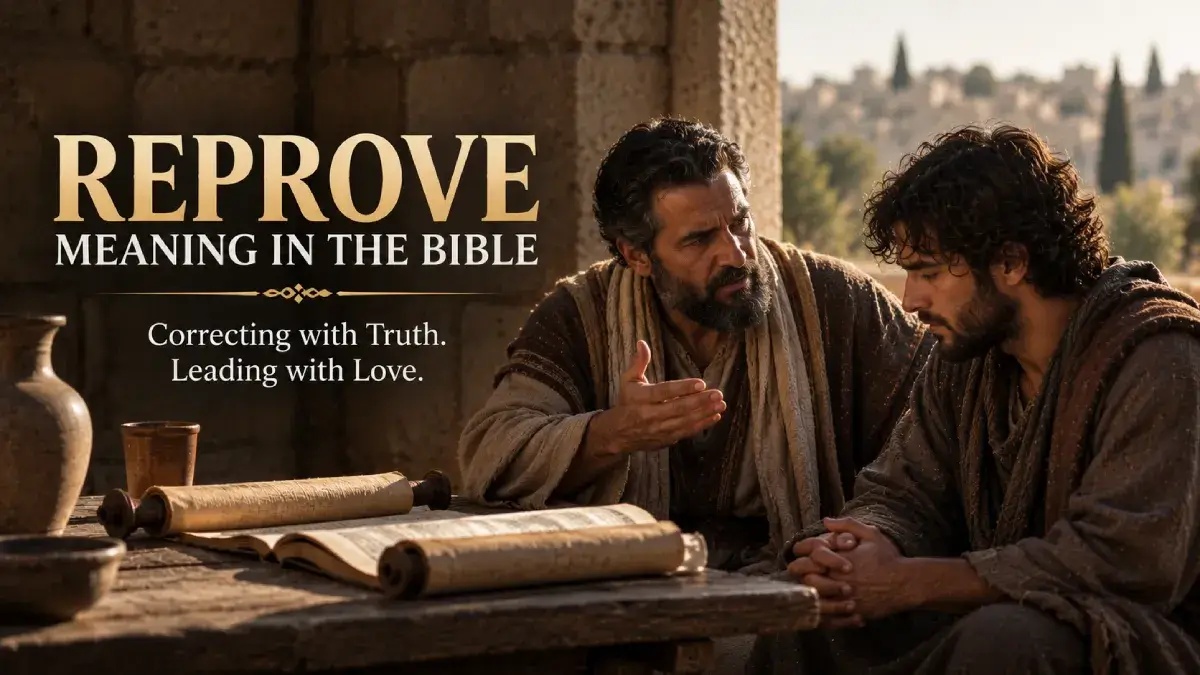
The word “reprove” appears in several important passages of the Bible, especially in the King James Version (KJV). But what does reprove actually mean in the Bible?
In modern English, the word can sound harsh or unfamiliar. Biblically, however, to reprove generally means to correct, expose, convince, or show someone that something is wrong.
Biblical reproof is not simply criticizing another person.
Its purpose is to bring wrongdoing into the light, correct what is wrong, and encourage a person toward truth and righteousness.
For example, Paul tells Timothy:
“Reprove, rebuke, exhort with all longsuffering and doctrine.”
— 2 Timothy 4:2, KJV
Notice that reprove appears alongside rebuke and exhort. These words are related, but they are not identical.
So, what does reprove mean in the Bible? Why does Scripture tell believers to reprove others? And how should Christians reprove someone without becoming judgmental or harsh?
Let’s explore what the Bible teaches.
What Does “Reprove” Mean in the Bible?
The basic biblical meaning of reprove is:
To correct, expose, convict, or demonstrate that something is wrong.
Depending on the context and Bible translation, “reprove” may be translated with words such as:
- Correct
- Convict
- Expose
- Rebuke
- Show someone their fault
- Bring wrongdoing to light
- Convince someone of an error
The exact meaning depends on the particular passage.
In general, biblical reproof involves confronting something that is wrong with the goal of bringing correction.
It is therefore different from simply insulting, shaming, or condemning someone.
What Is the Difference Between Reprove and Rebuke?
The words reprove and rebuke are closely related, but Scripture sometimes uses them together.
A rebuke can involve strongly expressing disapproval of wrongdoing.
To reprove can emphasize exposing or demonstrating that something is wrong and calling attention to it.
For example, Jesus told His disciples:
“If thy brother trespass against thee, go and tell him his fault between thee and him alone.”
— Matthew 18:15, KJV
This provides a helpful picture of biblical correction.
The goal is not humiliation.
The goal is restoration.
A Simple Way to Remember the Difference
Reprove: Show or expose what is wrong.
Rebuke: Strongly correct or warn against what is wrong.
Exhort: Encourage someone toward what is right.
Paul’s instruction in 2 Timothy 4:2 brings all three ideas together:
“Reprove, rebuke, exhort…”
Biblical correction may involve identifying the problem, confronting it, and encouraging the person toward a better path.
Reprove Meaning in the Original Biblical Languages
The English word “reprove” is used to translate several Hebrew and Greek concepts.
One important Greek word is elenchō, which carries the idea of exposing, convicting, convincing, or bringing something wrong to light.
This word appears in passages such as John 16:8 and Ephesians 5:11.
In John 16:8, Jesus says that the Holy Spirit will:
“reprove the world of sin, and of righteousness, and of judgment.”
The idea is that the Spirit brings the truth about sin and righteousness into clear view.
This gives us an important biblical understanding of reproof:
Reproof brings something hidden or wrong into the light of truth.
Ephesians 5:11 — Reprove the Works of Darkness
One of the most frequently quoted verses concerning biblical reproof is Ephesians 5:11:
“And have no fellowship with the unfruitful works of darkness, but rather reprove them.”
— Ephesians 5:11, KJV
Paul is teaching believers how they should live in contrast to sinful behavior.
He first says not to participate in the “unfruitful works of darkness.”
Then he says to reprove them.
What Does This Mean?
Paul is not telling Christians to constantly attack people.
The surrounding passage emphasizes living as children of light.
The contrast is between:
Darkness → sin and evil
Light → truth, goodness, righteousness, and obedience
To reprove works of darkness means to refuse to participate in them and expose their wrongness rather than approving or joining them.
Christians are called to stand for truth.
2. Timothy 3:16 — Scripture Is Profitable for Reproof
Another foundational passage is 2 Timothy 3:16:
“All scripture is given by inspiration of God, and is profitable for doctrine, for reproof, for correction, for instruction in righteousness.”
This verse gives us an important relationship between reproof and Scripture.
The Bible teaches.
The Bible reproves.
The Bible corrects.
The Bible trains.
In other words, God’s Word does not merely tell us what we want to hear.
It also shows us where we are wrong.
Reproof Is Part of Spiritual Growth
If Scripture only encouraged us but never corrected us, we would remain blind to many of our mistakes.
Biblical reproof helps us recognize:
- Wrong attitudes
- Sinful behavior
- False beliefs
- Harmful choices
- Disobedience
- Areas requiring spiritual growth
Therefore, reproof is not necessarily something negative.
Proper reproof is one of the ways God brings us toward maturity.
3. 2 Timothy 4:2 — Reprove, Rebuke, and Exhort
Paul gave Timothy a serious instruction:
“Preach the word; be instant in season, out of season; reprove, rebuke, exhort with all longsuffering and doctrine.”
— 2 Timothy 4:2, KJV
This verse is especially important because it places reproof, rebuke, and exhortation together.
But notice another phrase:
“with all longsuffering and doctrine.”
Correction is not supposed to be delivered with uncontrolled anger.
It should be grounded in God’s truth and accompanied by patience.
Biblical Reproof Requires Patience
A person may not change immediately.
Someone may not accept correction the first time.
Someone may struggle with the same problem repeatedly.
Biblical correction therefore requires longsuffering.
The goal is not:
“I proved you wrong.”
The goal is:
“I want you to understand the truth and walk in it.”
4. Proverbs 27:5 — Open Reproof Can Be Better Than Hidden Love
Proverbs 27:5 says:
“Open rebuke is better than secret love.”
This proverb highlights the value of honest correction.
There are times when genuine love requires us to say something difficult.
Silence is not always kindness.
If someone is heading toward serious harm, refusing to speak because confrontation feels uncomfortable may not actually be loving.
A faithful friend may lovingly point out a problem.
Love Sometimes Requires Correction
True biblical love is not merely making someone feel comfortable.
Love seeks another person’s good.
That means there may be times when a friend needs to hear:
- “That decision is dangerous.”
- “What you’re doing is wrong.”
- “You need to reconsider this.”
- “Scripture teaches something different.”
- “I am concerned about where this path is leading.”
Biblical reproof should come from love and truth, not superiority.
5. Leviticus 19:17 — Do Not Hate Your Brother
An important Old Testament passage connects correction with love.
Leviticus 19:17 says:
“Thou shalt not hate thy brother in thine heart: thou shalt in any wise rebuke thy neighbour, and not suffer sin upon him.”
This is a powerful principle.
The verse does not present correction as the opposite of love.
Instead, it connects responsible correction with refusing to harbor hatred.
The command suggests that ignoring serious wrongdoing is not always the loving response.
6. Jesus’ Teaching About Correcting Others
Jesus also taught His followers how to handle situations involving another believer’s wrongdoing.
Matthew 18:15 says:
“Moreover if thy brother shall trespass against thee, go and tell him his fault between thee and him alone.”
This is a remarkably practical instruction.
Jesus begins with private conversation.
He does not immediately tell the person to publicly shame the offender.
The initial step is personal and direct.
Why Correct Privately?
Private correction can:
- Protect someone’s dignity
- Prevent unnecessary embarrassment
- Reduce gossip
- Encourage honest conversation
- Give the person an opportunity to respond
- Provide an opportunity for reconciliation
This is an important principle for understanding biblical reproof.
Correction should seek restoration, not humiliation.
What Does It Mean to Reprove Someone Biblically?
To reprove someone biblically means to lovingly and truthfully identify wrongdoing or error and encourage the person toward what is right according to God’s Word.
That can involve:
- Identifying the problem
- Speaking truth
- Using Scripture appropriately
- Maintaining humility
- Allowing the person to respond
- Encouraging repentance
- Seeking restoration
Reproof should never become an excuse for cruelty.
Reproof Is Not the Same as Condemnation
This distinction is extremely important.
Reproof says:
“This behavior is wrong, and I want to help you turn from it.”
Condemnation says:
“You are worthless because you did this.”
The first seeks correction.
The second attacks the person’s identity and dignity.
Biblical correction addresses sin and behavior while recognizing that every person is accountable before God.
Should Christians Reprove Other People?
The Bible does instruct believers to correct one another in appropriate circumstances.
Galatians 6:1 gives an important qualification:
“Brethren, if a man be overtaken in a fault, ye which are spiritual, restore such an one in the spirit of meekness.”
The word “restore” is crucial.
The purpose of correction is restoration.
And notice the attitude required:
“the spirit of meekness.”
That means biblical reproof should be accompanied by humility.
Why Is Humility Important When Reproving Someone?
Because the person doing the correcting is also a sinner who needs God’s grace.
Galatians 6:1 continues by warning believers to consider themselves so that they are not also tempted.
Jesus similarly warned against hypocritical judgment in Matthew 7.
Before correcting another person, we should ask:
- Am I acting out of love?
- Am I motivated by anger?
- Am I trying to help or embarrass?
- Have I examined my own life?
- Am I accurately representing Scripture?
- Is this correction actually necessary?
- Am I willing to help the person afterward?
These questions can prevent biblical reproof from becoming self-righteous criticism.
When Should You Reprove Someone?
Not every disagreement requires reproof.
There is a difference between sin and simply having a different preference.
For example, believers can disagree about:
- Food preferences
- Personal habits
- Cultural traditions
- Nonessential practices
- Personal schedules
- Matters where Scripture allows Christian freedom
Reproof is most appropriate when a genuine biblical or moral issue is involved.
Ask: Is This Actually Sin?
Before correcting someone, make sure Scripture clearly addresses the issue.
Do not turn personal preferences into biblical commands.
A person should not say:
“The Bible says you’re wrong.”
when what they really mean is:
“I personally would do this differently.”
Biblical reproof must be grounded in biblical truth, not personal opinion.
How Should You Reprove Someone?
Here is a practical biblical approach.
1. Pray First
Before confronting someone, pray for wisdom.
Ask God to examine your own heart.
2. Check Your Motives
Are you trying to restore the person?
Or are you trying to win an argument?
3. Know What Scripture Says
Do not correct someone based solely on feelings.
Understand the biblical teaching involved.
4. Speak Privately When Appropriate
Matthew 18:15 provides a model of beginning with a private conversation.
5. Be Clear
Do not disguise correction behind vague statements.
Explain what concerns you.
6. Be Gentle
Galatians 6:1 emphasizes meekness.
Truth does not require cruelty.
7. Listen
Give the other person an opportunity to explain.
You may discover that you misunderstood the situation.
8. Point Toward Restoration
Do not stop at identifying the problem.
Help the person see the path toward what is right.
9. Be Patient
Change can take time.
Paul told Timothy to reprove with longsuffering.
What Is the Purpose of Reproof?
Biblical reproof can serve several purposes.
To Expose Sin
Ephesians 5:11 tells believers to reprove the works of darkness.
To Correct Error
2 Timothy 3:16 describes Scripture as profitable for reproof and correction.
To Encourage Repentance
Biblical correction can help someone recognize the need to turn away from wrongdoing.
To Protect Others
Correcting dangerous behavior can prevent further harm.
To Promote Spiritual Growth
Reproof can help believers become more mature.
To Restore Relationships
Matthew 18 connects correction with gaining a brother.
The ultimate goal should therefore be restoration and righteousness, not victory in an argument.
What Does Reprove Mean in Different Bible Translations?
The wording can vary considerably between Bible translations.
For example, a verse that uses “reprove” in the KJV may use words such as:
- Correct
- Expose
- Convict
- Rebuke
- Show someone their fault
in other translations.
This is why comparing translations can be useful when studying the meaning of a biblical word.
The underlying concept remains centered on bringing error or wrongdoing to light and responding with correction.
Bible Verses About Reproof
Here are some of the most useful passages to study.
Ephesians 5:11
“But rather reprove them.”
The verse teaches believers not to participate in works of darkness but instead to expose them.
2 Timothy 3:16
“All scripture is given by inspiration of God, and is profitable for doctrine, for reproof, for correction…”
Scripture itself provides reproof and correction.
2 Timothy 4:2
“Reprove, rebuke, exhort with all longsuffering and doctrine.”
Reproof should be combined with patience, biblical teaching, and encouragement.
Proverbs 27:5
“Open rebuke is better than secret love.”
Honest correction can be an expression of genuine care.
Proverbs 9:8
“Reprove not a scorner, lest he hate thee: rebuke a wise man, and he will love thee.”
This proverb highlights the difference between how wise and foolish people may respond to correction.
Proverbs 12:1
“Whoso loveth instruction loveth knowledge: but he that hateth reproof is brutish.”
A willingness to receive correction is connected with wisdom.
Proverbs 15:31
“The ear that heareth the reproof of life abideth among the wise.”
Listening to correction is presented as part of wisdom.
Proverbs 15:32
“He that refuseth instruction despiseth his own soul: but he that heareth reproof getteth understanding.”
Correction can produce understanding when it is received properly.
Leviticus 19:17
“Thou shalt in any wise rebuke thy neighbour…”
The passage connects responsible correction with loving one’s neighbor.
John 16:8
Jesus says the Holy Spirit will reprove the world concerning sin, righteousness, and judgment.
What Does It Mean That the Holy Spirit Reproves?
John 16:8 is particularly important:
“And when he is come, he will reprove the world of sin, and of righteousness, and of judgment.”
Here, reproof has a strong sense of convicting or exposing the truth.
The Holy Spirit brings awareness concerning:
- Sin
- Righteousness
- Judgment
This shows that biblical reproof is not merely human criticism.
Ultimately, God Himself brings people face-to-face with the truth.
Does Reproof Always Mean Speaking?
Not necessarily.
Ephesians 5:11 says to reprove the works of darkness, but Christian conduct itself can expose the contrast between righteousness and sinful behavior.
A life that consistently reflects truth, purity, integrity, and love can demonstrate that another way of living is possible.
Nevertheless, there are situations where verbal correction is appropriate.
Wisdom is needed to know when to speak and when actions provide the better testimony.
What Does the Bible Say About Receiving Reproof?
The Bible has a great deal to say about how we should respond when someone corrects us.
Proverbs repeatedly connects wisdom with receiving correction.
Proverbs 12:1 says:
“Whoso loveth instruction loveth knowledge: but he that hateth reproof is brutish.”
The biblical message is straightforward:
A wise person is willing to be corrected.
Nobody sees their own weaknesses perfectly.
A loving correction can reveal something we could not see ourselves.
How Should I Respond When Someone Reproves Me?
When someone gives you correction, consider:
Listen Before Defending Yourself
Do not immediately assume the other person is wrong.
Examine the Claim
Ask whether Scripture supports what they are saying.
Admit Wrongdoing When Necessary
If the correction is accurate, humility means acknowledging it.
Repent
Biblical reproof should lead toward change.
Thank the Person
If someone lovingly points out a serious problem, their willingness to speak may actually be an act of friendship.
Learn From It
Do not waste correction.
Use it as an opportunity to grow.
Reproof and Love
One of the most important lessons about biblical reproof is that love and correction are not opposites.
Sometimes love encourages.
Sometimes love comforts.
Sometimes love forgives.
And sometimes love corrects.
Proverbs 27:5–6 connects honest correction with the wounds of a friend.
The point is not that harshness is loving.
The point is that genuine friendship does not require pretending that everything is right when it is not.
Reproof Should Never Become Cruelty
There is a major difference between biblical reproof and verbal abuse.
Biblical reproof should not involve:
- Humiliation
- Mockery
- Name-calling
- Threats
- Public shaming
- Personal attacks
- Vindictive language
- Self-righteousness
The purpose is correction.
If your primary goal is to hurt someone, you have moved away from the biblical purpose of reproof.
Reproof Meaning in the Bible: A Simple Definition
If you need a short definition, remember this:
To reprove in the Bible means to expose, correct, or bring wrongdoing to light, with the purpose of leading a person toward truth and righteousness.
Biblical reproof can be uncomfortable.
But discomfort does not automatically make correction unloving.
Sometimes the most loving thing a person can do is speak the truth with humility and grace.
Reprove vs. Rebuke vs. Exhort
These three biblical concepts often appear together.
| Term | Basic Meaning | Main Emphasis |
|---|---|---|
| Reprove | Expose or correct wrongdoing | Showing what is wrong |
| Rebuke | Strongly correct or warn | Confronting wrongdoing |
| Exhort | Encourage or urge | Calling someone toward what is right |
Paul’s instruction in 2 Timothy 4:2 demonstrates how these ideas work together.
A person may need to be shown what is wrong, warned about it, and encouraged toward a better path.
Frequently Asked Questions About Reprove Meaning in the Bible
What does reprove mean in the Bible?
To reprove means to expose, correct, convict, or demonstrate that something is wrong, especially with the purpose of bringing correction.
What is an example of reproof in the Bible?
Ephesians 5:11 tells believers to reprove the unfruitful works of darkness. Another example is 2 Timothy 4:2, where Paul tells Timothy to reprove, rebuke, and exhort.
What does “reprove” mean in simple words?
In simple terms, reprove means to point out that something is wrong and encourage correction.
Is reprove the same as rebuke?
They are closely related but can emphasize different aspects. Reproof often involves exposing or showing an error, while rebuke can involve a stronger expression of correction or warning.
What does the Bible say about reproving others?
Scripture teaches that believers should correct one another when appropriate, but correction should be done with wisdom, humility, patience, and a desire for restoration.
Should you reprove someone who is sinning?
Biblically, there are situations where believers should lovingly confront wrongdoing. However, reproof should be grounded in Scripture rather than personal preference and should be carried out with humility.
What Bible verse says “reprove, rebuke, exhort”?
2 Timothy 4:2 says: “Reprove, rebuke, exhort with all longsuffering and doctrine.”
This instruction was given by Paul to Timothy concerning his ministry of preaching God’s Word.
What does Ephesians 5:11 mean by “reprove”?
Ephesians 5:11 calls believers not to participate in unfruitful works of darkness but rather to expose or reprove them.
What does 2 Timothy 3:16 mean by reproof?
It means that Scripture is useful for showing people where they are wrong and bringing their beliefs and behavior into alignment with God’s truth.
What does Proverbs say about reproof?
Proverbs repeatedly teaches that wise people listen to correction. Proverbs 12:1 says that loving instruction is connected with loving knowledge.
Is reproof a form of judgment?
Reproof involves identifying wrongdoing, but biblical reproof should not become hypocritical condemnation. Jesus taught His followers to examine themselves and approach others appropriately.
Can reproof be an act of love?
Yes. Proverbs 27:5 teaches that open correction can be better than hidden love. Loving someone may sometimes require respectfully pointing out harmful or sinful behavior.
How should Christians reprove someone?
Christians should pray, examine their own motives, use Scripture accurately, speak with humility, correct privately when appropriate, listen carefully, and seek restoration rather than humiliation.
What if someone becomes angry when I reprove them?
You cannot control another person’s response. Proverbs recognizes that people respond differently to correction. Speak truthfully and lovingly while remaining patient and humble.
Should you reprove someone publicly?
Not normally as a first step when the matter involves a personal offense between believers. Matthew 18:15 gives the principle of approaching the person privately first.
What is the opposite of reproof?
Depending on the context, the opposite could be approval of wrongdoing, ignoring an error, refusing correction, or failing to bring a problem into the light.
Final Thoughts: What Does Reprove Mean in the Bible?
The biblical meaning of reprove is much richer than simply telling someone they are wrong.
To reprove is to bring error or wrongdoing into the light and call for correction.
Scripture presents reproof as an important part of spiritual growth.
God’s Word provides reproof.
The Holy Spirit reproves the world concerning sin, righteousness, and judgment.
Believers are instructed to reprove, rebuke, and exhort.
Wise people are encouraged to receive correction.
And biblical correction is ultimately connected with truth, love, humility, repentance, and restoration.
The goal of reproof should never be:
“I want to prove that I’m better than you.”
It should be:
“I care enough to help you see the truth, and I want to walk with you toward what is right.”
That is why biblical reproof requires both truth and grace.
We need the courage to speak when correction is necessary, but we also need the humility to receive correction when we are the ones who are wrong.
As Proverbs repeatedly reminds us, the wise person does not hate reproof.
The wise person learns from it.
And ultimately, the greatest source of reproof and correction is God’s Word itself, which teaches, exposes, corrects, and trains us to live according to His truth.