Persia is one of the most important nations mentioned in the Bible.
Although the Persian Empire existed thousands of years ago, it played a remarkable role in biblical history and God’s plan for His people.
Persia appears throughout several books of the Old Testament, particularly:
📖 Ezra
📖 Nehemiah
📖 Esther
📖 Daniel
📖 Isaiah
📖 Ezekiel
Unlike many nations that opposed Israel, Persia often served as an instrument of God’s restoration and provision.
Most notably, Persian rulers allowed the Jewish people to return to Jerusalem after the Babylonian exile and rebuild the Temple.
“Who says of Cyrus, ‘He is my shepherd and will accomplish all that I please.'” — Isaiah 44:28
The story of Persia reminds believers that God remains sovereign over kings, empires, and the events of history.
What Was Persia?
Persia was an ancient empire located in what is now modern-day Iran.
Beginning in the sixth century BC, Persia became one of the largest and most powerful empires in the world.
The Persian Empire stretched across:
🌍 The Middle East
🌍 Parts of Asia
🌍 Egypt
🌍 Areas surrounding the Mediterranean
At its height, Persia ruled millions of people from many different cultures and nations.
Persia in Biblical History
Persia entered biblical history after the fall of Babylon.
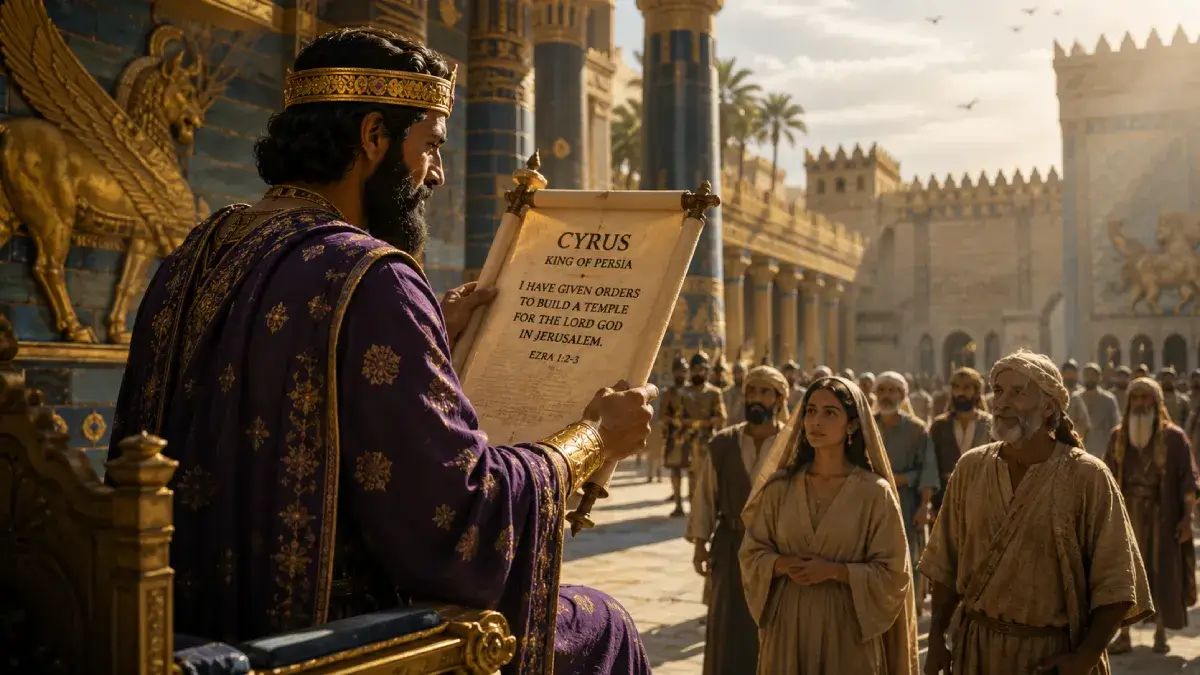
In 539 BC, the Persian king Cyrus the Great conquered Babylon and established Persian rule over the region.
This event dramatically changed the future of the Jewish people.
The Babylonian exile had lasted for many years.
Now, under Persian authority, God’s people were given hope.
God Foretold Persia’s Rise
Remarkably, Scripture predicted Persia’s role before it happened.
Isaiah 44:28
“Who says of Cyrus, ‘He is my shepherd and will accomplish all that I please.'”
Isaiah 45:1
“This is what the LORD says to his anointed, to Cyrus.”
These prophecies were written long before Cyrus came to power.
God specifically named Cyrus and declared that he would accomplish His purposes.
Why Is This Important?
These passages reveal an important truth:
God rules over nations and leaders.
Kings may appear powerful, but God’s purposes ultimately prevail.
Cyrus and the Return from Exile
One of Persia’s most significant contributions to biblical history was allowing the Jewish exiles to return home.
Ezra 1:2–3
“The LORD, the God of heaven… has appointed me to build a temple for him at Jerusalem.”
King Cyrus issued a decree allowing the Jewish people to:
✔ Return to Jerusalem
✔ Rebuild the Temple
✔ Restore worship
This fulfilled God’s promises spoken through the prophets.
Persia and the Rebuilding of Jerusalem
After the Temple was rebuilt, Persia continued to play an important role in Jewish history.
Ezra and Persian Support
Ezra returned to Jerusalem under Persian authority.
Ezra 7:27
“Praise be to the LORD… who has moved the heart of the king.”
God used Persian rulers to support the restoration of His people.
Nehemiah and King Artaxerxes
Nehemiah served as cupbearer to the Persian king Artaxerxes.
When Nehemiah desired to rebuild Jerusalem’s walls, the king granted his request.
Nehemiah 2:8
“The gracious hand of my God was on me.”
Persia became part of God’s restoration plan.
Persia in the Book of Esther
Perhaps the most famous biblical story involving Persia is found in the Book of Esther.
The entire story takes place within the Persian Empire.
King Xerxes (Ahasuerus)
King Xerxes ruled the Persian Empire during Esther’s time.
Esther became queen and ultimately saved the Jewish people from destruction.
Esther 4:14
“And who knows but that you have come to your royal position for such a time as this?”
Through Persia’s royal court, God protected His covenant people.
Spiritual Lesson
God often places people in strategic positions for His purposes.
Persia in the Book of Daniel
The Book of Daniel also mentions Persia several times.
Daniel served during the transition from Babylonian to Persian rule.
Daniel 6:28
“Daniel prospered during the reign of Darius and the reign of Cyrus the Persian.”
Daniel witnessed firsthand how God worked through changing empires.
The Vision of Persia
Daniel received visions concerning future kingdoms.
Daniel 8:20
“The two-horned ram that you saw represents the kings of Media and Persia.”
This prophecy emphasized God’s knowledge and control of future events.
The Kings of Persia Mentioned in the Bible
Cyrus the Great
Known for allowing the Jewish people to return home.
Darius
Supported the rebuilding of the Temple.
Xerxes (Ahasuerus)
The Persian king during Esther’s time.
Artaxerxes
Authorized Nehemiah’s mission to rebuild Jerusalem’s walls.
Why Persia Matters in the Bible
Persia matters because it demonstrates several important biblical truths.
God’s Sovereignty Over Nations
Empires rise and fall, but God remains in control.
God’s Faithfulness to His Promises
Persia became the instrument through which God fulfilled promises of restoration.
God’s Ability to Use Unlikely People
Persian rulers did not belong to Israel, yet God used them to accomplish His purposes.
God’s Care for His People
Even in exile and foreign lands, God continued to guide and protect His people.
Spiritual Lessons from Persia
1. God Controls History
Nations and rulers are ultimately under God’s authority.
2. God’s Promises Never Fail
The return from exile demonstrated God’s faithfulness.
3. God Can Use Anyone
God often works through unexpected people and circumstances.
4. God Provides Hope After Difficult Seasons
Exile was not the end of Israel’s story.
Restoration followed.
5. God’s Plans Are Bigger Than We Can See
The people living during Persia’s rise could not fully understand what God was doing.
Yet He was faithfully fulfilling His promises.
Persia and Modern-Day Iran
Modern Iran occupies much of the territory once known as ancient Persia.
While modern nations differ greatly from ancient empires, understanding Persia’s historical location helps readers appreciate the geographical setting of many biblical events.
A Devotional Reflection
Persia reminds us that God’s plans often unfold through unexpected circumstances.
The Jewish people may have believed their exile marked the end of their story.
Instead, God raised up an empire and even named its ruler centuries beforehand.
Through Persia, God restored worship, rebuilt Jerusalem, and preserved His people.
The same God who guided history then continues to rule today.
No situation is beyond His control.
No season of difficulty is beyond His ability to redeem.
“The LORD has established his throne in heaven, and his kingdom rules over all.” — Psalm 103:19
A Prayer Inspired by Persia’s Story
🙏 “Lord, thank You for reminding me that You are sovereign over history and every circumstance of life. Help me trust Your plans even when I cannot see the outcome. Strengthen my faith in Your promises and teach me to rest in Your wisdom and timing. Amen.”
Frequently Asked Questions
Where was Persia in the Bible?
Persia was located in the region that is largely modern-day Iran.
Which books of the Bible mention Persia?
Ezra, Nehemiah, Esther, Daniel, Isaiah, and Ezekiel.
Who was the most famous Persian king in the Bible?
Cyrus the Great is especially significant because he allowed the Jewish exiles to return to Jerusalem.
Why was Persia important to Israel?
Persia helped facilitate the rebuilding of the Temple and Jerusalem after the exile.
What spiritual lessons does Persia teach?
God is sovereign, faithful to His promises, and able to use unexpected people and nations to accomplish His purposes.
Final Reflection
Persia occupies a remarkable place in biblical history.
🏛️ It was a mighty empire.
📖 It fulfilled biblical prophecy.
🙏 It became an instrument of restoration.
✨ It demonstrated God’s sovereignty.
The story of Persia reminds believers that God rules over nations, leaders, and every event of history.
“The LORD has established his throne in heaven, and his kingdom rules over all.” — Psalm 103:19
May the story of Persia encourage you to trust God’s faithfulness and remember that His purposes always prevail.