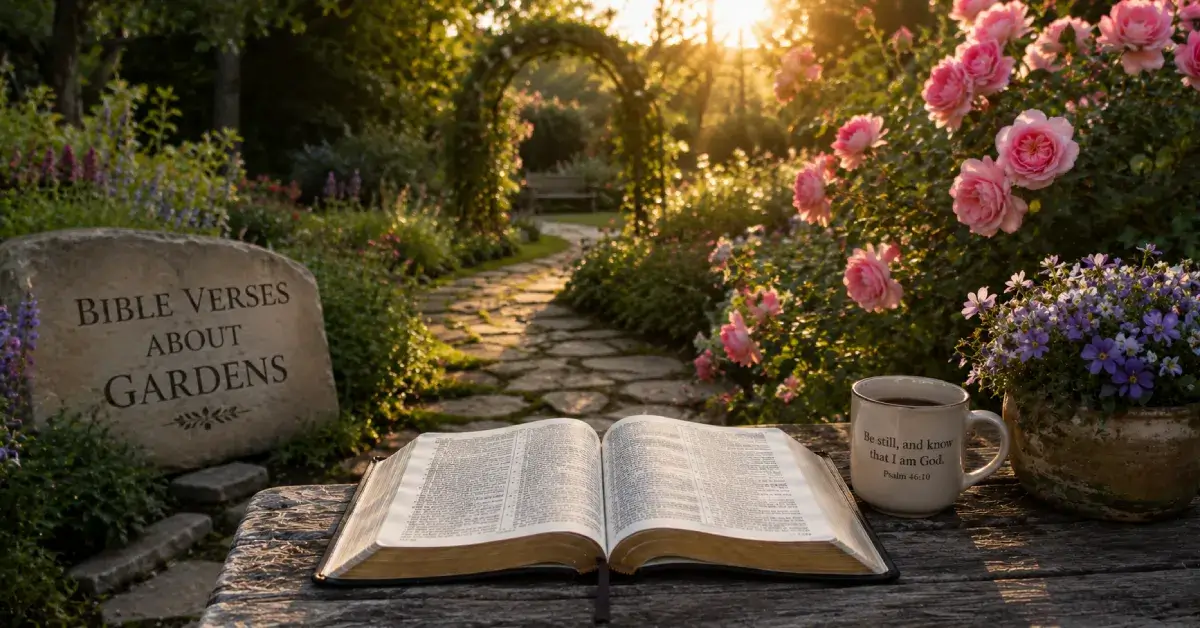
Gardens are woven throughout the Bible as places of beauty, peace, growth, and fellowship with God. From the Garden of Eden to the Garden of Gethsemane, gardens often represent spiritual truths about life, faith, renewal, and God’s presence.
Beyond the places themselves, Scripture also uses the process of gardening – seeds, planting, tending, and harvest – to teach how God works in us over time.
“The LORD God planted a garden in Eden.” – Genesis 2:8
Whether you love gardening, seek spiritual encouragement, or simply enjoy the beauty of creation, these Bible verses reveal how gardens point us toward God’s goodness and faithfulness.
What Do Gardens Symbolize in the Bible?
Gardens in Scripture often symbolize spiritual growth, fruitfulness, peace and rest, renewal and life, and God’s blessing and provision. A garden grows slowly and intentionally – much like a spiritual life actually does, whether or not that’s the pace we’d choose.
Bible Verses About Gardens
- Genesis 2:8 – “Now the LORD God had planted a garden in the east, in Eden.”
- Genesis 2:15 – “The LORD God took the man and put him in the Garden of Eden to work it and take care of it.”
- Song of Solomon 4:15 – “You are a garden fountain, a well of flowing water.”
- Isaiah 58:11 – “You will be like a well-watered garden.”
- Jeremiah 31:12 – “They will be like a well-watered garden.”
- Jeremiah 17:7–8 – “They will be like a tree planted by the water.” Trust in God produces lasting fruitfulness.
- Ecclesiastes 3:11 – “He has made everything beautiful in its time.”
Gardens and Spiritual Growth
- John 15:5 – “If you remain in me… you will bear much fruit.”
- Galatians 5:22–23 – “The fruit of the Spirit is love, joy, peace…”
- Psalm 1:3 – “Like a tree planted by streams of water.”
- Psalm 92:12 – “The righteous will flourish.”
- Colossians 2:7 – “Rooted and built up in Him.”
- Isaiah 61:11 – “As the soil makes the sprout come up.”
Gardens and God’s Peace
- Psalm 23:2 – “He leads me beside quiet waters.”
- Matthew 6:28–29 – “See how the flowers of the field grow.” Jesus used nature directly to teach trust and peace.
- Philippians 4:6–7 – “The peace of God… will guard your hearts.”
God as the Master Gardener
One of the most striking themes in Scripture is that God Himself acts as a gardener – He plants, waters, prunes, nurtures, and produces fruit, not passively but actively involved in the process.
“My Father is the gardener.” – John 15:1
Jesus used this image directly to explain God’s ongoing, hands-on care for believers – not a distant designer, but someone still tending what He planted.
Bible Verses About Seeds, Planting, and Harvest
Seeds and Planting
- Mark 4:26–27 – “The kingdom of God is as if a man should scatter seed.”
- Galatians 6:7 – “A man reaps what he sows.”
- Ecclesiastes 3:2 – “A time to plant and a time to uproot.”
- 2 Corinthians 9:6 – “Whoever sows generously will also reap generously.”
- Hosea 10:12 – “Sow righteousness for yourselves.”
- 1 Corinthians 3:6–7 – “I planted the seed, Apollos watered it, but God has been making it grow.” A reminder that even faithful effort isn’t what actually produces growth – God is.
Harvest
- Matthew 9:37 – “The harvest is plentiful.”
- Galatians 6:9 – “At the proper time we will reap a harvest.”
- Proverbs 20:4 – “Those too lazy to plow in season have no food at harvest.”
- Psalm 126:5 – “Those who sow with tears will reap with songs of joy.”
Important Gardens in the Bible
The Garden of Eden – where humanity first walked with God, symbolizing perfect fellowship and beauty before anything went wrong.
The Garden of Gethsemane – where Jesus prayed before the crucifixion, a place of surrender and obedience under real pressure, not just quiet reflection.
The Resurrection Garden – Jesus rose near a garden tomb, making the garden a symbol of hope and new life at the story’s most decisive turning point.
Spiritual Lessons from Gardens and Gardening
- Growth takes time. Plants don’t grow overnight, and neither does spiritual maturity – the timeline was never really the point.
- Patience is necessary. Gardeners learn to trust a process they can’t speed up by wanting to.
- Good soil matters. The condition of the heart affects what actually takes root, not just the quality of the seed.
- Every season has purpose, including the dormant-looking ones.
- God produces the growth. The gardener’s role is faithfulness; the increase itself belongs to God, not effort alone.
How to Grow Spiritually Like a Garden
- Spend time in God’s Word – Scripture nourishes the soul the way water nourishes soil.
- Pray daily – prayer keeps you connected to God, the way roots stay connected to water.
- Stay rooted in faith – strong roots create lasting growth that survives a hard season.
- Remove spiritual weeds – let go of bitterness and fear before they compete with what you actually want to grow.
- Trust God’s timing. Growth happens slowly more often than it happens all at once.
A Devotional Reflection
A garden doesn’t bloom overnight. Seeds grow quietly beneath the soil long before any flower appears – and for a season, it can look like nothing is happening at all.
The same is true spiritually. God often works in hidden ways before His purposes become visible. What feels like waiting may actually be preparation. What seems dormant may be growing beneath the surface the whole time.
“I planted the seed, Apollos watered it, but God has been making it grow.” – 1 Corinthians 3:6
As gardeners learn to trust the seasons, believers can trust the Master Gardener with the parts of growth they can’t see yet.
A Prayer Inspired by Gardens
“Lord, grow my faith like a flourishing garden. Plant Your peace, wisdom, and love deeply within my heart. As I tend what You’ve planted, remind me of the lessons You teach through growth, patience, and harvest. Help me remain rooted in You, trust Your timing, and produce spiritual fruit that brings glory to You. Amen.”
FAQ: Bible Verses About Gardens
What do gardens symbolize in the Bible?
Growth, peace, renewal, and God’s blessing – both as physical places and as an image of the spiritual life.
What is the most famous garden in the Bible?
The Garden of Eden.
Why did Jesus pray in a garden before His arrest?
Gethsemane was a place of prayer and surrender – the setting matters, since gardens throughout Scripture are already associated with fellowship with God.
Who is described as “the gardener” in the Bible?
John 15:1 describes God the Father directly as the gardener, actively tending what He’s planted.
What does planting and sowing symbolize spiritually?
Faith, obedience, and the beginning of spiritual growth – action taken before any visible result.
What does harvest represent in Scripture?
Blessing, fruitfulness, and the eventual, often delayed, result of God’s ongoing work in a person’s life.
Final Reflection
Gardens remind us that God is Creator, Provider, and Gardener of the soul all at once. He plants seeds of faith, waters weary hearts, and patiently brings growth in every season – including the ones that don’t look like growth from the outside.
“You will be like a well-watered garden.” – Isaiah 58:11
The next time you step into a garden – or wait through a season that feels more like dormant soil than anything blooming – remember the God who created every seed and is still, patiently, tending yours.