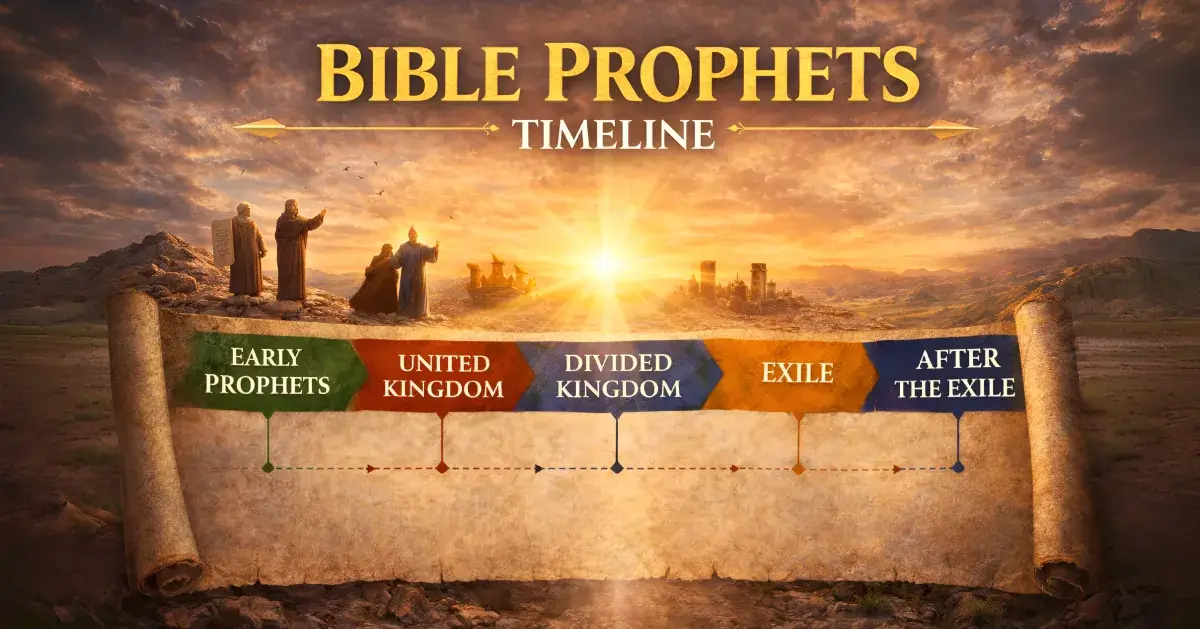
The prophets of the Bible were messengers chosen by God to speak truth, warn nations, and call people back to faithfulness. Their ministries spread across many centuries – from the time of Israel’s kings to the period of exile and restoration.
Understanding the Bible prophets timeline – and which king each prophet served under – helps connect prophetic messages to the historical events they were actually responding to.
“Surely the Sovereign LORD does nothing without revealing his plan to his servants the prophets.” – Amos 3:7
What Is a Prophet in the Bible?
A prophet spoke God’s message, warned against sin, called people to repentance, revealed future hope, and pointed toward God’s covenant.
“The word of the LORD came to…” – Jeremiah 1:4
Prophets weren’t fortune-tellers. They were spiritual messengers – and nearly all of them ministered directly to, or against, a specific ruling king, which is part of what makes their message make sense in context.
The Kingdom Divided
After King Solomon’s reign, Israel split into two kingdoms – the Northern Kingdom (Israel), capital Samaria, made up of ten tribes, and the Southern Kingdom (Judah), capital Jerusalem, made up primarily of Judah and Benjamin. This split explains why, from this point in the timeline forward, different prophets were often ministering simultaneously to two different kings in two different places.
Bible Prophets Timeline (Chronological Overview)
Early Prophets (Before the Kingdom)
Moses (c. 1400 BC) delivered God’s law and led Israel out of Egypt.
“The LORD would speak to Moses face to face.” – Exodus 33:11
Samuel (c. 1100 BC) guided Israel during the transition from judges to kings – he anointed both Saul and David.
“Speak, LORD, for your servant is listening.” – 1 Samuel 3:10
Prophets During the United Kingdom
Nathan (c. 1000 BC), serving under King David, confronted him directly about his sin with Bathsheba.
“You are the man!” – 2 Samuel 12:7
Gad (c. 1000 BC) advised David during times of crisis, alongside Nathan.
Ahijah served under Solomon and, after his turn toward idolatry, foretold that the kingdom would divide.
Prophets During the Divided Kingdom
Northern Kingdom (Israel)
- Elijah (c. 870 BC), during the reign of the idolatrous King Ahab: “How long will you waver between two opinions?” – 1 Kings 18:21
- Elisha (c. 850 BC) ministered to several kings after Elijah, performing many miracles.
- Jonah, Amos (c. 760 BC), and Hosea (c. 750 BC) all ministered during the reign of Jeroboam II. Amos: “Let justice roll on like a river.” Hosea: “I desire mercy, not sacrifice.”
Southern Kingdom (Judah)
- Isaiah (c. 740–680 BC) ministered across the reigns of Uzziah, Jotham, Ahaz, and Hezekiah – four kings across roughly sixty years. “Here am I. Send me!” – Isaiah 6:8
- Micah (c. 735–700 BC), a contemporary of Isaiah under the same kings: “Act justly and love mercy.” – Micah 6:8
- Zephaniah (c. 630 BC) warned of coming judgment.
- Jeremiah (c. 626–580 BC) ministered from King Josiah’s reign through Zedekiah’s, witnessing Judah’s fall to Babylon firsthand. “Before I formed you in the womb I knew you.” – Jeremiah 1:5
Prophets During the Exile
Ezekiel (c. 593–570 BC) ministered among the exiles in Babylon.
“I will give you a new heart.” – Ezekiel 36:26
Daniel (c. 605–530 BC) served faithfully in the Babylonian royal court itself.
“He reveals deep and hidden things.” – Daniel 2:22
Prophets After the Exile
Haggai (c. 520 BC), during Zerubbabel’s period, encouraged rebuilding the temple.
Zechariah (c. 520–480 BC) offered hope and messianic prophecy: “Not by might nor by power.” – Zechariah 4:6
Malachi (c. 430 BC), the final Old Testament prophet before Christ, called God’s people back to faithful worship: “Return to me, and I will return to you.” – Malachi 3:7
Kings and Prophets at a Glance
| Period | Kingdom | King | Major Prophets |
|---|---|---|---|
| United Kingdom | Israel | Saul | Samuel |
| United Kingdom | Israel | David | Nathan, Gad |
| United Kingdom | Israel | Solomon | Ahijah |
| Divided Kingdom | Israel | Jeroboam I | Ahijah |
| Divided Kingdom | Israel | Ahab | Elijah |
| Divided Kingdom | Israel | Jehoram | Elisha |
| Divided Kingdom | Israel | Jeroboam II | Jonah, Amos, Hosea |
| Divided Kingdom | Judah | Rehoboam | Shemaiah |
| Divided Kingdom | Judah | Asa | Azariah |
| Divided Kingdom | Judah | Jehoshaphat | Jehu |
| Divided Kingdom | Judah | Uzziah | Isaiah |
| Divided Kingdom | Judah | Jotham | Isaiah, Micah |
| Divided Kingdom | Judah | Ahaz | Isaiah, Micah |
| Divided Kingdom | Judah | Hezekiah | Isaiah, Micah |
| Divided Kingdom | Judah | Manasseh | Nahum (later period) |
| Divided Kingdom | Judah | Josiah | Jeremiah, Zephaniah |
| Judah’s Final Kings | Judah | Jehoiakim | Jeremiah, Habakkuk |
| Exile Period | Judah | Zedekiah | Jeremiah, Ezekiel |
| Babylonian Exile | Exiles | – | Daniel, Ezekiel |
| Return from Exile | Judah | Zerubbabel’s Period | Haggai, Zechariah |
| Post-Exile | Judah | – | Malachi |
Notable King-Prophet Relationships
David and Nathan – Even Israel’s greatest king was held accountable by God’s prophet. Lesson: no leader, however successful, is above correction.
Solomon and Ahijah – Solomon began well but turned toward idolatry; Ahijah foretold the coming division. Lesson: wisdom without sustained obedience still leads to decline.
Elijah and Ahab – Elijah confronted Israel’s most idolatrous king directly, challenging the prophets of Baal outright. Lesson: God consistently raises up faithful voices during the darkest spiritual periods, not only the stable ones.
Isaiah and the kings of Judah – Ministering across four reigns, Isaiah delivered both judgment and hope, along with extensive messianic prophecy. Lesson: faithful ministry sometimes spans far more time and far more rulers than any one message anticipates.
Jeremiah and Judah’s fall – Jeremiah repeatedly warned the nation to repent before the Babylonian conquest; the warnings went unheeded. Lesson: being right doesn’t guarantee being heeded – faithfulness and effectiveness aren’t the same thing.
Why Understanding This Timeline Matters
Learning how kings and prophets fit together helps readers connect prophetic messages to real history, understand God’s warnings and promises in context, see the progression toward Christ, and recognize the recurring themes of judgment and restoration.
“The grass withers… but the word of our God endures forever.” – Isaiah 40:8
Many confusing passages become clearer once you know who was ruling – and who was speaking to them – at the time.
Major Themes of the Prophets
Across centuries, the prophets consistently spoke about repentance, justice, faithfulness, hope, and the coming Messiah.
“A voice of one calling in the wilderness.” – Isaiah 40:3
Their messages, regardless of era or audience, ultimately pointed toward redemption.
How to Study the Prophets Effectively
- Read historical books alongside prophetic books – 1–2 Kings and 1–2 Chronicles provide the context prophetic books assume you already have.
- Note the audience and situation. Each prophet addressed specific circumstances, not general timeless advice.
- Look for messianic prophecy. Many passages point toward Jesus more directly than they first appear to.
- Focus on spiritual application. Their core messages – repentance, justice, faithfulness – remain directly relevant now.
A Devotional Reflection
The kings and prophets together reveal two recurring truths. First, human leaders consistently fail – even the good ones made real mistakes. Second, God never stopped pursuing His people despite that.
Again and again, across centuries and multiple failed kings, God sent prophets to warn, encourage, and restore. Their stories show that God’s faithfulness never depended on human perfection – and ultimately, the kings and prophets together prepare readers for the arrival of Jesus, the perfect King and final revelation of God’s truth.
“The LORD watches over all who love him.” – Psalm 145:20
A Prayer for Understanding God’s Word
“Lord, thank You for preserving the stories of the kings and prophets in Scripture. Help me understand their lessons and recognize Your faithfulness throughout history. Give me wisdom as I study Your Word and teach me to trust and obey You more fully. Amen.”
FAQ: Bible Prophets Timeline
Who was the first prophet in the Bible?
Moses is often considered the first major prophet.
Who was the last Old Testament prophet?
Malachi is generally recognized as the final prophet before the New Testament era begins.
Why did Israel end up with two kingdoms?
The kingdom divided after Solomon’s reign due to disobedience and political conflict, splitting into Israel (north) and Judah (south).
Which prophet confronted King Ahab?
Elijah, during one of the most spiritually dark periods of the Northern Kingdom.
Which prophets ministered during the Babylonian exile?
Daniel and Ezekiel, both ministering to exiled Israelites rather than to a king on a throne in Jerusalem.
Were prophets only active in the Old Testament?
Most were, but prophetic ministry continued into the New Testament as well, in a different form.
Final Reflection
The Bible prophets timeline shows how God continually reached out to His people through generation after generation of kings, both faithful and failed. Though the warnings were often urgent, the message always carried real hope alongside it.
“Return to me… says the LORD Almighty.” – Malachi 3:7
Understanding the prophets – and the kings they spoke to – helps reveal God’s patience, justice, and redeeming love across the whole of Israel’s history, not just in isolated moments of it.