What does the Bible say about self belief?
The Bible does not teach self-belief in the modern sense of believing that we are completely independent, powerful, or capable of accomplishing anything through our own strength. Instead, Scripture points us toward something deeper: confidence rooted in God.
The Bible teaches us to recognize the abilities God has given us, walk confidently in the calling He has given us, and refuse to be controlled by fear. But our confidence should ultimately rest in God’s character, presence, promises, and strength rather than in ourselves alone.
Paul expressed this balance beautifully:
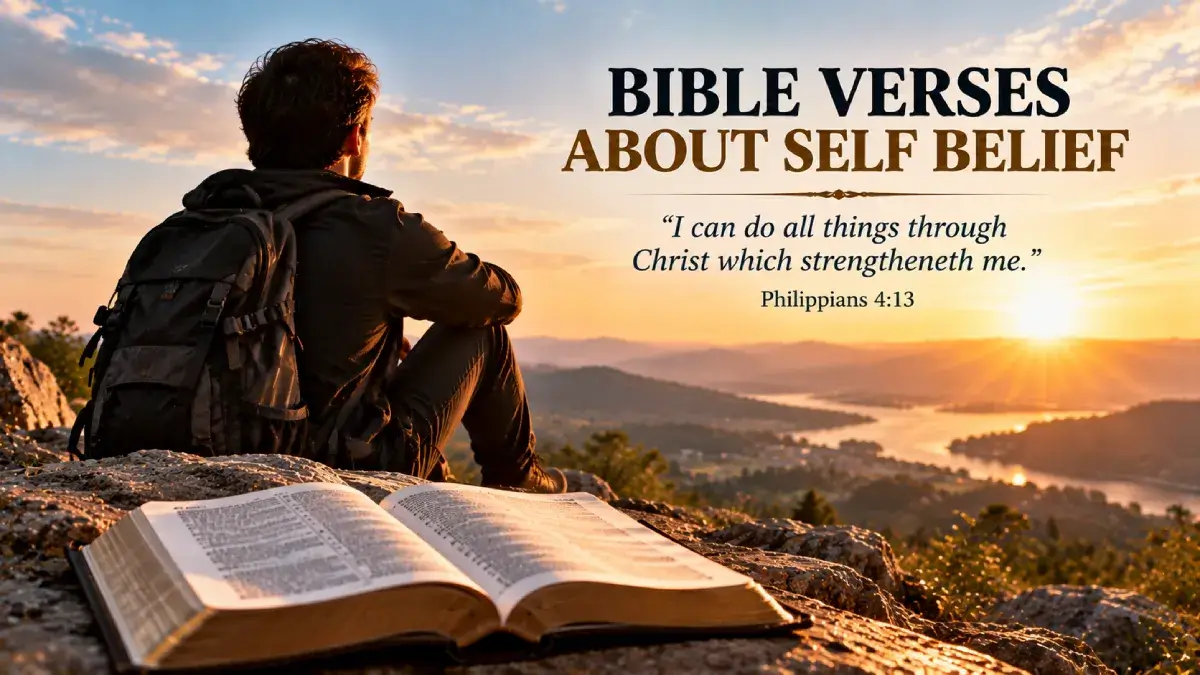
“I can do all things through Christ which strengtheneth me.” — Philippians 4:13, KJV
The emphasis is not simply “I can do anything.” It is “through Christ.”
Biblical confidence says:
“I may be weak, but God is strong.”
“I may be afraid, but God is with me.”
“I may not know everything, but I can trust God.”
“I may not feel capable, but God can equip me.”
In this article, we will explore some of the most encouraging Bible verses about self belief, confidence, courage, identity, and trusting God.
Does the Bible Teach Self Belief?
The Bible does not use the modern phrase “self belief” as a specific biblical doctrine.
Instead, Scripture emphasizes:
- Faith in God
- Confidence in God’s promises
- Courage
- Knowing your identity in Christ
- Using your God-given abilities
- Trusting God’s strength
- Overcoming fear
- Walking in your calling
- Depending on God rather than yourself
There is an important difference between biblical confidence and self-reliance.
Self-reliance says:
“I can do everything by myself.”
Biblical confidence says:
“God is with me, and I can trust Him to help me do what He has called me to do.”
That distinction is essential.
15 Bible Verses About Self Belief and Confidence
1. Philippians 4:13 — Confidence Through Christ
“I can do all things through Christ which strengtheneth me.” — Philippians 4:13, KJV
This is one of the most well-known Bible verses about confidence.
Paul does not say that he can accomplish anything he personally desires.
The context is about learning contentment in different circumstances.
Paul had experienced both abundance and need, yet he had learned to remain faithful because Christ strengthened him.
This gives us a powerful understanding of biblical self belief.
Your confidence does not have to come from believing you are naturally strong enough.
You can have confidence because Christ gives you strength.
2. Joshua 1:9 — Be Strong and Courageous
“Be strong and of a good courage; be not afraid, neither be thou dismayed: for the LORD thy God is with thee whithersoever thou goest.” — Joshua 1:9, KJV
Joshua faced an enormous responsibility.
He had to lead Israel after Moses.
God did not simply tell Joshua, “Believe in yourself.”
He gave Joshua something greater:
God’s presence.
The command to be strong and courageous was connected to the promise:
“The LORD thy God is with thee.”
This is the foundation of biblical confidence.
You can be courageous because you are not facing life alone.
3. Psalm 139:14 — You Are Wonderfully Made
“I will praise thee; for I am fearfully and wonderfully made.” — Psalm 139:14, KJV
This verse provides a healthy biblical foundation for understanding personal worth.
David recognizes that God intentionally created him.
Your value does not come from being better than everyone else.
It comes from being created by God.
This means Christians can reject both pride and destructive self-hatred.
You do not need to think:
“I am worthless.”
Nor do you need to think:
“I am better than everyone else.”
Instead:
“God created me, and my life has value before Him.”
4. 2 Timothy 1:7 — God Has Not Given You a Spirit of Fear
“For God hath not given us the spirit of fear; but of power, and of love, and of a sound mind.” — 2 Timothy 1:7, KJV
Fear can destroy confidence.
It can cause us to avoid opportunities, remain silent, refuse responsibility, and doubt our God-given abilities.
Paul reminds Timothy that fear should not control the Christian life.
God gives:
- Power
- Love
- A sound mind
This does not mean Christians will never experience fear.
It means fear does not have to be in control.
5. Proverbs 3:5–6 — Trust God Rather Than Yourself
“Trust in the LORD with all thine heart; and lean not unto thine own understanding.” — Proverbs 3:5, KJV
This passage provides an important balance to the idea of self belief.
The Bible does not tell us to place ultimate confidence in our own understanding.
Instead, we are instructed to trust God.
Verse 6 continues:
“In all thy ways acknowledge him, and he shall direct thy paths.”
Healthy confidence does not mean refusing advice, correction, or guidance.
It means confidently trusting God even when we don’t have all the answers.
6. Ephesians 2:10 — You Are God’s Workmanship
“For we are his workmanship, created in Christ Jesus unto good works.” — Ephesians 2:10, KJV
The word “workmanship” points to something intentionally made.
Your life has purpose.
God created you for good works that He has prepared.
This gives believers a reason to walk with confidence.
You are not an accident.
You are not without purpose.
God can use your abilities, experiences, gifts, and opportunities for His purposes.
7. 2 Corinthians 12:9 — God’s Strength in Your Weakness
“My grace is sufficient for thee: for my strength is made perfect in weakness.” — 2 Corinthians 12:9, KJV
This may seem like an unusual verse for self belief, but it contains one of the Bible’s deepest lessons about confidence.
Paul wanted his difficulty removed.
Instead, God reminded him that divine strength could be displayed through human weakness.
Paul responded:
“For when I am weak, then am I strong.”
Biblical confidence does not require pretending that you are strong all the time.
You can admit:
“I cannot do this by myself.”
That admission can become an opportunity to depend more deeply on God.
8. Romans 8:31 — If God Is for Us
“If God be for us, who can be against us?” — Romans 8:31, KJV
This verse provides tremendous encouragement.
Paul is not saying that Christians will never have opponents.
Instead, he is emphasizing that no opposition can ultimately defeat God’s purposes.
When you know that God is for you, you don’t have to live constantly controlled by fear of what others think.
Your confidence can rest in God’s sovereignty.
9. Psalm 56:3–4 — Trust God When You Are Afraid
“What time I am afraid, I will trust in thee.” — Psalm 56:3, KJV
Notice that David does not say:
“I will never be afraid.”
He says:
“When I am afraid, I will trust in You.”
That is an important distinction.
Biblical courage is not the absence of fear.
It is choosing trust in the middle of fear.
You can feel nervous and still move forward.
You can feel inadequate and still obey God.
You can feel afraid and still have faith.
10. 1 Corinthians 12:4–6 — God Gives Different Gifts
Paul teaches that believers have different spiritual gifts and abilities.
“Now there are diversities of gifts, but the same Spirit.” — 1 Corinthians 12:4, KJV
Not everyone is supposed to have the same abilities.
Some people teach.
Some encourage.
Some serve.
Some lead.
Some give.
Some show mercy.
God’s design includes diversity.
Therefore, you do not have to become someone else to have value.
Your responsibility is to faithfully use what God has entrusted to you.
11. Romans 12:3 — Think Soberly About Yourself
“Not to think of himself more highly than he ought to think; but to think soberly.” — Romans 12:3, KJV
This verse gives an important correction to unhealthy self-confidence.
The Bible does not encourage arrogance.
Christian confidence should be balanced with humility.
We should not think:
“I am better than everyone.”
But we also should not think:
“I have no value and nothing to contribute.”
Instead, Scripture says to think soberly.
See yourself realistically.
Recognize your strengths.
Acknowledge your weaknesses.
Know that your abilities are gifts from God.
12. Galatians 2:20 — Christ Lives in Me
“Christ liveth in me: and the life which I now live in the flesh I live by the faith of the Son of God.” — Galatians 2:20, KJV
Christian identity is not ultimately built around the self.
Paul describes his life in relation to Christ.
This is why biblical confidence is different from modern self-help philosophies.
The Christian does not have to say:
“I am enough on my own.”
Instead, the believer can say:
“Christ is my life, and His grace is sufficient for me.”
13. Psalm 27:1 — The Lord Is My Light and Salvation
“The LORD is my light and my salvation; whom shall I fear?” — Psalm 27:1, KJV
David’s confidence comes from God.
He does not say:
“I am fearless because I am naturally strong.”
He says:
“The LORD is my light and my salvation.”
When God is your source of security, fear does not have to control you.
14. Hebrews 10:35 — Don’t Throw Away Your Confidence
“Cast not away therefore your confidence, which hath great recompence of reward.” — Hebrews 10:35, KJV
The Bible actually uses the word confidence positively.
But this confidence is connected to faith and perseverance.
Believers are encouraged not to abandon their confidence when circumstances become difficult.
Sometimes confidence becomes hardest to maintain precisely when we need it most.
When circumstances change, remember what God has promised.
15. Philippians 1:6 — God Will Finish His Work in You
“He which hath begun a good work in you will perform it until the day of Jesus Christ.” — Philippians 1:6, KJV
You don’t have to have everything figured out today.
Spiritual growth is a process.
God is still working in you.
This verse can give confidence to someone who feels like they are not where they should be.
You may still have weaknesses.
You may still make mistakes.
You may still have areas where you need to grow.
But God is not finished with you.
What Is Biblical Self Belief?
Biblical self belief is not simply believing that you can accomplish anything.
It is better understood as confidence rooted in God, His promises, His calling, and the identity He gives you.
Biblical confidence says:
“God created me.”
Psalm 139:14 reminds us that we are wonderfully made.
“God has a purpose for me.”
Ephesians 2:10 points to the good works God has prepared.
“God is with me.”
Joshua 1:9 gives this promise of God’s presence.
“God can strengthen me.”
Philippians 4:13 points to strength through Christ.
“God can work through my weaknesses.”
2 Corinthians 12:9 teaches that God’s strength is displayed in weakness.
“I don’t have to live in fear.”
2 Timothy 1:7 reminds us that God gives power, love, and a sound mind.
What Is the Difference Between Self-Confidence and God-Confidence?
This distinction is extremely important.
Self-confidence says:
“I am capable because I am strong.”
God-confidence says:
“God can strengthen me even when I am weak.”
Self-confidence says:
“I know exactly what to do.”
God-confidence says:
“I will trust God for wisdom.”
Self-confidence says:
“I don’t need anyone.”
God-confidence says:
“I need God, and He can work through me.”
Self-confidence can produce pride.
God-confidence produces humility and courage.
The goal of Scripture is not to destroy your confidence.
It is to put your confidence on the right foundation.
Bible Verses About Believing in Yourself and Your Abilities
The Bible recognizes that people have different gifts and abilities.
Exodus 31:3 describes God filling Bezalel with wisdom, understanding, knowledge, and craftsmanship for the work God had called him to do.
Paul also told Timothy:
“Neglect not the gift that is in thee.” — 1 Timothy 4:14, KJV
And later:
“Stir up the gift of God, which is in thee.” — 2 Timothy 1:6, KJV
These verses teach an important principle:
Don’t bury the abilities God has given you.
You don’t honor God by constantly declaring yourself incapable when He has equipped you to serve.
Instead, recognize your gifts with humility and use them faithfully.
Bible Verses About Confidence in God
If you want to build confidence that is centered on God rather than yourself, these passages are especially helpful.
Proverbs 3:5–6
“Trust in the LORD with all thine heart.”
Psalm 20:7
“Some trust in chariots, and some in horses: but we will remember the name of the LORD our God.”
Psalm 118:8
“It is better to trust in the LORD than to put confidence in man.”
Jeremiah 17:7
“Blessed is the man that trusteth in the LORD, and whose hope the LORD is.”
Hebrews 13:6
“The Lord is my helper, and I will not fear what man shall do unto me.”
These verses move our confidence away from circumstances and toward God.
Bible Verses About Confidence When You Feel Inadequate
Sometimes the opposite of self belief is not arrogance but insecurity.
You may think:
- “I’m not talented enough.”
- “I’m not smart enough.”
- “I’m too young.”
- “I’m too old.”
- “Someone else could do this better.”
- “God couldn’t use me.”
The Bible contains many examples of people who initially felt inadequate.
Moses
Moses questioned his ability to speak and lead.
Yet God still called him.
Gideon
Gideon saw himself as insignificant.
Yet God called him to deliver Israel.
Jeremiah
Jeremiah felt too young.
God assured him that He would be with him.
Timothy
Timothy apparently needed encouragement to be courageous and faithfully use the gift God had given him.
The lesson is not:
“You are naturally capable of everything.”
The lesson is:
“God can equip people who feel inadequate.”
What Does the Bible Say About Believing in Yourself?
The Bible encourages us to have courage, recognize our God-given gifts, and walk confidently in God’s calling.
But Scripture does not encourage self-worship or unlimited faith in our own abilities.
Jeremiah 17:9 warns about the human heart.
Proverbs 3:5 tells us not to lean entirely on our own understanding.
Romans 12:3 tells us not to think more highly of ourselves than we should.
The biblical approach is balanced:
Know your worth without becoming proud.
Recognize your weaknesses without becoming hopeless.
Use your gifts without seeking glory for yourself.
Have courage without forgetting your dependence on God.
How Can I Build Biblical Confidence?
1. Know Who You Are in Christ
Your identity should not depend entirely on:
- Your career
- Appearance
- Wealth
- Education
- Popularity
- Achievements
- Other people’s opinions
For believers, identity begins with belonging to Christ.
2. Remember What God Has Already Done
When David faced Goliath, his confidence was shaped by his previous experiences of God’s faithfulness.
Remembering God’s past faithfulness can strengthen your confidence for present challenges.
Ask:
“Where have I seen God help me before?”
3. Stop Comparing Yourself With Everyone Else
Comparison can destroy confidence.
Someone else may have a different gift, personality, opportunity, or calling.
You do not need to become them.
Be faithful with what God has given you.
4. Develop the Gifts God Has Given You
Confidence often grows as we become more faithful and competent in the responsibilities God has entrusted to us.
Study.
Practice.
Learn.
Serve.
Accept correction.
Grow.
Don’t hide your gifts because you’re afraid of failure.
5. Replace Fear With Faith
When fear says:
“You can’t do this.”
Respond:
“God is with me.”
When fear says:
“What if I fail?”
Remember that your ultimate identity is not determined by one failure.
When fear says:
“Everyone will reject you.”
Remember that God’s presence is more important than human approval.
6. Pray for Wisdom
James 1:5 says:
“If any of you lack wisdom, let him ask of God.”
Confidence doesn’t mean refusing help.
A confident Christian can say:
“I don’t know. I need God’s wisdom.”
That is not weakness.
That is humility.
Bible Verses About Courage and Confidence
If you need encouragement before facing a difficult situation, meditate on these passages:
Joshua 1:9 — Be strong and courageous because God is with you.
Psalm 27:1 — The Lord is your light and salvation.
Psalm 56:3 — Trust God when you are afraid.
2 Timothy 1:7 — God gives power, love, and a sound mind.
Philippians 4:13 — Christ strengthens you.
Romans 8:31 — If God is for you, who can ultimately stand against you?
Hebrews 10:35 — Don’t throw away your confidence.
Psalm 139:14 — You are wonderfully made.
What Does the Bible Say About Low Self-Esteem?
The Bible does not use the modern psychological term “self-esteem” as we commonly use it today.
But Scripture addresses the underlying questions:
Do I have value?
Am I significant?
Does my life have purpose?
Can God use me?
The biblical answer is yes—but our value is ultimately rooted in God, not in personal achievement.
Psalm 139:14 says we are wonderfully made.
Ephesians 2:10 says we are God’s workmanship.
Romans 8:38–39 teaches that God’s love in Christ cannot be separated from His people.
Therefore, the Christian answer to low self-worth is not simply:
“Believe in yourself more.”
It is:
“Learn to see yourself through what God says about you.”
A Prayer for Self Belief and Confidence
Heavenly Father,
Thank You for creating me and giving my life purpose.
When I feel insecure, remind me that my worth comes from You and not from the opinions of other people.
Help me recognize the gifts and abilities You have given me. Teach me to use them faithfully without becoming proud.
When I feel inadequate, remind me that Your strength is made perfect in weakness.
When I am afraid, help me trust You.
Give me courage to step into the opportunities You place before me and wisdom to know when I need help.
Keep me humble when I succeed and faithful when I fail.
Help me build my confidence on Your promises rather than on my own strength.
May my life bring glory to You.
In Jesus’ name, Amen.
Frequently Asked Questions About Bible Verses About Self Belief
What is the best Bible verse about self belief?
Philippians 4:13 is one of the most popular: “I can do all things through Christ which strengtheneth me.”
It teaches that Christian confidence comes through Christ’s strength rather than self-reliance.
Does the Bible say to believe in yourself?
The Bible does not directly command people to “believe in yourself” in the modern self-help sense. Instead, Scripture teaches us to trust God, recognize our God-given abilities, have courage, and confidently follow God’s calling.
What does God say about believing in yourself?
God’s Word emphasizes that human beings have value because they are created by Him. Scripture also teaches that believers have gifts and purposes. At the same time, our ultimate confidence should be in God rather than ourselves.
What Bible verse says you are wonderfully made?
Psalm 139:14 says: “I will praise thee; for I am fearfully and wonderfully made.”
This verse reminds us to recognize God’s work in creating us.
What Bible verse helps with insecurity?
Several verses can help, including Psalm 139:14, Joshua 1:9, 2 Timothy 1:7, Psalm 56:3, and 2 Corinthians 12:9.
How can Christians become more confident?
Christians can grow in confidence by knowing God’s Word, remembering their identity in Christ, developing their God-given gifts, praying for wisdom, remembering God’s faithfulness, and trusting God instead of being controlled by fear.
Is believing in yourself a form of pride?
It can be if self-belief becomes self-reliance, arrogance, or a desire for personal glory. Biblical confidence is different because it recognizes both our value and our dependence on God.
Final Thoughts
The Bible’s message about self belief is deeper than simply telling us to have more confidence in ourselves.
Scripture teaches us to have confidence in God and the work He is doing through us.
You can recognize that you are wonderfully made without becoming proud.
You can acknowledge your gifts without comparing yourself with others.
You can be courageous without pretending that you are never afraid.
You can acknowledge your weaknesses without believing that you are worthless.
And you can move forward confidently while still depending completely on God.
Remember Joshua 1:9:
“Be strong and of a good courage; be not afraid, neither be thou dismayed: for the LORD thy God is with thee whithersoever thou goest.”
That is the heart of biblical confidence.
You don’t have to believe that you can do everything by yourself.
You can believe that God is with you, God can strengthen you, God has given you purpose, and God can work through you.
That kind of confidence is not pride.
It is faith.