The Bible does not literally use the phrase “a nation without borders.” The closest passages focus on unwalled lands, national boundaries, and God’s protection.
- Ezekiel 38:11 — Describes a “land of unwalled villages” where people live without walls, gates, or bars.
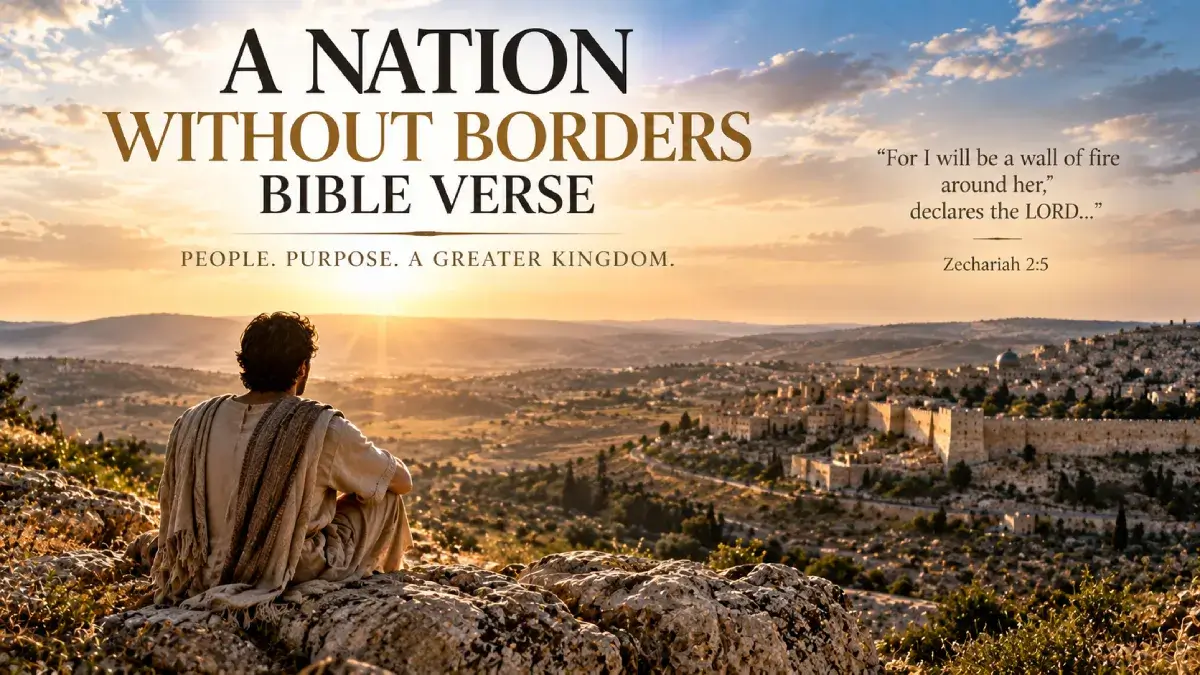
- Zechariah 2:4–5 — Jerusalem is described as being “without walls,” with God Himself serving as its protective “wall of fire.”
- Acts 17:26 — Says God determines the “bounds” of nations and where people live.
- Jeremiah 49:31 — Describes a people living without gates or bars.
- Psalm 127:1 — Reminds us that human defenses are ultimately insufficient without God.
Key takeaway: Scripture recognizes nations and their boundaries, but teaches that God is ultimately sovereign over nations and is the true source of security. “A nation without borders” is a modern expression, not a direct biblical phrase.
Is “A Nation Without Borders” in the Bible?
No. The exact phrase “a nation without borders” does not appear in the Bible.
The expression is sometimes used when people are discussing biblical passages about:
- nations and their boundaries,
- lands without walls,
- people living securely,
- God’s protection,
- Israel in prophecy,
- and the idea of physical borders versus divine protection.
It is important to distinguish between what the Bible actually says and a modern expression used to describe a biblical concept.
The closest biblical language generally involves “without walls,” “without bars,” “without gates,” or the “bounds” of nations.
Ezekiel 38:11 — A Land Without Walls
Perhaps the most relevant verse to the search for a “nation without borders” is:
“I will go up to the land of unwalled villages; I will go to them that are at rest, that dwell safely, all of them dwelling without walls, and having neither bars nor gates.”
— Ezekiel 38:11, KJV
This passage describes the thoughts of Gog, who plans an invasion.
The land is portrayed as having:
- unwalled villages,
- people living peacefully,
- people dwelling securely,
- no protective bars,
- and no gates.
At first glance, this might sound like a nation without borders. But the biblical text actually speaks more specifically about a land of unwalled villages, not a modern nation that has deliberately eliminated its political borders.
What Does “Without Walls” Mean?
In the ancient world, walls were an important form of defense. A fortified city could resist an invading army, while an unwalled settlement was much more vulnerable.
Gog therefore sees the people as an easy target.
Ezekiel 38:12 explains that his purpose is to take spoil and plunder from a people who have been gathered from the nations.
The important point is that “without walls” does not necessarily mean “without national identity or territorial boundaries.”
It describes a people who are living without conventional physical defenses.
Zechariah 2:4–5 — Jerusalem Without Walls
Another fascinating passage is found in Zechariah:
“Jerusalem shall be inhabited as towns without walls for the multitude of men and cattle therein.”
— Zechariah 2:4, KJV
Then God gives the reason:
“For I, saith the LORD, will be unto her a wall of fire round about, and will be the glory in the midst of her.”
— Zechariah 2:5, KJV
This is one of the clearest biblical pictures of a community that does not depend on conventional walls for its ultimate security.
Jerusalem is described as being “without walls,” but God Himself promises to be its protection.
What Does This Teach Us?
The passage points to an important spiritual truth:
God’s protection is greater than human defenses.
A wall can protect a city, but Scripture repeatedly emphasizes that ultimate security comes from God.
Psalm 127:1 says:
“Except the LORD keep the city, the watchman waketh but in vain.”
Human beings can build walls, gates, armies, and defenses, but none of these replaces dependence upon God.
Acts 17:26 — God Determines the Bounds of Nations
If you are searching for a Bible verse specifically about national borders, Acts 17:26 is one of the most important passages to consider.
Paul says:
“And hath made of one blood all nations of men for to dwell on all the face of the earth, and hath determined the times before appointed, and the bounds of their habitation.”
— Acts 17:26, KJV
The word “bounds” refers to limits or boundaries.
Paul’s larger point is that God is sovereign over humanity and the nations.
Human history is not outside God’s knowledge or authority.
Does This Verse Establish Modern Political Borders?
Not necessarily.
Acts 17:26 does not give a detailed political system for modern countries. Instead, it emphasizes God’s sovereignty over:
- nations,
- history,
- human habitation,
- and the course of peoples.
Therefore, it would be a mistake to use this verse as though it were a modern immigration or border-policy statute.
The broader theological principle is that God is sovereign over where peoples live and over the rise and course of nations.
Jeremiah 49:31 — A Nation Living Securely
Another passage provides similar language:
“Arise, get you up unto the wealthy nation, that dwelleth without care, saith the LORD, which have neither gates nor bars, which dwell alone.”
— Jeremiah 49:31, KJV
The passage concerns Kedar and the kingdoms of Hazor and describes a people living securely without conventional defenses.
Notice the similarity to Ezekiel 38:11.
Both passages speak about people who are:
- secure,
- relatively undefended,
- without gates or bars,
- and vulnerable to an invading power.
This helps us understand that “without walls” or “without gates” was ancient military language.
It should not automatically be interpreted as a prophecy about modern countries removing their political borders.
What Does the Bible Say About Borders?
The Bible does recognize distinctions between peoples and nations.
For example, Deuteronomy repeatedly describes land boundaries and territories given to different peoples.
The Old Testament also contains numerous references to:
- tribal territories,
- inherited land,
- geographical boundaries,
- cities,
- kingdoms,
- nations,
- and territorial possessions.
This means the biblical world was not one completely borderless political system.
At the same time, Scripture emphasizes that God is Lord over every nation.
Psalm 24:1 declares:
“The earth is the LORD’S, and the fulness thereof.”
Ultimately, no nation possesses the earth independently of God.
The Bible Does Not Present Borders as Our Ultimate Security
There is an important distinction between having boundaries and trusting boundaries for security.
The Bible does not teach that physical defenses are inherently wrong.
Cities had walls.
Kings maintained armies.
Nations defended their territories.
But Scripture repeatedly warns against placing ultimate confidence in human strength.
Psalm 20:7 says:
“Some trust in chariots, and some in horses: but we will remember the name of the LORD our God.”
The principle is broader than military strategy.
A nation can have:
- strong borders,
- powerful armies,
- wealth,
- technology,
- walls,
- and political institutions,
yet still be unable to guarantee its future.
God remains sovereign.
“Without Walls” Can Point to God’s Protection
One of the most beautiful themes surrounding these passages is the idea that God Himself can be a people’s protection.
Zechariah 2:5 gives the clearest picture:
“I will be unto her a wall of fire round about.”
A physical wall protects from the outside.
But God promises something greater: His own presence surrounding His people.
This does not mean Christians should reject ordinary protection or responsible government.
Rather, it teaches that human protection should never become a substitute for faith in God.
Does Ezekiel 38:11 Refer to Israel?
Ezekiel 38–39 describes a prophetic conflict involving Gog and Magog.
Ezekiel 38:8 describes the people as having been gathered from many nations and brought back to the land.
Then verse 11 describes the land as consisting of unwalled villages where people dwell securely.
Because of this context, many Bible readers understand the passage as referring to Israel in an eschatological or prophetic setting, although interpretations of Ezekiel 38–39 differ considerably among Christian traditions.
It is therefore wise not to make the passage say more than the text says.
The central description is clear:
Gog sees a people living securely in an apparently vulnerable land and plans to attack them.
The following verses then describe God’s response.
A Nation Can Be Secure Even Without Walls
One striking biblical idea is that physical vulnerability does not necessarily mean spiritual vulnerability.
Ezekiel 38:11 describes people who appear exposed because they live without walls, bars, and gates.
But the larger prophetic context shows that their ultimate security does not depend on military fortifications.
This connects with the broader biblical message:
God is the ultimate defender of His people.
Psalm 46:1 says:
“God is our refuge and strength, a very present help in trouble.”
And Psalm 121:2 says:
“My help cometh from the LORD, which made heaven and earth.”
These verses remind us that security ultimately comes from God rather than merely from physical circumstances.
What About a “Borderless Nation” Spiritually?
Sometimes Christians use the expression “a nation without borders” in a spiritual sense.
The New Testament does present God’s kingdom as transcending earthly national divisions.
Jesus commanded His followers to:
“Go ye therefore, and teach all nations.”
— Matthew 28:19, KJV
The gospel is not limited to one ethnic group or geographical boundary.
Revelation 7:9 describes a multitude from:
- all nations,
- kindreds,
- peoples,
- and tongues.
So while earthly nations have geographical distinctions, the people of God ultimately come from every nation.
The kingdom of God cannot be reduced to the borders of one earthly country.
The Church Is Made Up of People From Every Nation
The New Testament emphasizes that Christ brings people together across ethnic and national divisions.
Galatians 3:28 says:
“There is neither Jew nor Greek, there is neither bond nor free, there is neither male nor female: for ye are all one in Christ Jesus.”
This does not mean earthly nations cease to exist.
Rather, it means that our identity in Christ is greater than our earthly identity.
A Christian may belong to a particular country, culture, and community while also belonging to a worldwide spiritual family.
Does the Bible Say Nations Should Have No Borders?
The Bible does not explicitly command modern nations to have open or closed borders in the contemporary political sense.
That is an important distinction.
Scripture gives principles concerning:
- justice,
- hospitality,
- government,
- protection,
- strangers,
- foreigners,
- national distinctions,
- and God’s sovereignty.
But it does not provide a modern immigration policy manual.
Therefore, verses such as Ezekiel 38:11 should not be pulled out of their prophetic context and treated as a direct political command about contemporary national borders.
“A Nation Without Borders” Bible Verse: The Main Scriptures
If you are looking for Bible verses connected with this subject, these are among the most relevant:
| Bible Verse | Main Idea |
|---|---|
| Ezekiel 38:11 | Land of unwalled villages and people living securely |
| Zechariah 2:4–5 | Jerusalem without walls, with God as its protection |
| Acts 17:26 | God determines the bounds of nations |
| Jeremiah 49:31 | A nation living without gates or bars |
| Psalm 46:1 | God as refuge and strength |
| Psalm 127:1 | Human protection is insufficient without God |
| Matthew 28:19 | Gospel sent to all nations |
| Revelation 7:9 | People from every nation worshiping God |
What Is the Spiritual Lesson?
The passages about nations, borders, walls, and security ultimately point toward a larger biblical truth.
Human Beings Build Boundaries
God remains sovereign.
Nations Establish Defenses
God remains the ultimate protector.
People Live Within Geographical Territories
God’s authority extends over the whole earth.
Earthly Identities Divide People
Christ brings people from every nation into one spiritual family.
This gives Christians a balanced perspective.
We should not confuse physical borders with spiritual boundaries, nor should we confuse national identity with God’s kingdom.
Frequently Asked Questions
What Bible Verse Talks About a Nation Without Borders?
There is no Bible verse that literally says “a nation without borders.” The closest passages include Ezekiel 38:11, which speaks of a land of unwalled villages, and Zechariah 2:4–5, which describes Jerusalem as being inhabited without walls while God Himself protects it.
What Does Ezekiel 38:11 Mean?
Ezekiel 38:11 describes Gog’s intention to invade a land where people live securely in unwalled villages without bars or gates. The lack of walls portrays the people as apparently vulnerable to attack.
Does the Bible Say God Determines National Borders?
Yes. Acts 17:26 says God “hath determined … the bounds of their habitation.” The verse emphasizes God’s sovereignty over nations and human history.
What Bible Verse Says Jerusalem Will Have No Walls?
Zechariah 2:4 says: “Jerusalem shall be inhabited as towns without walls for the multitude of men and cattle therein.”
The following verse explains that God Himself would be “a wall of fire round about” Jerusalem.
Is Ezekiel 38:11 Talking About Israel?
The context connects the prophecy with a people gathered from the nations and living in the land. Many interpreters understand this as referring to Israel in the prophetic context of Ezekiel 38–39, although interpretations of the Gog and Magog prophecy differ.
Does the Bible Teach That Nations Should Have No Borders?
No. Scripture does not give a direct command that modern nations should eliminate their borders. It does, however, teach that God is sovereign over nations and that earthly boundaries are not the ultimate source of security.
What Is the Best Bible Verse About God Protecting a Nation?
Zechariah 2:5 is particularly powerful because God says: “I will be unto her a wall of fire round about.”
It presents God Himself as the ultimate protection of His people.
Final Thoughts on a Nation Without Borders in the Bible
The phrase “a nation without borders” is not found literally in Scripture. However, the Bible contains several passages that describe lands without walls, nations living securely, geographical boundaries, and God’s protection.
The most directly related verse is Ezekiel 38:11, which speaks of a “land of unwalled villages” where people live without walls, bars, or gates.
But Zechariah 2:4–5 gives an even deeper spiritual picture. Jerusalem is described as being without walls, yet God promises to surround it as a “wall of fire.”
And Acts 17:26 reminds us that God remains sovereign over the nations and “the bounds of their habitation.”
The biblical message is therefore not simply about whether a nation has physical borders. It is about who ultimately rules, protects, and sustains the nations.
Human borders may change. Walls can fall. Kingdoms rise and disappear. But God remains sovereign over the earth and every nation upon it.