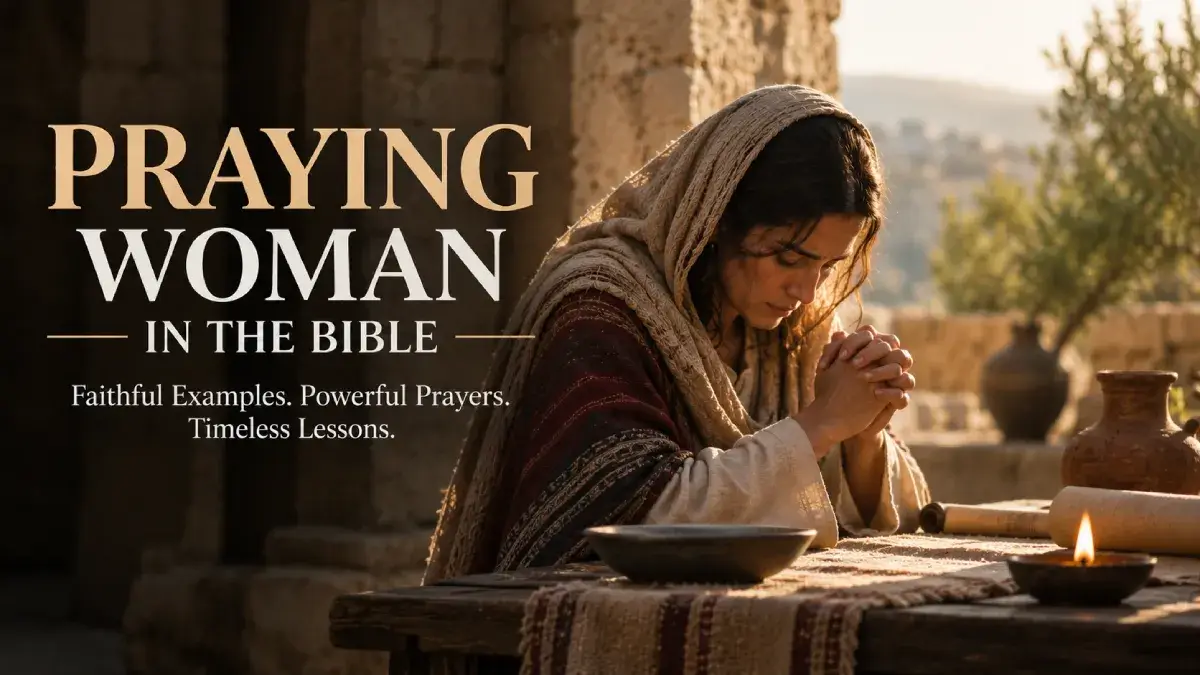
A praying woman in the Bible is not simply a woman who says prayers. Scripture presents women who pray as women who trust God, seek His help, worship Him, persevere through hardship, and surrender their circumstances to Him.
From Hannah’s desperate prayer for a child to Anna’s continual worship and prayer in the temple, the Bible gives us remarkable examples of women who turned to God.
Some prayed in moments of deep sorrow.
Others prayed in thanksgiving.
Some prayed privately.
Others prayed together with the people of God.
Their circumstances were different, but they shared something important: they brought their hearts before God.
So, who are the most important praying women in the Bible, and what can their lives teach us about prayer today?
What Does the Bible Say About a Praying Woman?
The Bible repeatedly shows women seeking God through prayer and worship.
A praying woman may be:
- A mother praying for her child
- A woman seeking God’s help in difficult circumstances
- A worshiper giving thanks to God
- A woman interceding for others
- A believer waiting patiently for God’s answer
- A disciple praying with other believers
- A woman surrendering her future to God’s will
Prayer in Scripture is not presented as a formula.
It is a relationship of dependence upon God.
The lives of biblical women demonstrate that prayer can come from joy, grief, desperation, gratitude, hope, and faith.
1. Hannah — A Woman Who Prayed With Tears
Hannah is perhaps the clearest example of a praying woman in the Bible.
Her story is found in 1 Samuel 1–2.
Hannah desperately wanted a child, but she was unable to conceive.
Her situation caused her tremendous emotional pain.
Rather than allowing her suffering to separate her from God, Hannah brought her anguish directly to Him.
1 Samuel 1:10 says that Hannah was:
“in deep anguish, crying bitterly.”
She prayed to the Lord and made a vow concerning the child she hoped God would give her.
Her prayer was deeply personal.
She did not hide her pain.
She poured out her heart before God.
Hannah Teaches Us to Pray Honestly
Hannah’s prayer is an important reminder that we do not have to pretend everything is fine when we come before God.
She prayed while grieving.
She prayed while misunderstood.
She prayed while waiting.
She prayed while carrying a burden that others could not fully understand.
This teaches us that honest prayer is still faith.
You can bring your tears to God.
You can bring your disappointment to God.
You can bring your unanswered questions to God.
You can tell Him what is hurting.
Hannah shows us that prayer is a place where we can pour out our souls before the Lord.
Hannah Kept Her Promise
God eventually answered Hannah’s prayer, and she gave birth to Samuel.
But Hannah did not forget her promise.
She brought Samuel to the Lord and dedicated him to God’s service.
Her story therefore involves more than asking God for something.
It also involves surrendering the answer back to God.
That is an important lesson for anyone learning to pray.
Sometimes the greatest expression of faith is not simply saying:
“God, please give me this.”
It is also saying:
“God, whatever You give me, I want to give it back to You.”
2. Anna — A Woman Who Prayed and Worshiped Continually
Another remarkable praying woman in the Bible is Anna, described in Luke 2:36–38.
Anna was a prophetess and an elderly widow who spent her time in the temple.
Luke says that she:
“never left the temple but worshiped night and day, fasting and praying.”
Anna’s life is one of the clearest biblical pictures of persistent prayer.
She continued seeking God over many years.
Then something extraordinary happened.
When Mary and Joseph brought the infant Jesus to the temple, Anna encountered Him.
She recognized the significance of the child and began giving thanks to God.
Anna Teaches Us About Perseverance
Anna’s story reminds us that a life of prayer is not measured only by dramatic answers.
Much of prayer involves faithful persistence.
She prayed.
She worshiped.
She waited.
And eventually she witnessed something she had been waiting for.
Her example encourages us not to give up simply because an answer does not come quickly.
God’s timing is not always our timing.
3. Mary — A Woman Who Responded With Worship
Mary, the mother of Jesus, provides another important example.
After receiving the angel’s announcement that she would give birth to the Messiah, Mary responded with a beautiful expression of praise commonly called the Magnificat.
It is recorded in Luke 1:46–55.
Mary begins:
“My soul glorifies the Lord.”
Her response reveals humility, worship, faith, and gratitude.
She recognized that God was doing something far greater than herself.
Mary’s Prayer Was Centered on God
Mary’s words focus heavily on God’s character and actions.
She speaks about:
- God’s greatness
- God’s holiness
- God’s mercy
- God’s faithfulness
- God’s power
- God’s promises
- God’s care for the humble
Her example teaches us that prayer does not have to be entirely about what we want God to do for us.
Prayer can also be about who God is.
A praying woman learns to worship God not only for His gifts but because He is worthy of worship.
4. The Women Who Prayed After Jesus’ Ascension
The book of Acts gives us another important picture of women praying.
After Jesus ascended into heaven, the disciples returned to Jerusalem.
Acts 1:14 says:
“They all joined together constantly in prayer, along with the women and Mary the mother of Jesus, and with his brothers.”
Women were therefore part of the community that gathered in prayer as the early church awaited the promised Holy Spirit.
This is significant.
Prayer was not merely an individual activity.
Women were participating in corporate prayer alongside the disciples.
What Can We Learn From These Women?
Sometimes prayer happens privately.
Sometimes prayer happens with other believers.
Both are important.
A praying woman does not have to pray alone all the time.
There is strength in gathering with other believers and seeking God together.
5. Mary Magdalene and the Women Who Followed Jesus
The Gospels describe several women who followed Jesus and supported His ministry.
Women were also present during crucial moments surrounding His death and resurrection.
While Scripture does not give us a detailed prayer from Mary Magdalene herself, her devotion to Jesus is clearly visible throughout the Gospel narrative.
She was among the women who witnessed the crucifixion and later discovered the empty tomb.
This reminds us that a life devoted to Christ includes faithful presence, even during painful seasons.
Prayer is not merely words.
It is also a life turned toward God.
6. The Woman of Canaan — A Woman Who Would Not Give Up
Matthew 15:21–28 tells the story of a Canaanite woman who came to Jesus because her daughter was suffering.
She pleaded with Him for mercy.
At first, the disciples wanted her sent away.
Yet she continued.
She said:
“Lord, help me!”
Her persistence is striking.
She would not walk away simply because the answer did not come immediately.
Jesus ultimately commended her great faith.
What Does Her Story Teach About Prayer?
Her story demonstrates the importance of persistent faith.
Sometimes prayer requires us to keep bringing our needs to God.
Jesus’ teaching elsewhere encourages persistence in prayer as well.
The lesson is not that we can force God to do whatever we want.
Rather, persistent prayer demonstrates that we continue to trust God even when circumstances are difficult.
7. The Widow in Jesus’ Parable — A Picture of Persistence
In Luke 18, Jesus tells a parable about a widow who repeatedly appealed to an unjust judge.
Her persistence eventually brought a response.
Jesus used the story to teach His followers that they should always pray and not give up.
The woman in the parable is not presented as a historical individual whose biography we know.
But she provides a powerful picture of persistent prayer.
Her example is especially meaningful for women who are praying about situations that seem to have no immediate solution.
Keep praying.
Keep trusting.
Keep bringing the matter before God.
8. Priscilla — A Woman Who Served in the Early Church
Priscilla appears several times in the New Testament alongside her husband, Aquila.
She and Aquila were active in Christian ministry and helped teach Apollos more accurately about the way of God.
Scripture does not give us a specific recorded prayer from Priscilla.
Therefore, we should not claim that the Bible records particular prayers she prayed.
But her life demonstrates another dimension of spiritual devotion: serving God’s people.
A praying life should eventually produce a life of service.
Prayer and action belong together.
9. The Women at the Cross
Several women remained connected to Jesus during His crucifixion when many others had fled.
The Gospel accounts describe women witnessing Jesus’ death and later participating in the events surrounding His burial and resurrection.
Their faithfulness is significant because they remained present during one of the darkest moments in the Gospel story.
While the Bible does not provide detailed prayers spoken by each of these women, their devotion reminds us that faithfulness sometimes means remaining near God during suffering.
A praying woman does not only seek God when life is easy.
She learns to remain faithful when life hurts.
10. The Woman Who Anointed Jesus
The Gospels record women who demonstrated extraordinary devotion to Jesus through acts of worship.
One woman anointed Jesus with expensive perfume, an act Jesus recognized and honored.
Although the passage is not specifically a recorded prayer, it demonstrates a heart of worship, sacrifice, and devotion.
This is another reminder that biblical devotion to God is larger than spoken words.
Prayer, worship, obedience, sacrifice, and service are interconnected.
Why Are Women Who Pray Important in the Bible?
The Bible includes many women whose lives demonstrate faith in God.
Their stories show that women are not merely passive figures in Scripture.
They:
- Pray
- Worship
- Serve
- Teach
- Intercede
- Demonstrate faith
- Encourage others
- Follow Jesus
- Support ministry
- Remain faithful during suffering
Their stories are valuable because they show that God sees and values the faith of women.
What Can We Learn From Hannah’s Prayer?
Hannah’s prayer provides several powerful lessons.
1. Tell God the Truth About Your Pain
Hannah did not hide her anguish.
2. Pray Instead of Giving Up
Her pain drove her toward God.
3. Trust God With the Answer
Hannah prayed specifically, but she ultimately surrendered Samuel to God’s purposes.
4. Remember God’s Faithfulness
After receiving an answer, Hannah worshiped and praised God.
5. Keep Your Promises to God
Hannah followed through on her commitment concerning Samuel.
What Can We Learn From Anna’s Prayer?
Anna demonstrates another kind of prayer.
She shows us the beauty of long-term faithfulness.
Her life teaches:
Prayer can become a lifestyle.
You do not have to wait for a crisis before praying.
You can develop a life of continual worship and prayer.
Anna’s story is especially encouraging for anyone who feels that their years of prayer have gone unnoticed.
God sees.
God knows.
God remembers.
What Can We Learn From Mary’s Prayer?
Mary teaches us to make God the center of our prayer.
Her prayer celebrates:
- God’s greatness
- God’s mercy
- God’s holiness
- God’s faithfulness
- God’s promises
When we pray, it is easy to focus entirely on our problems.
Mary reminds us to lift our eyes toward God.
Prayer changes when we remember who God is.
What Does the Bible Say About Women Praying?
The Bible does not present prayer as something reserved exclusively for men.
Women are clearly shown praying, worshiping, participating in gatherings of prayer, and demonstrating faith.
From Hannah in the Old Testament to women gathered with the disciples in Acts, Scripture gives repeated examples of women seeking God.
This demonstrates the important spiritual role women played throughout biblical history.
Can a Woman Pray Alone?
Absolutely.
Many biblical prayers are individual prayers.
Hannah prayed personally before God.
Jesus also taught His followers about private prayer.
Matthew 6:6 emphasizes going into a private place to pray.
Private prayer allows a person to speak honestly with God without worrying about what others think.
A praying woman can have a personal place and time where she regularly meets with God.
Can Women Pray in Groups?
Yes.
Acts 1:14 specifically describes women praying together with the disciples.
Corporate prayer is an important biblical practice.
Women can pray with:
- Family
- Friends
- Church members
- Prayer groups
- Other women
- Small groups
There is something powerful about believers bringing their burdens before God together.
What Should a Woman Pray For?
The Bible gives us many subjects for prayer.
A woman can pray for:
Wisdom
Ask God for wisdom when making decisions.
Family
Pray for your spouse, children, parents, siblings, and extended family.
Strength
Ask God for strength during difficult seasons.
Healing
Bring physical, emotional, and spiritual needs to God.
Forgiveness
Confess sin and seek God’s forgiveness.
Protection
Ask God to protect those you love.
Guidance
Ask God to direct your steps.
Other People
Intercede for friends, neighbors, leaders, churches, and people who are suffering.
God’s Will
Above all, seek God’s will rather than simply demanding your own.
Praying Woman in the Bible: What Does Prayer Look Like?
The biblical examples show that prayer can take many forms.
Prayer Can Be Emotional
Hannah prayed through deep anguish.
Prayer Can Be Persistent
Anna continued praying and worshiping.
Prayer Can Be Worship
Mary’s response to God was filled with praise.
Prayer Can Be Intercession
The Canaanite woman pleaded for her daughter’s healing.
Prayer Can Be Corporate
The women in Acts prayed together with the disciples.
Prayer Can Be Quiet
Not every biblical prayer is loud or public.
God sees the heart.
Bible Verses About a Praying Woman
If you are searching for Bible verses connected to a praying woman, these passages are especially meaningful.
1 Samuel 1:10–15
Hannah pours out her soul before the Lord.
1 Samuel 1:27
Hannah explains that she prayed for the child God gave her.
1 Samuel 2:1–10
Hannah responds to God’s faithfulness with praise.
Luke 1:46–55
Mary offers a beautiful song of praise to God.
Luke 2:36–38
Anna serves God through fasting, prayer, and worship.
Matthew 15:22–28
The Canaanite woman demonstrates persistent faith.
Luke 18:1–8
Jesus teaches through the persistent widow that people should always pray and not give up.
Acts 1:14
Women gather with the disciples in continual prayer.
Philippians 4:6–7
Believers are encouraged to bring their requests to God through prayer and thanksgiving.
1 Thessalonians 5:17
Believers are instructed to pray continually.
A Praying Woman Is Not a Perfect Woman
This is an important point.
The Bible does not present praying women as women who never struggle.
Hannah experienced grief.
Mary faced uncertainty and difficulty.
The Canaanite woman experienced what appeared to be rejection before receiving her answer.
The women surrounding Jesus experienced grief at His crucifixion.
Biblical faith does not mean never experiencing fear, sadness, confusion, or disappointment.
It means bringing those things to God.
A praying woman can be hurting and still have faith.
She can be confused and still pray.
She can cry and still trust.
She can wait and still believe.
Prayer Does Not Always Mean Immediate Answers
The examples of biblical women also remind us that prayer and waiting often go together.
Hannah waited.
Anna waited.
The early believers waited for the promised Holy Spirit.
Prayer does not mean God becomes obligated to answer according to our preferred schedule.
Instead, prayer places our lives in God’s hands.
Sometimes the answer is yes.
Sometimes it is no.
Sometimes the answer is wait.
But regardless of the answer, prayer invites us to trust God’s wisdom.
How Can I Become a Praying Woman?
If you want to develop a stronger prayer life, start simply.
1. Set Aside Regular Time
Choose a consistent time each day to pray.
2. Start With Gratitude
Thank God for His goodness before presenting your requests.
3. Be Honest
Tell God what you are actually experiencing.
4. Read Scripture
Let God’s Word shape what you pray.
5. Pray for Others
Do not make prayer only about yourself.
6. Keep a Prayer List
Write down people and situations you want to remember.
7. Persevere
Do not stop praying simply because you have not seen an answer yet.
8. Listen and Reflect
Prayer is not only about speaking. Spend time quietly reflecting on God’s Word and character.
9. Pray With Other Believers
Find mature Christians who can pray with you.
10. Trust God With the Outcome
After you pray, surrender the situation to God.
A Simple Prayer for Women
Here is a simple prayer inspired by the biblical examples of praying women:
“Heavenly Father, help me become a woman who seeks You faithfully. Teach me to pray when I am joyful and when I am hurting. Give me the perseverance of Anna, the honesty of Hannah, the worshipful heart of Mary, and the persistent faith of the woman who came to Jesus for help. Give me wisdom, strength, and peace. Help me trust Your timing and surrender my desires to Your will. Let my prayer life draw me closer to You and help me become a blessing to others. In Jesus’ name, Amen.”
Praying Woman in the Bible: Lessons for Today
The women of Scripture teach us that prayer is not limited to one personality type.
You do not have to pray with perfect words.
You do not have to know exactly what to say.
You do not have to pretend that you are stronger than you are.
Hannah shows us that you can pray through tears.
Anna shows us that you can pray through long seasons of waiting.
Mary shows us that you can respond to God’s work with worship.
The Canaanite woman shows us that you can persist when the answer seems delayed.
The women in Acts show us that you can pray with other believers.
Together, their stories create a beautiful picture of faithful prayer.
Frequently Asked Questions About a Praying Woman in the Bible
Who is the most famous praying woman in the Bible?
Hannah is one of the clearest examples. In 1 Samuel 1, she prayed deeply and honestly to God concerning her desire for a child.
Who was the woman who prayed for a child in the Bible?
Hannah prayed for a son. God answered her prayer, and she gave birth to Samuel.
Which woman prayed day and night in the Bible?
Anna is described in Luke 2:36–38 as a prophetess who worshiped God with fasting and prayer.
Which woman in the Bible prayed for her daughter?
The Canaanite woman in Matthew 15:21–28 pleaded with Jesus to help her suffering daughter.
What woman in the Bible prayed for a husband?
The Bible does not specifically identify a woman whose recorded prayer was for a husband. Scripture contains women who sought God in many circumstances, but we should not assign prayers to biblical women that the text does not record.
Did Mary pray in the Bible?
Yes. Mary’s response in Luke 1:46–55 is a beautiful expression of praise and worship commonly known as the Magnificat. Women, including Mary, are also explicitly described as participating in prayer in Acts 1:14.
Did Hannah pray for a baby?
Yes. Hannah prayed earnestly for a child in 1 Samuel 1, and God answered her prayer with the birth of Samuel.
What Bible verse talks about a woman praying?
Several passages feature women praying. One of the clearest is 1 Samuel 1:10–15, where Hannah prays in deep anguish. Luke 2:36–38 also describes Anna’s life of fasting and prayer.
Can women pray according to the Bible?
Yes. Scripture provides numerous examples of women praying, worshiping, and participating in corporate prayer.
What can women learn from Hannah’s prayer?
Hannah teaches women to bring their deepest pain honestly to God, persevere in prayer, trust Him with the answer, and remain faithful after receiving what they asked for.
What does Anna teach us about prayer?
Anna demonstrates the importance of continual prayer, worship, fasting, and patient faithfulness.
What does Mary teach us about prayer?
Mary’s praise in Luke 1 teaches us to focus on God’s greatness, holiness, mercy, faithfulness, and promises.
Does God hear a woman’s prayer?
Yes. The biblical examples of Hannah, Anna, and other women demonstrate that God hears those who seek Him.
Should a woman pray every day?
The Bible encourages believers to pray continually. A regular daily prayer practice can help develop a consistent relationship with God.
What should a woman pray for?
She can pray about anything that concerns her, including wisdom, family, relationships, health, spiritual growth, protection, guidance, other people, and God’s will.
What if God hasn’t answered my prayer?
The stories of Hannah and Anna remind us that prayer can involve long periods of waiting. Continue seeking God while trusting His wisdom and timing.
Can a woman pray with other women?
Yes. Scripture presents women participating in prayer with other believers. Acts 1:14 is a clear example.
Final Thoughts: Becoming a Praying Woman
The Bible gives us a beautiful collection of women who sought God through prayer.
Hannah prayed through heartbreak.
Anna prayed through years of waiting.
Mary responded to God’s work with worship.
The Canaanite woman prayed with persistent faith.
The women in Acts joined the disciples in continual prayer.
Their lives remind us that prayer is not about having perfect circumstances or perfect words.
It is about turning toward God.
When you are hurting, pray.
When you are grateful, pray.
When you are confused, pray.
When you are waiting, pray.
When you are afraid, pray.
When you do not know what to do, pray.
And when God answers, pray with thanksgiving.
A praying woman is not necessarily a woman whose life is free from problems.
She is a woman who has learned where to take those problems.
She takes them to God.
As Hannah’s story reminds us, we can pour out our hearts before the Lord. As Anna’s life demonstrates, we can remain faithful in prayer even while waiting. And as Mary’s worship shows us, our prayers can ultimately turn our attention away from our circumstances and toward the greatness of God.
A praying woman may bend her knees in weakness, but she rises with her hope placed in God.