Have you ever wondered what the Bible says about loving people who hurt you, disappoint you, reject you, or treat you unfairly?
The phrase “love them anyway” captures a powerful biblical idea: choosing to love others even when their actions make love difficult.
But is “love them anyway” a Bible verse?
No. The exact phrase “love them anyway” does not appear in the Bible. However, the principle behind it is clearly taught throughout Scripture.
Jesus commands His followers to love their enemies, pray for those who persecute them, do good to those who hate them, and forgive others. The Bible’s teaching on love goes far beyond loving people who are easy to love.
Christian love is not based entirely on how someone treats us.
It is a choice to respond according to God’s character rather than simply reacting to someone else’s behavior.
Is “Love Them Anyway” a Bible Verse?
No, “love them anyway” is not a specific Bible verse.
You will not find a verse that uses those exact words.
Instead, the idea comes from several biblical teachings about love, forgiveness, mercy, patience, kindness, and loving our enemies.
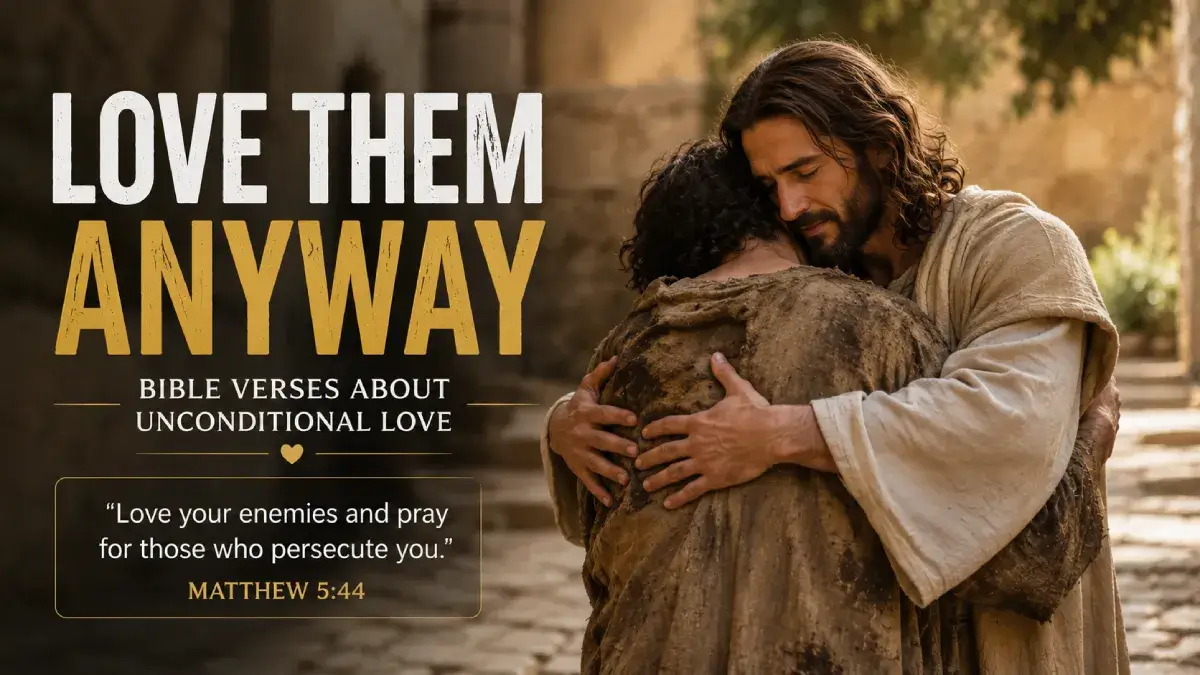
One of the clearest examples is Matthew 5:44, where Jesus teaches:
“Love your enemies and pray for those who persecute you.”
This command goes beyond ordinary human love.
It means Christians are called to love even people who may not love them in return.
That is the heart of the “love them anyway” principle.
What Does “Love Them Anyway” Mean?
“Love them anyway” means choosing to demonstrate love even when another person’s behavior makes it difficult.
It does not mean:
- Approving everything someone does
- Ignoring harmful behavior
- Refusing to establish boundaries
- Pretending you were not hurt
- Allowing someone to abuse or manipulate you
- Avoiding necessary confrontation
Instead, biblical love means responding with grace, truth, patience, forgiveness, and goodness rather than hatred or revenge.
You can love someone while disagreeing with them.
You can forgive someone while maintaining healthy boundaries.
You can pray for someone while keeping your distance.
You can refuse to repay evil with evil while still recognizing that what happened was wrong.
That is an important distinction.
The Best “Love Them Anyway” Bible Verse: Matthew 5:44
If you are looking for a Bible verse that most closely captures the idea of loving them anyway, Matthew 5:44 is one of the strongest answers.
Jesus says:
“Love your enemies and pray for those who persecute you.”
Jesus was teaching His disciples how they should respond to people who oppose or mistreat them.
Human instinct often says:
“Treat them the way they treated you.”
Jesus teaches something radically different:
Love them. Pray for them.
This does not mean their actions are acceptable.
It means their actions do not get to determine your character.
Luke 6:27–28 — Love Those Who Hate You
Luke 6:27–28 gives another powerful example.
Jesus tells His followers to:
- Love their enemies
- Do good to those who hate them
- Bless those who curse them
- Pray for those who mistreat them
This is perhaps one of the clearest biblical explanations of what it means to love someone anyway.
Notice that Jesus does not say to love only when the other person deserves it.
He calls His followers to love precisely when love is difficult.
That makes Christian love fundamentally different from ordinary reciprocity.
Romans 12:20–21 — Overcome Evil With Good
Romans 12 contains another powerful principle.
Paul teaches believers not to repay evil for evil.
Instead, he encourages them to respond to an enemy’s need with goodness.
He concludes with the memorable instruction:
“Do not be overcome by evil, but overcome evil with good.”
This is an important part of loving someone anyway.
When someone hurts us, we may be tempted to respond with anger, revenge, insults, or hatred.
Paul offers another way.
Do not allow someone else’s evil to produce evil in you.
Instead, overcome evil with good.
Proverbs 25:21–22 — Show Kindness to Your Enemy
The principle goes back even further.
Proverbs 25:21–22 teaches:
“If your enemy is hungry, give him food to eat; if he is thirsty, give him water to drink.”
This passage demonstrates that biblical love is practical.
It is not merely a feeling.
If someone who has treated you badly is genuinely in need, Scripture encourages a response of goodness rather than revenge.
This does not erase the wrong that occurred.
It demonstrates that our response can be guided by God’s character rather than resentment.
1 Corinthians 13:4–7 — What Does Biblical Love Look Like?
When discussing “love them anyway,” it is impossible to overlook 1 Corinthians 13.
Paul describes love as:
- Patient
- Kind
- Not envious
- Not boastful
- Not proud
- Not self-seeking
- Not easily angered
- Not keeping a record of wrongs
- Rejoicing with truth
- Protecting
- Trusting
- Hoping
- Persevering
This passage gives us a practical picture of biblical love.
Notice that love is described primarily through behavior and character.
That matters because you may not always feel affection toward someone who has hurt you.
Yet you can still choose patience.
You can choose kindness.
You can refuse revenge.
You can pray.
You can forgive.
You can seek their good.
In that sense, you can love someone even when your emotions have not caught up with your obedience.
“Love Them Anyway” Does Not Mean You Have to Like Them
This is an important distinction.
The Bible’s command to love someone does not necessarily mean you will enjoy being around them.
You may not like their personality.
You may disagree with their decisions.
You may be deeply hurt by something they have done.
You may even need distance from them.
Biblical love is not simply the same thing as liking someone.
Love can mean choosing to treat a person with dignity and goodwill even when you do not have warm feelings toward them.
Jesus Shows Us How to Love Difficult People
Jesus is the ultimate example of loving people who did not deserve His kindness.
He welcomed people who were rejected by society.
He showed compassion toward sinners.
He forgave.
He served.
He prayed for His enemies.
Even while being crucified, Jesus prayed for those responsible for His execution.
His life demonstrates that Christian love is not dependent upon receiving love in return.
John 13:34–35 — Love One Another
Jesus gave His disciples a new commandment:
“Love one another. As I have loved you, so you must love one another.”
The standard is significant.
Jesus did not simply say:
“Love people when they are kind to you.”
He pointed His followers toward His own example of love.
Christian love is supposed to reflect the love believers have received from Christ.
That means loving people when it is inconvenient.
Loving when there is no obvious reward.
Loving when forgiveness is difficult.
Loving when relationships are complicated.
Romans 5:8 — God Loved Us While We Were Still Sinners
Romans 5:8 provides one of the strongest foundations for understanding unconditional love.
Paul says that God demonstrates His love for us in that Christ died for us while we were still sinners.
Think about what that means.
God’s love was not a reward for human perfection.
Christ did not wait until people had everything right.
God’s grace moved toward people in their brokenness.
For Christians, this becomes a model of how to treat others.
We love because God first loved us.
Does Loving Someone Mean Forgiving Them?
Biblical love and forgiveness are closely connected, but they are not identical.
Scripture repeatedly encourages forgiveness.
Jesus teaches His followers to forgive others.
Ephesians 4:32 tells believers to be kind and compassionate, forgiving one another as God forgave them in Christ.
Forgiveness means releasing personal vengeance and refusing to remain controlled by bitterness.
But forgiveness does not necessarily mean:
- Trusting someone immediately
- Restoring the relationship to exactly what it was
- Ignoring consequences
- Allowing repeated harm
- Refusing appropriate boundaries
You can forgive someone while recognizing that trust may need to be rebuilt over time.
Can You Love Someone and Still Set Boundaries?
Yes.
This is an important practical application of biblical love.
Sometimes people misunderstand “love them anyway” to mean that Christians should tolerate every form of mistreatment.
That is not what Scripture teaches.
Love does not require you to remain in a harmful situation.
You can say:
“I forgive you, but I need some distance.”
You can say:
“I love you, but I cannot participate in this behavior.”
You can say:
“I want the best for you, but this relationship needs boundaries.”
These responses can be consistent with love.
Biblical love seeks what is good and true; it is not the same thing as unlimited access to your life.
Ephesians 4:15 — Speak the Truth in Love
Paul tells believers to speak the truth in love.
This is important because love does not mean avoiding every difficult conversation.
Sometimes loving someone means telling the truth.
Sometimes it means correcting a wrong.
Sometimes it means confronting destructive behavior.
But the manner matters.
The goal should not be humiliation or revenge.
The goal should be truth, restoration, wisdom, and genuine concern.
Truth without love can become harsh.
Love without truth can become misleading.
Biblical maturity brings both together.
Galatians 6:1 — Restore Gently
Galatians 6:1 provides another practical principle.
Paul instructs believers that when someone is caught in sin, they should seek restoration gently.
The purpose is not to prove that one person is better than another.
It is restoration.
This is another way Christians can “love them anyway.”
Instead of responding to someone’s failure with contempt, we can seek their restoration.
What If Someone Keeps Hurting You?
This is where wisdom becomes especially important.
Loving someone does not mean allowing repeated harm without response.
Jesus teaches forgiveness, but Scripture also recognizes wisdom, discernment, correction, and accountability.
If someone repeatedly hurts you, loving them may mean:
- Praying for them
- Forgiving them
- Refusing revenge
- Speaking honestly
- Establishing boundaries
- Seeking wise counsel
- Allowing appropriate consequences
- Protecting vulnerable people
- Hoping for genuine change
Sometimes the most loving response is not unlimited access.
Sometimes love requires a healthy boundary.
Does “Love Them Anyway” Mean Forgetting What They Did?
Not necessarily.
The Bible does not command you to erase your memories.
You may remember what happened and still choose forgiveness.
You may remember the pain and still refuse bitterness.
You may acknowledge the injustice and still refuse revenge.
Forgiveness is not pretending that something never happened.
Instead, it is choosing not to make retaliation the center of your life.
Bible Verses About Loving Difficult People
If you are studying “love them anyway” Bible verses, these passages are especially helpful.
Matthew 5:44 — Love Your Enemies
Jesus commands His followers to love their enemies and pray for those who persecute them.
Luke 6:27–28 — Love Those Who Hate You
Jesus teaches His followers to do good, bless, and pray even for people who mistreat them.
Romans 12:17–21 — Do Not Repay Evil
Paul teaches believers not to repay evil with evil and to overcome evil with good.
Proverbs 25:21–22 — Help Your Enemy
This passage encourages practical kindness toward an enemy who is hungry or thirsty.
1 Corinthians 13:4–7 — Love Is Patient and Kind
Paul explains that genuine love is patient, kind, humble, enduring, and not self-seeking.
John 13:34–35 — Love One Another
Jesus commands His followers to love one another as He has loved them.
Romans 5:8 — Christ Died for Sinners
God’s love is demonstrated through Christ dying for people while they were still sinners.
Ephesians 4:32 — Forgive Others
Believers are called to kindness, compassion, and forgiveness.
Colossians 3:13–14 — Forgive and Put on Love
Paul connects forgiveness with love, which binds Christian virtues together.
1 Peter 3:9 — Do Not Repay Insult With Insult
Peter teaches believers not to repay evil with evil or insult with insult, but to respond with blessing.
Why Does the Bible Tell Us to Love Our Enemies?
Jesus gives a powerful reason in Matthew 5.
He points toward the character of God, who shows kindness and goodness beyond the boundaries people might expect.
Loving difficult people reflects something about God’s character.
Anyone can love someone who loves them.
But choosing kindness toward an enemy demonstrates a radically different kind of love.
It shows that our behavior is not controlled entirely by how other people behave toward us.
Loving Them Anyway Is About Who You Become
One of the most powerful reasons to love someone anyway is that your response shapes your own heart.
If someone hurts you and you respond with hatred, their actions can continue controlling you long after the original event.
But choosing forgiveness and goodness breaks that cycle.
Romans 12:21 gives the principle:
“Do not be overcome by evil, but overcome evil with good.”
You cannot always control what someone else does.
But you can prayerfully choose how you respond.
Love Them Anyway When They Disagree With You
Christians will not agree with everyone.
People have different opinions, personalities, backgrounds, and perspectives.
The Bible does not command us to hate everyone who disagrees with us.
Instead, believers are repeatedly called to practice patience, humility, kindness, and love.
Disagreement does not have to become hostility.
You can hold firmly to your convictions while treating another person with dignity.
Love Them Anyway When They Hurt You
This is often the hardest application.
When someone hurts you, your emotions may naturally move toward anger or resentment.
The biblical response is not necessarily to pretend that the pain does not matter.
Instead:
Bring the pain to God.
Pray for wisdom.
Seek justice when necessary.
Set appropriate boundaries.
Refuse revenge.
Work toward forgiveness.
Choose goodness rather than hatred.
This process can take time.
Forgiveness is not always an instant emotional experience.
Sometimes it is a repeated decision to surrender bitterness to God.
Love Them Anyway When They Do Not Apologize
What if the other person never says they are sorry?
This can be especially painful.
Biblical forgiveness does not require you to wait for someone else’s apology before you begin releasing your desire for revenge.
You can forgive while recognizing that the other person remains responsible for their actions.
Forgiveness also does not mean that reconciliation is always possible.
Reconciliation requires relationship, repentance, and trust.
You may forgive someone while accepting that the relationship cannot return to what it once was.
Love Them Anyway Without Enabling Them
There is a major difference between loving someone and enabling harmful behavior.
Enabling can allow destructive patterns to continue.
Love seeks genuine good.
Sometimes genuine good requires saying no.
Sometimes it requires consequences.
Sometimes it requires confronting someone.
Sometimes it requires involving other people who can help.
A loving response should be guided by wisdom rather than guilt.
What If Loving Them Anyway Feels Impossible?
There may be times when you simply do not feel capable of loving someone.
That does not necessarily mean you have failed.
Christian love is not always an emotion that appears instantly.
You can begin with obedience.
Pray for the person.
Ask God to change your heart.
Refuse to speak maliciously about them.
Do not seek revenge.
Ask God for wisdom about appropriate boundaries.
Choose one small act of goodness where appropriate.
Over time, God can work in your heart.
A Simple Prayer to Love Someone Anyway
You can pray:
“Lord, help me love this person according to Your will. Heal the hurt in my heart. Keep me from bitterness and revenge. Give me wisdom to know when to speak, when to forgive, and when to set boundaries. Help me respond with truth, grace, and kindness. Change my heart and help me reflect the love of Christ. Amen.”
7 Practical Ways to Love Someone Anyway
1. Pray for Them
Matthew 5:44 specifically connects loving enemies with praying for them.
Prayer can change our perspective and place the situation in God’s hands.
2. Refuse Revenge
Romans 12 teaches believers not to repay evil with evil.
You do not have to get even.
3. Speak the Truth With Love
If a difficult conversation is necessary, communicate honestly without cruelty.
4. Forgive
Forgiveness releases your desire to personally repay someone for their wrong.
5. Set Wise Boundaries
Love does not require you to remain vulnerable to repeated harm.
6. Look for Opportunities to Do Good
When appropriate, respond to hostility with kindness.
7. Trust God With the Outcome
You cannot control whether someone changes.
You can control your own response and entrust the rest to God.
What “Love Them Anyway” Does Not Mean
It is helpful to be clear about what this phrase does not teach.
It Does Not Mean Approve of Sin
Biblical love does not require calling wrong things right.
It Does Not Mean Stay in an Abusive Situation
Wisdom and safety matter.
It Does Not Mean Ignore Injustice
The Bible takes justice seriously.
It Does Not Mean Trust Everyone
Forgiveness and trust are not identical.
It Does Not Mean Never Say No
Healthy boundaries can be an expression of wisdom.
It Does Not Mean Never Feel Angry
Anger can be a natural response to wrongdoing. The biblical challenge is how we handle it.
It Does Not Mean Reconciliation Is Always Possible
Some relationships may remain separated even after forgiveness.
Love Them Anyway vs. “Love the Sinner, Hate the Sin”
These two expressions are related but emphasize different things.
“Love the sinner, hate the sin” focuses on loving people while rejecting sinful behavior.
“Love them anyway” emphasizes continuing to choose love even when someone has hurt, rejected, disappointed, or mistreated you.
Both ideas can be connected to biblical teaching.
The important thing is not the slogan itself.
The important thing is whether our understanding reflects Scripture.
What Is the Greatest Example of Loving Anyway?
The greatest example is Jesus Christ.
The gospel presents Christ as loving people who were sinners.
Romans 5:8 tells us that Christ died for us while we were still sinners.
Jesus did not wait for humanity to become worthy.
He demonstrated sacrificial love.
That does not mean God ignored sin.
The cross demonstrates the opposite: sin is serious, yet God’s grace is extraordinarily great.
This is the foundation of Christian love.
We love because God first loved us.
How Can I Love Someone Who Has Hurt Me?
If someone has deeply hurt you, begin with prayer rather than forcing yourself to feel something you do not feel.
Ask God for:
- A heart free from bitterness
- Wisdom
- Strength
- Healing
- Appropriate boundaries
- The ability to forgive
- Courage to address the situation
- Compassion without enabling
- Peace about what you cannot control
You do not have to pretend the pain never happened.
You can acknowledge the hurt while choosing not to let hatred define your response.
FAQ About “Love Them Anyway” Bible Verses
Is “love them anyway” in the Bible?
No. The exact phrase “love them anyway” does not appear in the Bible. However, the Bible strongly teaches the principle through commands to love enemies, forgive others, pray for those who hurt us, and overcome evil with good.
What Bible verse says to love them anyway?
Matthew 5:44 is one of the clearest verses connected with the idea: Jesus tells His followers to love their enemies and pray for those who persecute them.
What is the best Bible verse about loving difficult people?
Matthew 5:44 and Luke 6:27–28 are especially relevant because Jesus specifically commands His followers to love enemies and do good to those who hate them.
Does the Bible say to love people who hurt you?
Yes. Jesus teaches His followers to love their enemies and pray for those who persecute them. Romans 12:17–21 also teaches believers not to repay evil with evil.
Does loving someone mean forgiving them?
Forgiveness is a major part of Christian love, but forgiveness does not necessarily mean immediately restoring trust or removing appropriate boundaries.
Can I love someone and still stay away from them?
Yes. You can love someone, forgive them, and desire their good while maintaining appropriate boundaries or distance.
Does loving someone mean approving their actions?
No. Biblical love does not require approval of sinful or harmful behavior. Christians are called to love people while remaining committed to truth and righteousness.
What does Romans 12:21 say about loving your enemies?
Romans 12:21 teaches believers not to be overcome by evil but to overcome evil with good. This captures the principle of responding to wrongdoing with goodness rather than revenge.
How did Jesus love people who hurt Him?
Jesus demonstrated compassion, forgiveness, prayer, and sacrificial love. Even while being crucified, He prayed for those responsible for His execution.
What Bible verse says to forgive someone who hurt you?
Several passages address forgiveness, including Ephesians 4:32, Colossians 3:13, and Jesus’ teaching about forgiveness throughout the Gospels.
Does God want us to love everyone?
Yes. Jesus teaches His followers to love their neighbors and even their enemies. Christian love is not limited to people who are easy to love.
What if I cannot feel love for someone?
You can begin by choosing loving actions and praying for the person. Biblical love is not merely an emotion; it is also demonstrated through choices, attitudes, and actions.
Does loving your enemy mean becoming friends with them?
No. Loving an enemy does not necessarily mean developing a close friendship. It means refusing hatred and revenge and seeking to respond according to God’s will.
Can I forgive someone without trusting them?
Yes. Forgiveness and trust are different. Trust may need to be rebuilt over time through consistent, trustworthy behavior.
What does “love them anyway” teach Christians?
It reminds Christians that their response should not be controlled entirely by how others treat them. Scripture calls believers to love, forgive, pray, show kindness, and overcome evil with good.
Final Thoughts: Love Them Anyway
The phrase “love them anyway” is not a Bible verse, but its message can be strongly connected to biblical teaching.
Jesus said:
“Love your enemies and pray for those who persecute you.” — Matthew 5:44
Paul wrote:
“Do not be overcome by evil, but overcome evil with good.” — Romans 12:21
And 1 Corinthians 13 reminds us that genuine love is patient, kind, humble, and enduring.
The biblical message is challenging because it asks us to love beyond convenience.
Love when they do not love you back.
Forgive when bitterness feels easier.
Pray when anger tells you not to.
Do good instead of seeking revenge.
Speak truth without hatred.
Set boundaries without becoming bitter.
And above all, remember the example of Christ.
You do not have to approve of everything someone does in order to love them.
You do not have to trust everyone in order to forgive.
You do not have to remain in a harmful relationship to wish someone well.
But as a follower of Christ, you can choose to refuse hatred and revenge.
Love them anyway—not because their actions are always right, but because God has called you to reflect His love.
When loving someone feels impossible, begin with a simple prayer:
“Lord, help me love them the way You want me to.”
Sometimes that is where healing begins.