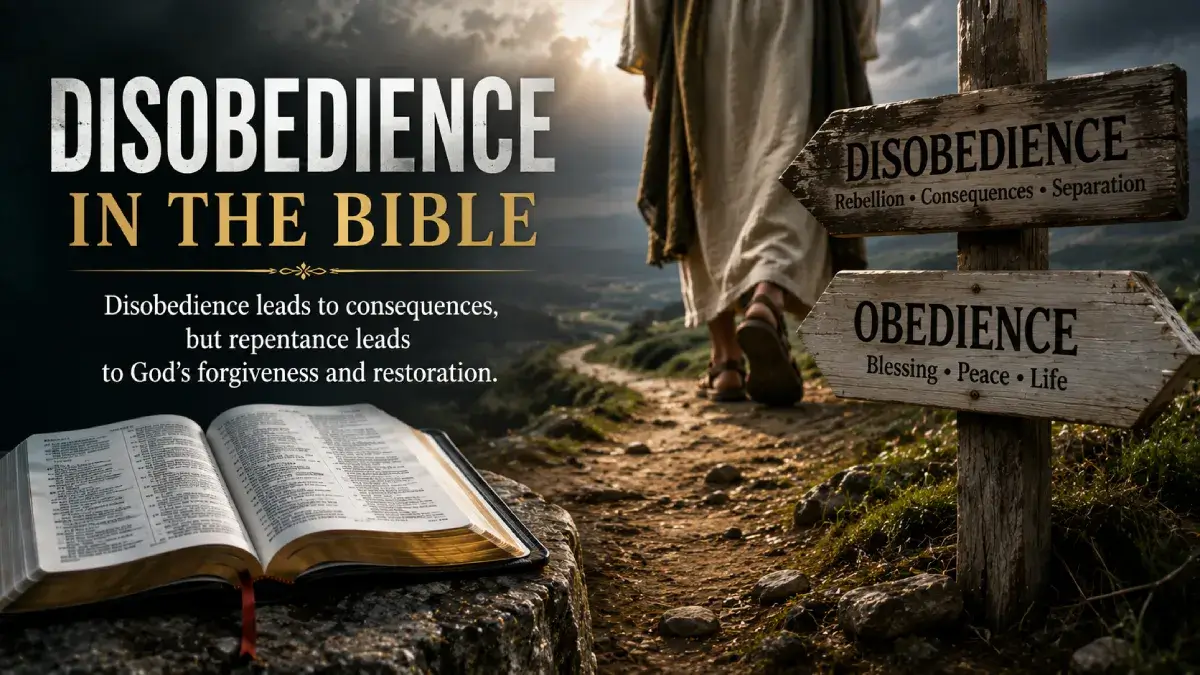
Disobedience in the Bible is the refusal or failure to follow God’s commands, instructions, or will. Scripture presents obedience as an important expression of faith, while persistent disobedience can lead to spiritual, relational, and practical consequences.
The Bible provides several examples of disobedience, including Adam and Eve, Jonah, King Saul, and the Israelites in the wilderness. Scripture warns about the consequences of disobedience, but it also teaches that God offers forgiveness and restoration to those who confess, repent, and turn back to Him.
From Adam and Eve in Genesis to King Saul, Jonah, and the nation of Israel, the Bible contains many examples of people who knew what God required but chose another path.
One of the clearest statements about obedience comes from Samuel’s words to Saul:
“Behold, to obey is better than sacrifice, and to hearken than the fat of rams.” – 1 Samuel 15:22, KJV
This verse captures a central biblical principle: God is concerned not merely with religious activity, but with a heart that listens to Him and obeys His Word.
But the Bible’s message about disobedience isn’t only a warning. Scripture also shows that God calls disobedient people to repentance, forgiveness, restoration, and renewed obedience.
What Does Disobedience Mean in the Bible?
In simple terms, disobedience means refusing to obey God or deliberately acting contrary to His commands.
Biblical disobedience can involve:
- Rejecting God’s commands
- Ignoring God’s warnings
- Choosing personal desires over God’s will
- Refusing correction
- Knowing what is right but choosing what is wrong
- Trusting human wisdom instead of God
- Continuing in sin without repentance
Disobedience isn’t simply making an honest mistake.
The Bible often presents it as a matter of the heart and will – how a person responds when God has revealed what is right.
What Does the Bible Say About Disobedience?
Scripture consistently presents obedience to God as important.
Deuteronomy 11:26–28 describes a choice between blessing associated with obedience and a curse associated with disobedience.
Jesus also connected love for Him with obedience:
“If ye love me, keep my commandments.” – John 14:15, KJV
Obedience doesn’t mean Christians earn God’s love by performing perfectly. Rather, obedience is an appropriate response to God’s love and grace.
The New Testament repeatedly calls believers to live differently because they belong to Christ.
10 Bible Verses About Disobedience
1. 1 Samuel 15:22 – Obedience Is Better Than Sacrifice
Samuel told King Saul:
“Behold, to obey is better than sacrifice, and to hearken than the fat of rams.”
Saul had failed to completely obey God’s command concerning the Amalekites. Although he had carried out part of the instruction, he attempted to justify keeping what God had commanded him to destroy.
Samuel’s response reveals an important truth:
Religious activity cannot substitute for obedience.
A person cannot deliberately ignore God’s commands and then compensate with outward religious practices.
Lesson
God wants a heart that listens and obeys, not merely religious actions performed without submission.
2. Genesis 3: Disobedience in the Garden of Eden
One of the earliest and most significant examples of disobedience occurs in Genesis 3.
God had commanded Adam not to eat from the tree of the knowledge of good and evil.
The serpent deceived Eve, she ate the fruit, and Adam also ate.
Their disobedience had profound consequences.
Genesis 3 describes the entrance of:
- Shame
- Fear
- Broken fellowship
- Pain
- Death
- Separation from the garden
The story demonstrates how seriously Scripture treats rebellion against God’s command.
Lesson
Disobedience can have consequences far beyond the immediate decision.
3. Jonah – Disobedience and Running From God
Jonah provides another memorable example.
God commanded Jonah to go to Nineveh and preach to the people there.
Instead, Jonah attempted to flee in the opposite direction.
Jonah 1:3 says:
“But Jonah rose up to flee unto Tarshish from the presence of the LORD.”
Jonah’s story shows that disobedience isn’t always about openly rejecting God.
Sometimes it looks like running from something God has clearly asked us to do.
Eventually, Jonah was brought back to God’s assignment.
Lesson
Running from God’s will doesn’t solve the problem. Repentance brings us back to obedience.
4. King Saul – Partial Obedience Is Still Disobedience
King Saul’s story in 1 Samuel 15 is particularly important.
God gave Saul a specific command, but Saul did not completely follow it.
When Samuel confronted him, Saul attempted to explain his actions by saying that the people had spared the best animals to sacrifice to the Lord.
Samuel responded:
“For rebellion is as the sin of witchcraft, and stubbornness is as iniquity and idolatry.” – 1 Samuel 15:23, KJV
Saul’s problem wasn’t a lack of religious activity.
His problem was disobedience disguised as religious reasoning.
Lesson
We shouldn’t use good intentions or religious activity to justify deliberately ignoring what God has commanded.
5. Israel in the Wilderness
The Israelites repeatedly struggled with obedience after leaving Egypt.
God had rescued them, provided for them, and led them toward the Promised Land. Yet they repeatedly complained, doubted, rebelled, and refused to trust Him.
Psalm 78 recounts many examples of Israel’s rebellion and failure to remember God’s works.
Hebrews 3:18–19 later connects Israel’s unbelief with disobedience.
Lesson
Experiencing God’s blessings doesn’t automatically produce obedience.
We must continue trusting God when circumstances become difficult.
6. Adam’s Disobedience and Romans 5
Paul uses Adam’s disobedience to explain a major biblical theme.
Romans 5:19 says:
“For as by one man’s disobedience many were made sinners, so by the obedience of one shall many be made righteous.”
Paul contrasts Adam’s disobedience with Christ’s obedience.
Adam’s disobedience represents humanity’s fall into sin, while Christ’s obedience points toward God’s provision of righteousness through Him.
Lesson
The gospel is ultimately about more than human failure. It is about God’s redemptive work through Jesus Christ.
7. Ephesians 2:2 – The Children of Disobedience
Paul describes people who lived according to the ways of the world and calls them:
“the children of disobedience.”
The expression emphasizes a pattern of life characterized by rebellion against God.
Paul’s message, however, doesn’t end there.
Ephesians 2:4–5 immediately emphasizes God’s mercy and love, explaining that God makes people alive with Christ.
Lesson
The Bible identifies the seriousness of disobedience while simultaneously proclaiming God’s grace.
8. Colossians 3:6 – God’s Judgment on Disobedience
Paul warns:
“For which things’ sake the wrath of God cometh on the children of disobedience.”
The verse occurs in a discussion of sinful behavior.
Scripture does not treat persistent rebellion against God as harmless.
Lesson
Sin has consequences, and believers should not treat disobedience casually.
9. Hebrews 3:15 – Do Not Harden Your Heart
Hebrews quotes Psalm 95:
“To day if ye will hear his voice, harden not your hearts, as in the provocation.”
This warning is especially significant because disobedience can become a pattern.
Repeatedly rejecting God’s correction can harden a person’s heart.
Lesson
When God reveals something that needs to change, respond rather than continually resisting Him.
10. James 4:17 – Knowing and Not Doing
James gives an especially practical definition of responsibility:
“Therefore to him that knoweth to do good, and doeth it not, to him it is sin.”
Disobedience isn’t limited to doing something God forbids.
It can also involve failing to do what we know is right.
This is sometimes called the idea of a “sin of omission.”
Lesson
Obedience includes both avoiding wrong and doing what is right.
What Are the Consequences of Disobedience in the Bible?
The Bible describes several consequences associated with disobedience.
1. Broken Fellowship With God
Adam and Eve’s sin resulted in separation from the immediate fellowship they had enjoyed in Eden.
2. Spiritual Hardening
Repeated rebellion can make a person’s heart increasingly resistant to God’s voice.
3. Broken Relationships
Sin frequently damages families, friendships, communities, and nations.
4. Loss of Blessing or Opportunity
Several biblical stories show people experiencing consequences after refusing God’s instructions.
5. Discipline and Judgment
Scripture repeatedly warns that God takes persistent rebellion seriously.
However, consequences don’t mean that forgiveness is impossible.
The Bible consistently presents repentance as the way back to God.
Is Disobedience the Same as Sin?
Disobedience and sin are closely related, but they aren’t exactly identical words.
Sin is the broader concept of falling short of God’s righteousness.
Disobedience emphasizes the act of refusing or failing to follow God’s revealed will.
For example, when God commands something and a person knowingly refuses to do it, that is an expression of disobedience.
The biblical story of Adam illustrates this connection clearly: God gave a command, Adam violated it, and sin entered the human story.
What Causes Disobedience According to the Bible?
The Bible identifies several attitudes that can lead to disobedience.
Pride
A person may believe their judgment is better than God’s.
Unbelief
We may know what God has said but fail to trust that His way is best.
Temptation
Like Adam and Eve, people can be persuaded to believe that disobedience will provide something desirable.
Selfish Desires
We sometimes prioritize what we want over what God commands.
Fear of People
Saul’s story shows how concern about pleasing people can interfere with obedience to God.
Hardness of Heart
Repeated resistance can make a person less responsive to God’s correction.
Is Partial Obedience Still Disobedience?
Yes, when God has given a clear command and a person deliberately chooses to follow only part of it.
King Saul is the clearest biblical example.
Saul obeyed some of God’s instructions but rejected others.
Samuel did not praise Saul for his partial obedience. Instead, he confronted him for rebellion.
This doesn’t mean every mistake is equivalent to deliberate rebellion.
There is a difference between:
- Forgetting
- Misunderstanding
- Making an honest mistake
- Deliberately refusing to obey
God knows the heart.
The important principle is that we should not deliberately choose which commands of God we will obey based solely on personal preference.
What Is the Difference Between Disobedience and Temptation?
Temptation is not the same as disobedience.
Jesus Himself was tempted in the wilderness, yet He did not sin.
Temptation presents an opportunity to choose wrongly.
Disobedience occurs when a person chooses to act contrary to God’s will.
This distinction is encouraging.
You may experience temptation without having sinned.
The biblical response is to resist temptation and choose obedience.
Can God Forgive Disobedience?
Yes.
The Bible repeatedly shows God forgiving people who repent.
One of the clearest examples is David.
After his serious sin, David confessed his wrongdoing and sought God’s mercy.
Psalm 51:10 records his prayer:
“Create in me a clean heart, O God; and renew a right spirit within me.”
The gospel provides the ultimate message of forgiveness.
1 John 1:9 says:
“If we confess our sins, he is faithful and just to forgive us our sins, and to cleanse us from all unrighteousness.”
Forgiveness doesn’t mean sin is insignificant.
It means God’s grace is greater than our failure when we genuinely repent and turn to Him.
How Can We Become More Obedient to God?
1. Know God’s Word
We cannot consistently obey commands we don’t know.
Regular Bible reading helps us understand God’s revealed will.
2. Pray for Wisdom
Ask God to help you recognize areas where your life isn’t aligned with Scripture.
3. Obey What You Already Know
Don’t wait for perfect understanding before following clear biblical instructions.
4. Respond Quickly to Conviction
When Scripture exposes something wrong, don’t continually postpone obedience.
5. Develop Accountability
Wise Christian relationships can help us recognize blind spots and remain faithful.
6. Remember God’s Character
Obedience isn’t merely about following rules.
We obey God because He is trustworthy, good, and worthy of our devotion.
Obedience and Grace
A common misunderstanding is that Christianity teaches:
“Obey perfectly, and God will love you.”
The gospel teaches something different.
God’s grace comes first.
We are saved by God’s grace through faith, not because we have achieved perfect obedience.
But grace does not make obedience irrelevant.
Instead, grace changes the reason we obey.
Jesus said:
“If ye love me, keep my commandments.” – John 14:15
Christian obedience should flow from love, faith, gratitude, and trust.
We don’t obey in order to earn God’s grace.
We obey because we have received His grace.
What Should We Do When We Have Disobeyed God?
When you recognize disobedience in your life, Scripture gives a clear path.
1. Admit it
Don’t make excuses or blame someone else.
2. Confess it
Bring the sin honestly before God.
3. Repent
Turn away from the sinful behavior rather than merely feeling sorry about it.
4. Receive God’s forgiveness
Trust God’s promise rather than remaining trapped in shame.
5. Make things right when possible
If your disobedience harmed another person, seek reconciliation where appropriate.
6. Walk differently
True repentance produces a change in direction.
A Prayer for Obedience
“Heavenly Father, Forgive me for the times I have chosen my own way instead of Yours. Search my heart and show me the areas where I need to repent and change. Give me a heart that listens to Your Word and trusts Your wisdom. Help me obey even when obedience is difficult or inconvenient. Protect me from pride, unbelief, temptation, and the desire to please people more than I please You. Thank You for Your mercy and forgiveness through Jesus Christ. Help me walk faithfully and live a life that reflects my love for You. In Jesus’ name, Amen.“
Final Thoughts on Disobedience in the Bible
Disobedience in the Bible is more than breaking a rule. It is a failure or refusal to submit to God’s revealed will.
The stories of Adam and Eve, Israel, Jonah, and King Saul demonstrate that disobedience can have serious consequences. Scripture warns that rebellion can damage our relationship with God, harden our hearts, and affect others around us.
Yet the Bible’s message isn’t simply:
“Don’t disobey.”
It also points us toward a better way:
Hear God’s Word.
Trust Him.
Obey Him.
Repent when you fail.
Receive His grace.
Keep walking with Him.
Jesus provides the ultimate example of faithful obedience. Paul contrasts Adam’s disobedience with Christ’s obedience in Romans 5:19, pointing believers toward the redemption God provides through Christ.
The goal isn’t to live in constant fear of failure.
It is to cultivate a heart that can sincerely say:
“Lord, I want to hear Your voice, trust Your ways, and obey You.”
Frequently Asked Questions
What is disobedience according to the Bible?
Disobedience is refusing or failing to follow God’s commands or revealed will. It can involve deliberately doing what God forbids or failing to do what God requires.
What is the first example of disobedience in the Bible?
The first major example is found in Genesis 3, when Adam and Eve ate from the tree God had commanded them not to eat from.
What is the most famous example of disobedience in the Bible?
Adam and Eve are perhaps the most widely known example, but King Saul’s disobedience in 1 Samuel 15 is another major example because Samuel explicitly teaches that obedience is better than sacrifice.
What Bible verse says obedience is better than sacrifice?
1 Samuel 15:22 says, “Behold, to obey is better than sacrifice, and to hearken than the fat of rams.”
Can God forgive disobedience?
Yes. Scripture repeatedly teaches that God forgives those who genuinely confess and repent. 1 John 1:9 promises forgiveness and cleansing from unrighteousness.
Is temptation the same as disobedience?
No. Temptation is an opportunity to choose sin; disobedience occurs when a person knowingly acts contrary to God’s will. Jesus was tempted but remained without sin.
Why is obedience important to God?
Obedience demonstrates trust, faith, love, and submission to God. Jesus connected love for Him with keeping His commandments in John 14:15.