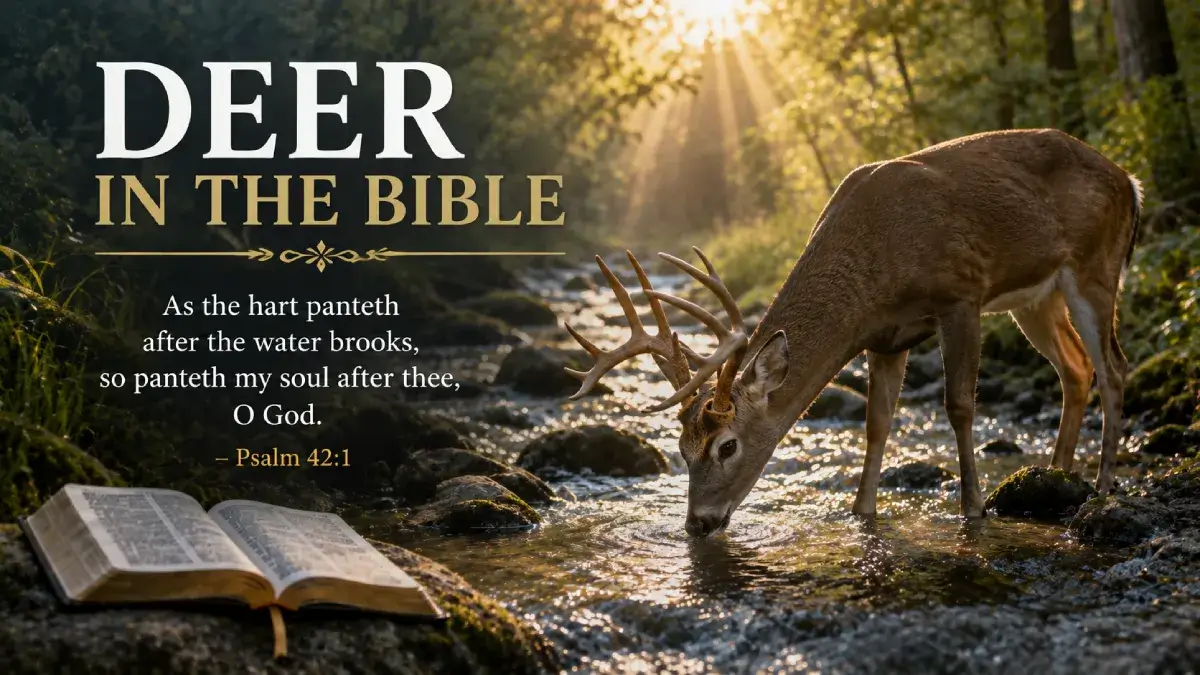
In the Bible, a deer can represent different things depending on the context, including spiritual thirst, longing for God, strength, agility, stability, beauty, and restoration. Psalm 42:1 famously compares a person’s longing for God to a deer panting for water: “As the hart panteth after the water brooks, so panteth my soul after thee, O God.” Other passages, including Psalm 18:33 and Habakkuk 3:19, use deer imagery to describe God-given strength and the ability to navigate difficult places.
Deer are mentioned several times throughout the Bible, and their appearances often carry meaningful imagery. Scripture refers to deer, hinds, does, and stags when describing animals, food, beauty, strength, speed, and spiritual longing.
One of the most familiar examples is Psalm 42:1:
“As the hart panteth after the water brooks, so panteth my soul after thee, O God.” – Psalm 42:1, KJV
The image of a deer desperately seeking water provides a powerful picture of a person longing for God.
Elsewhere, David describes God as the One who makes his feet “like hinds’ feet” (2 Samuel 22:34), emphasizing stability and ability to move through difficult terrain.
So, what does a deer represent in the Bible? Depending on the passage, deer imagery can point toward spiritual thirst, dependence on God, strength, agility, beauty, freedom, and the ability to navigate difficult circumstances.
Let’s explore what Scripture says about deer and the lessons Christians can learn from these references.
What Does a Deer Represent in the Bible?
The Bible does not assign one single symbolic meaning to deer. Their significance depends on the context.
However, several themes appear repeatedly.
Deer can represent:
- A longing for God
- Thirst and dependence
- Strength and agility
- Spiritual stability
- Freedom and movement
- Beauty and grace
- Peace and gentleness
- Life and abundance
The most important spiritual image is probably the deer searching for water in Psalm 42.
12 Important Bible Verses About Deer
1. Psalm 42:1 – A Deer Thirsting for Water
“As the hart panteth after the water brooks, so panteth my soul after thee, O God.” – Psalm 42:1, KJV
This is perhaps the best-known Bible verse about deer.
The psalmist compares his longing for God to a deer panting for streams of water.
The picture is one of intense desire and dependence.
A thirsty deer needs water to survive. Likewise, the psalmist recognizes that his soul needs God.
Spiritual lesson
Our relationship with God should not be treated as an occasional activity. Just as a thirsty deer seeks water, believers should develop a deep desire for God’s presence.
2. 2 Samuel 22:34 – Feet Like a Deer
“He maketh my feet like hinds’ feet: and setteth me upon my high places.” – 2 Samuel 22:34, KJV
David uses the image of a hind – a female deer – to describe the ability God gives him to navigate high and difficult places.
Deer can move through rugged terrain with remarkable agility.
David’s point is that God equips him to stand and move securely even when circumstances are difficult.
Spiritual lesson
God doesn’t always remove difficult terrain.
Sometimes He gives us the strength and stability to walk through it.
3. Psalm 18:33 – God Gives Stability
Psalm 18 contains a parallel statement:
“He maketh my feet like hinds’ feet, and setteth me upon my high places.” – Psalm 18:33, KJV
Again, the deer provides a picture of agility and stability.
The verse emphasizes God’s ability to equip His people to stand securely.
When life feels uncertain, we can remember that our stability ultimately comes from God.
4. Habakkuk 3:19 – Walking on High Places
“The LORD God is my strength, and he will make my feet like hinds’ feet, and he will make me to walk upon mine high places.” – Habakkuk 3:19, KJV
Habakkuk’s statement is especially meaningful because it comes in a context of uncertainty.
The prophet describes circumstances in which crops may fail and resources may disappear, yet he chooses to rejoice in God.
The deer imagery communicates strength and confident movement through difficult places.
Spiritual lesson
Faith doesn’t mean every path will be easy.
It means God can give you strength for the path you have to walk.
5. Proverbs 5:19 – The Beauty of a Deer
“Let her be as the loving hind and pleasant roe; let her breasts satisfy thee at all times; and be thou ravished always with her love.” – Proverbs 5:19, KJV
Here deer imagery occurs in the context of marriage.
The passage uses the beauty and attractiveness of a deer as part of an appeal toward marital faithfulness.
This is an important reminder that biblical references to deer aren’t always directly about spiritual symbolism.
Sometimes the deer is simply an image of beauty, affection, and attractiveness.
6. Song of Solomon 2:9 – A Gazelle and Young Deer
“My beloved is like a roe or a young hart: behold, he standeth behind our wall.” – Song of Solomon 2:9, KJV
The Song of Solomon repeatedly uses deer imagery in poetic descriptions of love.
The comparison communicates qualities such as:
- Grace
- Beauty
- Gentleness
- Movement
- Elegance
The passage demonstrates how the natural world is frequently used in biblical poetry to communicate human emotions and relationships.
7. Song of Solomon 2:17 – The Young Deer on the Mountains
“Until the day break, and the shadows flee away, turn, my beloved, and be thou like a roe or a young hart upon the mountains of Bether.” – Song of Solomon 2:17, KJV
The deer imagery contributes to the poetic atmosphere of longing and anticipation.
The animal’s movement across the mountains creates a picture of freedom, beauty, and graceful movement.
8. Song of Solomon 8:14 – Be Like a Gazelle
“Make haste, my beloved, and be thou like to a roe or to a young hart upon the mountains of spices.” – Song of Solomon 8:14, KJV
The final chapter of Song of Solomon returns to similar imagery.
The deer represents something swift and graceful moving through the mountains.
It contributes to the book’s broader themes of love, desire, beauty, and relationship.
9. Isaiah 35:6 – The Deer Will Leap
“Then shall the lame man leap as an hart, and the tongue of the dumb sing.” – Isaiah 35:6, KJV
Isaiah uses the image of a deer leaping to describe dramatic restoration.
A person who could not walk will leap.
The imagery communicates freedom, renewed strength, and joyful restoration.
Spiritual lesson
God’s restoration can bring life and movement where there was previously weakness.
10. 1 Kings 4:23 – Deer as Food
“Ten fat oxen, and twenty oxen out of the pastures, and an hundred sheep, beside harts, and roebucks, and fallowdeer, and fatted fowl.” – 1 Kings 4:23, KJV
Not every mention of deer has a symbolic meaning.
During Solomon’s reign, deer and other animals were included among the provisions for the royal household.
This passage gives us a practical glimpse into the place of deer among the animals known and used for food in ancient Israel.
11. Deuteronomy 14:5 – Deer Among Clean Animals
Deuteronomy 14 lists animals that the Israelites were permitted to eat, including several types of deer.
The passage mentions the:
- Hart
- Roe deer
- Fallow deer
- Wild goat
- Other animals
This shows that deer were part of the biblical dietary laws concerning clean animals.
12. Deuteronomy 12:15 – Eating Deer According to the Law
Deuteronomy 12 also mentions the eating of animals such as the roe and the hart.
The reference is significant because it shows that deer weren’t merely poetic symbols in Scripture. They were also real animals that played a practical role in the life and diet of ancient Israel.
What Does a Deer Mean Spiritually?
When Christians ask about the spiritual meaning of a deer in the Bible, Psalm 42:1 is usually the most important passage to consider.
The deer represents a creature that needs water and actively seeks it.
The psalmist takes that natural picture and applies it to the human soul.
“So panteth my soul after thee, O God.”
The spiritual message is straightforward:
Our souls need God.
Just as physical thirst drives a deer toward water, spiritual hunger should drive us toward the Lord.
Deer in the Bible and Spiritual Thirst
Psalm 42 teaches an important lesson about desire.
It’s possible to have many physical needs met while still experiencing deep spiritual emptiness.
The psalmist doesn’t say:
“My soul is satisfied with possessions.”
Instead, he longs for God.
This challenges us to ask:
What does my soul truly thirst for?
We can spend our lives pursuing success, money, recognition, relationships, entertainment, or comfort. Yet none of these can replace God.
The deer seeking water provides a memorable picture of what it means to seek Him.
Deer in the Bible and Strength
The deer imagery in 2 Samuel 22:34, Psalm 18:33, and Habakkuk 3:19 communicates another important theme: God-given strength.
A deer is capable of navigating steep and rugged terrain.
David uses this ability as a metaphor for God’s work in his life.
The lesson isn’t that believers will never face mountains.
Rather:
God can equip you to stand on difficult ground.
When circumstances become challenging, you can pray for the strength, wisdom, and stability to keep moving forward.
Deer in the Bible and Graceful Movement
Deer are also associated with graceful movement in biblical poetry.
Song of Solomon repeatedly uses deer and gazelles when describing beauty and love.
The animal’s characteristics – speed, grace, and elegance – make it an effective poetic comparison.
This reminds us that biblical animal imagery needs to be understood within its context.
A deer in Psalm 42 emphasizes thirst.
A deer in Habakkuk emphasizes strength and movement.
A deer in Song of Solomon contributes to imagery of beauty and love.
Does the Bible Say Deer Are Spiritually Significant Animals?
The Bible certainly uses deer imagery in spiritually meaningful ways, but Scripture does not teach that deer are sacred animals or that seeing a deer is automatically a divine message.
This distinction is important.
Christians can appreciate the symbolism Scripture uses without turning biblical imagery into superstition.
If you see a deer in nature, you don’t need to assume that God is sending you a hidden message.
However, Scripture’s use of the deer can remind you of biblical truths – especially the call to seek God, depend on Him, and trust His strength.
What Can Christians Learn From Deer in the Bible?
1. Seek God Like a Thirsty Deer Seeks Water
Psalm 42:1 encourages us to cultivate a genuine hunger for God.
2. Trust God on Difficult Ground
The deer imagery in Psalm 18 and Habakkuk 3 reminds us that God can strengthen us for difficult circumstances.
3. Don’t Confuse Difficulty With God’s Absence
David’s “high places” weren’t necessarily easy places. God can be with you even when your path is challenging.
4. Appreciate God’s Creation
The Bible frequently draws spiritual lessons from animals, plants, weather, mountains, and other parts of creation. Creation can point our attention toward the wisdom and power of its Creator.
5. Let Scripture Define the Symbolism
Instead of assigning personal or mystical meanings to deer, start with the passages where Scripture itself uses the imagery.
A Prayer Inspired by Deer in the Bible
Lord,
Give me a heart that longs for You like the deer longs for water. When I am spiritually dry, draw me back to Your presence and Your Word.
When I face difficult places, give me the strength and stability to keep walking. Make my feet steady when the path is steep and help me trust You when I cannot see what lies ahead.
Teach me to seek You above everything else and to remember that You are my source of strength, hope, and life.
In Jesus’ name, Amen.
Final Thoughts: What Does the Deer Represent in the Bible?
The deer in the Bible appears in several different contexts, so there isn’t one universal interpretation.
The most recognizable image comes from Psalm 42:1, where the deer represents deep spiritual thirst and longing for God.
Other passages use deer to illustrate:
- Strength – Psalm 18:33
- Stability – 2 Samuel 22:34
- Confidence in difficult circumstances – Habakkuk 3:19
- Beauty and love – Song of Solomon
- Restoration and joyful movement – Isaiah 35:6
- Food and provision – Deuteronomy 12:15 and 1 Kings 4:23
Perhaps the most memorable lesson is found in the words:
“As the hart panteth after the water brooks, so panteth my soul after thee, O God.” – Psalm 42:1
A thirsty deer doesn’t merely know where the water is.
It seeks it.
In the same way, Scripture calls us to seek God – not merely to know about Him, but to desire His presence and recognize our dependence upon Him.
When your soul feels dry, remember the picture of the deer.
Seek the living water. Seek God.
Frequently Asked Questions
What does a deer symbolize in the Bible?
A deer can symbolize different things depending on the passage, including spiritual thirst, longing for God, strength, agility, stability, beauty, restoration, and freedom.
What Bible verse compares us to a deer?
Psalm 42:1 compares the longing of the human soul for God to a deer panting for water: “As the hart panteth after the water brooks, so panteth my soul after thee, O God.”
What does a deer represent spiritually?
The most prominent spiritual image is a deep longing and thirst for God. Psalm 42 uses the deer seeking water as a picture of spiritual desire.
What does “feet like hinds’ feet” mean?
The phrase in 2 Samuel 22:34 and Psalm 18:33 refers to God’s ability to give His people stability and agility to navigate difficult or elevated places.
Are deer mentioned as food in the Bible?
Yes. Deer such as the hart, roe deer, and fallow deer appear in passages concerning food and the dietary practices of ancient Israel, including Deuteronomy 12 and 14 and 1 Kings 4.
Is seeing a deer a sign from God?
The Bible does not teach that seeing a deer automatically carries a supernatural message. However, Christians can use the biblical imagery of deer as a reminder of truths such as seeking God, depending on Him, and trusting His strength.