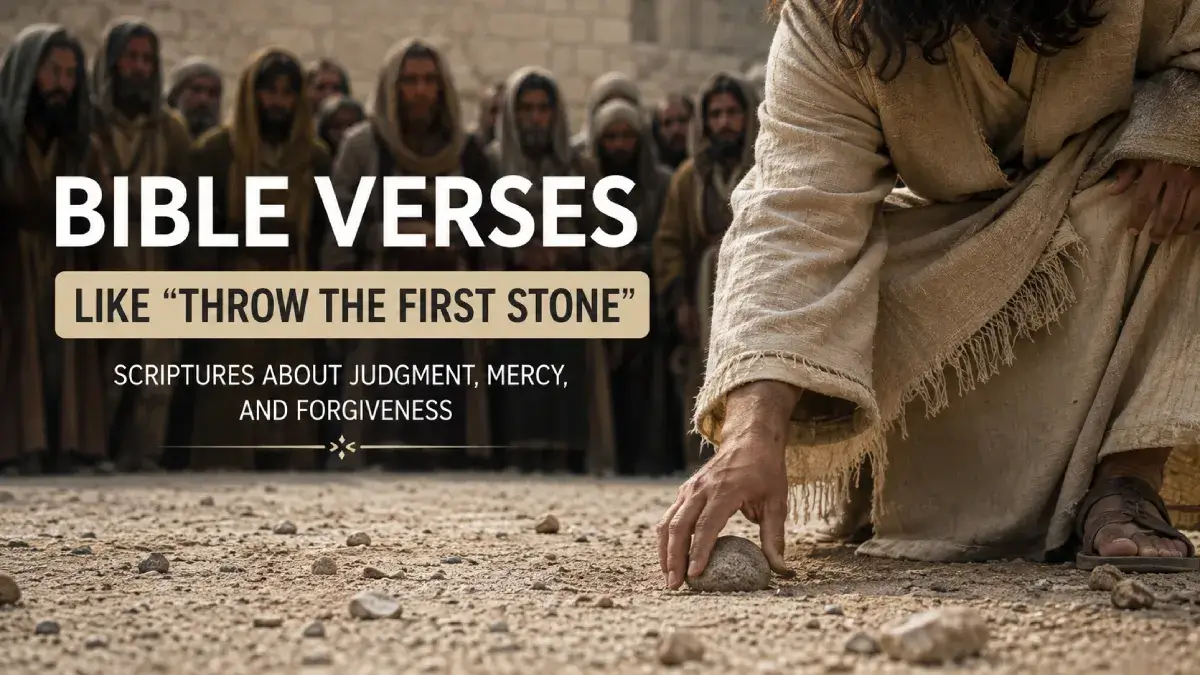
When people search for Bible verses like “throw the first stone,” they are usually looking for Scriptures about judging others, showing mercy, forgiveness, and recognizing our own sin before condemning someone else.
The expression comes from Jesus’ words in John 8:7:
“He that is without sin among you, let him first cast a stone at her.” — John 8:7, KJV
The statement captures a central biblical truth: God calls His people to take sin seriously without becoming self-righteous judges of others.
Several other passages develop the same themes. They don’t all mean exactly the same thing, but together they provide a balanced biblical view of judgment, correction, mercy, and restoration.
What Does “Throw the First Stone” Mean?
The setting is the account of a woman accused of adultery. Religious leaders bring her before Jesus and ask whether she should be condemned according to the Law of Moses.
Jesus responds:
“He that is without sin among you, let him first cast a stone at her.” — John 8:7
Jesus does not say that adultery is acceptable or that sin doesn’t matter. Instead, He exposes the hypocrisy of people eager to condemn another person while failing to confront their own hearts.
After the accusers leave, Jesus tells the woman:
“Neither do I condemn thee: go, and sin no more.” — John 8:11
That final command is important. Jesus combines mercy with a call to repentance.
An Important Textual Note
John 7:53–8:11, commonly called the story of the woman caught in adultery, has a complicated textual history. Many of the earliest Greek manuscripts do not contain this passage, and some ancient manuscripts place it elsewhere. Modern Bible translations commonly note this issue.
That doesn’t change the usefulness of the passage for understanding Christian reflection on mercy and judgment, but it is important to be honest about its manuscript history rather than treating the textual question as though it does not exist.
Bible Verses About Judgment, Mercy, and Forgiveness
1. Matthew 7:1–5 — Examine Yourself Before Judging Someone Else
“Judge not, that ye be not judged.” — Matthew 7:1
This is one of the closest parallels to “throw the first stone.”
Jesus immediately explains His statement with the image of a beam and a speck. Someone sees a tiny piece of material in another person’s eye while failing to notice the much larger object in their own.
The point isn’t that Christians must never recognize wrongdoing.
Jesus actually says that the person should eventually help remove the speck—but only after dealing honestly with the beam in his own eye.
The Lesson
Before correcting another person, ask:
- Am I ignoring the same sin in myself?
- Am I motivated by love or superiority?
- Have I examined my own heart?
- Am I trying to restore someone or simply condemn them?
2. Romans 2:1 — Don’t Condemn Others While Practicing the Same Things
“Therefore thou art inexcusable, O man, whosoever thou art that judgest.”
Paul develops a similar argument in Romans.
People can be remarkably good at recognizing sin in others while overlooking their own behavior.
Paul’s concern is hypocrisy—condemning another person while being guilty of similar wrongdoing.
This doesn’t mean moral discernment is forbidden. Rather, Scripture challenges the person who uses moral judgment as a weapon while refusing to submit to the same standard.
The person pointing the finger must also examine the hand doing the pointing.
3. Luke 6:36–37 — Be Merciful
“Be ye therefore merciful, as your Father also is merciful.”
Jesus connects mercy with the character of God.
He then says:
“Judge not, and ye shall not be judged: condemn not, and ye shall not be condemned.”
The emphasis is not on pretending that evil doesn’t exist.
It is on refusing to adopt a posture of condemnation toward other people.
Christians have received mercy from God and are therefore called to extend mercy to others.
4. James 2:13 — Mercy Triumphs Over Judgment
“For he shall have judgment without mercy, that hath shewed no mercy; and mercy rejoiceth against judgment.”
James strongly emphasizes the importance of mercy.
This is especially significant because James is not teaching that justice doesn’t matter. His letter repeatedly calls Christians to righteous behavior.
Instead, mercy demonstrates that a person’s faith has transformed how they treat others.
A Christian who understands God’s mercy should not become eager to withhold mercy from everyone else.
5. Galatians 6:1 — Restore People Gently
“Restore such an one in the spirit of meekness; considering thyself, lest thou also be tempted.”
This is one of the most practical Scriptures for understanding how Christians should respond when someone sins.
Paul doesn’t say:
Expose them. Humiliate them. Destroy their reputation.
He says:
Restore them.
And then he adds:
“Considering thyself.”
That is very close in spirit to Jesus’ warning about the stone and the person with the beam in his own eye.
Correction should come with humility, because none of us is beyond temptation.
6. Proverbs 17:9 — Love Doesn’t Constantly Rehearse Someone’s Failure
“He that covereth a transgression seeketh love; but he that repeateth a matter separateth very friends.”
This proverb addresses the destructive habit of repeatedly bringing up another person’s wrongdoing.
There is a difference between appropriately confronting serious sin and continually using someone’s past against them.
Love doesn’t require pretending that wrongdoing never happened.
But love does resist turning another person’s failure into permanent ammunition.
7. Colossians 3:12–13 — Forgive as Christ Forgave You
“Forbearing one another, and forgiving one another.”
Paul tells Christians to put on compassion, kindness, humility, meekness, and patience.
Then comes the standard:
“Even as Christ forgave you, so also do ye.”
Christian forgiveness isn’t based on the idea that the other person deserved it.
It is based on the mercy Christians themselves have received from Christ.
This makes forgiveness fundamentally different from saying that wrongdoing doesn’t matter.
It means refusing to make another person’s sin the final definition of that person.
8. Ephesians 4:32 — Be Kind and Forgiving
“And be ye kind one to another, tenderhearted, forgiving one another, even as God for Christ’s sake hath forgiven you.”
This verse connects forgiveness directly to God’s forgiveness.
The Christian doesn’t forgive because every offense is insignificant.
The Christian forgives because God’s grace has fundamentally changed the way believers relate to one another.
This is especially relevant when the temptation is to publicly shame someone for a mistake.
9. Micah 6:8 — Do Justice, Love Mercy, Walk Humbly
“And what doth the LORD require of thee, but to do justly, and to love mercy, and to walk humbly with thy God?”
Micah provides a valuable balance.
Biblical Christianity is not:
justice without mercy.
Nor is it:
mercy without righteousness.
Micah places justice, mercy, and humility together.
That balance helps us understand Jesus’ statement about casting the first stone.
The answer to hypocrisy isn’t ignoring sin.
It’s pursuing righteousness with humility and mercy.
10. Hosea 6:6 — God Desires Mercy
“For I desired mercy, and not sacrifice.”
Jesus later refers to this passage in Matthew 9:13 and 12:7.
God’s concern isn’t merely outward religious performance.
He wants His people to reflect His character.
Someone can be extremely religious while being harsh, proud, and merciless toward others.
Hosea challenges that kind of spirituality.
True devotion to God should produce mercy.
11. Matthew 5:7 — Blessed Are the Merciful
“Blessed are the merciful: for they shall obtain mercy.”
Jesus repeatedly places mercy near the center of kingdom ethics.
Mercy doesn’t mean approving everything people do.
It means responding to human weakness with compassion rather than delighting in condemnation.
This becomes particularly challenging when the person who has sinned is someone we dislike.
It’s easy to show mercy to people we love.
Biblical mercy becomes visible when we extend grace beyond our preferred circle.
12. 1 Peter 4:8 — Love Covers a Multitude of Sins
“Above all things have fervent charity among yourselves: for charity shall cover the multitude of sins.”
Peter emphasizes the power of love within the Christian community.
“Cover” should not be understood as permission to conceal abuse, criminal behavior, or serious wrongdoing that requires intervention.
The context is about believers responding to one another with persistent love rather than allowing minor offenses to continually fracture relationships.
Love doesn’t keep a permanent record of every irritation.
What Does the Bible Say About Judging Others?
The Bible’s teaching is more nuanced than simply saying “never judge.”
Jesus tells His followers to remove the beam from their own eye before helping someone else with a speck. Paul tells Christians to restore people who fall into sin. Scripture also repeatedly calls believers to discern right from wrong.
The issue is how and why judgment is exercised.
There is a difference between:
- discerning that something is sinful;
- confronting wrongdoing appropriately;
- protecting someone from harm;
- restoring a repentant person;
and:
- condemning someone from a position of superiority;
- enjoying another person’s failure;
- ignoring your own sin;
- humiliating people publicly;
- refusing to forgive.
The biblical model is truth with humility and mercy.
“Throw the First Stone” and Christian Relationships
The principle has practical implications for families, churches, friendships, and online communities.
Before publicly criticizing someone, Christians should ask whether their response reflects Christ.
Instead of Asking:
“How can I expose this person’s failure?”
Ask:
“How can truth, justice, mercy, and restoration be pursued here?”
That distinction matters.
Social media makes public condemnation incredibly easy. A person can be judged by thousands of people who know almost nothing about the circumstances.
The biblical call to humility is therefore especially relevant.
Before condemning someone else’s failure, remember your own need for grace.
The Main Lesson Behind These Bible Verses
The message of “throw the first stone” is not:
“Sin doesn’t matter.”
It is:
“Don’t use someone else’s sin to make yourself feel righteous.”
Jesus calls people to repentance, not hypocrisy.
Paul calls believers to restoration, not humiliation.
James emphasizes mercy.
Proverbs warns against repeatedly spreading another person’s failures.
Micah brings justice, mercy, and humility together.
And throughout the New Testament, Christians are reminded that they themselves live by God’s grace.
That produces a healthy biblical posture:
Take sin seriously.
Take your own sin seriously.
Speak truth when necessary.
Protect people from harm.
Correct with humility.
Forgive where forgiveness is called for.
Pursue restoration rather than humiliation.
Leave ultimate judgment to God.
Frequently Asked Questions
What Bible Verse Says “Throw the First Stone”?
The phrase comes from John 8:7, where Jesus says, “He that is without sin among you, let him first cast a stone at her.”
What Bible Verse Is Similar to “Let Him Who Is Without Sin Cast the First Stone”?
Matthew 7:1–5 is one of the closest parallels. Jesus teaches people to examine their own faults before attempting to correct someone else’s.
Does “Throw the First Stone” Mean We Shouldn’t Judge Anyone?
Not in the sense that Christians should never exercise moral discernment. Scripture calls believers to recognize wrongdoing and restore people who fall into sin. The warning is against hypocritical, self-righteous condemnation.
What Bible Verse Says to Forgive Others?
Ephesians 4:32 says Christians should forgive one another as God has forgiven them through Christ. Colossians 3:13 gives a similar command.
What Is the Main Lesson of John 8:7?
The statement emphasizes humility and exposes hypocritical condemnation. Jesus’ interaction with the woman also shows that mercy and repentance belong together: He does not condemn her, but He also tells her to leave her sinful way of life.
Key Takeaway
If you’re looking for Bible verses like “throw the first stone,” start with Matthew 7:1–5, Romans 2:1, Luke 6:36–37, Galatians 6:1, James 2:13, Colossians 3:13, and Micah 6:8.
Together, these passages teach a consistent principle:
Christians are called to pursue righteousness without becoming self-righteous, confront sin without becoming cruel, and extend mercy because they themselves have received mercy.
The question isn’t simply, “Is this person guilty?”
A better biblical question is:
“How can I respond to this person’s sin in a way that reflects the holiness, truth, justice, and mercy of God?”