The Old Testament contains the stories of kings who ruled God’s people and prophets whom God sent to guide, warn, and encourage them.
For many Bible readers, understanding how these kings and prophets fit together can feel confusing.
Questions often arise:
- Which prophets lived during which kings?
- Were all prophets during the same time period?
- What happened after King Solomon?
- Why were there two kingdoms?
The good news is that a simple timeline can make the Old Testament much easier to understand.
“Surely the Sovereign LORD does nothing without revealing his plan to his servants the prophets.” — Amos 3:7
This guide provides a beginner-friendly kings and prophets Bible chart and explains how God’s messengers ministered throughout Israel’s history.
Why Are Kings and Prophets Important in the Bible?
The kings and prophets played essential roles in God’s redemptive story.
Kings
Kings governed God’s people.
They influenced:
👑 Worship
👑 National decisions
👑 Obedience to God’s Law
👑 The spiritual direction of the nation
Prophets
Prophets served as God’s messengers.
They:
📖 Called people to repentance
📖 Warned about judgment
📖 Encouraged faithfulness
📖 Proclaimed hope and restoration
📖 Foretold the coming Messiah
Together, kings and prophets reveal God’s justice, mercy, and faithfulness.
The Kingdom Divided
After King Solomon’s reign, Israel divided into two kingdoms:
Northern Kingdom (Israel)
Capital: Samaria
Consisted of 10 tribes.
Southern Kingdom (Judah)
Capital: Jerusalem
Consisted primarily of Judah and Benjamin.
This division explains why multiple kings sometimes ruled simultaneously.
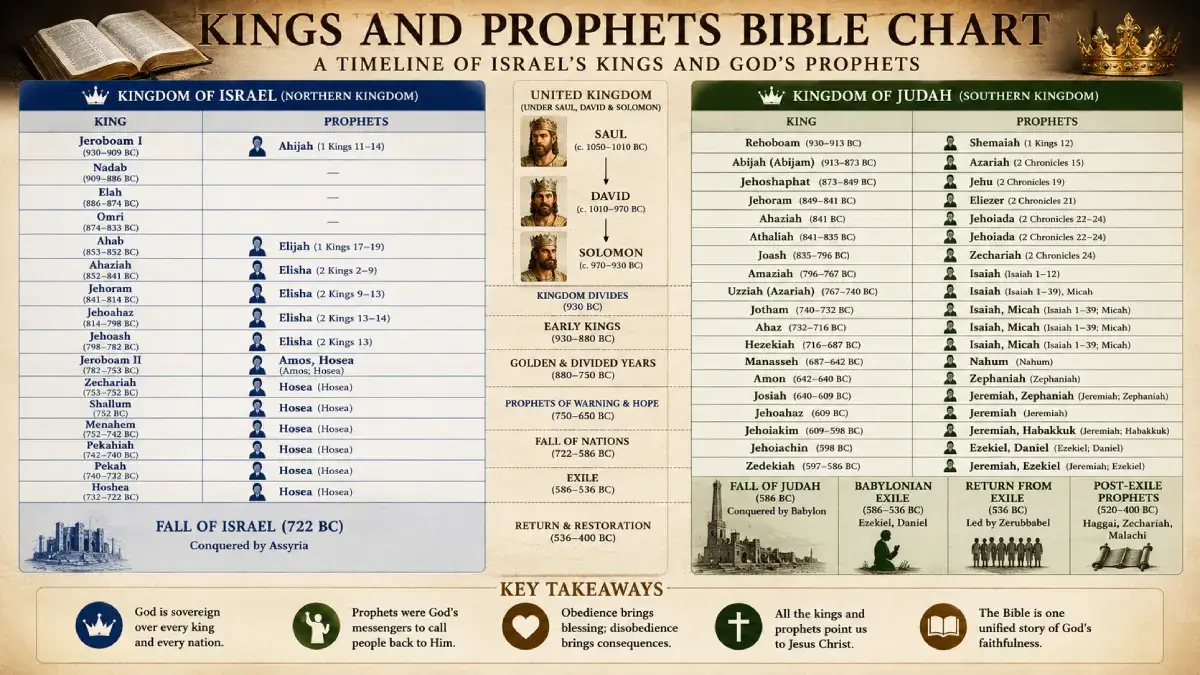
Kings and Prophets Bible Chart
| Period | Kingdom | King | Major Prophets |
|---|---|---|---|
| United Kingdom | Israel | Saul | Samuel |
| United Kingdom | Israel | David | Nathan, Gad |
| United Kingdom | Israel | Solomon | Ahijah |
| Divided Kingdom | Israel | Jeroboam I | Ahijah |
| Divided Kingdom | Israel | Ahab | Elijah |
| Divided Kingdom | Israel | Jehoram | Elisha |
| Divided Kingdom | Israel | Jeroboam II | Jonah, Amos, Hosea |
| Divided Kingdom | Judah | Rehoboam | Shemaiah |
| Divided Kingdom | Judah | Asa | Azariah |
| Divided Kingdom | Judah | Jehoshaphat | Jehu |
| Divided Kingdom | Judah | Uzziah | Isaiah |
| Divided Kingdom | Judah | Jotham | Isaiah, Micah |
| Divided Kingdom | Judah | Ahaz | Isaiah, Micah |
| Divided Kingdom | Judah | Hezekiah | Isaiah, Micah |
| Divided Kingdom | Judah | Manasseh | Nahum (later period) |
| Divided Kingdom | Judah | Josiah | Jeremiah, Zephaniah |
| Judah’s Final Kings | Judah | Jehoiakim | Jeremiah, Habakkuk |
| Exile Period | Judah | Zedekiah | Jeremiah, Ezekiel |
| Babylonian Exile | Exiles | — | Daniel, Ezekiel |
| Return from Exile | Judah | Zerubbabel’s Period | Haggai, Zechariah |
| Post-Exile | Judah | — | Malachi |
Timeline of Major Kings and Prophets
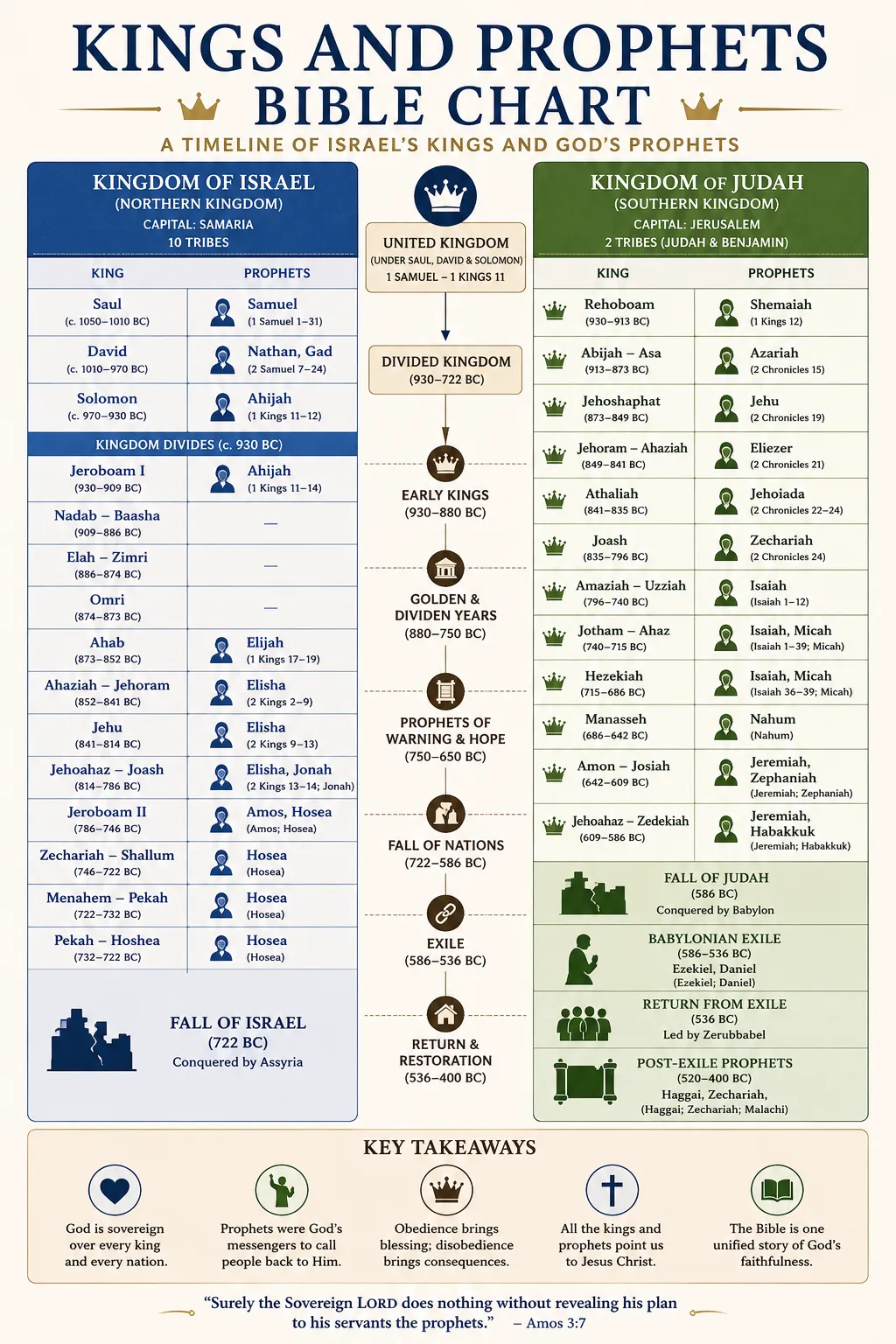
Samuel
   │
Saul ─ David ─ Solomon
                 │
         Kingdom Divides
      ┌──────────────┬──────────────┐
      │              │
  Israel         Judah
      │              │
 Elijah         Isaiah
 Elisha         Micah
 Amos           Jeremiah
 Hosea           Ezekiel
 Jonah           Daniel
      │              │
 Assyria      Babylonian Exile
                     │
           Haggai • Zechariah • Malachi
Samuel: Prophet and Kingmaker
Key Scriptures:
1 Samuel
Samuel served during the transition from judges to kings.
He:
✔ Anointed Saul
✔ Anointed David
✔ Guided Israel spiritually
Samuel demonstrated faithful leadership during a critical period in Israel’s history.
David and Nathan
Key Scriptures:
2 Samuel
David is considered Israel’s greatest king.
Nathan served as God’s prophet and confronted David after his sin with Bathsheba.
Lesson
Even great leaders are accountable to God.
Solomon and Ahijah
Key Scriptures:
1 Kings
Solomon began well but later turned toward idolatry.
Prophet Ahijah foretold the kingdom’s division.
Lesson
Wisdom without obedience can lead to spiritual decline.
Elijah and King Ahab
Key Scriptures:
1 Kings 17–19
King Ahab led Israel into deep idolatry.
Elijah courageously confronted him and challenged the prophets of Baal.
Lesson
God often raises faithful voices during spiritually dark times.
Elisha and the Kings of Israel
Key Scriptures:
2 Kings
Elisha ministered to several kings and performed many miracles.
His ministry emphasized:
✨ God’s power
✨ Mercy
✨ Faithfulness
Isaiah and the Kings of Judah
Key Scriptures:
Isaiah
Isaiah ministered during the reigns of:
- Uzziah
- Jotham
- Ahaz
- Hezekiah
He delivered messages of judgment and hope while prophesying extensively about the coming Messiah.
Jeremiah During Judah’s Fall
Key Scriptures:
Jeremiah
Jeremiah ministered during Judah’s final years before the Babylonian exile.
He repeatedly warned the nation to repent.
Unfortunately, the people ignored God’s message.
Lesson
Ignoring God’s warnings has consequences.
Ezekiel and Daniel During Exile
Ezekiel
Ministered among exiles in Babylon.
Daniel
Served in Babylonian courts while remaining faithful to God.
Lesson
God remains present even during difficult seasons and exile.
Haggai, Zechariah, and Malachi
After the exile, God sent prophets to encourage His people.
Haggai
Encouraged rebuilding the Temple.
Zechariah
Offered hope and messianic prophecies.
Malachi
Called God’s people back to faithful worship.
Why Did God Send Prophets?
The prophets had several important purposes.
📖 Call People to Repentance
❤️ Reveal God’s Character
⚠️ Warn of Judgment
✨ Offer Hope
👑 Point Toward the Messiah
Many prophecies ultimately pointed to Jesus Christ.
Major Themes in the Kings and Prophets
God’s Faithfulness
Despite human failure, God remained faithful.
The Consequences of Sin
Many kings suffered because they rejected God’s commands.
The Need for Repentance
Prophets continually called people back to God.
Hope of Restoration
Even after judgment, God promised restoration.
The Coming Messiah
The prophets repeatedly foretold Christ’s coming.
How Understanding This Chart Helps Bible Study
Learning the relationship between kings and prophets helps readers:
✔ Understand biblical chronology
✔ Follow Israel’s history more easily
✔ See the context of prophetic books
✔ Appreciate God’s patience and mercy
✔ Recognize the Bible’s unified story
Many confusing passages become clearer when readers understand who ruled and which prophets ministered during those periods.
A Devotional Reflection
The kings and prophets reveal two recurring truths.
First, human leaders often fail.
Even good kings made mistakes.
Second, God never stops pursuing His people.
Again and again, God sent prophets to warn, encourage, and restore.
Their stories remind us that God’s faithfulness does not depend on human perfection.
Throughout Israel’s history, God continually pointed His people toward redemption.
Ultimately, the kings and prophets prepare readers for the arrival of Jesus—the perfect King and final revelation of God’s truth.
“The LORD watches over all who love him.” — Psalm 145:20
A Prayer for Understanding God’s Word
🙏 “Lord, thank You for preserving the stories of the kings and prophets in Scripture. Help me understand their lessons and recognize Your faithfulness throughout history. Give me wisdom as I study Your Word and teach me to trust and obey You more fully. Amen.”
Frequently Asked Questions
Why did Israel have two kingdoms?
The kingdom divided after Solomon’s reign because of disobedience and political conflict.
Which prophet confronted King Ahab?
Elijah.
Which prophet ministered during King Hezekiah’s reign?
Isaiah.
Which prophets lived during the Babylonian exile?
Daniel and Ezekiel.
Which prophet came after the exile?
Haggai, Zechariah, and Malachi.
Final Reflection
The kings and prophets of the Bible tell one remarkable story:
👑 Human leaders often fail.
📖 God continually sends His Word.
❤️ God’s mercy never ends.
✨ His promises remain faithful.
Understanding the relationship between Israel’s kings and God’s prophets makes the Old Testament come alive and reveals the incredible consistency of God’s plan throughout history.
“Surely the Sovereign LORD does nothing without revealing his plan to his servants the prophets.” — Amos 3:7
May this kings and prophets Bible chart deepen your understanding of Scripture and strengthen your appreciation for God’s faithfulness through every generation.